
The best professional knife set for chefs is not always the one with the most pieces. A useful set should match the way you prep, feel balanced in your hand, and include the blade shapes you reach for most. These five options range from compact three-knife collections to larger sets with a storage block or carrying case. Compare their knife lineups, steel details, and care needs to find the right fit for your kitchen.
Quick Comparison
| Knife Set | Pieces and Main Knives | Notable Details | Best For |
|---|---|---|---|
| imarku Japanese 3-Piece Set | Chef, nakiri, and paring knives | Japanese high-carbon stainless steel; pakkawood handles | A focused everyday lineup |
| imarku 3-Piece Chef Set | Chef, santoku, and utility knives | Full-tang handles; Japanese high-carbon stainless steel | Versatile slicing and prep |
| PAUDIN 3-Piece Set | Chef, nakiri, and paring knives | 5Cr15MoV steel; 13-degree edge angle per side | Produce-heavy prep |
| Yatoshi 15-Piece Block Set | Chef, bread, slicing, santoku, utility, paring, and steak knives; shears | Acacia block; 7Cr17 steel | A broad lineup with countertop storage |
| FYNCUT 8-Piece Damascus Set | Chef, bread, carving, santoku, filleting, utility, fruit, and cleaver knives | Red pakkawood handles; leather roll case | A varied lineup for portable storage |
Our Picks: Best Professional Knife Set For Chefs reviews
imarku Japanese 3-Piece Set: A focused lineup for daily prep

This three-knife set covers several common prep jobs without taking up space on your counter. It includes an 8-inch chef knife for general chopping and slicing, a 7-inch nakiri for vegetables and larger ingredients, and a 3.5-inch paring knife for smaller, more controlled tasks.
The knives are made from Japanese high-carbon stainless steel and are listed at 57±1 HRC. The maker also specifies a hand-polished, 15-degree double-bevel edge and a 2.3 mm blade thickness. Pakkawood handles are designed for a comfortable grip, while the set’s compact size means you can choose your own storage solution rather than making room for a block.
The lineup is practical if you do a lot of vegetable prep and want a dedicated nakiri alongside a general-purpose chef knife. Its main limitation is that it leaves out blades such as a bread knife and utility knife. The supplied details recommend hand washing and drying, so it is a better match for someone willing to care for knives by hand.
Pros:
- Includes a chef knife, nakiri, and paring knife for core prep tasks
- 15-degree double-bevel edge and specified 57±1 HRC hardness
- Pakkawood handles and a compact three-knife format
- Comes in a gift box, according to the product description
Cons:
- Does not include a bread knife or dedicated utility knife
- Hand washing and prompt drying are recommended
Verdict: Choose this imarku set if you want a compact, produce-friendly trio and do not need a large assortment of blades.
imarku Chef, Santoku, and Utility Set: Three versatile blade shapes
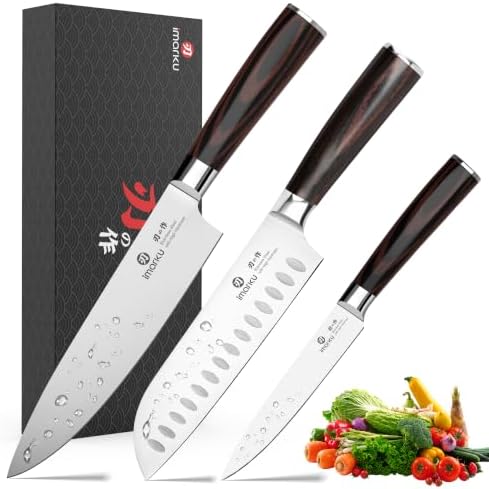
This imarku set swaps the nakiri and paring knife combination for a chef knife, santoku, and utility knife. That mix gives you two larger all-purpose options with different blade profiles, plus a smaller knife for more precise slicing and prep.
The product description lists Japanese high-carbon stainless steel, a hardness of 57±1, and a hand-polished edge of 15 degrees per side. It also specifies full-tang pakkawood handles, with the tang running through the handle for a connected construction. The steel is described as stain- and rust-resistant, though the care guidance still recommends hand washing and drying with a towel.
This set may suit cooks who prefer having both a chef knife and santoku rather than a dedicated nakiri. It is also the more adaptable of the two imarku trios for users who want a utility knife for smaller jobs. It does not include a paring knife, so very fine peeling or detail work may call for a separate blade.
Pros:
- Chef, santoku, and utility knives provide three distinct options
- Specified 15-degree-per-side edge and 57±1 hardness
- Full-tang construction with pakkawood handles
- Steel is described as resistant to rust and stains
Cons:
- No paring knife for small, detailed tasks
- Care instructions call for hand washing and towel drying
Verdict: Pick this set if you want a chef-and-santoku pairing with a utility knife, and value blade variety over a dedicated paring knife.
PAUDIN 3-Piece Set: A produce-oriented trio with a fine edge

PAUDIN’s three-piece set has the same basic knife roles as the first imarku set: an 8-inch chef knife, a 7-inch nakiri, and a 3.5-inch paring knife. It is designed to handle everyday chopping, mincing, dicing, and smaller precision tasks without adding extra blades you may not use.
The blades use 5Cr15MoV high-carbon stainless steel, with a listed hardness of 56+ Rockwell and a 13-degree edge angle on both sides. The description also calls out a wave pattern on the blade and pakkawood handles shaped for grip and balance. The patterned finish is described as decorative, not real Damascus steel.
The narrow edge angle may appeal to cooks looking for a keen-feeling cutting edge, while the nakiri gives produce prep a dedicated blade. The set’s three-knife limit is also its main trade-off: there is no bread or utility knife. The maker describes the handle as non-slip, including when hands are wet, but safe knife handling still matters around moisture.
Pros:
- Includes chef, nakiri, and paring knives
- 5Cr15MoV high-carbon stainless steel with a listed 56+ HRC hardness
- 13-degree edge angle on both sides
- Pakkawood handles and a distinctive wave-pattern blade finish
Cons:
- No bread knife or utility knife in the set
- The blade pattern is not real Damascus steel
Verdict: Consider the PAUDIN trio if you want a compact chef-and-nakiri set with a fine specified edge angle and do not need extra knife types.
Yatoshi 15-Piece Block Set: A broad assortment with built-in storage

For a kitchen that needs a wider selection, the Yatoshi set includes an 8-inch chef knife, bread knife, slicing knife, 7-inch and 5-inch santoku knives, a 5-inch utility knife, a 3.5-inch paring knife, six steak knives, and kitchen shears. The set also comes with an acacia wood block for countertop storage.
The blades are made from 7Cr17 high-carbon stainless steel, hardened to HRC 57–58, with a specified 15-degree edge. The handles are pakkawood, and the product description notes a hidden full-length tang and a sloped bolster intended to support a pinch grip. The block has deep slots and a non-slip rubber base, details that may matter if you want the set stored together and stable on the counter.
This is the most comprehensive option here for a shared kitchen or a cook who wants steak knives, shears, and several prep blades in one purchase. In return, it takes more storage space than the compact sets, and some buyers may rarely use every included knife. Its broad lineup is useful only if you have room for the block and expect to reach for several of the included pieces.
Pros:
- Wide selection includes bread, slicing, santoku, utility, paring, and steak knives
- Includes kitchen shears and an acacia storage block
- 7Cr17 steel is specified at HRC 57–58 with a 15-degree edge
- Block has deep slots and a non-slip base
Cons:
- The block requires more counter space than a compact set
- The large assortment may be unnecessary if you only use a few knife types
Verdict: Choose Yatoshi if you want a full countertop set with steak knives and shears, rather than a small collection of core prep knives.
FYNCUT 8-Piece Damascus Set: A varied kit with a roll case

The FYNCUT set takes a different approach from the smaller trios: it includes eight knives—a chef knife, bread knife, carving knife, santoku, filleting knife, utility knife, fruit knife, and cleaver—plus a leather roll case. That lineup covers a wide range of cutting styles, including bread slicing, filleting, and heavier chopping.
The product description says the knives use high-carbon steel and feature a forged Damascus pattern, with each pattern described as unique. Red pakkawood handles give the set a traditional look, and the roll case is intended to keep the knives organized and protected. The supplied information does not specify steel grade, hardness, or edge angle, so it is harder to compare its sharpening and edge characteristics directly with the other sets.
The roll case may suit a cook who needs portable storage or prefers not to keep a knife block on the counter. However, the set has more specialized blades than a basic home cook may need, and the available details do not provide a specific washing routine or hardness rating. If you are comparing knife performance by steel specifications, the imarku, PAUDIN, and Yatoshi options give more detail to assess.
Pros:
- Eight knife types cover general, specialized, and heavier prep tasks
- Includes a leather roll case for organized storage
- Red pakkawood handles and a forged Damascus pattern
- Offers a filleting knife, carving knife, and cleaver alongside core blades
Cons:
- Steel grade, hardness, and edge angle are not specified in the supplied details
- The specialized lineup may be more than a basic kitchen needs
Verdict: Pick FYNCUT if you want a broad mix of knife styles and portable roll-case storage, but consider another set if detailed steel specifications are a priority.
How to Choose a Professional Knife Set
Choose the knife shapes you will actually use
Start with your usual prep tasks. A chef knife is a flexible everyday choice, while a santoku offers another general-purpose blade shape. A nakiri is aimed at vegetable prep, and a paring knife is useful for small, controlled work. Bread, slicing, filleting, and cleaver knives serve more specific needs. A compact set can be the smarter choice if it includes the few blades you reach for most.
Compare steel details, not just “sharp” claims
Look for the stated steel type, hardness, and edge angle when the information is available. These details can help you compare how a set is designed, but they do not tell the whole story of cutting feel or maintenance. In this group, the products list different steel grades and hardness details, while FYNCUT does not provide a specific grade or hardness in the supplied description.
Think about edge care and cleaning
Several of these sets recommend hand washing and drying. That routine helps you avoid leaving moisture on the blades and handles, but it does require more attention than placing knives in a dishwasher. Check the care guidance for the particular set you choose, and plan to keep the blades sharp with appropriate maintenance.
Assess handle comfort and control
Handle shape, balance, and grip can affect how comfortable a knife feels during longer prep sessions. Pakkawood handles appear across several of these options, while the Yatoshi set also describes a hidden full-length tang and sloped bolster. If possible, consider how the handle size and shape will suit your hand and preferred grip before choosing.
Plan for storage before buying
The Yatoshi set includes a countertop block, while FYNCUT supplies a roll case. The three-piece sets do not list a block or roll case in their descriptions, so you will need to decide how to store them safely. Think about available counter or drawer space, whether you want the knives portable, and how you will keep their edges protected.
Match the set size to your kitchen
A larger set can cover more jobs, but extra pieces add storage needs and may go unused. A three-piece set is easier to store and can be a sensible starting point, while a broad collection is more useful when several people cook or you regularly need specialty knives. Choose based on your real prep habits rather than the piece count alone.
Frequently Asked Questions
What knives should a professional chef set include?
A useful core set often includes a chef knife and smaller knife for detail work. Depending on your cooking, you may also want a santoku or nakiri, a bread knife, or a utility knife. The best mix depends on the foods you prepare and how you prefer to cut them.
Which set here is best for vegetable preparation?
The imarku and PAUDIN three-piece sets both include a nakiri, a blade designed for vegetable and larger-ingredient prep. Both also include a chef knife and paring knife, making them compact options for cooks who want that specific blade shape.
Which option includes the most storage?
The Yatoshi set includes an acacia block for countertop storage. FYNCUT comes with a leather roll case, which is a different option for keeping a larger group of knives together.
Are the patterned PAUDIN blades Damascus steel?
No. The PAUDIN product description specifically identifies its wave pattern as decorative and says it is not real Damascus steel. FYNCUT, by contrast, describes its pattern as forged Damascus.
Do these knife sets include knives for bread?
The Yatoshi and FYNCUT sets list bread knives. The three-piece imarku and PAUDIN sets do not include one, so you would need to buy a bread knife separately if you want that blade.
Can I put these knives in the dishwasher?
The supplied details for the first imarku set recommend hand washing and drying, and the second imarku set gives similar care instructions. Check the instructions for your specific set, and avoid assuming dishwasher use is suitable when the product information does not say so.
Final Recommendation
For a practical, compact set with a nakiri, the imarku Japanese three-piece or PAUDIN three-piece set is a good place to start; compare their stated steel and edge details to choose between them. If you prefer a chef knife, santoku, and utility knife, consider the other imarku trio. Choose Yatoshi for a broad assortment with a block, or FYNCUT if you want a range of specialized knives stored in a roll case. The right choice is the one that fits your prep style, storage space, and willingness to maintain the blades.