A pull-out kitchen faucet needs a different filter solution than a standard fixed faucet. Many familiar faucet-mount models, including the Brita and PUR options below, explicitly do not fit pull-out or handheld faucets. The KLLEYNA and CECEFIN models are designed with pull-out faucet adapters, but fit can still depend on your faucet’s aerator and shape. Check compatibility before you buy; if no faucet-top filter fits, an under-sink system may be a better option.
Quick Comparison
| Product | Pull-Out Faucet Fit | Key Consideration |
|---|---|---|
| Brita Elite Chrome Faucet Water Filter System | No | Chlorine and contaminant reduction; standard faucets only |
| Brita Elite Advanced White Faucet Water Filter System | No | Three spray options; standard faucets only |
| KLLEYNA Pull Down Faucet Filter | Designed for pull-out faucets | Adapter set and swiveling joints; check faucet fit |
| CECEFIN 720 Swivel Sink Faucet Water Filter | Designed for some pull-out faucets | Many adapters; low-arc pull-out faucets are not recommended |
| PUR Plus Faucet-Mount Water Filtration System | No | Certified reductions for several substances; standard faucets only |
Our Picks: Best Water Filter For Sink With Pull Out Faucet reviews
1. Brita Elite Chrome: A Strong Filter for Fixed Faucets

The Brita Elite Chrome is a faucet-mounted carbon-block filter intended for standard, fixed faucets. Its listed features include two spray options, a filter-change indicator, and tool-free installation. Brita says the system reduces chlorine taste and odor and reduces more than 60 contaminants, including 99% of lead.
The chrome finish may suit a kitchen with metallic fixtures, and the faucet-mounted design gives you filtered water directly at the sink. The listed filter capacity is 100 gallons, with a filter life of up to four months. Actual replacement timing can depend on how much water you use.
The main issue for this guide is fit: Brita says this model does not fit pull-out or spray-style faucets. It may be a sensible option for a standard faucet in another sink, but it is not a match for most pull-out kitchen faucets. If your faucet is fixed and compatible, it offers more contaminant-reduction detail than the pull-out-focused choices here.
Pros:
- Carbon-block filtration with stated reduction of chlorine taste and odor
- Brita states it reduces more than 60 contaminants, including 99% of lead
- Includes two spray options and a filter indicator
- Listed filter life is up to four months or 100 gallons
Cons:
- Not designed for pull-out or spray-style faucets
- Fit is limited to standard faucets
Verdict: Choose this Brita only if you have a compatible fixed faucet; for a pull-out faucet, look at the KLLEYNA or CECEFIN instead.
2. Brita Elite Advanced White: A Fixed-Faucet Option with Three Spray Modes

This white Brita faucet-mount system shares several core features with the chrome model: carbon-block filtration, a filter-change indicator, and tool-free installation. The listed version has three spray options. Brita says it reduces chlorine taste and odor and more than 60 contaminants, including 99% of lead.
The compact body is designed to attach to a standard faucet, and the product information lists a 100-gallon capacity and up to four months of filter life. The white finish gives you a different look from the chrome option, while the extra spray setting may be useful if you want more ways to direct water at the sink.
As with the chrome Brita, the deciding drawback is compatibility. The manufacturer says this filter does not fit pull-out or spray-style faucets. It should be treated as an alternative for a fixed faucet—not as a solution for a pull-out faucet. The listed maximum flow rate is lower than the chrome model’s, so consider whether flow speed matters to your routine.
Pros:
- Three spray options
- Brita states it reduces chlorine taste and odor and more than 60 contaminants
- Filter indicator helps signal when replacement is due
- No-tools installation on compatible standard faucets
Cons:
- Not compatible with pull-out or spray-style faucets
- Listed maximum flow rate is 0.5 gallons per minute
Verdict: This is worth considering for a compatible fixed faucet if you want three spray modes, but it is not suitable for the pull-out faucet named in your search.
3. KLLEYNA Pull Down Faucet Filter: The Most Adaptable Pull-Out Pick
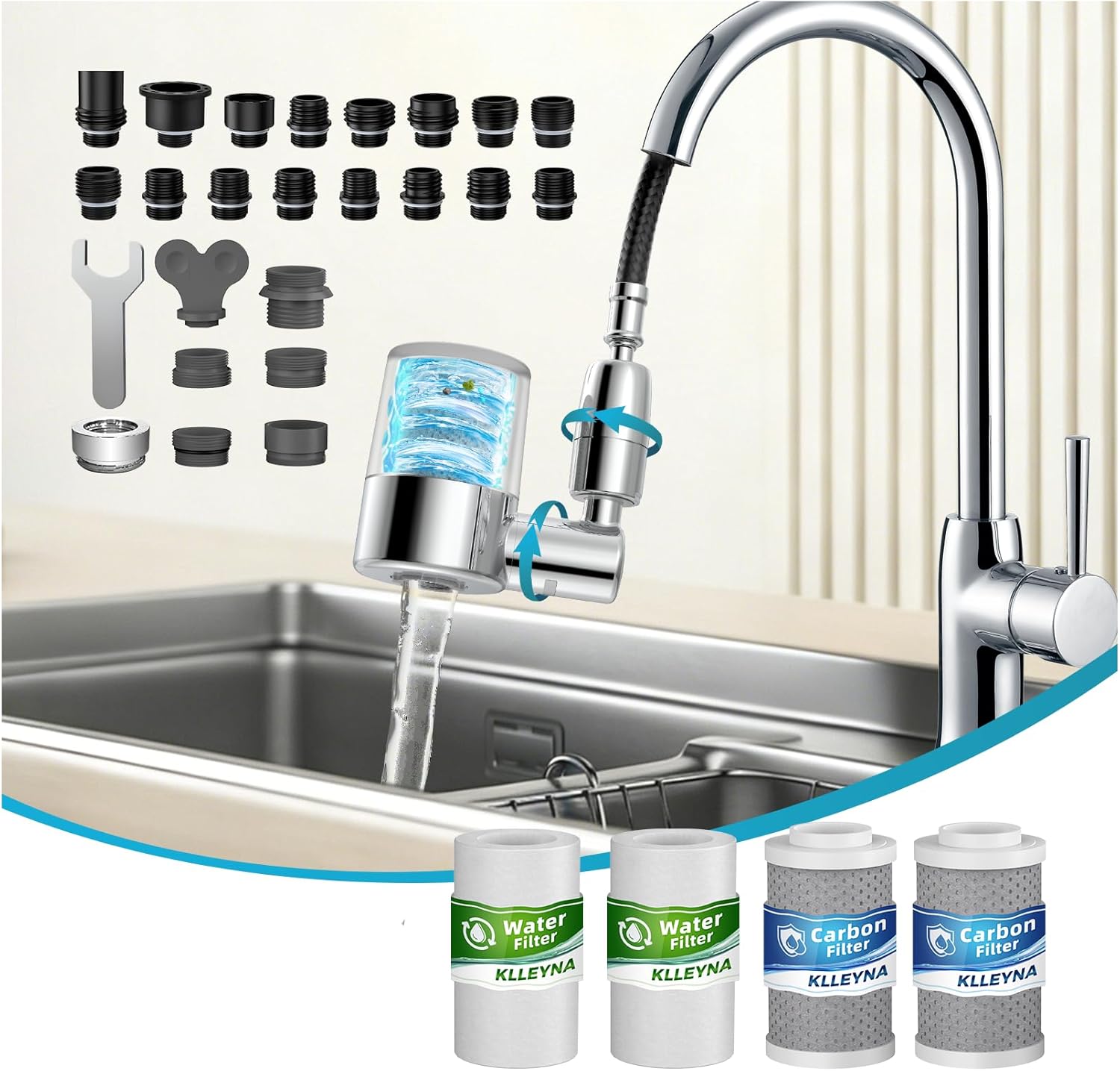
Unlike the Brita and PUR faucet mounts, the KLLEYNA is specifically presented as a filter for pull-down and pull-out faucets. It comes with 17 adapters for pull-out faucets and five couplings for regular taps, along with installation tools and tape. That adapter range may help with unusual connections, but you should still compare the included options with your faucet before ordering.
The filter uses activated carbon, and the product description claims it reduces chlorine, odor, lead, heavy metals, impurities, and suspended matter. Those are manufacturer claims; check the product’s current documentation for the exact test basis and substances covered. The listed cartridge life is up to 528 gallons or about three months, depending on use.
Two swiveling joints give the unit a wide range of movement, and its two-mode aerator switches between a stream and spray. This can add flexibility for rinsing or filling containers, though an attachment at the end of a pull-out faucet may change how the faucet handles or moves. Some owners describe the assembly as straightforward once they identify the correct adapter, while fit and pressure can still vary by faucet.
Pros:
- Includes adapters specifically intended for pull-out faucets
- Two swiveling joints and a two-mode aerator
- Listed capacity of up to 528 gallons per cartridge
- Includes tools and installation materials
Cons:
- Adapter count does not guarantee a fit with every faucet
- Filter replacement timing and water pressure may vary with use and water conditions
Verdict: KLLEYNA is the strongest starting point if you want a pull-out-specific faucet filter and can confirm that one of its adapters matches your faucet.
4. CECEFIN 720 Swivel: A Flexible Filter with a Broad Adapter Set
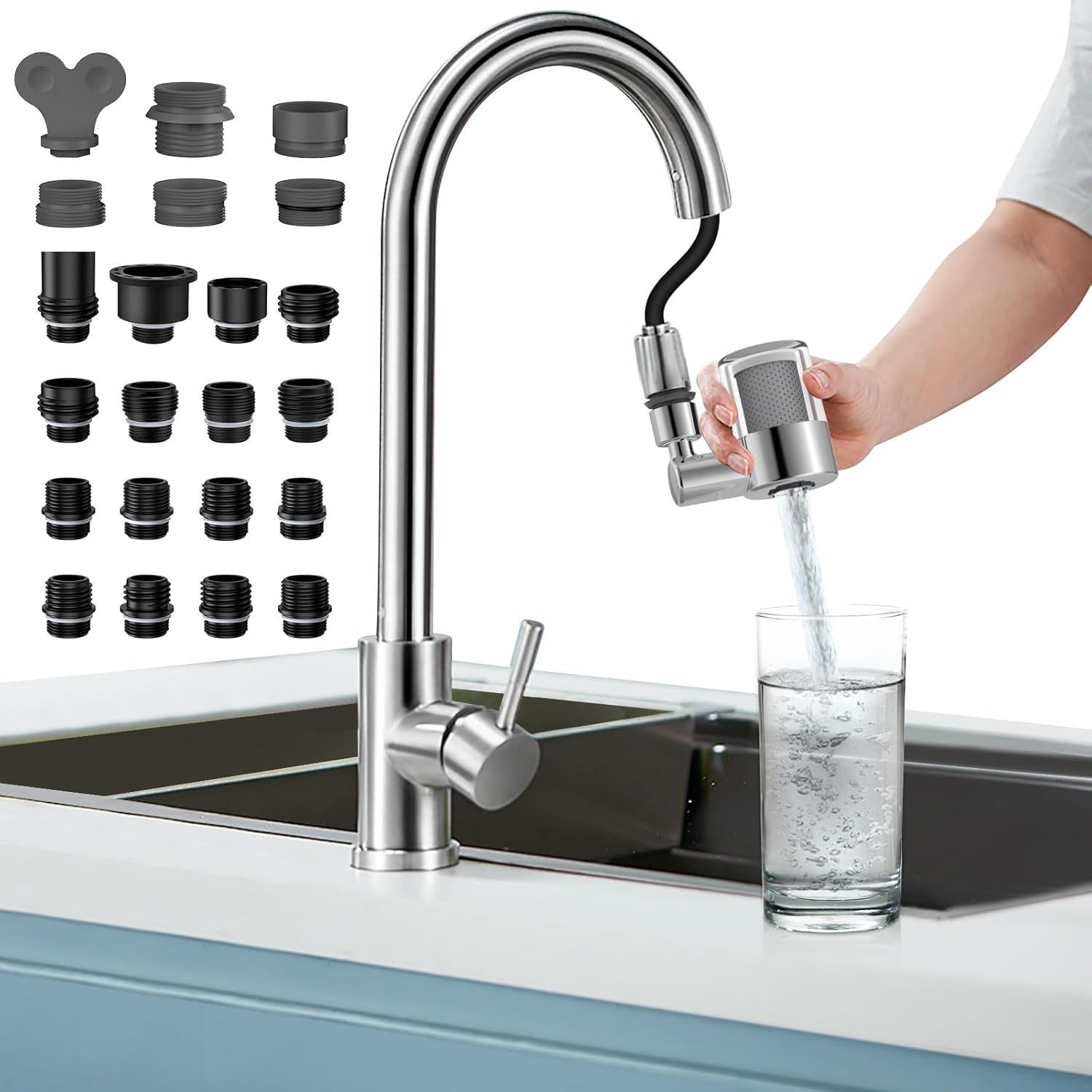
CECEFIN’s faucet filter has two 360-degree swivel joints and comes with 17 adapters described for pull-out faucets, plus five for regular faucets. The moving head is intended to help direct water around the sink, and the design is presented as a way to add a filter without replacing the faucet.
Compatibility needs careful attention. The product information says it will not fit faucets with non-removable aerators and does not recommend it for low-arc pull-out faucets. It also notes that some adapters may not match every faucet. A few owners report that finding the right connector can take extra effort, so check the faucet thread and aerator before buying and stop if the connection leaks.
The listing references NSF/ANSI/CAN 372. That standard concerns lead content in drinking-water system components; it should not be read as proof that the filter reduces lead or other contaminants from water. The supplied product details do not provide a clear filter capacity or replacement interval for this model, so confirm cartridge-life information and replacement availability before choosing it.
Pros:
- Includes a range of adapters for pull-out and regular faucets
- Two swiveling joints make it easier to aim the water outlet
- Compact faucet-mounted format avoids an under-sink installation
- Replacement cartridges are identified in the product information
Cons:
- Not suitable for faucets with non-removable aerators; low-arc pull-out faucets are not recommended
- Supplied details do not clearly state filter capacity or replacement interval
Verdict: Consider CECEFIN if its adapters match your faucet and you value a swiveling outlet, but verify cartridge details and leak-free fit before relying on it.
5. PUR Plus Faucet-Mount System: Certified Filtration for Compatible Fixed Faucets

PUR Plus is a faucet-mounted system with a three-in-one filter and a change indicator. PUR says the filter is WQA certified to reduce lead and NSF certified to reduce microplastics, chlorine, and 70 chemical and physical substances. Its stated filter life is up to 100 gallons or three months.
The gray housing may coordinate with common metal sink finishes, and the listed design installs without tools on many standard faucets. A filter indicator is useful if you would rather not track replacement by memory. As with any filter, the stated capacity is a guide; your water use determines how quickly you reach it.
PUR explicitly says this vertical faucet-mount model is not designed for pull-out or handheld faucets. It therefore does not solve the central fit problem, despite its detailed filtration claims. Some owners find installation simple on compatible faucets, but compatibility should come first. Of the fixed-faucet alternatives here, PUR offers the clearest stated certification details in the supplied product information.
Pros:
- PUR states the filter is certified to reduce lead, microplastics, chlorine, and other listed substances
- Filter-change indicator
- Tool-free installation on many compatible standard faucets
- Listed filter life of up to 100 gallons or three months
Cons:
- Not designed for pull-out or handheld faucets
- Filter replacements are needed as the capacity or time limit is reached
Verdict: PUR Plus is a strong option for a compatible fixed faucet, but pull-out faucet owners should choose a model designed for their faucet or consider an under-sink system.
How to Choose a Water Filter for a Sink with a Pull-Out Faucet
Confirm the Faucet Connection Before Comparing Filters
Start by checking whether the faucet aerator can be removed and identifying its thread type. Pull-out faucet heads vary, and a large adapter set does not mean every connection will fit. Compare your faucet with the manufacturer’s compatibility information, and contact the seller if the thread or adapter is unclear. Avoid forcing a connection; a poor fit can leak or affect how the faucet works.
Check Whether the Filter Is Actually Made for Pull-Out Faucets
Many faucet filters attach to the end of a fixed faucet and add weight or bulk to the outlet. That setup may interfere with a pull-out hose or spray head. The Brita and PUR models in this guide exclude pull-out or handheld faucets. KLLEYNA and CECEFIN are the options listed as suitable for some pull-out faucets, but their limitations still matter.
Match Filtration Claims to Your Water Concern
Think about what you want to reduce, such as chlorine taste or a specific contaminant identified in your local water information. Compare the product’s stated reductions and certifications rather than relying on broad terms like “purifies” or “clean.” A filter should not be assumed to remove every possible contaminant. If you have a specific health or water-quality concern, look for documentation that names that substance and its test standard.
Understand Capacity and Replacement Needs
Filter life may be listed by time, gallons, or both. The KLLEYNA listing gives a capacity of up to 528 gallons or about three months, while the Brita and PUR products list 100 gallons and time-based replacement guidance. How quickly you reach a capacity depends on household use and water conditions. Check the cost and availability of replacement cartridges before choosing a system.
Consider Pressure, Movement, and Daily Use
A swiveling head can help direct water around the basin, but any attachment can change the faucet’s balance, reach, or spray pattern. Filter media can also affect flow. CECEFIN notes that its carbon cartridge may cause a slight pressure drop, while the KLLEYNA offers a two-mode aerator. Consider how you use the pull-out hose for rinsing dishes, filling pots, or cleaning the sink.
Know What a Certification Does—and Does Not—Mean
Check the exact standard and claim attached to a certification. For example, NSF/ANSI/CAN 372 relates to lead content in system components; by itself, it does not establish that a filter reduces lead in water. A contaminant-reduction claim should be supported by documentation that specifically covers the substance and the relevant filtration performance.
Consider an Under-Sink Filter if Faucet-Mount Fit Is Uncertain
If your faucet has a non-removable aerator, an unusual connector, or a low-arc pull-out head, a faucet-mounted model may not be a reliable choice. An under-sink filter is another format to explore because it does not attach to the moving faucet head. Check installation requirements, available space, replacement filters, and whether the system needs a separate drinking-water tap.
Frequently Asked Questions
Can I use a standard faucet-mount filter with a pull-out faucet?
Not always. The Brita and PUR models in this guide explicitly exclude pull-out or handheld faucets. Use a model specifically designed for your faucet type, and confirm its adapter matches before installation.
Which options in this guide are intended for pull-out faucets?
KLLEYNA and CECEFIN are described as having adapters for pull-out faucets. Neither is guaranteed to fit every faucet. CECEFIN also says it will not fit a non-removable aerator and is not recommended for low-arc pull-out faucets.
Does a larger adapter set guarantee a better fit?
No. Faucet threads, aerator shapes, and clearances vary. An adapter set can improve the chance of finding a match, but it cannot guarantee compatibility. Check the faucet details and product instructions before ordering.
How often should I replace a faucet filter cartridge?
Follow the product’s instructions and any filter-change indicator. The products here list replacement guidance ranging from 100 gallons or about three to four months to up to 528 gallons or about three months. Use and water conditions can affect how soon a cartridge needs changing.
Does NSF/ANSI/CAN 372 mean a filter removes lead from water?
No. That standard addresses lead content in drinking-water system components. It is not, by itself, a certification that the filter reduces lead in water. Look for a separate, specific lead-reduction claim and supporting documentation.
Will a faucet filter remove every contaminant?
No filter should be assumed to remove everything. Check the product’s exact contaminant claims and certification details, and compare them with your water-quality information. For a specific concern, choose a system whose documentation covers that substance.
What should I do if none of the adapters fit?
Do not force the connection or keep using an attachment that leaks. Remove it and restore the original faucet aerator. Contact the manufacturer or seller to confirm compatibility, or consider an under-sink filter that does not attach to the pull-out faucet head.
Conclusion
For a sink with a pull-out faucet, start with the KLLEYNA or CECEFIN and verify the adapter fit before purchase. KLLEYNA provides clearer capacity information and is presented specifically for pull-out faucets; CECEFIN offers a swiveling head but has notable faucet restrictions and less clear capacity details in the supplied information. Brita and PUR provide more established fixed-faucet alternatives, but their listed models are not designed for pull-out faucets. If compatibility is uncertain, an under-sink filter may be the more practical route.
