
A wet bar needs more than a machine that can make a lot of ice. The right choice depends on whether you want specialty cocktail ice, a steady supply for parties, or a compact way to keep ice and drinks together. We compared five under-counter and commercial-style options, focusing on ice output, storage, installation needs, and how well each fits a home bar.
Quick take: The Ca’Lefort is the most complete wet-bar setup because it combines clear ice spheres with separate freezer and beverage compartments. For higher-volume cube ice, the Mojgar, EUHOMY, and Nanori offer larger stated daily output, but they need a water connection and drain. The SUNGDOGIN is another high-output option, though the supplied product data marks it as unavailable.
Quick Comparison
| Product | Ice type and output | Storage | Best for | Availability in supplied data |
|---|---|---|---|---|
| Ca’Lefort 3-in-1 Clear Ice Ball Maker & Beverage Fridge | 2-inch clear ice spheres | Up to 40 spheres, plus separate freezer and beverage zones | Premium cocktails and an all-in-one bar setup | Available |
| SUNGDOGIN Commercial Ice Maker | Up to 110 lb per day; 36 cubes per cycle | 33 lb bin | Parties and frequent entertaining | Marked unavailable |
| Mojgar Commercial Ice Maker | Up to 120 lb per day | 33 lb bin | High-volume cube ice in a small bar or home | Available |
| EUHOMY Commercial Ice Maker | Up to 120 lb per day; 45 cubes per cycle | 33 lb bin | Adjustable cubes and scheduled operation | Available |
| Nanori Commercial Ice Maker | Product title says 110 lb per day; description states up to 100 lb | 33 lb bin | Customizable cube thickness and timed operation | Marked unavailable |
Our Picks: Best Ice Maker For Wet Bar reviews
1. Ca’Lefort 3-in-1: Best All-in-One Wet Bar Upgrade

The Ca’Lefort takes a different approach from the commercial-style cube makers. It makes 2-inch clear ice spheres and combines that ice maker with a 0°F freezer and a separate beverage refrigerator. For a wet bar where you want chilled drinks, frozen garnishes, and cocktail ice in one appliance, that combination is its biggest advantage.
The insulated ice bin holds up to 40 spheres. Its beverage zone is independently controlled from 34–65°F and can hold up to 60 cans, while the freezer zone is intended for frozen items such as desserts and cocktail garnishes. Three adjustable glass shelves give you some flexibility for cans, mixers, and taller bottles. A double-paned Low-E glass door and soft tricolor lighting add practical and visual touches for a home bar.
An inverter compressor runs the separate cooling zones, and the unit is ENERGY STAR certified. Its stainless-steel frame is designed for built-in or freestanding use. Still, “built-in-ready” does not confirm that it will fit every cabinet opening, so check the product listing for dimensions, ventilation needs, and required clearances before planning your bar cabinetry.
The main trade-off is that this is a specialty appliance, not a high-volume cube maker. Its stated ice capacity is a bin of 40 spheres, and the supplied details do not give a daily production rate. Choose it for presentation and convenience, not for the highest ice output at a large gathering.
Pros:
- Makes 2-inch clear ice spheres for spirits and cocktails.
- Combines ice making, a 0°F freezer, and a beverage fridge.
- Stores up to 40 spheres and up to 60 cans.
- Offers adjustable shelves, interior lighting, and built-in or freestanding placement.
Cons:
- No daily ice-production figure is provided in the supplied details.
- Its cabinet fit and installation clearances should be confirmed before purchase.
Verdict: Choose the Ca’Lefort if your wet bar needs clear cocktail spheres and chilled drink storage more than a high daily volume of standard cubes.
2. SUNGDOGIN Commercial Ice Maker: High Output for Busy Gatherings
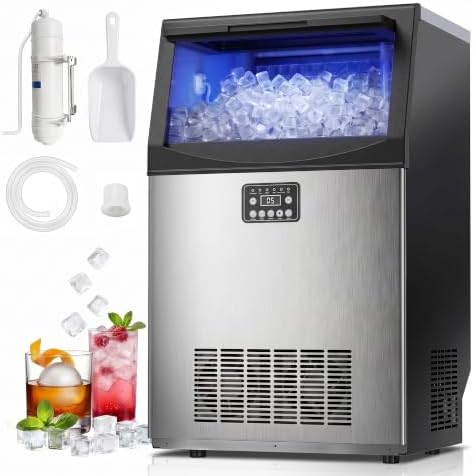
The SUNGDOGIN is a cube-ice machine aimed at settings that need more ice than a small countertop unit can supply. Its listed capacity is up to 110 pounds per day, with 36 cubes made in a cycle described as taking 7–14 minutes. A 33-pound insulated storage bin gives you a ready supply between batches.
A one-touch self-cleaning program is included, which may make routine upkeep simpler, though it does not remove the need to follow the maker’s cleaning and sanitizing instructions. The product description presents it for both under-counter and freestanding use. Before treating it as a built-in choice, verify its dimensions and ventilation requirements against your cabinet layout.
Its main strength is batch output, not specialty ice or drink storage. Unlike the Ca’Lefort, it does not include a beverage refrigerator or freezer. The supplied product data marks this item as unavailable, so check the listing before making it part of your bar plan. Availability can change, and the provided information does not establish when it may be available again.
Pros:
- Lists up to 110 pounds of ice production per day.
- Makes 36 cubes per cycle, with a stated cycle time of 7–14 minutes.
- Includes a 33-pound insulated storage bin.
- Has a one-touch self-cleaning program.
Cons:
- Marked unavailable in the supplied product data.
- Does not include a separate beverage refrigerator or freezer.
Verdict: Consider the SUNGDOGIN if its high-output cube format fits your needs, but confirm that it is available and verify installation details before choosing it.
3. Mojgar Commercial Ice Maker: Strong Output with Clear Drain Requirements

The Mojgar is a high-output cube maker with a stated daily capacity of up to 120 pounds and a 33-pound storage bin. The first batch is described as ready in 10–18 minutes. Its listed dimensions are 15.1 by 15.7 by 29 inches, and front venting is intended to support under-counter or freestanding placement.
It includes adjustable ice thickness, a blue light that activates when the door opens, and a one-touch self-cleaning function. The stainless-steel body and food-grade interior components are designed for regular use. The product description also notes an R290 compressor and estimates energy savings, but actual operating costs depend on use and installation conditions.
Pay close attention to the drain setup. This unit uses gravity drainage, and the listing says a floor drain or suitable gravity drain is required; a drain pump is not included. The drain hose must sit lower than the machine for proper drainage. It also needs to remain upright for at least 24 hours before first use so the refrigerant can settle. Those requirements may make it a poor fit for a wet bar without nearby plumbing and a workable drain route.
Pros:
- Lists up to 120 pounds of ice production per day and a 33-pound bin.
- Provides adjustable ice thickness and a self-cleaning function.
- Lists dimensions and front venting for under-counter planning.
- Includes a stated 24-month machine and compressor warranty.
Cons:
- Requires gravity drainage; a drain pump is not included.
- Needs an upright settling period before first use.
Verdict: The Mojgar is a capable option for a wet bar with a water supply and properly placed drain, but skip it if the required gravity-drain setup is impractical.
4. EUHOMY Commercial Ice Maker: Flexible Controls for Frequent Use

The EUHOMY is another high-output cube maker, listed at up to 120 pounds per day. It makes 45 cubes in a stated 10–15 minutes and stores up to 33 pounds. Its ice thickness can be adjusted by changing the ice-making time, which is useful if you want to tune cubes for different drinks rather than rely on one fixed setting.
The LCD panel displays ambient temperature and controls the self-cleaning function and 24-hour timer. The machine also has a viewing window and a three-layer insulated design intended to help keep stored ice solid longer. These features make it a practical fit for a wet bar that gets regular use, though it still needs a water supply and gravity drainage.
The product data says it can be used as a built-in or freestanding unit and notes ETL certification for commercial use. Confirm the required opening size and ventilation clearances before installing it inside cabinetry. The supplied details do not give a specific cutout size, so do not assume it will fit a standard cabinet without checking.
Pros:
- Lists up to 120 pounds per day and 45 cubes per cycle.
- Offers adjustable ice thickness, a 24-hour timer, and self-cleaning.
- Includes a 33-pound bin and viewing window.
- Has a layered insulated design and stainless-steel body.
Cons:
- Requires both a water supply and gravity drainage.
- Cabinet dimensions and ventilation needs should be confirmed before installation.
Verdict: Pick the EUHOMY if you want a high-output cube maker with adjustable settings and a timer, and your wet bar can support its plumbing needs.
5. Nanori Commercial Ice Maker: Adjustable Ice with a Spec to Verify

The Nanori is a stainless-steel cube maker with a 33-pound storage bin, a built-in water filter, and adjustable ice thickness. Its description says it can make 50 cubes in 7–16 minutes and provides 10 thickness settings. The stated flexibility could help if your wet bar serves a mix of cocktails, soft drinks, and blended drinks.
There is an important specification mismatch to check: the product title lists 110 pounds of ice per day, while the description says up to 100 pounds per day. Its controls include a one-click cleaning function, a 24-hour timer, and a defrost function. The listing also describes a sliding transparent door, blue indicator lights, and included installation accessories such as hoses, a drain pipe, and an ice scoop.
The supplied data marks the Nanori as unavailable. It also requires water and drainage connections, so confirm that your space can support its plumbing before considering it. Compared with the EUHOMY, it emphasizes a built-in filter and more ice-thickness settings; compared with the Ca’Lefort, it prioritizes cube volume rather than spheres and beverage storage.
Pros:
- Offers 10 ice-thickness settings and a built-in water filter.
- Lists 50 cubes per cycle and a 33-pound storage bin.
- Includes a timer, one-click cleaning, and installation accessories.
- Uses a sliding transparent door to view the ice-making area.
Cons:
- Marked unavailable in the supplied product data.
- Daily output differs between the product title and description.
Verdict: The Nanori could suit a bar that values adjustable cubes and included accessories, but verify its availability and daily-output specification before buying.
How to Choose an Ice Maker for a Wet Bar
Match the ice style to the drinks you serve
Clear spheres make a polished choice for whiskey and cocktails, while cube ice is more flexible for everyday drinks, coffee, and parties. Think about what you usually serve before comparing output numbers. A specialty-ice appliance may be more useful for a small cocktail bar, while a cube maker is a better fit if guests use ice steadily throughout an event.
Estimate how much ice you need at one time
Daily production and bin capacity are different measurements. Daily output describes how much a machine may produce over a full day under its stated conditions; the bin tells you how much it can hold ready at once. For parties, consider both the expected demand and how quickly the machine can replenish its supply. Treat listed production as a guide, not a guarantee for every room or installation.
Check water and drainage before choosing a spot
Commercial-style units in this group require a water supply and drainage. Gravity-drain models need a drain route that sits low enough for water to flow away; a pump may be necessary if your layout cannot provide that slope, but confirm compatibility rather than assuming one is included. A wet bar without nearby plumbing may be better suited to an appliance that does not require a fixed water and drain connection.
Measure the cabinet opening and ventilation space
Do not rely only on a product’s “under-counter” or “built-in” label. Measure the opening, account for the appliance’s depth and height, and check the listing for ventilation and clearance requirements. This is especially important for machines with front or side vents. Confirm door swing and access for cleaning, too, so the unit remains usable after installation.
Decide whether you need drink storage as well as ice
A dedicated ice maker saves space only if you already have room for cold drinks and frozen items. The Ca’Lefort combines an ice sphere maker with separate beverage and freezer compartments, while the commercial cube machines focus on ice production and storage. If your wet bar lacks a beverage fridge, an all-in-one unit may be more useful even if it does not match the cube makers’ stated daily output.
Plan for cleaning and ongoing care
Self-cleaning functions can make regular maintenance easier, but they are not a substitute for following the manufacturer’s cleaning instructions. Consider how easy it is to reach the bin, water connections, and drain. If the machine will see frequent use, a simple control panel and a routine you can follow matter as much as a high production figure.
Check the full specification, not just the headline
Compare the product title with the detailed description, especially when output figures differ. Also verify included filters, hoses, drain parts, certifications, warranty terms, and whether the ice bin is a freezer or an insulated holding area. These details can change the real installation cost and how well the machine fits your routine.
Frequently Asked Questions
What type of ice maker works best for a wet bar?
It depends on how you use the bar. A clear-sphere maker suits cocktails and spirits, while a high-output cube machine is more appropriate for frequent entertaining. If you also need cold drinks and freezer space, an all-in-one beverage center may be the better fit.
Does an under-counter ice maker need a water line?
The commercial-style machines in this guide require a water supply. Check each product’s installation instructions for the connection type and any included parts before you buy. The supplied details do not describe the Ca’Lefort’s water connection requirements, so confirm those with its listing.
Do these ice makers need a drain?
The Mojgar and EUHOMY descriptions specify drainage, and the Mojgar explicitly uses gravity drainage. The Nanori also includes a drain pipe and lists water and drain connections. Check the specific product instructions to understand whether your wet bar needs a floor drain, a suitable gravity route, or a compatible pump.
Is a 33-pound ice bin the same as a freezer?
No. A stated bin capacity is the amount of ice the storage area can hold, not a promise that the bin freezes or preserves ice indefinitely. The Mojgar description specifically says its bin is not a freezer. For any other model, check the product details for how its storage area is designed.
Can a commercial ice maker be installed under a counter?
Some models are described as suitable for under-counter or built-in use, but that does not guarantee a fit in every cabinet. Measure your available space and check the appliance’s dimensions, vent location, and required clearances before installation.
Which model is best for cocktails?
The Ca’Lefort is the clearest choice here for cocktails that benefit from large, slow-melting ice spheres. The cube makers offer adjustable thickness or cube size on some models, but they do not provide the same sphere format.
Final Recommendation
For most home wet bars, the Ca’Lefort is the most complete choice because it pairs clear ice spheres with separate beverage and freezer storage. If your priority is making more standard ice for gatherings, the Mojgar or EUHOMY is a better match, provided your space has the required water and drain connections. The SUNGDOGIN and Nanori have useful stated features, but the supplied product data marks both as unavailable, and the Nanori’s daily-output figures conflict. Check the product listings and installation requirements before deciding.