
Choosing the best food processor for commercial use depends on what you prep most, how much you make at once, and how much control you need over texture. The machines below are heavy-duty bowl-style choppers built for batch processing—not necessarily all-purpose processors with slicing and shredding discs. Compare working capacity, speed controls, safety features, and the listing details before choosing one for your kitchen.
Quick Comparison
| Food Processor | Listed Capacity | Motor / Speed | Best For |
|---|---|---|---|
| HAKKA Commercial Food Processor | Not specified | 1800W; 1,000–2,500 RPM | Variable-speed vegetable and ingredient prep |
| Garvee 16-Quart Commercial Food Processor | 16 qt (also described as 15L) | 1400W; 1,400 RPM | Large-batch chopping and grinding |
| CLIVIA 12L Commercial Food Processor | 12L empty barrel; 5.6L/5.9 qt working capacity | Stepless control, about 986–2,470 RPM | Texture-sensitive batch prep |
| Knxiodrtv 10L Commercial Food Processor | Listing title says 10L; description says 15L bowl | 1100W | Basic meat and vegetable chopping |
| SLEKVERSA 15L Commercial Food Processor | Listing references 15L, 16 qt, and 63 cups | 1400W; 1,400 RPM | Large-batch prep on a budget |
Capacities and features above are based on the supplied product descriptions. Where a listing gives conflicting capacity or power details, verify the current product page before buying.
Our Picks: Best Food Processor For Commercial Use reviews
1. HAKKA Commercial Food Processor: Best for Adjustable Speed

The HAKKA is a stainless-steel commercial vegetable cutter with an 1800W motor and a speed range listed from 1,000 to 2,500 RPM. Its main advantage is control: instead of being limited to one operating speed, you can adjust the machine for different chopping and mixing tasks.
The all-stainless-steel construction is intended for frequent kitchen use and offers a straightforward, wipe-down-friendly exterior. The listing also describes a patented stainless-steel blade and dual safety protection. It says food can be added while the machine is running, but use the feed opening and follow the product instructions rather than reaching into the bowl or near the blade.
This model could suit cafeterias, hotels, and other kitchens that process vegetables or varied ingredients in batches. The listing does not state the bowl capacity, so it is harder to judge how many servings it can handle at once. If batch size is your top concern, the Garvee or SLEKVERSA provides a stated large capacity, though their listings also need careful comparison.
Pros:
- Adjustable speed from 1,000 to 2,500 RPM
- Stainless-steel machine and blade
- Designed for a range of chopping and mixing tasks
- Listing describes dual safety protection
Cons:
- The supplied description does not give a bowl capacity
- Speed control alone does not tell you how much the machine can process per batch
Verdict: Choose the HAKKA if adjustable speed and stainless-steel construction matter more to you than a clearly stated batch capacity.
2. Garvee 16-Quart Commercial Food Processor: Best for Large Batches

Garvee’s processor is built around a large stainless-steel bowl, listed as 16 quarts and also described as 15 liters. It has a 1400W motor, a stated operating speed of 1,400 RPM, and S-curve blades. The product description lists chopping, grinding, blending, emulsifying, and dicing among its functions.
A large bowl can reduce the number of batches needed for catering, deli prep, or a busy food truck. It also takes up more space than a smaller countertop chopper, so measure your work area and consider where the machine will be cleaned and stored. The description mentions continuous feeding and included cut-resistant gloves, but it does not specify blade attachments for every listed function. Check the product page to confirm which tasks and accessories are included.
Compared with the HAKKA, Garvee gives you a clearer capacity target but less listed speed flexibility. Its description positions it for both commercial kitchens and high-demand home use. For very fine pastes or delicate ingredients, the CLIVIA’s adjustable speed may offer more control; for straightforward large-batch processing, Garvee’s stated bowl size is the key draw.
Pros:
- Large bowl listed at 16 quarts
- 1400W motor and stainless-steel bowl
- Described for chopping, grinding, blending, and other prep tasks
- Continuous-feed design and cut-resistant gloves are mentioned
Cons:
- The large capacity may be impractical for kitchens with limited counter space
- Confirm the included attachments and actual working capacity before ordering
Verdict: Garvee is a strong option to consider when you need a large stated bowl capacity and plan to process ingredients in batches.
3. CLIVIA 12L Commercial Food Processor: Best for Texture Control
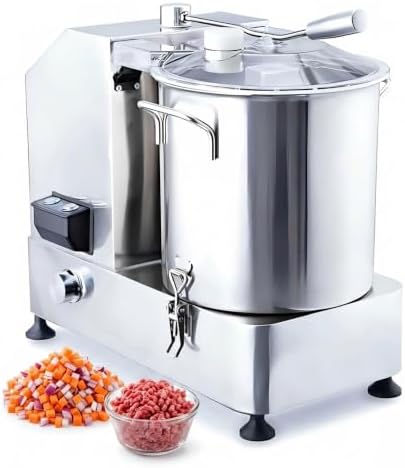
The CLIVIA is a bowl cutter with stepless speed control, a transparent lid, and curved multi-layer blades. Its description gives a speed range of about 986 to 2,470 RPM and recommends short bursts, checking texture between runs. That approach can help you stop before chopped ingredients become a paste.
Pay close attention to its capacity figures: the listing describes a 12-liter empty barrel but gives a working capacity of 5.6 liters, or about 5.9 quarts. That working figure is more useful for planning a batch. The description also says to cut food into small pieces, fill only part of the bowl, and use the scraper between bursts for more even processing.
The clear lid has a seasoning hole, and the listing describes a safety arm, lid lock, and suction feet. One specification needs clarification before purchase: the title says 2200W, while the description refers to an 1800W industrial motor. Confirm the rated power on the product page. Compared with the HAKKA, CLIVIA provides a stated working capacity and more detailed instructions for controlling texture, but its power information is inconsistent.
Pros:
- Stepless speed control for different textures
- Working capacity is stated separately from empty-barrel capacity
- Transparent lid and safety features are described
- Instructions recommend short bursts to reduce over-processing
Cons:
- Power figures conflict between the title and description
- Working capacity is much smaller than the empty-barrel figure may suggest
Verdict: Consider the CLIVIA if variable speed and texture control are priorities, but verify its power specification and working capacity before buying.
4. Knxiodrtv 10L Commercial Food Processor: Best for Simple Chopping

This model is described as a basic commercial chopper for meat and vegetables, with a 1100W motor, stainless-steel construction, and an S-shaped blade. Its controls are presented as simple, and the listing says the food-contact parts can be removed without tools for cleaning.
There is an important specification mismatch: the product title says 10 liters, while the description refers to a 15-liter stainless-steel bowl. The listing also makes specific claims about processing times, but actual results can depend on ingredient size, load, and the texture you want. Treat the capacity and speed claims as details to verify rather than assuming the machine will match those figures in your kitchen.
The straightforward design may appeal to a kitchen that mainly needs to chop or grind and does not require the variable speed controls found on the HAKKA or CLIVIA. The product data supplied for this item marks it as unavailable, so check the listing for current availability and confirm the bowl size before making plans around it.
Pros:
- 1100W motor and stainless-steel construction are listed
- S-shaped blade is described for chopping and grinding
- Food-contact parts are said to remove without tools
- Simple operation may suit basic prep needs
Cons:
- Capacity is inconsistent between the title and description
- Availability may be limited; check the listing before purchase
Verdict: This is worth considering for basic chopping only if the listing confirms availability, capacity, and the included components.
5. SLEKVERSA 15L Commercial Food Processor: Best for Multi-Task Batch Prep

The SLEKVERSA is described as a large stainless-steel chopper with a 1400W motor, a stated speed of 1,400 RPM, and S-curve blades. Its listed tasks include chopping, grinding, mixing, and blending, making it a possible fit for kitchens that want one machine for several kinds of batch prep.
Its capacity details need a closer look: the title says 15 liters and 63 cups, while the description gives a 16-quart container. These are not identical measurements, so check the exact bowl capacity and usable fill level on the product page. The listing also mentions continuous feeding and protective gloves, but does not provide a detailed working-capacity figure.
On paper, its motor and speed resemble the Garvee’s, and both are aimed at high-volume prep. Garvee’s description gives a clearer account of its stated 16-quart capacity and specific functions, while SLEKVERSA emphasizes several prep modes. Neither listing’s motor wattage alone tells you how evenly it will process a particular ingredient or how much it can handle at once.
Pros:
- 1400W motor and 1,400 RPM are listed
- Stainless-steel construction and S-curve blades
- Described for chopping, grinding, mixing, and blending
- Continuous feeding and protective gloves are mentioned
Cons:
- Capacity is described with several different figures
- Working capacity and included accessories should be confirmed
Verdict: The SLEKVERSA may suit batch kitchens seeking several prep functions, provided you verify the bowl capacity and included parts first.
How to Choose a Commercial Food Processor
Match the machine to your prep tasks
Start with the jobs you do most often. These picks are primarily bowl-style choppers, and their descriptions focus on chopping, grinding, mixing, or making pastes. If you need uniform slices, shreds, or cubes, check whether the model includes the right discs or cutting attachments. A claim such as “multi-functional” does not by itself confirm that those parts are included.
Compare working capacity, not just the headline number
A large empty-bowl measurement does not always mean you can process that much food in one batch. Look for a stated working capacity or maximum fill line, and consider how much room ingredients need to move around the blades. The CLIVIA listing, for example, separates its 12-liter empty barrel from a 5.6-liter working capacity. Several other listings have capacity figures that do not fully agree, so verify the details before ordering.
Choose speed control for the textures you need
Variable-speed machines can give you more control over whether ingredients stay coarse or become finely chopped. The HAKKA and CLIVIA list adjustable speed ranges, while the Garvee and SLEKVERSA describe a single operating speed. Remember that RPM figures alone do not guarantee a particular texture: blade shape, ingredient load, and processing time matter too. Short runs with checks in between can help you avoid processing food past the texture you want.
Consider construction and cleanup
Stainless-steel bowls and surfaces are common across these choices, but cleaning details differ. Check which parts can be removed, how the blade assembly is handled, and what the manufacturer says about washing and drying. Do not assume a removable part is dishwasher-safe unless the product instructions say so. A machine that is difficult to clean can slow down a kitchen even if its motor is powerful.
Look for clear safety instructions
Pay attention to lid locks, safety arms, feed openings, and any instructions for stopping the machine before opening it. Use the included accessories as directed and keep hands away from moving blades. For a shared kitchen, make sure staff can understand the controls and safe operating steps before the machine is put into routine use.
Check the electrical and counter-space requirements
Motor wattage is only one part of choosing equipment. Confirm the product’s voltage, plug, dimensions, and operating instructions on its listing, especially if it will run in a commercial kitchen. Measure the counter area and leave room for loading ingredients, removing parts, and cleaning. A large-capacity processor can be a poor fit if it crowds the prep station.
Resolve conflicting specifications before buying
Some listings here give different capacity or power figures in the title and description. When the details do not match, use the product page and manufacturer information to confirm the exact model, bowl capacity, rated power, and included accessories. If you cannot confirm an important specification, consider a model with clearer details.
Frequently Asked Questions
What is the difference between a commercial food processor and a bowl cutter?
The products in this roundup are mostly bowl-style cutters that process ingredients with a central blade. A traditional food processor may also come with discs for slicing and shredding. Check the included attachments if your kitchen needs those specific cuts.
Which pick has the most clearly stated working capacity?
The CLIVIA listing gives a working capacity of 5.6 liters, or about 5.9 quarts, as well as a larger empty-barrel measurement. Other products list larger headline capacities, but some figures vary between the title and description.
Is a higher-wattage motor always better?
No. Wattage is one specification, but blade design, working capacity, speed, and the type and amount of food also affect performance. Compare the complete specifications and intended tasks rather than choosing on wattage alone.
Can these machines process meat as well as vegetables?
Several product descriptions say they can handle meat and vegetables. Use the manufacturer’s directions for portion size, preparation, and cleaning, and confirm that the model is suitable for the type of meat you plan to process.
Are these processors suitable for slicing and shredding?
Not necessarily. The descriptions focus mainly on chopping, grinding, blending, and related bowl-processing tasks. Confirm that a machine includes the discs or attachments you need for slicing or shredding before purchase.
How can I avoid turning chopped ingredients into puree?
Use short processing bursts and check the texture between runs. The CLIVIA description specifically recommends this method. Ingredient size and batch load can also affect the result, so follow the instructions for your chosen model.
What should I do when a product listing has conflicting specifications?
Confirm the exact model and details on the current product page or with the manufacturer before ordering. Pay particular attention to working capacity, rated power, and included accessories if those details affect your kitchen’s workflow.
Final Recommendation
The HAKKA is the most appealing choice if you want adjustable speed and stainless-steel construction, while the Garvee stands out for its listed large-batch capacity. Choose the CLIVIA when texture control is important, but verify its conflicting power figures and use its stated working capacity for planning. The Knxiodrtv and SLEKVERSA may fit specific needs, though their capacity details should be confirmed. For any of these machines, compare the current listing with your daily prep volume and the cuts your kitchen actually needs.