
A hot plate with a magnetic stirrer can heat and mix a liquid at the same time, which is useful for lab work, teaching, and other controlled mixing tasks. The right choice depends on the temperature range and batch size you need, how closely you need to monitor the liquid itself, and whether you want features such as a timer or programmable settings. Here are five options, with their stated specifications and the trade-offs to consider.
Quick Comparison
| Product | Stated capacity | Temperature and speed | Notable feature |
|---|---|---|---|
| VOEDOR 85-2 Digital Magnetic Stirrer Hot Plate | Up to 1,000 mL | Up to 100°C; up to 2,000 RPM | 304 stainless steel plate and four stir bars |
| LABHOUSE LHS-300 Digital Magnetic Stirrer Hot Plate | Up to 5 L | Up to 300°C; 200–1,500 RPM | Liquid temperature probe and programmable timer |
| GDIFLS Digital Magnetic Hot Plate Stirrer | Title states 2,000 mL / 84 oz | 32–392°F; 200–2,000 RPM | PID temperature control and automatic shutoff claim |
| sertheha 10L Digital Magnetic Hot Plate Stirrer | Up to 10 L | RT–100°C; speed figures conflict in listing | Timer and large stated stirring capacity |
| LICHEN Digital Magnetic Stirrer Hot Plate | Up to 5 L | Up to 300°C; 100–1,600 RPM | PT1000 probe, timer, and stored programs |
Our Picks: Best Hot Plate With Temperature Control And Magnetic Stirrer reviews
VOEDOR 85-2: A Compact Choice for Small, Low-Temperature Batches

The VOEDOR is a straightforward option for smaller mixtures. It is specified for up to 1,000 mL, with a 250-watt heater that reaches up to 100°C and a stirring speed of up to 2,000 RPM. That makes it a better fit for routine, lower-temperature work than for procedures that need hotter plate settings or larger batches.
The 304 stainless steel plate is a practical, durable surface, and the digital display lets you set and view the temperature. Stirring speed is adjusted with a stepless knob. The package also includes four stir bars and an adjustable support rod for positioning a temperature sensor. The listing describes a fuse and non-skid feet as safety features.
A key limitation is the 100°C maximum temperature. The listing also says the unit is not suitable for highly viscous liquids, so it is not a good match for thick mixtures that need strong mechanical agitation. Compared with the larger LABHOUSE and LICHEN models, it offers a simpler setup and lower stated capacity.
Pros:
- Compact capacity suited to batches up to 1,000 mL
- Digital temperature display and stepless speed adjustment
- Includes four stirring bars and an adjustable support rod
- Stated stirring speed reaches 2,000 RPM
Cons:
- Maximum temperature is 100°C
- Not intended for high-viscosity liquids
Verdict: Choose the VOEDOR if you need a simple magnetic stirrer for small batches that stay at or below 100°C.
LABHOUSE LHS-300: Higher Heat and Probe-Based Monitoring

The LABHOUSE LHS-300 is designed for routine lab mixing with batches up to 5 L. Its stated temperature ceiling is 300°C, and its speed range is 200–1,500 RPM. A 140 mm ceramic-coated aluminum surface provides the heating area, while a digital display shows the operating settings.
One useful distinction is its dual temperature monitoring: the listing describes both a plate sensor and an included liquid temperature probe. Measuring the liquid with a probe can be more relevant than relying only on the plate setting when your procedure calls for monitoring the sample. The unit also has a timer adjustable from one minute to 99 hours and over-temperature protection, according to the product information.
The stated speed tops out below the VOEDOR, GDIFLS, and sertheha figures, so compare speed needs with batch size and mixing conditions rather than assuming a higher RPM is always better. The supplied availability information marks this item unavailable; stock can change, so check the listing before making plans to buy.
Pros:
- Stated capacity of up to 5 L
- Temperature range reaches 300°C
- Includes a liquid temperature probe
- Programmable timer and over-temperature protection are listed
Cons:
- Maximum stirring speed is 1,500 RPM
- Supplied listing information marks it unavailable
Verdict: The LABHOUSE is worth considering for larger batches that need high heat and liquid-probe monitoring, if it is available when you shop.
GDIFLS: A Broad Temperature Range with Fine Speed Adjustment

The GDIFLS model is specified for temperatures from 32°F to 392°F and stirring from 200 to 2,000 RPM. Its listing describes PID temperature control with ±1°F accuracy, a ceramic-coated aluminum plate, and an automatic shutoff at 400°F. These are useful features to compare if you need a wider temperature range and precise adjustment.
The listing describes the unit as handling an 84-ounce batch, while its title also gives a 2,000 mL capacity. Those figures do not match, so confirm the usable capacity with the seller before choosing a vessel or planning a batch. The product information also mentions a magnetic stir bar, but does not specify a liquid temperature probe. If direct sample-temperature monitoring matters for your process, a model that includes one may be a better fit.
Its stated top speed matches the VOEDOR and is higher than the LABHOUSE and LICHEN figures. The listing mentions uses such as lab preparation and paint mixing, but magnetic stirring is generally best suited to liquids that can be moved effectively by a stir bar rather than thick mixtures.
Pros:
- Stated temperature range extends to 392°F
- Speed adjusts from 200 to 2,000 RPM
- Listing describes PID control and automatic over-temperature shutoff
- Ceramic-coated aluminum plate is specified
Cons:
- Capacity figures in the title and description conflict
- A liquid temperature probe is not listed as included
Verdict: Consider the GDIFLS for its wide stated temperature and speed ranges, but verify the capacity before ordering.
sertheha 10L: A Large-Capacity Option with Conflicting Speed Specs
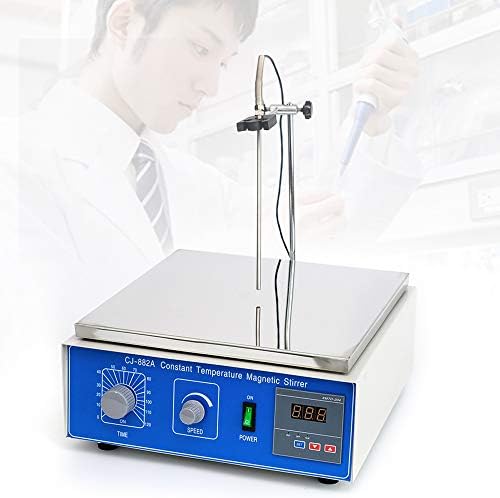
This sertheha model stands out for its stated maximum stirring volume of 10 L, much larger than the 1 L VOEDOR and the 5 L LABHOUSE and LICHEN units. It has 300 watts of heating power, a digital temperature display, and a temperature range from room temperature to 100°C. The listing also describes a 0–120-minute timer and a brushless DC motor.
There is an important specification conflict to resolve before buying: the product title says 0–1,250 RPM, while the description says 0–2,000 RPM. Do not base a procedure on the higher figure until the seller confirms the correct range. The listing describes a magnetic steel surface with a sprayed finish rather than the ceramic-coated or stainless steel surfaces specified for some competing models.
The large stated capacity may appeal to users preparing bigger liquid batches, but actual stirring performance can depend on the vessel, liquid properties, and stir bar. The product information does not list a liquid temperature probe, which may matter if you need to measure the sample rather than set a plate temperature.
Pros:
- Stated stirring volume reaches 10 L
- 300 watts of heating power
- Digital temperature display and a timer up to 120 minutes
- Brushless DC motor is specified
Cons:
- Stirring speed differs between the title and description
- Maximum temperature is 100°C
Verdict: This is the capacity-focused choice, but confirm the speed specification and make sure its 100°C ceiling suits your work.
LICHEN: Programmable Mixing with an Included PT1000 Probe

The LICHEN combines a stated 5 L capacity with heating up to 300°C and stirring from 100 to 1,600 RPM. Its included PT1000 temperature sensor is intended to monitor the solution, and the listing gives a solution-temperature accuracy claim of ±0.5°C. It also states plate accuracy of ±3°C, so the two figures apply to different measurements.
This model offers more control features than the simpler options: a timer up to 99 hours and 59 minutes, six stored programs, and forward/reverse stirring with pauses between direction changes. The listing also describes slow-start stirring and a 550-watt heater. These features may help with repeated or multi-step procedures, though the listed temperature and accuracy figures are product claims rather than a guarantee for every setup.
The ceramic-coated plate is described as corrosion-resistant and easy to clean. At 5 L, its capacity is below the sertheha’s stated 10 L, but its longer timer, probe, and program storage make it better suited to controlled routines. Its maximum speed is lower than the 2,000-RPM models.
Pros:
- Includes a PT1000 sensor for solution-temperature monitoring
- Stated heating range reaches 300°C
- Timer runs up to 99 hours and 59 minutes
- Stores up to six programs and supports direction changes
Cons:
- Maximum stirring speed is 1,600 RPM
- Stated capacity is 5 L, below the sertheha model’s 10 L figure
Verdict: Choose the LICHEN if probe monitoring, longer timed runs, and saved programs matter more to you than maximum capacity or top speed.
How to Choose a Hot Plate with Temperature Control and Magnetic Stirrer
Match Capacity to Your Actual Batch Size
Start with the amount of liquid you plan to mix, then leave room in the vessel for stirring and safe handling. The five options list capacities from 1,000 mL to 10 L, but a stated maximum capacity does not guarantee that every liquid or container will stir well at that volume. Check the product details and choose a unit with enough capacity for your normal batch, not just your largest occasional one.
Choose a Temperature Range That Fits Your Process
Maximum temperatures vary considerably here: the VOEDOR and sertheha are specified up to 100°C, while the LABHOUSE, GDIFLS, and LICHEN list higher limits. Do not choose by the highest number alone. Think about your required sample temperature, and remember that a plate setting and the temperature of the liquid are not necessarily the same measurement.
Look for a Liquid Temperature Probe When Needed
A built-in or plate-based reading tells you about the hot plate, while a probe placed in the sample can monitor the liquid more directly. The LABHOUSE lists an included liquid temperature probe, and the LICHEN includes a PT1000 sensor. The supplied information does not list a liquid probe for every model, so confirm what is included if your method depends on sample temperature.
Consider Stirring Speed and Liquid Thickness
Maximum RPM is only one part of mixing performance. The right speed depends on the liquid, vessel, stir bar, and batch size. The VOEDOR listing specifically says it is not suitable for high-viscosity liquids. If your material is thick or difficult to move with a magnetic stir bar, check the manufacturer’s guidance rather than assuming a higher speed will solve the problem.
Compare Timers and Program Controls
A timer can help limit a run or support a repeated procedure. The sertheha lists a timer up to 120 minutes, the LABHOUSE covers one minute to 99 hours, and the LICHEN lists a timer up to 99 hours and 59 minutes plus stored programs. Choose controls that match the length and repeatability of your work; extra programming features may not be useful for simple mixing tasks.
Check the Plate Surface and Safety Features
The listed surfaces include stainless steel, ceramic-coated aluminum, and magnetic steel with a sprayed finish. Consider the materials you work with and follow the manufacturer’s directions for cleaning and chemical compatibility. Also check which safety features are actually specified for the model, such as over-temperature protection, automatic shutoff, a fuse, or non-slip feet.
Resolve Conflicting Specifications Before Ordering
Some product information here contains figures that do not agree: the sertheha listing gives two different maximum stirring speeds, and the GDIFLS title and description state different capacities. Confirm any specification that affects your procedure with the seller or manufacturer before purchase. A clear answer is especially important when selecting a vessel, planning a batch, or setting a required speed.
Frequently Asked Questions
What does a magnetic stirrer hot plate do?
It heats a vessel from below while a rotating magnetic field turns a stir bar inside the liquid. This combines heating and mixing in one instrument. The product descriptions here position these units for laboratory, teaching, research, or related work.
Is a plate temperature setting the same as the liquid temperature?
No. A plate sensor measures the plate, while a temperature probe placed in the liquid measures the sample more directly. The LABHOUSE and LICHEN list liquid-temperature sensors; check the included accessories for other models.
Which option has the largest stated capacity?
The sertheha listing states a maximum stirring volume of 10 L. However, confirm that capacity and the conflicting speed figures with the seller before relying on them. The GDIFLS also has inconsistent capacity information in its title and description.
Which models are specified to reach 300°C?
The LABHOUSE and LICHEN list maximum temperatures of 300°C. The GDIFLS lists a range up to 392°F. Actual sample temperature can differ from the plate setting, so use a suitable probe when your procedure requires direct measurement.
Can these units stir thick liquids?
Magnetic stirrers are generally best suited to liquids that a stir bar can move effectively. The VOEDOR description specifically cautions against high-viscosity liquids. For thicker materials, check the manufacturer’s guidance and consider whether a different type of mixer is more appropriate.
Does every model include a temperature probe?
No. The supplied information lists a liquid temperature probe with the LABHOUSE and a PT1000 sensor with the LICHEN. The other product descriptions do not clearly list an included liquid probe, so verify the package contents if you need one.
Final Recommendation
For small, low-temperature batches, the VOEDOR is the simplest fit. If you need a liquid probe and a long timer, compare the LABHOUSE and LICHEN, noting that the supplied availability information marks the LABHOUSE unavailable. The LICHEN offers the most detailed set of timing and program features, while the sertheha has the largest stated capacity but needs specification confirmation. Before choosing any model, match its temperature range and capacity to your process and verify conflicting listing details.