
Finding the best home theater speaker package for a small room means balancing immersive sound with a setup that won’t overwhelm your space. A compact 5.1 system can add dedicated center and surround channels, while a 2.1 system takes up less room but cannot provide the same speaker-by-speaker surround layout. The five options below range from complete AV receiver bundles to simpler powered systems, so you can match the setup to your room, equipment, and appetite for installation work.
Quick Comparison
| Product | Setup | Best suited for | Standout feature |
|---|---|---|---|
| Yamaha YHT-4970U | 5.1-channel receiver bundle | A complete movie and gaming setup | Room correction and modern HDMI features |
| Energy RC-Micro with Onkyo TX-RZ70 | Compact 5.1 speakers with AV receiver | Small speakers paired with a feature-rich receiver | Dirac Live room correction and network audio |
| Acoustic Audio AA5170 | Powered 5.1 system | Simple connections and built-in streaming | Bluetooth, USB, SD, and optical inputs |
| Rockville HTS56 | Powered 5.1 system | Flexible connections and karaoke features | Microphone inputs, EQ, and LED modes |
| Rockville RHB70 | Powered 2.1 system | A compact setup for a desk or bedroom | Small footprint with Bluetooth and several inputs |
Our Picks: Best Home Theater Speaker Packages For Small Rooms reviews
Yamaha YHT-4970U: A Complete 5.1 System with Room Correction

The Yamaha YHT-4970U is a full home theater package, with an AV receiver, five speakers, a powered subwoofer, speaker wire, and a subwoofer cable. For a small room, having the main pieces in one bundle can make it easier to plan a matched 5.1 setup rather than choosing each component separately.
The receiver supports Dolby Atmos and DTS Virtual:X processing, along with 4K/120 and 8K/60 video support, Dolby Vision, HDR10+, and eARC/ARC. The supplied speaker layout is 5.1, so the system does not include separate height speakers; its dimensional sound options should be understood as processing features, not extra physical channels in the box.
Yamaha includes a setup microphone and room-correction feature to measure the room and speakers, which can be useful when walls, furniture, or speaker positions limit placement options. Bluetooth Multipoint can pair two source devices, and the receiver includes sound modes and customizable Scene presets. In a compact room, plan where the receiver and subwoofer will go as well as the five speakers, and take care not to place the subwoofer where bass becomes distracting.
Pros:
- Complete 5.1 package includes receiver, speakers, subwoofer, and basic wiring.
- Room-correction microphone helps tailor playback to the space.
- Supports modern video features, including 4K/120, 8K/60, and eARC/ARC.
- Bluetooth Multipoint and Scene presets add convenient everyday controls.
Cons:
- A receiver and six speaker components require more setup and floor or shelf space than a soundbar.
- The package does not include dedicated height speakers for physical overhead sound.
Verdict: Choose the Yamaha if you want a complete, flexible 5.1 system and are comfortable making room for a receiver and separate speakers.
Energy RC-Micro and Onkyo TX-RZ70: Compact Speakers, Extensive Receiver Features

This bundle combines Energy’s compact RC-Micro 5.1 speaker system with an Onkyo TX-RZ70 receiver. Four satellite speakers, a center speaker, and a powered subwoofer provide the familiar front, center, surround, and bass channels. The satellite and center speakers have keyhole slots and threaded inserts, giving you mounting options that can help free up limited shelf space.
The Onkyo is a feature-rich receiver with 11 channels of amplification rated at 140 watts per channel, HDMI 2.1 support, 4K/120 and 8K video support, Dolby Vision, HDR10+, and eARC. It also includes Dirac Live Full Bandwidth room correction and network audio features such as Wi-Fi, DTS Play-Fi, and AirPlay. This is considerably more receiver capability than many small-room setups need, but it may suit someone who values extensive system controls or expects to build out a larger setup later.
The subwoofer is specified with a 240-watt amplifier and an 8-inch woofer. That offers dedicated bass, but small rooms can make bass placement especially noticeable; leaving room to adjust the subwoofer’s position is sensible. The main trade-off is that the speakers are compact while the receiver is an advanced, substantial component, so check your available shelf or cabinet space before choosing this bundle.
Pros:
- Four compact satellite speakers and a center speaker make up a complete 5.1 layout.
- Keyhole slots and threaded inserts allow flexible speaker mounting.
- Dirac Live room correction and broad network-audio support are included.
- Receiver supports current high-resolution video and HDMI features.
Cons:
- The receiver’s extensive channel and network features may be more than a small room requires.
- Requires planning for a receiver, five speakers, and a separate subwoofer.
Verdict: Pick the Energy and Onkyo bundle if you want compact satellite speakers but also want an especially capable receiver and room-correction tools.
Acoustic Audio AA5170: A Powered 5.1 System with Broad Input Options

The Acoustic Audio AA5170 is a powered 5.1 speaker system built around an amplified subwoofer and five passive wired satellite speakers. Unlike the Yamaha and Onkyo bundles, it does not include a separate AV receiver. Its built-in Bluetooth receiver, optical input, RCA connections, USB input, and SD card slot provide several ways to connect audio sources.
The system has a Pro Surround function that converts stereo input to 5.1 playback, along with a remote and front-panel controls. The listed package includes cables for the front and center speakers, longer cables for the rear speakers, and an optical cable. Those cable lengths may help in a small room, but you will still need to route several wires neatly between the powered subwoofer and the satellite speakers.
This setup may appeal if you want multiple connection options without choosing an AV receiver separately. It is less suitable if you need the HDMI switching, eARC, or advanced video support found on the Yamaha and Onkyo receivers. The listed system power is 700 watts; treat that as the product’s stated figure rather than a direct measure of how loud it will sound in your specific room.
Pros:
- Five satellites and a powered subwoofer provide a full 5.1 speaker arrangement.
- Bluetooth, optical, RCA, USB, and SD inputs support varied sources.
- Includes a remote, optical cable, and speaker cables with different lengths.
- Does not require a separate AV receiver for its listed connections and features.
Cons:
- Does not offer the receiver-based HDMI switching and video features of the Yamaha or Onkyo bundles.
- Wired satellites mean cable routing still matters, even in a compact space.
Verdict: Consider the AA5170 if you want powered 5.1 sound with several direct audio inputs and do not need an advanced HDMI receiver.
Rockville HTS56: A Feature-Packed Powered 5.1 System

The Rockville HTS56 is a powered 5.1 system with five satellite speakers and an 8-inch subwoofer. It is designed to offer a complete speaker arrangement without a separate receiver. Its listed connections include Bluetooth, USB, SD, RCA, and optical input, making it useful for households with a mix of audio sources.
This system has a different personality from a straightforward movie-focused bundle. It includes two microphone inputs with echo control, a five-band EQ, FM radio, and LED lighting modes on the speakers and subwoofer. Those extras may be appealing for karaoke or casual gatherings, but the lights and party features are not essential for watching films in a small room.
Rockville lists the system at 1,000 watts peak and 250 watts RMS. The package includes speaker cables up to 30 feet, mounting kits, and signal and antenna cables. The longer wiring can give you placement flexibility, though it may take extra effort to keep cables tidy in a small space. As with the other powered systems, check that its listed inputs match your TV or source device before buying.
Pros:
- Five satellites and an 8-inch subwoofer provide a 5.1 layout.
- Bluetooth, USB, SD, RCA, and optical inputs offer varied connection choices.
- Includes microphone inputs, echo control, EQ, and FM radio.
- Speaker cables and mounting kits are included.
Cons:
- LED lighting and karaoke functions may be unnecessary if you mainly watch movies.
- Check source compatibility carefully, since this is not an AV receiver bundle with HDMI switching.
Verdict: Choose the HTS56 if you want a powered 5.1 system that can also handle karaoke and casual entertainment, rather than a receiver-centered movie setup.
Rockville RHB70: A Compact 2.1 Alternative for Smaller Setups
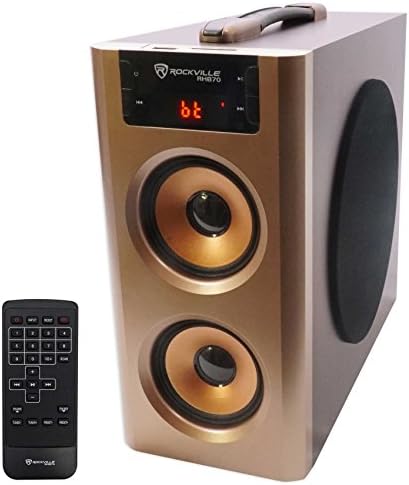
The Rockville RHB70 is a powered 2.1 system with two 3-inch speakers and a 4-inch subwoofer in a cherry wood enclosure. Its compact dimensions—4.73 inches wide, 9.65 inches high, and 10.64 inches deep—make it the smallest-footprint option in this group. It is better thought of as a simple stereo-plus-subwoofer setup than as a full home theater surround package.
Bluetooth, USB, SD card, RCA, and 3.5mm auxiliary connections give you several ways to play music or connect compatible equipment. The system also includes an LED display and remote control. Its stated output is 25 watts RMS, 50 watts program, and 100 watts peak, so the listed peak figure should not be confused with continuous output.
For a bedroom, desk, or small living area, a 2.1 layout can be easier to place and wire than five separate speakers. The trade-off is clear: it does not provide dedicated center or rear surround speakers, so it is not the right choice if true 5.1 channel placement is your priority. The supplied product data marks this item unavailable, so check its current listing status before planning a purchase.
Pros:
- Compact enclosure fits desks, shelves, and counters.
- Bluetooth, USB, SD, RCA, and 3.5mm inputs support a range of sources.
- Includes a remote and front-panel controls.
- Uses a simpler 2.1 arrangement with fewer speakers and cables than the 5.1 options.
Cons:
- 2.1 playback does not provide dedicated center and rear surround channels.
- Supplied product information indicates the item is unavailable; listing status may change.
Verdict: The RHB70 makes sense if compact size matters more than true surround sound, but choose one of the 5.1 systems for a more complete movie theater layout.
How to Choose a Home Theater Speaker Package for a Small Room
Decide Between 5.1 and 2.1 Sound
A 5.1 setup uses front left and right speakers, a center speaker, two surround speakers, and a subwoofer. That layout can provide more directional sound for movies, but it also needs more placement space and cable planning. A 2.1 system uses two speakers and a subwoofer, making it easier to fit into a tight space, but it does not have dedicated center or rear channels. Choose based on whether surround placement or a simple, compact setup matters more to you.
Check Whether You Need a Receiver
Receiver bundles such as the Yamaha and Energy/Onkyo packages provide HDMI connections and broader system control, but the receiver needs a stable shelf or cabinet space. Powered systems such as the Acoustic Audio and Rockville models have built-in amplification and use their listed audio inputs instead. Before choosing, check the connections on your TV, game system, and other sources. HDMI features such as eARC are useful only when the relevant devices and cables support the connection.
Measure Your Room and Plan Speaker Placement
Measure the space around your TV, seating area, and likely speaker positions. A small room can make it harder to place surround speakers behind or beside the listening position, and a subwoofer may need a few placement adjustments to suit the room. Mounting features, such as the keyhole slots and threaded inserts on the Energy satellites, can help if shelves are limited. Also consider where cables will run and whether they can be tucked away safely.
Match the System to Your Main Use
If movies and games are your focus, a complete 5.1 package gives you dedicated speaker positions for dialogue and surround effects. If you mainly listen to music, watch TV at a desk, or want a bedroom setup, a compact 2.1 system may be a better fit. Extra functions also matter: the Rockville HTS56 includes microphone inputs and lighting features, while the Yamaha and Onkyo bundles focus more on receiver controls, video support, and room correction.
Understand Power and Processing Claims
Power figures may be presented in different ways, such as RMS, program, or peak output, so they are not always directly comparable. Consider the speaker layout, connections, room size, and placement along with the stated numbers. Sound-processing features such as Dolby Atmos or DTS Virtual:X do not add physical height speakers to a package that does not include them. Read the included component list to understand what channels and hardware you are actually getting.
Think About Setup and Everyday Control
A package with a receiver can offer more input switching and system controls, while a powered system may be simpler to connect if its inputs match your equipment. Room correction can help adjust a system to its surroundings, but it does not remove the need to place speakers sensibly. Look at what comes in the box, including cables, remote controls, setup microphones, and mounting hardware, so you know what extra setup work to expect.
Frequently Asked Questions
What type of home theater speaker package works best in a small room?
The best fit depends on the available space and how much surround sound you want. A compact 5.1 system can give you separate center and surround speakers, while a 2.1 system uses fewer components and is easier to place. Measure your room and decide whether you can position the extra speakers before choosing.
Is a 5.1 system worth it in a small room?
It can be, if you can place the front, center, and surround speakers around your seating area. A small room does not prevent you from using 5.1, but furniture and cable routes may limit placement. If you cannot position the surround speakers well, a simpler system may be more practical.
Do these packages include an AV receiver?
The Yamaha YHT-4970U and the Energy RC-Micro bundle include AV receivers. The Acoustic Audio AA5170 and Rockville HTS56 are powered systems with their own listed connections. The Rockville RHB70 is also powered, but it is a 2.1 system rather than a full surround package.
Can I use Dolby Atmos without height speakers?
The Yamaha bundle lists Dolby Atmos and DTS Virtual:X support, but its included speakers form a 5.1 layout and do not include separate height speakers. Processing can create a more dimensional effect, but it is not the same as having dedicated physical speakers positioned overhead.
Which option is easiest to fit on a shelf or desk?
The Rockville RHB70 has the smallest stated footprint, but it is a 2.1 system. The Energy satellites are compact and include mounting features, though the bundle also includes a full-size AV receiver and subwoofer. Consider all components—not just the satellite speakers—when checking available space.
What should I check before connecting a powered system to my TV?
Compare your TV’s audio outputs with the system’s listed inputs. The Acoustic Audio AA5170 lists optical and RCA inputs, while the Rockville HTS56 lists optical and RCA among its connections. If you plan to connect through HDMI or use eARC, a compatible receiver such as the Yamaha or Onkyo bundle may be a better match.
Final Recommendation
For most people seeking a complete small-room theater setup, the Yamaha YHT-4970U is the most balanced place to start: it includes a receiver, 5.1 speakers, a powered subwoofer, room correction, and modern video support. The Energy RC-Micro and Onkyo bundle is a strong alternative if you want compact satellites and more extensive receiver and network features. Choose the Acoustic Audio or Rockville HTS56 if you prefer a powered system with multiple direct inputs, and consider the RHB70 only if a small 2.1 setup matters more than full surround sound. Confirm the connections, dimensions, and current availability that matter to your setup before deciding.