
In an RV kitchen, a dish drainer needs to fit the sink, keep water off limited counter space, and store easily when you need room to work. The best choice depends on your sink’s shape and whether you want a fixed in-sink rack, an expandable rack, or a roll-up design. These five options offer different ways to make hand-washing dishes more manageable in a compact kitchen.
| Dish Drainer | Style | Key feature | Best for |
|---|---|---|---|
| JASIWAY In-Sink Expandable Rack | Expandable, in- or over-sink | Holds plates, bowls, cups, and utensils | People who want one rack for several dish types |
| Sakugi Expandable Dish Rack | Expandable, in- or over-sink | Removable cutlery holder and three cup holders | Compact kitchens needing organized drying space |
| MECHEER Roll-Up Rack | Roll-up over-sink rack | Stores rolled up and has multiple uses | Those who want to clear the sink area after use |
| MAJALiS Expandable Rack | Expandable, over-sink | Anti-slip grips and protective feet | Small daily loads and adjustable sink fit |
| Better Houseware In-Sink Rack | Fixed in-sink rack | Removable utensil caddy | Those who prefer a simple rack inside the basin |
Our Picks: Best Rv Dish Drainer For Kitchen Sink reviews
JASIWAY In-Sink Expandable Rack: Best for Flexible Use
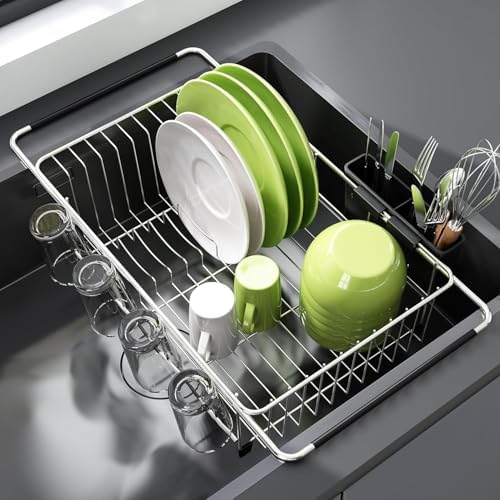
The JASIWAY rack can sit inside the sink or extend across it, making it a versatile option when an RV kitchen has limited counter space. Its supporting bars adjust from 15.5 to 23.2 inches, while the rack itself measures 15.5 by 11 by 4.8 inches. Measure your sink before ordering, especially if you have a narrow basin or unusual faucet placement.
Its layout is designed to keep different dishes organized: the manufacturer lists room for plates, bowls, cups, and silverware, with a dedicated utensil holder. The open grid lets water drip into the sink, and the stainless steel frame is listed with a load capacity of up to 70 pounds. That capacity is a stated product specification, not a reason to overload the rack; balance dishes evenly and use it on a secure sink.
The silicone sleeves on the supports help protect surfaces and reduce sliding. No assembly is required, which is useful when you want a straightforward setup. Compared with the roll-up MECHEER, this model offers more built-in organization, but it takes up more space when stored.
Pros:
- Can be used inside or across the sink
- Adjustable support bars accommodate a range of sink widths
- Includes plate slots and holders for cups and utensils
- Stainless steel frame and silicone-covered supports
Cons:
- Its fit depends on your sink dimensions and layout
- Not as compact to store as a rack that rolls up
Verdict: Choose the JASIWAY if you want an adjustable rack with dedicated places for several types of dishes and have measured your sink to confirm the fit.
Sakugi Expandable Rack: Best for Organized Drying

The Sakugi is a compact expandable rack with a black finish, a removable cutlery holder, and three cup holders. It measures 15.4 by 9.8 by 3 inches, and its supporting bars extend from 15.4 to 24 inches. It can be used inside the sink or rested across it, so you can choose the setup that works best for your RV’s basin.
The removable holder makes it easier to carry utensils to a drawer or rinse the holder separately. The rack can also serve as a colander for rinsing produce, according to the product description. Its stainless steel construction has a food-safe coating, though the description does not specify a weight capacity. For heavier dishes, load it evenly and check that the supports rest securely on both sides of the sink.
Compared with the JASIWAY, the Sakugi has a smaller stated rack footprint and a clearly described removable cutlery holder and cup hooks. It may suit a compact basin well, but the same compact dimensions may limit room for larger pots or a big drying load.
Pros:
- Expands to fit a range of sink widths
- Includes a removable cutlery holder and three cup holders
- Can be used as a produce-rinsing colander
- Compact dimensions suit small kitchen spaces
Cons:
- Its smaller footprint may not suit large drying loads
- No weight capacity is provided in the supplied product details
Verdict: The Sakugi is a practical choice if you want a compact expandable rack with separate places for cups and cutlery.
MECHEER Roll-Up Rack: Best for Easy Storage

Unlike a rack with fixed sides or extending bars, the MECHEER uses 18 stainless steel pipes connected with silicone. Unroll it over the sink to dry dishes, then roll it up for storage. Its listed size is 17.5 by 11.8 inches, so check that it spans your sink securely before use.
This design is also described for rinsing produce, cooling hot cookware, thawing frozen food, and providing a temporary surface for food preparation. The silicone is listed as food-safe, dishwasher-safe, and heat-resistant up to 400°F. The rack’s stated load capacity is 33 pounds. As with any over-sink rack, keep heavier items centered and avoid using it if the supports do not sit firmly on your sink edges.
The roll-up format is the main advantage for an RV: it can be put away when you need the sink or counter space. However, it does not include plate dividers, cup holders, or a utensil caddy like the JASIWAY and Sakugi. Dishes may need to be positioned carefully so they remain stable while drying.
Pros:
- Rolls up for compact storage
- Works as a drying rack and for several kitchen tasks
- Stainless steel pipes are joined with silicone
- Listed heat resistance up to 400°F and load capacity of 33 pounds
Cons:
- Does not include dedicated plate, cup, or utensil holders
- Its fixed dimensions require a careful sink measurement
Verdict: Pick the MECHEER if easy storage and a multipurpose surface matter more to you than built-in dish organization.
MAJALiS Expandable Rack: Best for Small Daily Loads

The MAJALiS is an expandable stainless steel rack intended for small loads and quick hand-washing jobs. Its description says the depth adjusts for different basins, but does not give a precise size range. Check the product listing and your sink measurements before buying so you can confirm that the rack will sit securely.
Anti-slip silicone grips help hold the rack over wet sink edges, while six covered feet protect the basin when the rack is used in the sink. The open design lets water drain into the basin rather than collect on the counter. Unlike the JASIWAY and Sakugi, it does not list a utensil caddy or dedicated cup holders, so it is a simpler option for plates and everyday dishes.
The protective details are useful in a small RV sink where a rack may be moved often. Still, its lack of listed dimensions and a stated weight limit makes fit and load planning especially important. It is best treated as a compact rack for regular light-to-moderate dish loads, not as a place to stack heavy cookware.
Pros:
- Expandable design is intended to fit different basins
- Silicone grips help reduce slipping over the sink
- Covered feet help protect sink surfaces
- Open design drains water directly into the sink
Cons:
- Exact dimensions and adjustment range are not stated in the supplied details
- No dedicated utensil or cup holders are listed
Verdict: Consider the MAJALiS for everyday small loads if its adjustable fit works with your sink and you do not need separate holders.
Better Houseware In-Sink Rack: Best for a Simple Fixed Setup

The Better Houseware rack is a fixed-size, coated-steel option designed to sit inside the sink rather than stretch across it. It measures 14.5 by 13 by 5 inches, which may work in one basin of a double sink or in a single-basin sink with enough room. Its plate slots keep dishes upright, while the open center section accommodates bowls and cups.
A removable utensil caddy clips onto the side and can be lifted off for rinsing. The coated handles and rubber feet are intended to make the rack easier to move and help protect the sink finish. Because water drains into the basin, you do not need a countertop tray, but the rack will occupy part of the sink while in use.
Compared with the expandable options, this model has fewer fit adjustments but a straightforward in-sink design. It is made from coated steel rather than the stainless steel specified for several other picks, so dry it as needed and follow the care instructions in the product listing. Its fixed dimensions make measuring your basin especially important.
Pros:
- Fixed in-sink design keeps the counter clear
- Includes a removable utensil caddy
- Plate dividers help keep dishes upright
- Rubber feet help protect the sink surface
Cons:
- Fixed dimensions offer less flexibility than expandable racks
- Uses coated steel rather than the stainless steel specified for some other picks
Verdict: Choose the Better Houseware rack if you want a simple in-basin drainer with plate slots and a removable utensil caddy.
How to Choose an RV Dish Drainer for Your Kitchen Sink
Measure the Sink Before Choosing a Rack
Measure the inside width and length of the basin, as well as the distance between the edges where an over-sink rack would rest. Compare those measurements with the rack’s stated size and adjustment range. In an RV, sink shapes and counter layouts can vary, so do not assume that a rack described as fitting “most” sinks will fit yours. Also check whether a faucet, cover, or nearby fixture could interfere with placement.
Decide Between In-Sink, Over-Sink, and Roll-Up Styles
An in-sink rack keeps the counter clear and directs water into the basin, but it uses some of the sink while dishes dry. An over-sink rack can free up counter space and may leave part of the basin available, provided it fits securely across the edges. A roll-up rack is easier to put away when not in use, though it usually offers fewer built-in dividers and holders.
Match the Rack to Your Typical Dish Load
Think about what you wash by hand most often. Plate slots help keep plates upright, while cup hooks and utensil holders give small items their own space. If you mainly wash a few dishes at a time, a compact rack may be enough. For larger loads, compare the rack’s dimensions, layout, and any stated capacity rather than relying on a general claim that it suits an RV.
Consider Materials and Sink Protection
Stainless steel, coated steel, silicone, and rubber each serve different roles in these designs. Protective sleeves, grips, or feet can help reduce movement and prevent direct contact with the sink. Check the manufacturer’s care guidance, and wipe the rack dry when needed. A protective coating or rust-resistant claim does not mean a rack should be left wet or neglected.
Check How You Will Store It
Storage can matter as much as drying space in a compact RV. A roll-up model can be stored rolled, while a fixed or expandable rack needs a place to sit when not in use. Consider where you will keep it during travel, and whether its holders or protruding supports could make it awkward to stow.
Look for Stable Placement and Clear Load Guidance
A rack should sit level and securely on the sink or counter. Non-slip covers and rubber feet can help, but they cannot make an ill-fitting rack safe. Follow any stated weight limit, spread dishes across the frame, and avoid placing heavy items near an unsupported edge. If the product does not list a capacity, use extra care with heavier cookware.
Frequently Asked Questions
What type of dish drainer works best in an RV kitchen?
It depends on your sink and storage needs. A roll-up rack is easy to put away, while an expandable rack can offer more organized drying space. A fixed in-sink rack may suit you if you want a simple setup that stays inside the basin.
Should I choose an in-sink or over-sink dish rack?
Choose an in-sink model if you want water to drain into the basin and do not mind using some sink space. An over-sink model may keep more counter space open, but you need to confirm that it rests securely across your sink.
How do I know whether an expandable rack will fit?
Measure the sink where the rack’s supports will rest, then compare that measurement with the rack’s adjustment range. Also check the rack’s width and depth, since a suitable support-bar length alone does not guarantee a good fit.
Can I use a roll-up rack for more than drying dishes?
The MECHEER product description also lists uses such as rinsing produce, cooling hot cookware, thawing food, and providing a temporary food-preparation surface. Follow the product’s stated heat and load limits for the task.
Do these dish drainers need a countertop tray?
The in-sink and over-sink designs direct water into the sink, so they do not rely on a countertop tray underneath. Make sure the rack is positioned above the basin so drips reach the drain.
Which option has a removable utensil holder?
The JASIWAY and Sakugi include utensil holders, and the Better Houseware rack includes a removable utensil caddy. The MAJALiS and MECHEER descriptions do not list a dedicated utensil holder.
Can an RV dish drainer stay in place while driving?
These product descriptions do not establish that the racks are designed for travel while loaded. Remove dishes and store the rack securely before driving, following any guidance from the manufacturer.
Final Recommendation
For a flexible, organized setup, the JASIWAY is the strongest all-around option in this group because it can be used inside or across the sink and includes several dish holders. If easy storage is your priority, consider the roll-up MECHEER. For any of these choices, measure your RV sink first and make sure the rack sits securely before loading it.