
A 4K dash cam can capture more road detail than a standard-resolution camera, but night footage depends on more than resolution. Sensor quality, aperture, HDR or WDR processing, and camera placement all matter when headlights, dark roads, or glare make details harder to see. The picks below range from a simple front camera to multi-channel systems, so you can match the coverage and setup to the way you drive.
Quick Comparison
| Dash cam | Video coverage | Night-vision features | Standout detail |
|---|---|---|---|
| 70mai M310 Plus 4K Front Dash Cam | 4K front | F1.55 aperture, WDR, 3D noise reduction | Pre-recording for impact events |
| 70mai 4K 3-Channel Dash Cam | 4K front, 1080p interior and rear | HDR, 3D noise reduction, switchable interior IR | GPS, Wi-Fi 6, and included 64GB card |
| REDTIGER F7NP 4K Front and Rear Dash Cam | 4K front, 1080p rear | STARVIS 2, F1.5 aperture, WDR and HDR | Included memory card and fast Wi-Fi |
| VIOFO A229 Pro 4K HDR Dash Cam | 4K front, 2K rear | Dual STARVIS 2 sensors and HDR on both cameras | Buffered parking recording |
| ROVE R2-4K Dash Cam | 4K front | Sony IMX415 sensor, F1.5 aperture, six-glass lens | Built-in GPS and Wi-Fi 6 |
Our Picks: Best 4K Dash Cams With Night Vision reviews
70mai M310 Plus: A Front-Facing 4K Camera With Pre-Recording

The 70mai M310 Plus is a front-only dash cam for drivers who want 4K recording without adding rear or cabin cameras. Its 140-degree field of view is designed to capture a broad area ahead, while the F1.55 aperture, WDR, and 3D noise reduction are intended to help preserve detail in dim conditions and manage bright headlights.
One useful feature is emergency pre-recording. When the G-sensor detects an impact, the camera can lock a clip that includes footage from before the event, as well as the impact itself. That can provide more context than a clip that starts only after a collision. The camera also supports parking monitoring and time-lapse recording, but those functions require a compatible UP03 or UP06 hardwire kit, which is not included.
Wi-Fi app access and voice operation offer ways to manage footage without taking the camera out of the car. The trade-off is its limited coverage: it records the front view only, so it will not capture activity inside the cabin or behind the vehicle. The supplied listing information also indicates that availability may be limited, so check the listing before choosing it.
Pros:
- 4K front recording with a 140-degree field of view
- F1.55 aperture, WDR, and 3D noise reduction for low-light recording
- Pre-recording can preserve footage leading up to an impact
- Wi-Fi app access and voice operation
Cons:
- Does not include rear or interior camera coverage
- Parking monitoring requires a separately purchased hardwire kit
Verdict: Choose the M310 Plus if you want a relatively simple front-facing camera with pre-recording, but check availability and consider a multi-camera option if you need coverage beyond the road ahead.
70mai 4K 3-Channel: Front, Cabin, and Rear Coverage

This 70mai system is built for drivers who want to record more than the road ahead. It combines 4K front video with 1080p interior and rear cameras, making it a practical fit for rideshare work, family driving, or anyone who wants a view of the cabin and traffic behind the car.
For low-light use, the system includes HDR and 3D noise reduction. The interior camera has switchable infrared recording, which is intended to improve visibility inside the vehicle at night. That IR feature applies to the cabin camera; it is not a substitute for good road-facing exposure. The system also includes GPS, Wi-Fi 6, voice control, and a 64GB memory card, with support for cards up to 512GB.
Three cameras bring more coverage but also mean more equipment to position and connect than a single-camera setup. Parking monitoring requires a compatible hardwire kit, and the listing specifies that 4G connectivity is not supported. If you mainly need a front camera, this system may offer more than you need; for drivers who need cabin footage, its three-channel design is the key advantage.
Pros:
- Records 4K front video plus 1080p interior and rear video
- Switchable infrared recording for the interior camera
- Includes GPS, Wi-Fi 6, and a 64GB memory card
- Supports memory cards up to 512GB
Cons:
- More involved to position and install than a front-only camera
- Parking monitoring requires a compatible hardwire kit
Verdict: This is a strong match for rideshare and family drivers who want front, cabin, and rear footage in one system, rather than a simpler front-only setup.
REDTIGER F7NP: 4K Front and 1080p Rear With STARVIS 2

The REDTIGER F7NP pairs a 4K front camera with a 1080p rear camera. Its listed hardware includes a STARVIS 2 sensor, F1.5 aperture, and a six-layer optical lens. WDR and HDR are designed to balance bright and dark areas in a scene, which can be helpful when nighttime footage includes headlights or uneven street lighting.
The front lens has a 170-degree field of view, while the rear lens covers 140 degrees. Built-in 5.8GHz Wi-Fi connects to the companion app for previewing and downloading files, and the system can record GPS details such as route, speed, and location. A memory card is included, so the camera is ready for recording without an additional card purchase.
For parked-car monitoring, the F7NP offers time-lapse and G-sensor modes. The hardwire kit needed for parking mode is not included, so factor that into your setup if you want the camera to monitor the car while it is parked. Compared with the single-camera ROVE, this model adds rear coverage; compared with the VIOFO, its listed rear resolution is lower.
Pros:
- 4K front and 1080p rear recording
- STARVIS 2 sensor, F1.5 aperture, WDR, and HDR
- Includes a memory card and supports GPS data
- 5.8GHz Wi-Fi supports app-based file access
Cons:
- Parking mode requires a separately purchased hardwire kit
- Rear recording is 1080p rather than 2K or 4K
Verdict: Pick the F7NP if you want a dual-camera system, an included memory card, and night-focused imaging features without stepping up to a 2K rear camera.
VIOFO A229 Pro: Higher-Resolution Front and Rear Recording
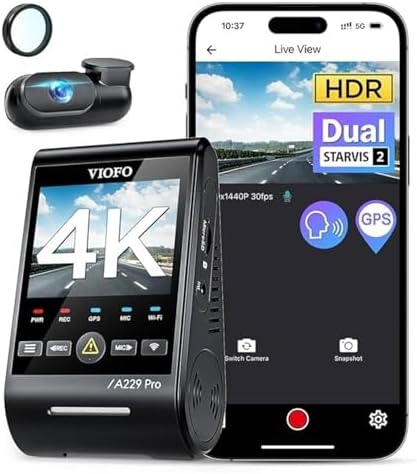
The VIOFO A229 Pro stands out for its dual STARVIS 2 sensors and its combination of 4K front and 2K rear recording. HDR is available for both cameras, with the goal of retaining detail across bright highlights and darker areas. This higher rear resolution gives it an edge over the REDTIGER F7NP if you want more detail from both ends of the car.
For parking protection, the A229 Pro offers three modes: automatic event detection, low-bitrate recording, and time-lapse. Its buffered event recording can save video from before and after a detected event, giving a clip more context. The required HK4 ACC hardwire cable is not included, so parked-car features need extra equipment.
Other features include 5GHz Wi-Fi, GPS logging, and hands-free voice controls. The combination of two high-resolution cameras and multiple parking options makes this a feature-rich choice, but it may be unnecessary if you only need a front-facing camera. Check the included components and plan for a compatible memory card and hardwire setup as needed.
Pros:
- Records 4K front and 2K rear video
- Dual STARVIS 2 sensors and HDR for both cameras
- Three parking modes, including buffered event detection
- GPS, 5GHz Wi-Fi, and voice controls
Cons:
- Parking monitoring requires a separately purchased hardwire cable
- Its multi-feature setup may be more than front-only drivers need
Verdict: Choose the A229 Pro if you want stronger rear-camera resolution and flexible parking modes, and are comfortable arranging the hardwire setup separately.
ROVE R2-4K: A 4K Front Camera With GPS and Wi-Fi 6

The ROVE R2-4K is a front-facing camera that records up to 4K UHD using a Sony IMX415 sensor. Its night-vision system combines that sensor with an F1.5 aperture and a six-glass lens. The 150-degree lens offers a wide view ahead, while built-in GPS can record driving location and speed.
Wi-Fi 6 and the ROVE app let you view and manage recordings on a phone, and the camera supports firmware updates through the app. It also includes parking mode, motion detection, loop recording, emergency file locking, and time-lapse recording. The listing states that the memory card is not included, so you will need to buy a compatible card separately.
Unlike the REDTIGER and VIOFO options, the R2-4K does not include a rear camera. That keeps the system focused on front coverage, but it is not the right fit if you need footage behind the vehicle. Its combination of 4K recording, GPS, and a wide lens makes it a straightforward option for drivers who want a single-camera setup.
Pros:
- 4K recording with a Sony IMX415 sensor and F1.5 aperture
- 150-degree field of view and built-in GPS
- Wi-Fi 6 app access and firmware updates
- Includes parking, motion-detection, and time-lapse features
Cons:
- Memory card is not included
- Records the front view only
Verdict: The R2-4K suits drivers who want a front-only 4K camera with GPS and app access, as long as they are prepared to add a memory card.
How to Choose a 4K Dash Cam With Night Vision
Consider What You Need to Record
A front-only camera is usually the simplest choice if your main goal is to document the road ahead. A front-and-rear system adds coverage behind your vehicle, while a three-channel camera can also record the cabin. Rideshare drivers may value interior footage; other drivers may prefer the simpler setup and lower equipment count of a front camera.
Look Beyond the 4K Label for Night Footage
Resolution affects how much detail a camera can record, but it does not guarantee clear video in the dark. Features such as a larger aperture, STARVIS sensors, HDR, WDR, and noise reduction are intended to help capture detail in low light or balance bright headlights against dark surroundings. These features can help, but conditions such as glare, weather, and road lighting still affect what the camera records.
Compare Resolution Across All Cameras
On a dual-camera system, check the resolution of both the front and rear units. Some models pair 4K front video with 1080p rear footage, while the VIOFO A229 Pro offers 4K front and 2K rear recording. If rear footage matters to you, do not assume that a 4K label applies to every camera in the system.
Check What Parking Mode Requires
Parking features may need a hardwire kit that is sold separately. Check whether the model you choose requires a compatible kit and whether it offers event-triggered recording, time-lapse, or another mode. Also consider the camera’s power protections and installation requirements before relying on it for parked-car monitoring.
Plan for Memory and File Access
4K files use storage quickly, so check the camera’s supported card capacity and whether a card is included. The REDTIGER and 70mai three-channel systems include a card, while the ROVE listing says its card must be purchased separately. Wi-Fi and app tools can make it easier to view or download footage, but connection speed and app features differ by model.
Think About Installation and Daily Use
A front-only camera is generally less involved to place than a system with rear and interior cameras. Multi-camera models can offer broader coverage, but you will need to position each unit and manage their connections. Voice controls, GPS, and app access are useful extras, but prioritize the camera angles and recording features that match your driving needs.
Frequently Asked Questions
Does 4K automatically mean better night footage?
No. 4K describes video resolution, but low-light clarity also depends on the camera sensor, aperture, image processing, and lighting conditions. Features such as HDR, WDR, and noise reduction are relevant when comparing night recording.
What does night vision mean on a dash cam?
For road-facing cameras, the term often refers to low-light imaging features such as a large aperture, HDR or WDR processing, and a light-sensitive sensor. Some cabin cameras also have infrared recording, as with the 70mai three-channel model. Infrared cabin recording is intended for the interior, not for illuminating the road ahead.
Do these dash cams record the rear of the car?
Some do and some do not. The REDTIGER records 4K front and 1080p rear video, while the VIOFO records 4K front and 2K rear. The 70mai three-channel system adds both rear and interior cameras. The 70mai M310 Plus and ROVE R2-4K are front-only models.
Do I need a hardwire kit for parking mode?
Some parking features require a hardwire kit. The M310 Plus, 70mai three-channel camera, REDTIGER F7NP, and VIOFO A229 Pro all specify a compatible kit for parking monitoring. Check the product listing for the exact kit and installation requirements.
Which models include a memory card?
The 70mai three-channel camera includes a 64GB card, and the REDTIGER F7NP listing says a memory card is included. The ROVE R2-4K listing says a card is not included. Check the package details for the other models before ordering.
Can I use a phone to view dash-cam footage?
All five models list Wi-Fi or app-based access. The app features vary, but they can include viewing, downloading, or managing recordings. A phone connection does not replace a memory card; the camera still needs compatible storage for recording.
Final Recommendation
For broad coverage and higher rear resolution, the VIOFO A229 Pro is the most capable dual-camera choice in this group, with 4K front and 2K rear recording. The REDTIGER F7NP is a practical alternative with an included memory card, while the 70mai three-channel model is the better fit when cabin footage matters. If you only need a front camera, compare the ROVE R2-4K’s GPS and wide field of view with the 70mai M310 Plus’s pre-recording feature, and check availability and included accessories before you buy.