
A radio station needs more than enough inputs: the mixer has to handle microphones, playback, and other sources clearly and reliably, while fitting the way your studio operates. The five options below are general-purpose mixers rather than dedicated broadcast consoles, so consider whether you need radio-specific features such as phone-call integration, talkback, or built-in on-air routing before choosing.
Quick Comparison
| Mixer | Channels | Notable features | Best suited for |
|---|---|---|---|
| Yamnweo MD-14 | 14 | 99 DSP effects, Bluetooth, USB, 9-band EQ | Stations needing many inputs and onboard effects |
| Pyle 12-Channel Bluetooth Mixer | 12 | USB audio interface, Bluetooth, LED level meter | Small studios that also record to a computer |
| Pyle 10-Channel Mixer | 10 | Bluetooth 5.0, USB playback and recording, DSP effects | Compact setups with a mix of mics and playback |
| Mackie Mix12FX | 12 | Four mic/line inputs, four stereo line inputs, effects | Stations seeking a straightforward analog mixer |
| MIZISNR 12-Channel Mixer | 12 | 99 DSP effects, 7-band main EQ, USB recording | Studios wanting extensive onboard sound shaping |
Our Picks: Best Broadcast Audio Mixers For Radio Stations reviews
Yamnweo MD-14: A High-Input-Count Mixer with Extensive Effects

The MD-14 is a general-purpose 14-channel mixer with individual channel controls, a large LED display, and a broad selection of built-in effects. Its input count gives a small station room to connect several microphones and playback sources, though you should confirm the specific input types suit your equipment before buying.
Its 99 DSP effects include reverbs, delays, choruses, and other processing options. A 9-band equalizer and 48V phantom power add useful sound-shaping and microphone support. Bluetooth and USB playback can simplify playing audio from a device or compatible files without adding another source player.
For radio, the main appeal is flexibility: the effect library and larger channel count can help when a studio also hosts interviews, live performances, or other productions. The tradeoff is that a large effects menu is not the same as broadcast routing. The supplied details do not specify dedicated phone-hybrid connections, talkback, or on-air control, so check whether your station’s workflow needs those features.
Pros:
- 14 independent channels for a larger collection of sources
- 99 DSP effects and a 9-band equalizer
- Bluetooth and USB playback support
- 48V phantom power for compatible condenser microphones
Cons:
- Broadcast-specific routing and phone integration are not listed
- The number of effects may be more than a simple talk studio needs
Verdict: Choose the MD-14 if you want a feature-rich general mixer with many channels, but verify its connections and routing against your station’s broadcast setup.
Pyle 12-Channel Bluetooth Mixer: A Flexible Computer-Recording Option
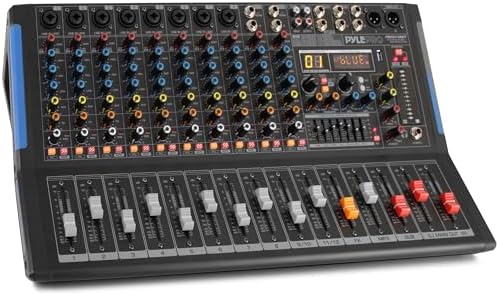
This 12-channel Pyle mixer combines a console-style layout with Bluetooth streaming and a USB sound card for connecting to a Mac or PC. That computer connection may be useful for recording a show or adding a software-based audio workflow, while the mixer’s physical controls allow adjustments at the desk.
The listed connections include XLR/combo and line inputs, stereo outputs, a headphone jack, and send/return connections. LED indicators and a multi-segment stereo level meter help you monitor output and spot clipping. The mixer also offers channel balance and high- and low-frequency adjustments.
Bluetooth can provide a convenient playback source, but it is not a substitute for a dedicated, wired studio playback path when timing and dependable operation matter. The supplied information does not describe broadcast-specific controls or multichannel USB recording, so check the computer functions and routing details if those are essential to your station.
Pros:
- USB sound card supports connection to a Mac or PC
- Bluetooth streaming offers an additional playback option
- LED level metering makes output easier to monitor
- Multiple input and connection types for varied sources
Cons:
- Bluetooth may not be the right choice for critical on-air playback
- Dedicated broadcast features are not listed
Verdict: This Pyle is worth considering for a small studio that wants hands-on mixing and a simple computer connection, provided its routing fits your broadcast chain.
Pyle 10-Channel Mixer: A Compact Choice for Mics and Playback

This 10-channel mixer offers a combination of XLR, 1/4-inch, and RCA connections for microphones, instruments, and other audio devices. Each channel has gain, EQ, effects, and level controls, giving an operator access to basic adjustments without relying entirely on computer software.
Bluetooth 5.0 provides wireless streaming, while the USB port supports playback from a flash drive and connection to a computer for recording. An LED display and level indicators provide visual information during operation. The mixer also includes 48V phantom power and low-cut and HI-Z switches, according to the product details.
Those features could suit a compact studio that records interviews or mixes a few microphones with prerecorded audio. However, a 10-channel layout may leave less room for expansion than the 12- and 14-channel options. As with the other general-purpose models here, the supplied specifications do not identify dedicated phone-call or on-air routing features.
Pros:
- Multiple input types for microphones and playback equipment
- USB playback and computer-recording support
- Bluetooth 5.0 and onboard DSP effects
- 48V phantom power and low-cut/HI-Z switches
Cons:
- Fewer channels than the 12- and 14-channel choices
- Broadcast-specific routing is not listed
Verdict: Pick this Pyle if you want a smaller mixer with USB and Bluetooth functions, and your studio does not need the extra inputs of a larger console.
Mackie Mix12FX: A Straightforward Analog Mixer for Small Studios

The Mackie Mix12FX is a compact analog mixer with 12 total channels, including four mic/line inputs and four stereo 1/4-inch line inputs. Its layout may suit a small studio that wants direct, physical control of microphones and other audio sources without relying on a menu-driven interface.
Each mic/line input has a three-band EQ, low-cut filter, pan, level control, and overload indication. The mixer also includes phantom power for compatible condenser microphones, 12 built-in effects, and dedicated stereo RCA inputs and outputs for playback or recording.
Its simpler design can be an advantage if you want basic mixing controls rather than Bluetooth, USB playback, or a large effects library. On the other hand, the product details do not list a USB computer interface or broadcast-specific phone and talkback functions. Confirm that the RCA connection and available outputs work with the rest of your studio gear.
Pros:
- Four mic/line inputs and four stereo line inputs
- Three-band EQ and low-cut filtering on mic/line channels
- Phantom power for compatible condenser microphones
- Dedicated stereo RCA inputs and outputs
Cons:
- USB computer recording and Bluetooth are not listed
- Fewer mic/line inputs than some larger-featured alternatives
Verdict: The Mix12FX is a sensible choice for a small radio room that values direct analog controls and does not need built-in computer connectivity or advanced broadcast routing.
MIZISNR 12-Channel Mixer: Broad EQ and DSP Control

The MIZISNR is a 12-channel mixer with XLR and stereo line inputs. Its channel controls include gain, EQ, auxiliary send, pan, and mute, giving an operator several ways to balance microphones and connected sources. The main output also has a seven-band EQ for shaping the overall mix.
For sound processing, the mixer offers 99 DSP effects, plus 48V phantom power and a PAD switch for handling higher-level input signals. Bluetooth supports wireless audio input, and the USB connection is described as supporting computer recording and playback. Its built-in player and recorder support MP3, WAV, and WMA files, according to the supplied product details.
That combination makes it one of the more feature-heavy options for a station that also produces varied content or wants onboard processing. The number of effects and controls may take time to learn, and wireless playback may not be ideal for a critical on-air source. Confirm the exact USB recording workflow and output routing before making it the center of a broadcast system.
Pros:
- 12 channels with channel-level gain, EQ, AUX, pan, and mute controls
- 99 DSP effects and a seven-band main-output EQ
- USB playback and recording, plus a built-in MP3 player and recorder
- 48V phantom power and PAD switch
Cons:
- Many effects and controls may be unnecessary for a basic talk studio
- Dedicated broadcast functions are not listed
Verdict: Consider the MIZISNR if you want detailed EQ and onboard processing, but make sure its USB and routing features meet your station’s exact needs.
How to Choose a Broadcast Audio Mixer for Your Radio Station
Count the sources you need to connect
List every source that may need to be live at once: host microphones, guest microphones, computer playback, external players, and any other devices. Then leave room for future additions. Pay attention to the type of input as well as the channel count; a stereo source can use inputs differently from a single microphone, and product descriptions may count channels in different ways.
Check the connections in your signal chain
Match the mixer’s inputs and outputs to your microphones, headphones, computer, and broadcast equipment. Look closely at XLR, 1/4-inch, RCA, USB, and send/return connections. A mixer can have plenty of channels and still be a poor fit if it cannot connect cleanly to the devices your station already uses.
Decide whether you need a dedicated broadcast console
The products in this guide are general-purpose mixers. The supplied details do not list dedicated phone hybrids, talkback controls, or on-air routing for these models. If your station relies on call-ins, separate studio and program feeds, or fast switching between on-air sources, confirm those capabilities before buying—or consider a purpose-built broadcast console.
Choose the right kind of computer integration
Some mixers list a USB sound card or computer recording support, while others focus on analog inputs and outputs. Check what the USB connection actually does: playback, recording, or both. Do not assume that a USB port supports multichannel recording or every computer workflow unless the product specifications say so.
Prioritize clear, easy-to-use controls
For live speech, quick access to gain, level, mute, and EQ can matter more than a long menu of effects. Consider whether operators can see levels and adjust the controls comfortably during a show. A large number of DSP effects can be useful for varied production, but it is not essential for a straightforward talk format.
Check microphone power and signal adjustment
If you use condenser microphones, look for 48V phantom power. Also consider whether the mixer offers input controls such as a PAD switch or low-cut filter, which can help adapt signals and shape sound. Check the product details and your microphone documentation to confirm compatibility before connecting equipment.
Plan for reliable playback
Bluetooth can be handy for casual playback, but it introduces a wireless connection into the audio path. For an important on-air cue or scheduled segment, consider how you will connect and control the source reliably. USB playback, RCA inputs, or a wired computer connection may be better suited to some station workflows.
Frequently Asked Questions
Are these mixers dedicated broadcast consoles?
No. The listed products are general-purpose audio mixers. Their supplied details do not specify dedicated broadcast functions such as phone-hybrid integration, talkback, or on-air routing. Check your station’s workflow and equipment requirements before choosing one.
How many channels does a small radio station need?
It depends on how many microphones and playback sources you use at the same time. Count the sources you need to mix during a typical show, then leave spare capacity for guests or future equipment. Also check the number and type of inputs, not just the headline channel count.
Can I connect a condenser microphone to these mixers?
The product details list 48V phantom power for the Yamnweo MD-14, Pyle 10-channel mixer, Mackie Mix12FX, and MIZISNR mixer. The Pyle 12-channel listing describes use with condenser microphones but does not specify phantom power in the supplied details. Confirm the exact model specifications and your microphone’s requirements before connecting it.
Does Bluetooth make a mixer suitable for on-air playback?
Bluetooth provides a convenient way to bring audio into a mixer, but it may not be the best choice for a critical live cue or scheduled broadcast source. Consider using a wired connection when dependable playback and timing are important.
Will USB let me record every channel separately?
Not necessarily. The product descriptions mention USB playback, computer connections, or recording for some models, but they do not confirm multichannel recording for every mixer. Check the manufacturer’s specifications for the number of channels sent over USB and the recording software requirements.
Which mixer is best if I want simple analog controls?
The Mackie Mix12FX is the most clearly described analog-focused option here, with physical channel controls, stereo RCA connections, and built-in effects. It may suit a small studio that does not need listed Bluetooth or USB computer features.
Final Recommendation
For a general-purpose studio mixer with the highest listed channel count and extensive effects, consider the Yamnweo MD-14. The MIZISNR stands out for its main-output EQ and USB playback and recording features, while the Mackie Mix12FX offers a more straightforward analog layout. Before choosing any of them, verify that its inputs, outputs, and routing support your station’s specific on-air workflow; none of the supplied descriptions identifies dedicated broadcast-console functions.