
Choosing a powered mixer for church sound means balancing input count, speaker power, and easy control during services. The options below range from a compact four-channel model to mixers with many mic preamps, built-in effects, and USB or Bluetooth features. Check the specifications against your microphones and speakers before buying, especially the amplifier output and the speakers’ impedance.
Quick Comparison
| Powered mixer | Channels and mic preamps | Notable features | Best fit |
|---|---|---|---|
| Peavey PVi 6500 | Channel count not stated in the supplied details | Feedback Locating System, master mute, effects defeat | Shoppers considering a simple all-in-one mixer with feedback tools |
| Rockville RPM1870 | 18 channels; 16 XDR2 mic preamps | USB, Bluetooth, effects, dual 7-band EQ | Churches needing many inputs and extensive onboard controls |
| Rockville RPM1470 | 14 channels; 14 XDR2 mic preamps | USB and SD recording, Bluetooth, effects, dual 7-band EQ | Mid-size setups needing multiple mic inputs and playback options |
| Rockville RPM45 | 4 channels | USB, effects, +15V phantom power | Small, straightforward setups with a limited number of sources |
Our Picks: Best Powered Mixers For Church Sound Systems reviews
Peavey PVi 6500: An All-in-One Option With Feedback Controls

The Peavey PVi 6500 is an all-in-one powered mixer whose listed features focus on basic live-sound control. It includes a Feedback Locating System, master mute, and a way to defeat effects with a foot switch. The supplied description also identifies combination XLR and 1/4-inch input jacks for channels 1–5.
Those controls may be useful in a church where a volunteer needs to mute several channels at once or quickly manage effects. A feedback-locating feature can help with troubleshooting, but it should not replace careful microphone placement and speaker positioning. The available product details do not specify its total channel count, amplifier output, or speaker impedance, so confirm those details before planning a system around it.
The listing supplied for this guide is marked unavailable. That makes the PVi 6500 a less practical choice if you need to buy and install a mixer now. Compared with the Rockville models here, it also has fewer stated connectivity and power details in the supplied information.
Pros:
- Feedback Locating System is included.
- Master mute and foot-switchable effects defeat are listed.
- Combination XLR and 1/4-inch inputs are specified for channels 1–5.
Cons:
- The supplied listing is marked unavailable.
- Key details such as total channels and amplifier output are not provided here.
Verdict: Consider the Peavey only if you can verify availability and confirm that its full specifications suit your speakers and input needs.
Rockville RPM1870: A High-Input Mixer for Larger Setups

The RPM1870 is the most input-heavy option in this group. It has 18 channels and 16 XDR2 mic preamps, with 48V phantom power listed for microphones that require it. That combination gives a church room to connect a range of vocal and instrument sources, though you should map your actual inputs before deciding whether you need all 18 channels.
For sound shaping, the mixer includes 16 presets in a 24-bit effects processor, plus dual 7-band graphic EQs for the main and monitor outputs. It also lists an aux send and return on every channel. These controls can help manage effects and tune the main and monitor mixes, but they add complexity for a volunteer team that only needs basic level and mute control.
USB supports MP3, WAV, and WMA playback and recording, while Bluetooth provides wireless streaming. The listed amplifier figures are 750 watts RMS per side at 4 ohms and 3,000 watts per side peak at 4 ohms. For a church installation, pay more attention to the RMS and impedance specifications than the peak figure, and verify that your speakers are compatible. This is the most feature-rich and high-capacity option here, but may be more mixer than a small service needs.
Pros:
- 18 channels and 16 mic preamps provide room for many sources.
- 48V phantom power is listed for compatible microphones.
- USB playback and recording, plus Bluetooth streaming.
- Separate main and monitor EQs and built-in effects.
Cons:
- The large feature set may take more time to learn and manage.
- Confirm speaker impedance and power needs rather than relying on peak wattage alone.
Verdict: Choose the RPM1870 if your church needs many inputs and wants onboard playback, effects, and detailed EQ control.
Rockville RPM1470: A Mid-Size Mixer With USB and SD Recording

The RPM1470 offers 14 channels and 14 XDR2 mic preamps, giving it fewer total channels than the RPM1870 while still providing a substantial number of mic inputs. It also lists +48V phantom power, so check the requirements of your microphones and use the mixer’s documentation when connecting them.
Its 24-bit effects processor includes 16 presets, and dual 7-band graphic EQs are provided for the main and monitor outputs. The mixer supports USB playback of MP3, WAV, and WMA files, Bluetooth streaming, and recording to USB or an SD card according to the supplied description. Those options can be handy for playing service music or capturing a mix without adding as many separate devices.
The listed amplifier output is 750 watts RMS per side at 4 ohms, with a 6,000-watt peak figure. As with the RPM1870, match the RMS output and impedance to your speakers; the peak rating is not a substitute for checking system compatibility. This model may be a better fit than the RPM1870 if you want many mic inputs but do not need its additional four channels.
Pros:
- 14 mic preamps and 14 channels suit multi-microphone setups.
- USB playback, USB or SD recording, and Bluetooth are listed.
- Built-in effects and separate main and monitor EQ controls.
- Offers many of the RPM1870’s core features in a 14-channel format.
Cons:
- May still be more complicated than needed for a small, simple setup.
- Confirm speaker compatibility using the RMS and impedance specifications.
Verdict: The RPM1470 is a strong middle-ground choice if you need numerous mic inputs and useful playback or recording features without stepping up to 18 channels.
Rockville RPM45: A Compact Choice for Four-Channel Systems
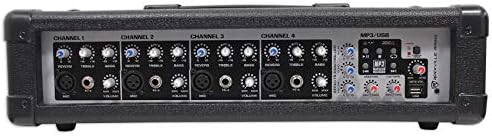
The RPM45 is a four-channel powered mixer for a smaller, simpler system. Its listed features include USB, effects, a 1/4-inch effects loop, dual 1/4-inch speaker outputs, and a fan cooling system. With only four channels, it is best suited to a setup where the number of microphones and other sources is limited.
The supplied specifications list +15V phantom power. That is different from the +48V phantom power listed for the two larger Rockville models, so check the needs of your microphones before buying. The product details give amplifier figures of 225 watts per side at 8 ohms in parallel mono and 450 watts per side of program power in the same configuration. Match the appropriate output specification and speaker impedance to your system.
This model has fewer channels and less extensive EQ detail in the supplied information than the RPM1470 and RPM1870. That can make it easier to narrow down for a small room or basic setup, but it is not the most flexible choice if you expect to add several microphones, instruments, or separate monitor requirements.
Pros:
- Four-channel layout is suited to a limited number of sound sources.
- USB, effects, and a 1/4-inch effects loop are listed.
- Dual 1/4-inch speaker outputs and fan cooling are specified.
Cons:
- Four channels may be too limiting for a growing worship team.
- Its listed +15V phantom power may not suit microphones that require +48V.
Verdict: Pick the RPM45 for a small setup with modest input needs, but verify microphone power requirements and speaker matching before you connect the system.
How to Choose a Powered Mixer for a Church Sound System
Count your inputs before comparing mixers
List every source you expect to connect, including microphones, instruments, playback devices, and any other audio feeds. Leave room for occasional needs such as a guest speaker or an extra instrument. The RPM45 has four channels, while the RPM1470 and RPM1870 list 14 and 18 channels. The Peavey details supplied here do not state its total channel count, so check the full specifications before comparing it on capacity.
Check the microphone preamps and phantom power
Mic preamps handle microphone-level signals, and phantom power is needed by some microphones. The Rockville RPM1870 lists 16 XDR2 mic preamps and +48V phantom power; the RPM1470 lists 14 XDR2 preamps and +48V. The RPM45 lists +15V phantom power. Confirm the requirements of each microphone you plan to use, rather than assuming all phantom-power outputs are interchangeable.
Match amplifier output to your speakers
A powered mixer includes an amplifier, but its output must suit the speakers connected to it. Check both the speakers’ impedance and their power requirements against the mixer’s specifications. Use RMS output figures as a practical reference where they are provided, and do not treat a peak or program rating as the same measurement. If your speakers are powered, confirm whether they need a line-level signal rather than a speaker-level amplifier output.
Decide how much control your volunteers need
Effects and graphic EQ can help shape vocals and manage the main and monitor sound, but extra controls also create more settings to learn. The RPM1870 and RPM1470 list dual 7-band EQs for main and monitor outputs and 16 effects presets. The Peavey lists feedback and mute-related features. Think about who will run the mixer during services and whether those features match their comfort level.
Consider playback and recording needs
Built-in playback can reduce the number of separate devices needed for music or other audio. The RPM1870 and RPM1470 list USB playback and Bluetooth; the RPM1470 also lists USB or SD recording. The RPM45 includes USB, while the supplied information does not describe its playback formats or recording functions. Choose based on the audio sources and recording workflow your church actually uses.
Plan for the room and future changes
The number of inputs is only one part of a church sound setup. Consider how many speaker outputs and monitor mixes you need, how the mixer will be positioned, and whether your system may grow. Confirm all output connections in the full product specifications before purchasing. A mixer with extra capacity can offer room to expand, but it may also add controls your team does not need.
Frequently Asked Questions
What is a powered mixer?
A powered mixer combines an audio mixer with a power amplifier. It can connect sources such as microphones and instruments, adjust their levels, and amplify the combined signal for compatible passive speakers. Check the specific unit’s outputs and your speakers’ requirements before connecting them.
Which mixer in this list has the most channels?
The Rockville RPM1870 lists 18 channels. The RPM1470 lists 14, and the RPM45 lists four. The supplied Peavey PVi 6500 details do not state its total channel count.
Do these mixers work with powered speakers?
Possibly, but check the output connections and signal level first. Powered speakers generally need a line-level input, while a powered mixer can also provide amplified speaker outputs. Connecting an amplified output to an input that is not designed for it can cause problems.
Which models list +48V phantom power?
The supplied details list +48V phantom power for the Rockville RPM1870 and RPM1470. The RPM45 lists +15V phantom power. Verify the power requirement of your microphones before choosing a mixer.
Is more amplifier wattage always better for a church?
No. The mixer’s output must match your speakers, the room, and the way the system will be used. Compare RMS output and speaker impedance where available, and do not choose based on a peak wattage figure alone.
Which option is best for a small church?
The RPM45 may suit a small setup if four channels are enough and its phantom-power specification matches your microphones. If you need more microphones or room to expand, consider the RPM1470 instead.
Final Recommendation
For a church that needs many mic inputs and built-in control options, the Rockville RPM1470 is a balanced choice among the supplied products. The RPM1870 makes more sense when you need its additional channels, while the RPM45 is a simpler fit for a limited-input setup. Before ordering any model, confirm its full output specifications, speaker compatibility, and microphone power requirements. The Peavey PVi 6500 has useful listed feedback and mute features, but its supplied listing is marked unavailable and key specifications are not provided here.