The best whole-house cartridge for well water depends on what is coming through your plumbing. If your main issue is sand, rust, or silt, a sediment cartridge can help protect fixtures and equipment—but it will not make water safe from bacteria, dissolved minerals, or other contaminants it is not designed to reduce. Start with a well-water test, then match the cartridge’s size, micron rating, and media to the problem you need to address.
These five options are sediment filters in common housing sizes. The Membrane Solutions, GE, Aquaboon, and Culligan cartridges are 10 by 2.5 inches; the PUREPLUS cartridge is the larger 10 by 4.5-inch format. Check your housing before ordering, since those sizes are not interchangeable.
Quick Comparison
| Product | Size | Filtration | Best for |
|---|---|---|---|
| Membrane Solutions 5 Micron String-Wound Cartridge | 10 × 2.5 in | 5-micron sediment | High sediment loads in a standard housing |
| GE FXWPC Whole House Filter | 10 in; drop-in style | Sediment, sand, and rust | Broad compatibility and a familiar replacement option |
| Aquaboon 5 Micron Sediment Filter | 10 × 2.5 in | 5-micron sediment | A multi-pack for standard housings |
| PUREPLUS 5 Micron Well-Water Filter | 10 × 4.5 in | 5-micron sediment | Large-format housings and well-water sediment |
| Culligan P5 Whole House Filter | 10 × 2.5 in | Particles larger than 5 microns | Fine sediment and silt in a standard housing |
Our Picks: Best Whole House Water Filter Cartridge For Well Water reviews
Membrane Solutions 5-Micron String-Wound Cartridge: For Sediment-Heavy Water

This 5-micron cartridge uses food-grade polypropylene wound into a graded, honeycomb-like structure. The outer layers are more open, while the inner layers are denser. That depth-filtration design is intended to trap larger particles first and finer sediment closer to the core.
It is a practical first-stage filter for a compatible 10 by 2.5-inch housing when your well water carries sand, silt, rust, or similar undissolved particles. The manufacturer says its string-wound design has higher dirt-holding capacity and flow than a standard polypropylene sediment filter, and lists a capacity of up to 15,000–20,000 gallons. Actual life depends on the water, so treat that figure as an estimate rather than a fixed replacement schedule. The product is tested and certified to NSF/ANSI 42 for material requirements only—not as proof that it removes every listed contaminant.
The six-pack is useful if your well’s sediment load means you change cartridges often. Some users report that the filters perform well where incoming water carries a lot of visible sediment. The trade-off is that a 5-micron filter may clog more quickly when the source water is especially dirty; check the cartridge and watch for a drop in flow instead of relying only on the advertised capacity.
Pros:
- 5-micron rating targets common well-water sediment.
- String-wound depth design is intended for higher dirt-holding capacity.
- Standard 10 by 2.5-inch size fits many housings.
- Six cartridges provide replacements on hand.
Cons:
- Material certification does not establish removal of bacteria or dissolved contaminants.
- Actual service life can vary widely with incoming water quality.
Verdict: Choose this pack if your standard-size system needs a 5-micron sediment cartridge and you value a wound design for a well with a noticeable particle load.
GE FXWPC Whole House Filter: A Familiar Drop-In Replacement

The GE FXWPC is a drop-in-style whole-house cartridge designed to reduce sediment, sand, and rust. It is listed as fitting many 10-inch whole-house filter systems from brands including GE, Culligan, Dupont, Brita, and Whirlpool. Confirm your housing’s required cartridge dimensions and style before buying; a brand name alone does not guarantee a fit.
GE recommends replacing this two-pack’s cartridges every three months or 30,000 gallons for best filtration results. Those are maximum guideline figures, not a promise that every well will get that much use from a cartridge. In everyday use, the right interval depends on sediment levels and household water demand. Some users find it a reasonably priced, consistent option for reducing visible sediment in well-pump water.
Compared with the dedicated 5-micron options in this list, the supplied product details do not specify a micron rating for the FXWPC. That makes it harder to compare its particle capture directly with the other cartridges. It may suit households looking for a recognizable replacement cartridge, but it is not the clearest choice if you need a particular micron threshold.
Pros:
- Designed to reduce sediment, sand, and rust.
- Listed as compatible with many 10-inch drop-in systems.
- Two cartridges per pack.
- Replacement guidance includes both time and gallon limits.
Cons:
- The supplied product details do not state a micron rating.
- Compatibility still needs to be checked against your exact housing.
Verdict: Consider the GE FXWPC if you want a broad-fit drop-in replacement and your priority is general sediment reduction rather than a stated 5-micron rating.
Aquaboon 5-Micron Sediment Filter: A Straightforward Standard-Size Pack
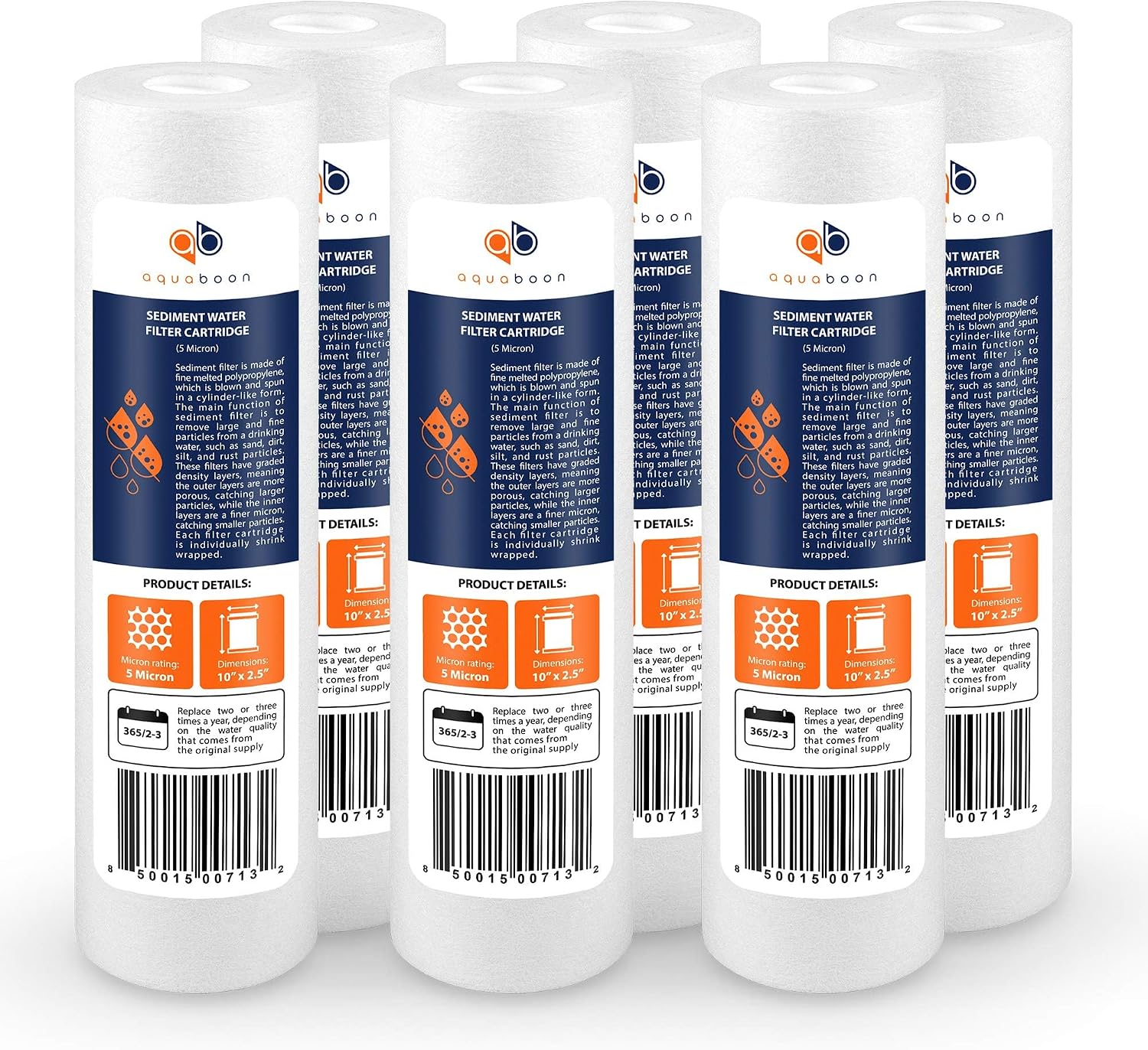
Aquaboon’s cartridge is a 5-micron sediment filter made from food-grade polypropylene. Its multi-layered, melt-blown construction is designed to capture rust, sand, dirt, and sludge in a standard 10 by 2.5-inch housing. The supplied product information lists a six-cartridge pack and identifies compatibility with several common sediment-filter models.
This is a focused option for protecting plumbing and downstream equipment from particles. It does not add carbon filtration or address dissolved substances, and the supplied details do not give a specific capacity or recommended replacement interval. Check the cartridge regularly, especially if your well water is cloudy or carries visible sediment. Some users find it a useful value compared with buying replacements one at a time, though long-term life will depend on source-water conditions.
The Aquaboon and Membrane Solutions cartridges share a 5-micron rating and the same nominal dimensions. Aquaboon emphasizes melt-blown construction, while Membrane Solutions describes a string-wound depth structure and provides a stated capacity range. If knowing a published gallon estimate matters to you, Membrane Solutions offers more specific guidance in the supplied product details.
Pros:
- 5-micron filtration targets common sediment particles.
- Food-grade polypropylene construction.
- Standard size fits many 10 by 2.5-inch housings.
- Six cartridges make it convenient to keep replacements available.
Cons:
- No specific gallon capacity or change-out schedule is provided in the supplied details.
- It is a sediment filter, not a complete well-water treatment system.
Verdict: Pick Aquaboon if you need a multi-pack of standard 5-micron cartridges and can monitor replacement timing based on your own water conditions.
PUREPLUS 5-Micron Filter: A Larger Cartridge for Heavy-Duty Housings

This PUREPLUS cartridge is built for a 10 by 4.5-inch heavy-duty housing, a larger format than the 10 by 2.5-inch cartridges elsewhere in this roundup. Its string-wound polypropylene design has a denser inner structure and a more open outer layer, intended to collect sediment through the depth of the cartridge. The company describes it as suitable for well water and lists sand, rust, color, and sediment among the particles it reduces.
The product information gives a capacity of up to 30,000 gallons and recommends replacement every three to six months, depending on use and water quality. It also lists compatibility with several 10 by 4.5-inch housings, including certain Culligan, GE, Aqua-Pure, Pentek, and Whirlpool models. Verify both the housing size and model compatibility before ordering. The product is sold as a two-pack, which leaves you with a spare for the next change.
Some users report a good fit and effective sediment control without an obvious pressure reduction during the cartridge’s useful life. That experience can vary: a filter loaded with sediment may restrict flow, and no cartridge can avoid that indefinitely. This model may be a better match than the smaller options if your existing housing takes the 4.5-inch diameter format, but it will not fit a standard 10 by 2.5-inch housing.
Pros:
- 5-micron sediment filtration in a larger 10 by 4.5-inch format.
- Designed for well-water sediment such as sand and rust.
- Published capacity of up to 30,000 gallons, depending on water quality.
- Two-pack includes a replacement cartridge.
Cons:
- Does not fit standard 10 by 2.5-inch housings.
- Actual capacity and flow depend on sediment load and household use.
Verdict: Choose PUREPLUS if your system uses a 10 by 4.5-inch cartridge and you want a 5-micron sediment filter intended for well-water use.
Culligan P5 5-Micron Filter: For Fine Sediment in a Standard Housing

The Culligan P5 is a spun-polypropylene cartridge rated to reduce particles larger than 5 microns. Its depth-filtration construction is intended to trap sediment through the filter media, including silt, dirt, rust, scale, and fine sand. It fits Culligan HF-360A/B, WH-S200-C, and HF-150A housings, as well as many standard 10 by 2.5-inch housings on 3/4-inch lines.
Culligan lists a service life of up to 8,000 gallons and recommends replacing the cartridge every two months. That shorter interval is worth factoring into ongoing maintenance, especially if your well water contains a lot of sediment. The four-pack can reduce the need to order replacements as often, but keep an eye on water flow and cartridge condition rather than treating the stated limit as a guarantee.
The P5 is a strong fit if your main concern is extra-fine sediment in a compatible standard housing. Its stated particle threshold makes it easier to compare with the other 5-micron options, while the shorter replacement guidance is more conservative than the longer capacity estimates listed for some alternatives. Its IAPMO R&T certification is for material requirements under NSF/ANSI 42, not a claim that the cartridge removes microbes or dissolved contaminants.
Pros:
- Designed to reduce particles larger than 5 microns.
- Depth-filter construction targets fine sediment and silt.
- Fits specified Culligan models and many standard-size housings.
- Four-pack provides several replacement cartridges.
Cons:
- Listed change-out guidance is every two months or up to 8,000 gallons.
- Compatibility depends on both housing dimensions and connection setup.
Verdict: The Culligan P5 is a sensible choice when you want a clearly stated 5-micron threshold and are prepared for more frequent cartridge changes.
How to Choose a Whole-House Filter Cartridge for Well Water
Test Your Well Water First
A sediment cartridge only addresses the particles it is designed to capture. It does not automatically remove bacteria, viruses, dissolved metals, nitrates, hardness minerals, or other substances. Have your well water tested by a qualified lab so you know what needs treatment. Use the test results to choose the right filtration stages rather than expecting one cartridge to solve every water-quality issue.
Match the Cartridge to Your Housing
Check the dimensions printed on your existing cartridge or housing manual. A 10 by 2.5-inch cartridge is not interchangeable with a 10 by 4.5-inch cartridge. Also verify the filter style, model compatibility, and any connection requirements. A cartridge can have the right filtration rating and still be the wrong fit for your system.
Choose a Micron Rating That Fits the Problem
A lower micron rating generally targets smaller particles, but a finer cartridge may clog sooner when the source water has a heavy sediment load. The five options here are mostly 5-micron filters, while the GE listing does not provide a micron rating in the supplied details. Consider how much sediment your well carries and whether a coarse prefilter is needed to protect a finer cartridge downstream.
Consider Filter Media and Dirt-Holding Capacity
String-wound and spun or melt-blown polypropylene cartridges use different structures to trap particles. Product descriptions may include capacity estimates, but those figures depend on incoming water quality and household use. A cartridge exposed to a muddy or sediment-heavy well may need replacement well before its advertised maximum gallon figure.
Plan for Replacement and Flow Changes
Follow the manufacturer’s replacement guidance, but also watch for a drop in water pressure or visible loading. A cartridge that is overdue can restrict flow and may not protect downstream equipment as intended. If sediment levels change through the year, check the cartridge more often and keep compatible replacements on hand.
Know What Certification Does—and Does Not—Mean
Read certification claims closely. Some of these products describe certification for material requirements under NSF/ANSI 42; that is not the same as proving removal of all contaminants. Confirm that any claimed reduction matches your test results and the specific treatment you need. For health-related concerns, use a treatment system certified for the relevant contaminant and consult a water-treatment professional.
Frequently Asked Questions
Is a 5-micron cartridge enough for well water?
It can help reduce sediment particles around the stated size, such as rust, sand, and silt, depending on the filter and water conditions. It is not a complete well-water treatment system and does not by itself address bacteria or dissolved contaminants. Test your water to identify any additional treatment needs.
Will a whole-house sediment cartridge make well water safe to drink?
Not necessarily. Sediment filtration can improve particle removal, but safety depends on the contaminants present in your well. Use a lab test to check for microbial and chemical concerns, then select treatment designed and certified for the specific contaminants found.
How often should I change a well-water filter cartridge?
Follow the cartridge maker’s guidance and monitor your water flow and cartridge condition. The products in this list have different recommendations, ranging from every two months to every six months, and water quality can change how long a cartridge lasts. Heavy sediment can shorten its useful life.
Can I use a 10 by 2.5-inch cartridge in a 10 by 4.5-inch housing?
No. These are different cartridge formats. Check your current cartridge and housing specifications before ordering; the PUREPLUS option here is 10 by 4.5 inches, while the Membrane Solutions, GE, Aquaboon, and Culligan options are intended for smaller standard formats.
Does a finer micron rating always mean a better filter?
No. Finer filtration can target smaller particles, but a cartridge may clog faster in water with a heavy sediment load. Choose a rating based on your water test, the treatment system, and the balance between particle capture and maintenance needs.
Do these cartridges remove hard-water minerals?
They are presented as sediment filters, not water softeners. They are not designed to remove dissolved hardness minerals. If hardness is a concern, test your water and consider a treatment system made for that issue.
Final Recommendation
For most standard 10 by 2.5-inch housings, the Membrane Solutions cartridge is a well-rounded pick when your main concern is sediment and you want a string-wound design with a stated capacity range. Choose the Culligan P5 if a clearly stated 5-micron threshold and fine-sediment focus matter more than longer replacement intervals. If your housing is the larger 10 by 4.5-inch format, the PUREPLUS cartridge is the matching option in this group. Whichever cartridge you choose, confirm the fit and base your whole-house treatment plan on a current well-water test.
