
A tube headphone amplifier can add a tube-based sound character to your listening setup, and many models also work as preamps for speakers or a home amplifier. The right choice depends on your headphones, the connections you need, and whether you want tube-swapping options or a compact, simple setup. These five picks cover a range of headphone impedances, outputs, and features; check each listing for current availability and compatibility before buying.
Quick Comparison
| Amplifier | Headphone range | Notable features | Best fit |
|---|---|---|---|
| Nobsound P32 | 24–600Ω | 1000mW output; swappable tubes and op-amps | Flexible desktop and speaker setups |
| FX-Audio Tube-02 Pro | Not specified | 5725 tubes; 850mW output; preamp connections | Listeners who want tube-rolling options |
| Douk Audio Tube Headphone Amp | 16–600Ω | 2000mW output; XLR, 4.4mm, and 6.35mm jacks | Headphone setups with varied plug types |
| Douk Audio H2 | 16–600Ω | Balanced XLR input; adjustable gain and L/R balance | Listeners with an XLR source or DAC |
| Fosi Audio GR70 | 16–300Ω | Four tubes; low- and high-impedance modes | A compact amp for common headphone types |
Our Picks: Best Tube Headphone Amplifiers For Audiophiles reviews
1. Nobsound P32: A Versatile Tube Amp and Desktop Preamp
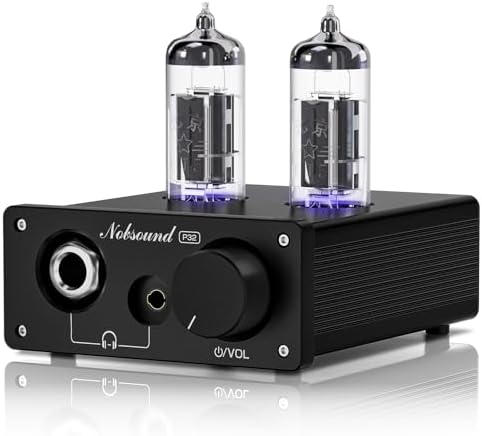
The Nobsound P32 is designed to do more than drive headphones. Its listed 1000mW output and stated 24–600Ω range make it a potential match for a broad selection of wired headphones, while its preamp function lets you connect it to powered speakers or a home amplifier.
For inputs, it accepts RCA and 3.5mm connections, with both 3.5mm and 6.35mm headphone outputs. That mix makes it easier to connect common desktop sources and different headphone plugs without relying on a separate adapter for every connection.
The P32 also allows users to swap its tubes and dual op-amp chips. That flexibility may appeal if you enjoy adjusting your setup, but it adds another layer of choice rather than guaranteeing a better sound. Its listed features are broad; shoppers who want a simpler, fixed configuration may not need that customization.
Pros:
- Rated output of 1000mW, with a stated 24–600Ω headphone range
- Functions as a headphone amp and stereo preamp
- RCA and 3.5mm inputs, plus 3.5mm and 6.35mm headphone outputs
- Swappable tubes and op-amps for system customization
Cons:
- Its many connection and component options may be more than a basic desktop setup needs
- Check the listing for current availability before planning a purchase
Verdict: Choose the Nobsound P32 if you want one unit for headphones and speakers, along with room to experiment with replaceable components.
2. FX-Audio Tube-02 Pro: A Tube-Rolling-Friendly Preamp

The Tube-02 Pro combines 5725 vacuum tubes with a transistor Class A buffer. The supplied details list up to 850mW of output power and describe it as a headphone amplifier and preamp for amplifiers, active speakers, and other audio gear. Two line-output sets may also be useful if you want to connect more than one downstream component.
It has a high-gain mode that raises gain by 2.5dB. The included 5725 tubes can be replaced with 6J1 or 6J2 tubes, according to the product information. That gives tube enthusiasts a defined set of compatible options, though you should confirm tube compatibility before purchasing replacements.
One practical limitation is that the supplied description does not state a headphone impedance range. If you have demanding or unusual headphones, check that the amp is suitable for their impedance and sensitivity rather than relying only on its output-power figure. Its feature set may be most appealing to listeners who want a small tube preamp as part of a larger system.
Pros:
- Up to 850mW output, according to the product information
- Works as a headphone amplifier and preamp
- Two sets of line outputs for connecting audio components
- Supports specified 6J1 and 6J2 tube replacements
Cons:
- The listed information does not specify a headphone impedance range
- Tube replacement options require checking compatibility before buying
Verdict: The Tube-02 Pro is a good fit to consider if preamp duties and compatible tube-swapping options matter more to you than a clearly stated headphone impedance range.
3. Douk Audio Tube Headphone Amp: High Output and Three Headphone Jacks

This Douk Audio model stands out for its choice of headphone connections: XLR, 4.4mm, and 6.35mm, with a 6.35mm-to-3.5mm adapter also listed. It is rated for 16–600Ω headphones and uses dual TPA6120 chips, with the product information specifying up to 2000mW of output.
The amp uses German Valvo ECF801 tubes and includes a walnut-panel design with vintage-style VU meters. These details give it a distinctive look, while the op-amp can be swapped for listed compatible options such as Muses02, 2604, or 2134. The product description also says it can function as a headphone amp and stereo preamp, with RCA sources.
The multiple headphone outputs are useful only if they match your headphones and intended setup; an XLR headphone jack is not the same as an XLR input. Confirm the connections on your source and headphones before choosing it. Its stated output and impedance range are among the widest in this group, but the extra features may be unnecessary if you use one pair of headphones and a simple source.
Pros:
- Three headphone jack options: XLR, 4.4mm, and 6.35mm
- Stated 16–600Ω range and up to 2000mW output
- Can serve as a headphone amplifier and stereo preamp
- Replaceable op-amp and distinctive walnut-panel, VU-meter design
Cons:
- Its many connection types make it important to check your source and headphone plugs carefully
- Op-amp swaps add optional complexity that not every listener will want
Verdict: Pick this Douk Audio amp if you need several headphone output formats and want a high-output unit that can also serve as a preamp.
4. Douk Audio H2: Balanced XLR Input and Adjustable Controls

The Douk Audio H2 is a desktop headphone amp built around a pluggable 6N3 tube and dual TPA6120 headphone amplifier chips. It supports headphones from 16–600Ω, and the listed controls include adjustable gain and independent left-right balance adjustment.
A key distinction is its real balanced XLR input: this is for connecting a compatible audio source, such as a DAC, rather than describing the headphone output. The product information also lists a 6.35mm headphone output and includes a 6.35mm-to-3.5mm adapter. An LED display shows working status, while the black aluminum-alloy chassis and tube lighting give it a more traditional desktop audio appearance.
The H2 is worth considering if you already have an XLR-output source and want gain and balance controls. If your source only has RCA or 3.5mm output, confirm the input options on the listing before buying. Its control set is more involved than a basic headphone amp, but it can help you tailor operation to different sources and listening needs.
Pros:
- Balanced XLR input for compatible audio sources
- Listed 16–600Ω headphone range and adjustable gain
- Independent left-right balance adjustment
- Includes two 6N3 tubes, a power adapter, and a headphone adapter
Cons:
- The XLR connection is an input, so it may not suit shoppers seeking an XLR headphone output
- Check your source connections before purchasing
Verdict: Choose the H2 if you need a tube headphone amp with a balanced XLR input and useful gain and balance controls.
5. Fosi Audio GR70: Four-Tube Design in a Compact Format

The Fosi Audio GR70 uses four vacuum tubes in a two-stage amplification setup: two tubes boost voltage, while the other two handle power amplification. Its product information lists up to 300mW output and a 16–300Ω headphone range, with selectable low- and high-impedance modes.
It has 6.35mm and 3.5mm headphone jacks on the front, plus RCA input and output connections for linking it with a home audio system. The CNC-machined aluminum-alloy body keeps the design compact, and the listed RCA output is 1.2V. These features make it a practical option if you want both headphone connections and a way to integrate the amp with other RCA-based equipment.
Compared with the higher-output Douk Audio models here, the GR70 has a lower stated maximum output and a narrower impedance range. That does not automatically make it unsuitable: headphone sensitivity and listening needs also matter. Still, owners of headphones above 300Ω should look at another option in this list or confirm compatibility before purchasing.
Pros:
- Four-tube design with separate voltage and power amplification stages
- Low- and high-impedance modes for the stated 16–300Ω range
- 3.5mm and 6.35mm headphone jacks
- RCA input and output for home audio integration
Cons:
- Its stated impedance range stops at 300Ω
- Listed output is lower than the 850mW–2000mW figures of several alternatives here
Verdict: The GR70 is a sensible choice if your headphones fall within its stated range and you want a compact four-tube amp with RCA connections.
How to Choose a Tube Headphone Amplifier
Match the amp to your headphones
Start with your headphones’ impedance, but do not use that number alone to predict volume or performance. The models here list different ranges, from 16–300Ω for the Fosi GR70 to 16–600Ω for two Douk Audio options. Headphone sensitivity and the amp’s output also matter, so check the specifications for both devices and make sure the connections are compatible.
Check the input and headphone connections
Look at the ports on your source and headphones before choosing an amp. RCA and 3.5mm inputs are common in the options here, while the Douk H2 specifically lists a balanced XLR input. Headphone outputs vary too: the Douk model with three jacks includes XLR, 4.4mm, and 6.35mm, while other models offer 3.5mm and 6.35mm connections. Be careful not to confuse an XLR input with an XLR headphone output.
Decide whether you need preamp functions
Several of these models can connect to powered speakers or another amplifier as a preamp. If you want to use headphones and a speaker system with the same unit, check for the correct line inputs and outputs for your setup. If you only need headphone amplification, preamp features may add connections you will not use.
Consider output power alongside impedance
Some listings state output power, including 300mW for the GR70, 850mW for the Tube-02 Pro, 1000mW for the P32, and up to 2000mW for one Douk Audio model. These figures are useful points of comparison, but they do not guarantee a particular listening level with every pair of headphones. Use the headphone maker’s specifications and your listening needs to judge whether an amp is suitable.
Think about tube and op-amp swapping
Replaceable tubes or op-amps can offer room to experiment, but they also require careful compatibility checks. The P32 lists swappable tubes and dual op-amps; the Tube-02 Pro specifies compatible 6J1 and 6J2 tubes; and the Douk model with walnut panels lists several compatible op-amp choices. If you prefer a straightforward setup, prioritize the connections and controls you will use rather than the number of upgrade options.
Choose controls and design for your listening space
Gain modes and left-right balance adjustment can be useful when your system calls for them, as with the Tube-02 Pro and Douk H2. Display features, chassis material, and styling are more personal considerations. Compare the unit’s size and design with your desk or audio rack, and confirm what accessories are included if you need a power adapter or headphone plug adapter.
Frequently Asked Questions
What does a tube headphone amplifier do?
It amplifies an audio signal for wired headphones using a circuit that includes vacuum tubes. Some models in this guide also function as preamps, sending a signal to powered speakers or another amplifier.
Will a tube amp work with every pair of headphones?
No single impedance range guarantees compatibility with every headphone. Check the amplifier’s stated range, output, and connections against your headphones’ impedance and sensitivity. The Tube-02 Pro listing does not specify an impedance range, so confirm compatibility before choosing it.
Is a balanced XLR input the same as an XLR headphone output?
No. An XLR input connects an audio source to the amplifier. An XLR headphone output connects compatible headphones to the amplifier. The Douk H2 lists a balanced XLR input, while the other Douk Audio model lists an XLR headphone jack.
Can I connect these amplifiers to powered speakers?
Several models are described as having preamp functions or RCA outputs for connecting to speakers or other audio equipment. Check the exact input and output connections for your intended setup, and follow the manufacturer’s instructions.
Do swappable tubes mean the amp will sound better?
Not necessarily. Tube swapping gives you a way to experiment, but compatibility and personal preference matter. Use only tube types listed as compatible for the model, and do not assume that a replacement will provide a specific improvement.
Which model has the most headphone connection options?
The Douk Audio model with XLR, 4.4mm, and 6.35mm headphone jacks lists the widest selection of headphone outputs among these picks. It also includes a 6.35mm-to-3.5mm adapter.
Final Recommendation
For a flexible desktop unit that can also serve as a preamp, the Nobsound P32 offers a useful mix of inputs, headphone outputs, and component-swapping options. If your priority is headphone connection choice and a high stated output, consider the Douk Audio model with XLR, 4.4mm, and 6.35mm jacks. For simpler needs, the Fosi GR70 combines a compact format with RCA integration, provided your headphones fit its stated 16–300Ω range. Before choosing any of them, verify the listing status, your source connections, and your headphones’ requirements.