
If your tap water leaves white crust on faucets, cloudy spots on glass, or a stiff, dry feel on your skin after showering, you are probably dealing with hard water. Hard water carries dissolved calcium and magnesium, and over time those minerals build up in pipes, water heaters, and appliances. A whole-house water softener is the most direct way to address the problem at its source, because it treats every tap in the home rather than just one sink. This guide covers five whole-house systems, explains how each one fits different households, and walks through what to weigh before you buy.
Quick Comparison Table
| Product | Best For | Rated Capacity | Standout Feature | Stock Note |
|---|---|---|---|---|
| Aquasure Harmony Series 48,000 Grains Whole House Water Softener | Larger homes with 3 to 4 bathrooms | 48,000 grains | Digital metered control head with programmable auto-flush | Listed as available |
| Aquasana SimplySoft 40K Grain Whole House Water Softener | Homes with up to 5 people and 4 bathrooms | 40,000 grains | NSF/ANSI 44 certification and metered operation | Listing has shown as unavailable |
| Whole House Water Filter System, Heavy Metal & Anti-Scale Filtration | Budget-minded buyers who want filtration plus softening | Cartridge-based (not rated in grains) | Three-stage cartridge system with three full sets of filters included | Listed as available |
| Aquasure Whole House Water Filtration Bundle w/Water Softener, 75 GPD RO System | Households wanting softened water plus drinking-water filtration | 48,000 grains | Softener paired with a 4-stage reverse osmosis system | Listed as available |
| Kenmore 420 Water Softener System, 40,000 Grain Capacity | Homes on well water with iron concerns | 40,000 grains | IntelliSoft technology that regenerates based on usage patterns | Listing has shown as unavailable |
Our Picks: Best Water Softener System For Hard Water reviews
Aquasure Harmony Series: Strong Pick for Larger Homes With Multiple Bathrooms

The Aquasure Harmony Series is a whole-house softener built for homes with heavier water demand. It is rated to treat 48,000 grains of hardness, and the manufacturer positions it for homes with three to four bathrooms. That capacity matters because a larger tank means the unit can handle more water between regeneration cycles, which helps when several people shower, run dishwashers, and do laundry on the same day.
The control head is one of the more useful features here. It uses a backlit digital display that lets you adjust auto-flush intervals based on your incoming water quality and how much water your household actually uses. That flexibility is a practical advantage over fixed timer schedules, since a household with an unusual schedule can tune the system instead of accepting a one-size-fits-all cycle.
The build reflects a focus on longevity. The tank is a fiberglass-lined polyethylene design with a corrosion-resistant construction, and it comes with a durable bypass valve and prefilled premium-grade resin. The included triple-purpose pre-filter combines sediment, carbon, and zinc media, which the listing says helps with chlorine, odors, and sediment. Many owners appreciate that the pre-filter helps protect the softener resin from fine debris, which can shorten the life of the softening media in homes with older pipes.
In everyday use, this system suits a homeowner who wants full-house coverage without frequent attention. Buyers often note that the setup is straightforward once the unit is sited correctly, though a tank of this size needs a suitable location and room for the salt supply. The manufacturer’s support terms are a notable part of the package, with a 30-day money-back window, a 5-year extended warranty, and lifetime U.S.-based tech support when the product is activated online within 60 days. Those terms reduce some of the risk of an expensive installation.
Compared with the Aquasana model below, the Harmony offers more grain capacity and a clear focus on larger households. It does not carry the same NSF/ANSI 44 certification language, so buyers who prioritize third-party certification may lean toward the Aquasana instead.
Pros:
- Rated for 48,000 grains, which suits homes with three to four bathrooms
- Programmable digital control head lets you adjust regeneration timing to your water and usage
- Fiberglass-lined tank and durable bypass valve support long-term reliability
- Generous support terms, including a 5-year extended warranty and lifetime U.S.-based tech support
Cons:
- The tank footprint and salt storage needs may be a challenge in tight utility rooms
Verdict: If your home has several bathrooms and you want a high-capacity softener with programmable controls and strong warranty coverage, the Aquasure Harmony Series is one of the best-equipped options in this group. Make sure you have the space and the water demand to match its capacity.
Aquasana SimplySoft 40K: A Certified Choice for Mid-Sized Households

The Aquasana SimplySoft 40K is a 40,000-grain whole-house softener aimed at homes with up to five people and four bathrooms. It is rated for flow up to 15.5 GPM, which covers typical whole-home demand. The unit is IAPMO certified to NSF/ANSI Standard 44 for water hardness reduction and to CSA B483.1, and that certification is a meaningful point for buyers who want independent verification rather than manufacturer claims alone.
The metered operation is the feature that sets this model apart. According to the manufacturer, the SimplySoft can use up to 50% less salt and 28% less water in metered mode compared with standard time-based regeneration. Those figures come from the manufacturer, so treat them as a starting point, but the underlying logic is sound: a softener that regenerates based on actual water use avoids wasting salt and water on days when the household uses less.
The LCD interface is designed to be simple, which makes it approachable for homeowners who do not want to program a complicated panel. Users who value a clean, uncluttered control experience tend to appreciate this approach. The unit works with either city or well water, which broadens its usefulness across different properties.
The listing also recommends an optional pre-filter, which Aquasana sells separately. That detail matters for budgeting. Pre-filtration protects the resin from sediment and chlorine, so a buyer should plan to add that cost up front rather than treating it as optional in a home with silty or heavily treated water.
Stock availability has been inconsistent for this listing in our research, so check whether the unit is in stock before planning an installation date. Buyers choosing between this model and the Aquasure Harmony should weigh certification and metered efficiency against the Harmony’s higher grain rating and larger-home positioning.
Pros:
- NSF/ANSI 44 and CSA B483.1 certifications offer third-party verification of hardness reduction
- Metered operation is designed to reduce both salt and water use compared with time-based systems
- Simple LCD interface is easy to read and adjust
- Works with both city and well water supplies
Cons:
- The recommended pre-filter is sold separately, which adds to the total setup cost
Verdict: For a household of up to five people that values certified performance and salt-saving metered operation, the Aquasana SimplySoft 40K is a strong, well-rounded choice. Confirm stock before you commit, and budget for the optional pre-filter if your water carries sediment or chlorine.
Mervian Whole House Filter System: An Affordable Cartridge Approach

This Mervian system takes a different approach from the tank-based softeners above. It is a three-stage whole-house filter that combines a sediment filter for rust and debris, a granular activated carbon filter for chlorine and odors, and a water softener filter cartridge aimed at hard water minerals and limescale. Because the softening step relies on replaceable cartridges, it is a different category of product, and buyers should understand that difference before comparing it to a regenerating resin system.
The listing is clear that the system removes sediment, chlorine, and odors while preserving natural minerals, and that total dissolved solids will not be reduced. That is an honest limitation, and it is worth knowing if you are considering this for drinking water. Some buyers prefer water that keeps its natural mineral content, but others expecting a full purification result will need a different solution.
The package includes three complete sets of replacement cartridges. The listing estimates that this provides roughly one and a half to two years of use under regular conditions, which removes the need to buy replacements right away. Many owners appreciate having a stocked supply, since cartridge-based systems can become costly if you must reorder frequently.
Installation is supported by three-quarter-inch brass threaded ports and an included bypass valve. The system is rated for up to 15 GPM and is described as suitable for both well and municipal water. In practical terms, a plumber or handy homeowner should be able to fit it in a basic utility setup, though you should confirm the port sizes match your existing lines.
The main trade-off is that this system does not offer the same regenerating softening capacity as the tank-based models. Households with severe hardness or heavy scale problems may find that cartridges need changing more often than the estimate suggests. For a moderate hardness level and a budget-conscious buyer, however, it provides a practical way to improve water quality across the home.
Pros:
- Combines sediment, carbon, and softening stages in one whole-house system
- Three full sets of replacement cartridges are included, which reduces early reorder costs
- Brass threaded ports and a bypass valve simplify installation
- Works with both well water and city water
Cons:
- Does not reduce total dissolved solids, and cartridge-based softening may not match the capacity of regenerating tanks in very hard water
Verdict: If you want a filtration and softening setup with a lower upfront commitment and you have moderate hardness, the Mervian system is a sensible option. Households with very hard water or those who need a full-capacity regenerating softener should look at the Aquasure or Aquasana models instead.
Aquasure Whole House Filtration Bundle: Softening Plus Drinking Water Purification
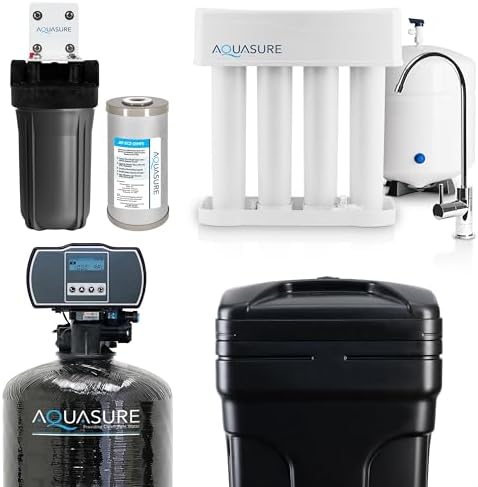
This bundle pairs a 48,000-grain whole-house softener with a 75 GPD reverse osmosis system. The softener handles the whole home, treating hardness at every outlet, while the four-stage reverse osmosis unit is intended to provide filtered drinking water at a single point, typically the kitchen. That two-part design makes the bundle appealing to buyers who want both softer bathing water and better-tasting drinking water without assembling components from different brands.
The softener half shares much of the same engineering as the Aquasure Harmony. It uses a digital metered control head with a backlit display, lets you set auto-flush intervals, and is built with a fiberglass-lined polyethylene tank, a durable bypass valve, and prefilled resin. The triple-purpose sediment, carbon, and zinc pre-filter is designed to remove a broad set of contaminants, including chlorine, sediment, and some metals, as described in the product listing.
Maintenance is the area where a bundle needs more attention than a single unit. The listing recommends replacing the reverse osmosis filters every six to twelve months, and the replacement is identified separately. Buyers who keep up with filter changes generally get the best flow and filtration, but missing changes will reduce performance. Think about whether you will remember the schedule before you commit.
In practical terms, this bundle suits a larger home with one or two priority areas for drinking water. It is less necessary for a smaller household that only wants softened water for fixtures and appliances. The reverse osmosis component also takes up additional space under the sink or in a utility area, which should factor into planning.
Compared with the standalone Aquasure Harmony, the bundle offers the same softening capacity with added filtration. The trade-off is a more complex installation and an ongoing filter schedule. Buyers who only need softening can save on complexity by choosing the standalone unit.
Pros:
- Combines 48,000-grain whole-house softening with point-of-use reverse osmosis filtration
- Digital metered control head automatically handles regeneration and backwash
- Triple-purpose pre-filter addresses sediment, chlorine, and a range of other contaminants
- Covers both whole-home softening and drinking water needs in one purchase
Cons:
- Reverse osmosis filters require replacement every six to twelve months, adding ongoing maintenance
Verdict: If you want softened water throughout the house and purified drinking water from a single purchase, this bundle is a well-matched option. Buyers who only need softening will get better value from the standalone Aquasure Harmony.
Kenmore 420 Water Softener: Smart Regeneration for Well Water Households

The Kenmore 420 is a 40,000-grain whole-home softener designed for households of up to five people. It targets hard minerals such as calcium and magnesium, and it also addresses dissolved iron, which makes it a practical consideration for homes on well water. Iron is a common problem in private wells, where it can stain fixtures and laundry, so a softener that handles it alongside hardness can simplify the treatment setup.
The defining feature is the IntelliSoft system, which the listing describes as using artificial intelligence to learn household water use patterns and regenerate only when needed. The stated benefit is reduced salt use and less wasted water. The concept is appealing, especially for homes with variable schedules, though buyers should understand that the actual savings depend on how a household uses water. A family with predictable habits may see less dramatic gains than one with irregular demand.
For well owners, the built-in sediment screen and enhanced iron reduction are the most relevant design points. Sediment screens protect the valve and resin from grit, which is useful when water comes from a well rather than a treated municipal supply. Many owners in well-water settings appreciate a single unit that tackles several problems, since it can reduce the number of separate components needed.
The warranty structure is a strong point. The listing includes a one-year full warranty, three years on electronics, and ten years on the tank. Those terms give buyers a clear sense of which parts are most likely to need coverage. The brand’s recognized name may also reassure buyers who prefer a familiar appliance maker.
Stock availability has been unreliable for this listing in our research, so confirm it is available before you plan a project. If you have iron concerns and a household of moderate size, the Kenmore 420 is a well-targeted option. If you need higher grain capacity or your home has several bathrooms, the Aquasure Harmony is the better fit.
Pros:
- Addresses both hardness and dissolved iron, which is useful for well water
- IntelliSoft regeneration adjusts to household usage patterns
- Built-in sediment screen helps protect the valve and resin
- Layered warranty covers the tank for ten years and electronics for three years
Cons:
- Salt-saving results depend on household usage, and the listing’s 40,000-grain capacity is smaller than the top two softeners in this group
Verdict: For a household of up to five on well water with both hardness and iron problems, the Kenmore 420 is a practical, well-supported choice. Buyers with larger homes or municipal water and no iron concerns may find the Aquasure or Aquasana models more suitable.
How to Choose the Right Water Softener for Hard Water
Start With a Water Hardness Test
Before you compare models, find out how hard your water actually is. Hardness is usually measured in grains per gallon or milligrams per liter, and local water utilities often publish annual water quality reports that list hardness levels. If you have a private well, you will need to arrange a test through a certified lab or a water treatment dealer. Knowing your number lets you size a softener correctly. A unit that is too small will regenerate too often and run out of capacity, while one that is oversized can waste salt and water because it sits unused for long stretches.
Match Grain Capacity to Household Size and Water Use
Grain capacity tells you how much hardness the softener can remove before it needs to regenerate. To estimate the size you need, multiply the number of people in the home by the daily water use per person, then multiply by your hardness level, and add a margin for peak days. Homes with three to four bathrooms or heavy laundry loads will generally need more capacity than a two-person household. The softeners in this guide range from 40,000 to 48,000 grains, so the choice often comes down to whether your home sits comfortably within the lower or upper range.
Consider Flow Rate for Whole-Home Coverage
Flow rate determines how much water can pass through the system at once. If several taps, showers, and appliances run at the same time, a softener with a low flow rate can cause pressure drops. Check the rated GPM for each model and compare it with your household’s peak demand. A higher flow rating generally gives you more flexibility when multiple fixtures are running, which is the situation where whole-home systems are most tested.
Understand Regeneration Methods
Traditional softeners regenerate on a fixed schedule, which can waste salt and water on days when the household uses less. Metered and smart systems track usage and regenerate when the resin is near capacity. Models with programmable digital controls let you adjust regeneration timing to fit your water quality and habits. Metered and adaptive systems tend to be more efficient, but they also add complexity. Choose a control style you feel comfortable maintaining over the long term.
Decide Whether You Need Filtration as Well
A water softener removes hardness minerals, but it does not necessarily address chlorine, sediment, taste, or odor. If those issues bother you, look for a system with a pre-filter or a separate filtration stage. Some models include sediment and carbon media in the box, while others recommend an add-on. Keep in mind that drinking water purification, such as reverse osmosis, is a separate category and usually sits at a single tap rather than the whole house. Decide which problems matter most to your household before paying for features you may not need.
Think About Well Water Versus City Water
Well water often carries iron, manganese, sediment, and sometimes bacteria, so the treatment setup may need more than a basic softener. Municipal water is usually treated but can still be hard, and its chlorine content may affect taste and odor. If you are on a well, look for a softener with iron handling or a sediment screen, and consider testing for additional contaminants. Models that are described as working with either well or city water offer more flexibility if you ever change your supply source.
Evaluate Certification and Build Quality
Third-party certifications offer a measure of independent verification that is easy to overlook. NSF/ANSI 44 is the standard for residential cation exchange water softeners, and it is a useful signal when comparing claims. Beyond certification, look at the tank material, valve design, and resin quality. Fiberglass-lined polyethylene tanks are common because they resist corrosion, and a durable bypass valve makes future service easier. Build quality affects how long the system lasts and how much maintenance it demands.
Compare Warranty and Support Terms
A softener is a long-term appliance, so the warranty deserves close attention. Pay attention to how long the tank, valve, and electronics are covered, since those parts are the most likely to need service. Some manufacturers also offer trial periods or technical support tied to online product activation. Read the terms carefully, including any deadlines for registration. Strong support can make the difference between a minor repair and an expensive replacement.
Plan for Installation, Space, and Ongoing Upkeep
Whole-house softeners need a suitable location, usually near the main water line and a drain, and they require room for a salt supply. Measure the space before you buy, and confirm that the bypass valve and port sizes match your plumbing. Factor in ongoing costs such as salt, replacement filters, and periodic service. A softener that is easy to maintain is more likely to keep performing well for years, while a neglected system can lose efficiency and develop problems.
Frequently Asked Questions
How do I know if I need a water softener?
Common signs include white scale on faucets and showerheads, soap that does not lather well, dry or itchy skin after bathing, and stiff laundry. Appliances that develop scale or heat less efficiently can also point to hard water. A water hardness test gives you a clear answer and helps you choose the right size.
Will a water softener make my water safe to drink?
A softener is designed to reduce hardness minerals, not to purify water. It does not remove every contaminant, and some softening processes can add sodium to the water. If you have health concerns about drinking water, consider a separate point-of-use filtration system, and have your water tested for contaminants of concern.
How often does a water softener need salt or cartridge replacement?
Tank-based softeners need salt refilled periodically, and the frequency depends on water hardness, household size, and regeneration settings. Cartridge-based systems need replacement cartridges on a schedule set by the manufacturer. Check the specifications for each model and factor the ongoing cost into your budget before buying.
What is the difference between a water softener and a water filter?
A water softener removes hardness minerals such as calcium and magnesium, usually through ion exchange. A water filter removes sediment, chlorine, odors, or other specific contaminants, often through media like carbon. Many whole-house setups combine both functions, while others focus on one. Identify your main problem first, then choose the equipment that addresses it.
Can I install a whole-house water softener myself?
Some homeowners with plumbing experience can complete the installation, but it requires cutting into the main water line, connecting a drain, and sometimes handling electrical connections for the control head. If you are not comfortable with these tasks, a licensed plumber can handle the work. Confirm the port sizes, bypass valve setup, and local plumbing codes before starting.
Do water softeners reduce water usage?
Traditional softeners use water during regeneration, so they do consume some water. Metered and smart models aim to reduce that waste by regenerating only when needed. The actual savings depend on your household’s usage and your water hardness. Manufacturer efficiency claims are useful starting points, but your results will vary.
Is a water softener worth the cost?
For many households with hard water, a softener pays off over time by reducing scale damage, extending appliance life, and lowering the amount of soap and cleaning products needed. The value depends on how hard your water is and how many fixtures and appliances you have. Weigh the upfront cost, ongoing salt or filter expenses, and expected appliance savings before deciding.
Final Recommendation
For most households dealing with hard water, the Aquasure Harmony Series stands out as the strongest all-around choice. Its 48,000-grain capacity, programmable digital control, and generous support terms make it a dependable option for larger homes with several bathrooms. If certified performance and salt-saving metered operation matter more to you, the Aquasana SimplySoft 40K is an excellent alternative for a household of up to five people. Buyers who need softened water and drinking water filtration in one package should consider the Aquasure bundle, while well owners dealing with both hardness and iron will find the Kenmore 420 well matched to the job. The Mervian cartridge system works best as a budget-friendly option for moderate hardness, provided you understand its limits. Start with a water hardness test, match capacity to your household, and confirm stock before you buy.