
The best hot water kettle for coffee depends on how you brew. A gooseneck spout gives you more control when pouring over grounds, while a standard electric kettle can be a practical choice when you mainly need water boiled quickly. The picks below range from simple, pour-focused models to a kettle with temperature control, so you can match the features to your coffee routine.
Quick Comparison
| Product | Best for | Capacity | Standout feature |
|---|---|---|---|
| Nueve&Five Electric Gooseneck Kettle | Pour-over brewing with a visible temperature reading | 1.0 L | Built-in thermometer |
| Chefman Gooseneck Electric Kettle | Compact, simple pour-over brewing | 0.8 L | One-touch operation |
| Amazon Basics Electric Kettle with Glass Carafe | Fast boiling for everyday drinks | Not specified | 1500W heating element |
| Bodum Bistro Gooseneck Electric Kettle | Controlled pouring with a simple design | 0.8 L | Cork handle and knob |
| INTASTING Gooseneck Electric Kettle | Brewing with a chosen water temperature | 0.9 L | Temperature control advertised to ±1°F |
Our Picks: Best Hot Water Kettle For Coffee reviews
1. Nueve&Five Gooseneck Kettle: Best for Temperature Checks

The Nueve&Five pairs a gooseneck spout with a built-in thermometer, making it a useful pick if you want to watch the water temperature as you prepare coffee. The thermometer provides a visible reading; the supplied details do not indicate that the kettle lets you set a target temperature or hold water at one.
Its 1.0-liter capacity gives it more room than the two 0.8-liter gooseneck options in this roundup. A 1000W heating element, one-touch switch, LED indicator, and cordless 360-degree base keep the design straightforward. Food-grade 304 stainless steel is used for the water-contact surfaces, and the kettle has automatic shutoff and boil-dry protection.
The narrow spout is the main draw for pour-over coffee, where a slower, more controlled pour can be helpful. The removable lid also makes rinsing easier. Compared with the INTASTING, this model offers a thermometer rather than advertised temperature control, so it suits people who want to check the heat themselves rather than choose a precise setting.
Pros:
- 1.0-liter capacity
- Built-in thermometer for checking water temperature
- Gooseneck spout for controlled pouring
- Automatic shutoff and boil-dry protection
Cons:
- No temperature-setting or keep-warm feature is specified
- Its 1000W rating is lower than the Amazon Basics kettle’s 1500W rating
Verdict: Choose the Nueve&Five if you want a pour-over kettle with a thermometer and a little more capacity than the smaller gooseneck models.
2. Chefman Gooseneck Kettle: Best for Simple Pour-Over Brewing

The Chefman is a compact electric gooseneck kettle for coffee or tea. Its 0.8-liter capacity keeps the footprint practical for a small coffee station, while the shaped spout is made for a steadier pour than a typical wide-spout kettle.
Operation is simple: press the switch to heat the water. The blue LED indicators light while it heats and turn off when the water reaches a rolling boil. The kettle lifts off its base for cordless pouring, and its removable lid and water-level gauge help with filling and checking the amount inside.
Chefman lists a 1000W heating element and says the kettle can boil water in as little as three minutes. That timing can vary with the amount and starting temperature of the water. Automatic shutoff and boil-dry protection add useful safety features. Unlike the Nueve&Five and INTASTING models, it does not have a thermometer or temperature-control feature listed, so it is best for people who are happy to heat water to a boil.
Pros:
- Gooseneck spout for controlled pouring
- One-touch operation with LED heating indicators
- Cordless kettle lifts off its base
- Automatic shutoff and boil-dry protection
Cons:
- 0.8-liter capacity is smaller than the Nueve&Five’s
- No temperature display or temperature setting is specified
Verdict: The Chefman is a good fit if you want a compact, easy-to-operate gooseneck kettle and do not need temperature selection.
3. Amazon Basics Glass Kettle: Best for Fast Everyday Boiling

This Amazon Basics model takes a different approach from the gooseneck kettles: it uses a glass carafe and a 1500W heating element designed to bring water to a boil quickly. That makes it a practical option if your main goal is boiling water for coffee, tea, or other hot drinks rather than controlling a slow pour for a pour-over dripper.
The carafe has a wide opening for filling and cleaning, plus a water-level indicator. The product description also specifies BPA-free water-contact materials, blue LED lighting during boiling, automatic shutoff, and boil-dry protection. It includes a Strix thermostat control system, but no user-selectable temperature settings are listed.
The main trade-off is pour control. The supplied details do not describe a gooseneck spout, so this is not the most targeted choice for carefully pouring water over a coffee bed. Its capacity is also not specified in the product information provided here, making it harder to compare serving volume with the other picks.
Pros:
- 1500W heating element for rapid boiling
- Glass carafe with a wide opening for filling and cleaning
- BPA-free water-contact materials
- Automatic shutoff and boil-dry protection
Cons:
- No gooseneck spout is listed for controlled pour-over brewing
- Capacity is not specified in the supplied product details
Verdict: Pick this kettle if you value fast boiling and an easy-to-clean glass carafe more than a specialized pour-over spout.
4. Bodum Bistro Gooseneck Kettle: Best for a Simple, Controlled Pour

The Bodum Bistro is a 0.8-liter electric gooseneck kettle made for pour-over coffee and tea. Its narrow spout is designed to help you control the speed and consistency of the water flow, making it a focused option for manual brewing rather than a general-purpose kettle with added temperature features.
The kettle is made of stainless steel, with a non-slip handle and knob made from cork. It separates from its base for cordless pouring, and the base has a simple power switch and automatic shutoff. The design keeps the controls uncomplicated, but the supplied information does not list a thermometer or selectable temperature settings.
Its 0.8-liter capacity is the same as the Chefman’s and smaller than the Nueve&Five’s 1.0-liter capacity. If you want a visible temperature reading, the Nueve&Five is a closer match; if you want a specified temperature-control feature, consider the INTASTING instead. The Bodum is a straightforward choice when a controlled pour and simple operation are the priorities.
Pros:
- Gooseneck spout designed for a controlled pour
- Stainless-steel construction
- Cork handle and knob
- Cordless design with automatic shutoff
Cons:
- 0.8-liter capacity may be limiting when you need more water
- No thermometer or temperature settings are specified
Verdict: The Bodum suits you if you want a simple stainless-steel pour-over kettle with a cork grip and do not need temperature controls.
5. INTASTING Gooseneck Kettle: Best for Temperature Control
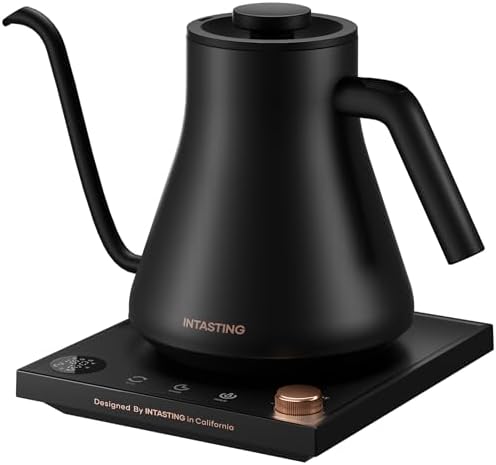
The INTASTING stands out for its advertised temperature control, with the product title specifying accuracy of ±1°F. That feature gives it an advantage over kettles that only show a temperature or heat water to a boil. It may suit coffee drinkers who want to choose a water temperature as part of their brewing routine.
The 0.9-liter kettle has a gooseneck spout for controlled pouring and a stainless-steel inner construction. Its capacity sits between the 0.8-liter Chefman and Bodum models and the 1.0-liter Nueve&Five. The product information describes a temperature probe and a program that adjusts heating power as the water approaches the selected temperature.
Compared with the Nueve&Five, the INTASTING is the more feature-focused choice for setting water temperature; the Nueve&Five offers a thermometer for checking it. The supplied details do not specify the INTASTING’s wattage, automatic shutoff, or boil-dry protection, so check the product listing for the operating and safety details you want before buying.
Pros:
- Temperature control advertised to ±1°F
- Gooseneck spout for controlled pouring
- Stainless-steel inner construction
- 0.9-liter capacity
Cons:
- Wattage is not specified in the supplied product details
- Automatic shutoff and boil-dry protection are not specified in the supplied details
Verdict: Choose the INTASTING if selecting a target water temperature matters more to you than having a larger kettle or a simple thermometer.
How to Choose a Hot Water Kettle for Coffee
Choose a Spout That Matches Your Brewing Method
If you make pour-over coffee, a gooseneck spout can help you pour more slowly and direct the water where you want it. That control is useful when brewing by hand. If you mostly need boiling water for a drip machine, French press, or instant coffee, a standard kettle may be enough; a gooseneck is not essential for every method.
Decide Whether You Need Temperature Control
Some coffee routines call for water below a full boil. A kettle with selectable temperature control lets you choose a target, while a built-in thermometer lets you check the water temperature as it heats. These are different features: a thermometer displays information, but does not necessarily control the heating. If you always use boiling water, you may not need either one.
Pick a Capacity That Fits Your Routine
Capacity affects how much water you can heat in one batch. The gooseneck models here range from 0.8 to 1.0 liters, with the Nueve&Five offering the largest stated capacity. A smaller kettle can be convenient for a compact coffee setup, while a larger one may be useful when you prepare several cups. Check the marked water levels and avoid filling beyond the kettle’s stated maximum.
Compare Heating Power Carefully
Wattage is one factor in heating speed, but it is not the only one; the amount and starting temperature of the water also matter. The Amazon Basics kettle lists 1500W, while the Nueve&Five and Chefman list 1000W. Wattage is not provided for every option, so compare only the models with stated figures rather than assuming all kettles heat at the same rate.
Look at Materials and Cleaning Access
Consider which surfaces touch the water and how easy the kettle is to clean. The Nueve&Five specifies food-grade 304 stainless steel water-contact surfaces, while the INTASTING lists a stainless-steel inner construction. The Amazon Basics model has a glass carafe and a wide opening, and the Nueve&Five and Chefman list removable lids. Those details can make filling and routine rinsing more convenient.
Check the Safety Features
Automatic shutoff and boil-dry protection can add peace of mind during routine use. These features are specified for the Nueve&Five, Chefman, Amazon Basics, and Bodum models in this roundup. The supplied INTASTING details do not list those protections, so check its product information if they are important to you.
Think About Counter Space and Handling
A kettle should be comfortable to lift, pour, fill, and store where you plan to use it. Compare its capacity and base arrangement with the room available on your counter. If you carry hot water away from the counter, a cordless design can make pouring more flexible; the Chefman and Bodum descriptions specifically note that the kettle lifts from its base.
Frequently Asked Questions
Is a gooseneck kettle better for pour-over coffee?
A gooseneck spout can make it easier to pour slowly and direct the water over coffee grounds. It is a useful feature for manual pour-over brewing, but it is not required if you use a different brewing method or simply need water boiled.
Do I need temperature control for coffee?
Not necessarily. Temperature control is helpful if you want to choose a specific water temperature. If you are comfortable heating water to a boil or checking its temperature yourself, a kettle without selectable settings may meet your needs.
What is the difference between a thermometer and temperature control?
A thermometer shows the water temperature so you can monitor it. Temperature control lets you choose a target temperature and adjusts the heating toward it. The Nueve&Five lists a thermometer, while the INTASTING advertises temperature control.
Which kettle in this roundup has the largest stated capacity?
The Nueve&Five has a stated capacity of 1.0 liter, the largest listed among the models with published capacities in this roundup. The Amazon Basics capacity is not specified in the supplied product details.
Can I use a regular electric kettle for pour-over coffee?
Yes. A regular kettle can heat water for pour-over brewing, but a gooseneck spout can provide more control over the flow. Choose based on how much control you want during the pour, not just on whether the kettle can boil water.
Which kettle is best if I want water boiled quickly?
The Amazon Basics kettle lists a 1500W heating element and is described as a rapid-heating model. The Chefman lists 1000W and says it can boil water in as little as three minutes, though actual heating time depends on the amount and starting temperature of the water.
Final Recommendation
For most pour-over coffee setups, the Nueve&Five is a well-rounded choice because it combines a gooseneck spout, a visible thermometer, and a 1.0-liter capacity. Choose the INTASTING instead if selectable temperature control is your priority. If speed matters more than precise pouring, the Amazon Basics glass kettle is the strongest fit among these options based on its listed 1500W heating element.