
A good sharpening stone gives you more control over a Japanese knife’s edge than a pull-through sharpener, but the right choice depends on how dull the blade is and how polished you want the finish. The options below range from a versatile medium-and-fine combination stone to a coarse repair stone and specialty finishing stones. Compare the grit, included accessories, and setup before choosing one for your knives.
Quick Comparison
| Product | Grit | Best for | Standout detail |
|---|---|---|---|
| MITSUMOTO SAKARI 1000/3000 Grit Whetstone | 1000/3000 | Everyday sharpening and honing | Bamboo base with non-slip pad |
| Yoshihiro Professional Grade Toishi Set | 1000/3000/6000 | A multi-step sharpening setup | Includes a stone fixer and nagura stone |
| Naniwa Chosera 400-Grit Whetstone | 400 | Repairing or reshaping a worn edge | Includes a holder and Toishi |
| Kota Japan 3000/8000 Grit Whetstone | 3000/8000 | Refining and polishing an edge | Non-slip silicone holder |
| KITAYAMA 8000-Grit Japanese Whetstone | 8000 | Fine edge finishing | Made in Kyoto; no base included |
Our Picks: Best Sharpening Stone For Japanese Knives reviews
1. MITSUMOTO SAKARI 1000/3000 Grit: A Practical Everyday Combination
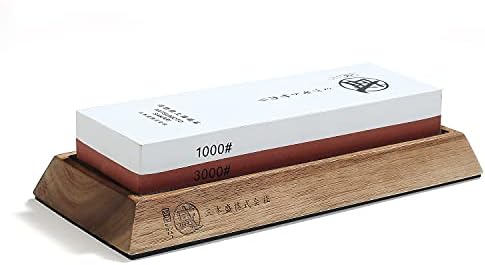
This double-sided water stone pairs a 1000-grit face for sharpening with a 3000-grit face for honing and polishing. That range makes it a flexible choice for routine edge maintenance when a knife is dull but does not need major repair.
The stone uses white corundum and has a bamboo base with a non-slip pad. Its water-absorbing structure is designed to form a sharpening slurry, and it does not require oil. The base can make it easier to keep the stone steady, though you still need to control the knife’s angle and pressure yourself.
Compared with the three-grit Yoshihiro set, this is a simpler setup with fewer stages and accessories. It may suit home cooks who want one stone for regular sharpening and a finer follow-up. It is not the best match for a badly damaged edge, where a coarser stone may be more appropriate.
Pros:
- Two useful grits for sharpening and honing
- Non-slip bamboo base is included
- Water-based use avoids sharpening oil
Cons:
- Does not include a coarse repair grit
- Provides fewer grit options than a multi-stone set
Verdict: Choose this stone if you want a straightforward, stable setup for regular knife maintenance rather than a full sharpening progression.
2. Yoshihiro Toishi Set: A Three-Grit Kit With Conditioning Tools

The Yoshihiro set includes 1000-, 3000-, and 6000-grit stones, plus a stone fixer and nagura conditioning stone. The grit range allows you to begin with sharpening, move to a finer honing stage, and finish with a higher-grit stone.
Each stone measures 8 inches long and 2.9 inches wide, providing a broad surface for working along a knife edge. The listed height is 0.9 inches, and the set is made in Japan. It does not specify an included base, so plan your sharpening area accordingly and check the product details before purchase.
This is the most complete option here for someone who wants several stages and tools to maintain the stones. It also asks more of the user: switching grits takes time, and a multi-stone set is more involved than the MITSUMOTO SAKARI’s two-sided design. For basic touch-ups, all three stones may be more than you need.
Pros:
- Three grits cover sharpening through fine finishing
- Includes a stone fixer and nagura conditioning stone
- Wide, 8-inch sharpening surface
Cons:
- More steps and equipment to manage than a combination stone
- An included base is not specified in the product details
Verdict: Pick this set if you want a broad grit range and stone-care accessories in one purchase.
3. Naniwa Chosera 400-Grit Stone: A Coarse Option for Edge Repair

This 400-grit stone is a coarse sharpening option for a blade that needs more work than routine honing. Its lower grit is intended for removing material more quickly than the 1000-grit stones in this guide, which can help when an edge is worn or needs reshaping.
The stone measures 210 by 70 by 25 mm and comes with a sturdy holder and a Toishi. The holder gives you a ready-made support, while the included smaller stone provides an accessory for conditioning the sharpening surface.
A 400-grit stone is a specialist tool, not a complete sharpening system by itself. After using it, you will generally want a finer stone to refine the edge; the MITSUMOTO SAKARI or Yoshihiro options offer higher grits for that next step. Use the coarse face only when the blade needs it, since sharpening removes material.
Pros:
- Coarse grit suits edge repair and reshaping
- Includes a sturdy holder and Toishi
- Broad surface for working along the blade
Cons:
- Too coarse to serve as a fine finishing stone
- Best paired with a higher-grit stone for a refined edge
Verdict: Choose this Naniwa Chosera stone when you need a coarse repair stage and already have, or plan to add, a finer stone.
4. Kota Japan 3000/8000 Grit: A Fine-Grinding and Polishing Pair

The Kota Japan stone combines 3000 and 8000 grits. The 3000-grit side is intended for refining an edge, while the 8000-grit side provides a finer polishing stage. That makes it a finishing-focused choice for knives that are already reasonably sharp.
It is made from aluminum oxide and comes with a non-slip silicone holder. The product instructions specify soaking the stone in water for 10–15 minutes before use. It can also be used on other listed blades and tools, including pocket knives, scissors, and straight razors.
Its grit range is the main limitation for someone sharpening a very dull knife: there is no medium or coarse side for initial sharpening or repair. In contrast, the MITSUMOTO SAKARI starts at 1000 grit, making it more practical as a single-stone option for everyday edge work.
Pros:
- Two fine grits for refining and polishing
- Non-slip silicone holder is included
- Water-based use; no oil is needed
Cons:
- No coarse or medium grit for initial sharpening
- Requires a 10–15 minute soak before use
Verdict: This is a good fit if your knife already has a sound edge and you want to focus on finer refinement and polishing.
5. KITAYAMA 8000-Grit Stone: A Specialty Finisher Made in Kyoto

The KITAYAMA is an 8000-grit finishing stone made in Kyoto by Ōtani Toishi. Its resinoid-bonded construction is designed to provide a consistent sharpening feel, and its fine grit is intended for finishing an edge rather than repairing a dull or damaged one.
The stone measures about 8.07 by 2.95 by 0.98 inches. This version does not include a base or nagura stone, so you will need a suitable holder or setup if you do not already have one. The listed manual is in Japanese, which may be a consideration if you prefer English instructions.
The supplied product information marks this item as unavailable, so check its listing status before building a sharpening setup around it. If you want a fine grit with a holder included, the Kota Japan option is a more self-contained alternative, while the Yoshihiro set offers more grit stages and accessories.
Pros:
- Very fine 8000 grit for finishing
- Made in Kyoto by a specialized whetstone maker
- Full-size stone offers a broad working surface
Cons:
- No base or nagura stone is included
- Not suitable as the only stone for a dull or damaged edge
Verdict: Consider this stone if you already have a sharpening setup and specifically want a high-grit finisher, but confirm availability first.
How to Choose a Sharpening Stone for Japanese Knives
Match the grit to the knife’s condition
Grit determines how the stone works on the edge. A coarse stone such as the 400-grit Naniwa Chosera is intended for repair or reshaping. A 1000-grit stone is a practical starting point for routine sharpening, while higher grits such as 3000, 6000, or 8000 are used to refine or polish an edge. If you are buying only one stone, a medium grit or a combination stone is usually more versatile than a finishing stone alone.
Decide whether you need one stone or several
A double-sided combination stone keeps the setup simple by putting two grits in one tool. A multi-stone set offers more control over the sharpening stages, but it takes more storage space and time to use. Consider how often you sharpen and whether you are willing to move between stones during a session.
Check the base and sharpening surface
A stable base can help keep the stone from sliding while you work. Some options here include bamboo or silicone holders, while the KITAYAMA stone has no base. Make sure your setup is steady before sharpening, and choose a stone with enough length and width to comfortably work along your knife edge.
Understand water and soaking needs
These products are water stones, so they do not require sharpening oil. Soaking instructions can differ: the Kota Japan product specifies a 10–15 minute soak, while the other listings describe their water use without giving the same timing. Follow the instructions for the specific stone rather than assuming every water stone needs the same preparation.
Plan for stone care and accessories
Some sets include tools to condition or maintain the stone, such as the fixer and nagura in the Yoshihiro set or the Toishi included with the Naniwa Chosera. These extras may be useful if you want a more complete setup. If you choose a stone sold without a base or conditioning accessory, account for those needs separately.
Use a controlled angle and light, steady pressure
Keeping a consistent angle matters more than chasing a very high grit. Follow the angle recommended for your knife when available; the MITSUMOTO SAKARI listing suggests a 15°–20° sharpening angle. Work carefully and avoid pressing harder than needed. If you are new to whetstones, practice with a knife you are comfortable maintaining before sharpening a valuable blade.
Frequently Asked Questions
What grit is a good starting point for Japanese knives?
A 1000-grit stone is a versatile starting point for routine sharpening. If the edge is badly worn or needs reshaping, a coarser stone such as a 400-grit option may be useful. A fine stone is best treated as a finishing stage, not a replacement for initial sharpening.
Is an 8000-grit stone enough by itself?
Usually not for a dull knife. An 8000-grit stone is designed for fine finishing, so it is more useful after the edge has been sharpened on a lower-grit stone.
Do water stones need sharpening oil?
No. The stones in this guide are water stones and are intended for use with water rather than sharpening oil. Check each product’s instructions for whether it should be soaked or used with water on the surface.
Which option is best for routine home sharpening?
The MITSUMOTO SAKARI 1000/3000 combination is a practical choice for routine sharpening and honing because it includes two useful grits and a non-slip base. The Yoshihiro set is a better fit if you want more stages and stone-care accessories.
Should I buy a stone with a holder?
A holder can help stabilize the stone, which makes sharpening easier to control. If a stone does not include one, make sure you have a steady, suitable setup before you begin.
Can I use these stones on knives other than Japanese kitchen knives?
Some product descriptions list other uses, including chef knives, utility knives, pocket knives, scissors, or straight razors. Check the individual product details and make sure the stone is suitable for the tool you plan to sharpen.
Final Recommendation
For most home cooks, the MITSUMOTO SAKARI 1000/3000-grit stone is the most balanced pick because it combines routine sharpening and honing with a non-slip base. Choose the Yoshihiro set if you want a fuller multi-grit progression and included conditioning tools. If your priority is repairing a worn edge, look at the coarse Naniwa Chosera; if you already have a sharp edge and want a fine finish, consider one of the 8000-grit options.