
A 2.7 cu. ft. mini fridge can add useful cold storage to a dorm, office, bedroom, or small apartment without taking up the space of a full-size refrigerator. The right choice depends on what you plan to store: some models focus on a compact single-door design, while others add a separate freezer, crisper drawer, or adjustable shelves. These five options offer different ways to make a small footprint work harder.
Quick Comparison
| Mini Fridge | Design | Standout Feature | Best For |
|---|---|---|---|
| Midea 2.7 Cu.ft Mini Fridge | Single door | ENERGY STAR certified; reversible door | Efficient everyday chilling |
| HUXLARO 2.7 Cu. Ft. Mini Fridge | Two doors | Separate freezer and crisper drawer | Organized frozen and fresh storage |
| MicroChill 2.7 Cu. Ft. Mini Fridge | Single door | 38 dB listed noise; reversible door | Quiet rooms and flexible placement |
| Casanta 2.7 Cu Ft Mini Refrigerator | Two doors | Top freezer, crisper, and egg tray | Compact spaces needing freezer storage |
| WINRIZZ 76L Personal Double-Door Mini Fridge | Two doors | Seven-level thermostat control | Small rooms needing two-zone storage |
Our Picks: Best Mini Fridge 2.7 Cu Ft reviews
1. Midea 2.7 Cu.ft Mini Fridge: Best for Efficient Everyday Cooling

The Midea is a straightforward single-door mini fridge for keeping drinks, snacks, and fresh food close at hand. Its 2.7 cu. ft. capacity fits small rooms, and the listed footprint is 17.6 inches deep, 18.6 inches wide, and 27.4 inches high. Measure your space carefully, including room for the door to open.
Its ENERGY STAR certification and listed annual energy consumption of 255 kWh make efficiency a notable part of its appeal. The thermostat adjusts from 33.8°F to 50°F, and a multi-airflow system is designed to circulate cool air through the compartment. The door can be reversed to open from either side, which can help when the fridge has to fit beside a desk or cabinet.
Storage touches include a can rack for up to six cans and a door shelf sized for a 2-liter bottle. Unlike the two-door picks below, this model does not provide a separate freezer compartment. Choose it for chilled food and drinks rather than regular frozen storage.
Pros:
- ENERGY STAR certified with 255 kWh listed annual consumption
- Reversible door offers more placement flexibility
- Adjustable temperature range from 33.8°F to 50°F
- Door storage accommodates a 2-liter bottle and up to six cans
Cons:
- No separate freezer compartment
- Its width may be limiting in especially narrow spaces
Verdict: Pick the Midea if you want an efficient, flexible single-door fridge for everyday chilled items and do not need a dedicated freezer.
2. HUXLARO 2.7 Cu. Ft. Mini Fridge: Best for Separate Freezer Storage

The HUXLARO uses a tall, upright layout to fit a refrigerator and freezer into a 2.7 cu. ft. appliance. Its listed dimensions are 16.1 by 17.3 by 38 inches, so it takes up relatively little floor area but stands taller than the single-door options. Check overhead clearance as well as the space needed for the doors to swing open.
Separate exterior doors let you reach the freezer or refrigerator without opening the other compartment. Inside, glass shelves help divide food and containers, while a crisper drawer gives produce a dedicated spot. Refrigerator door racks provide additional room for bottles and smaller items. A rotary thermostat lets you adjust the cooling setting.
This layout is useful if you want both frozen and fresh storage in one compact appliance. Its tall profile may be less convenient under a low counter, and the product information does not list an energy-use figure or noise rating for comparison. Compared with the Casanta and WINRIZZ, it offers similar two-door organization but has the tallest listed height among these picks.
Pros:
- Separate doors for freezer and refrigerator compartments
- Glass shelves and a crisper drawer support organized storage
- Vertical design uses a compact floor footprint
- Adjustable rotary thermostat
Cons:
- At 38 inches tall, it may not fit beneath some counters
- No energy-use or operating-noise figure is listed in the supplied product details
Verdict: Choose the HUXLARO if separate freezer access and a crisper matter more to you than a short overall height.
3. MicroChill 2.7 Cu. Ft. Mini Fridge: Best for Quiet, Flexible Placement
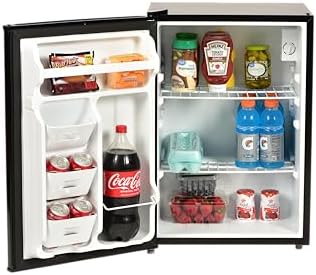
The MicroChill is a single-door, 2.7 cu. ft. refrigerator with a black steel exterior, recessed handle, and hidden hinges. Its low-noise compressor is listed at 38 decibels, making this model worth considering for a bedroom, office, or other space where background noise matters. Noise can still be noticeable depending on the room and placement, so treat the rating as a point of comparison rather than a guarantee of silence.
Two adjustable or removable wire shelves let you make room for different-sized items. A four-can door rack and storage for a 2-liter bottle add options for drinks, while adjustable legs can help level the unit. The door can be set to open from the left or right, and the product information also lists interior lighting and automatic defrost.
The listed refrigerant is R600A, and the product is described as ENERGY STAR certified and UL certified. It does not have a separate freezer, so it is best suited to refrigerated food and beverages. The stated energy use is nearly 0.70 kWh per day; actual consumption can vary with use and conditions.
Pros:
- Listed operating noise of 38 dB
- Reversible door and adjustable legs support flexible placement
- Removable shelves, can rack, and 2-liter bottle storage
- Automatic defrost and interior lighting are listed features
Cons:
- No separate freezer compartment
- Wire shelves may be less convenient than glass for some containers
Verdict: The MicroChill is a strong fit if you want a compact fridge with a listed low-noise rating, automatic defrost, and a reversible door.
4. Casanta 2.7 Cu Ft Mini Refrigerator: Best for Compact Two-Door Storage

The Casanta combines a top freezer and lower refrigerator in a cabinet measuring 14.8 inches wide, 16.5 inches deep, and 30.8 inches high. That narrow listed width could suit a tight spot where a wider mini fridge will not fit. As with any compact appliance, leave the ventilation and door-opening clearance specified in its manual.
Its two removable shelves can be repositioned to fit different items. A crisper drawer, bottle rack, and egg tray add dedicated storage instead of leaving everything in a single open compartment. The numbered rotary thermostat offers five settings. The listed temperature ranges are -0.4°F to 32°F for the freezer and 32°F to 50°F for the refrigerator.
The product information lists 38 dB operating noise and annual energy use of 116.8 kWh. It uses manual defrost, so you will need to remove frost periodically. That trade-off is worth keeping in mind if you prefer not to handle routine defrosting. Compared with the Midea and MicroChill, the Casanta offers a freezer but takes a simpler approach to maintenance.
Pros:
- Separate top freezer and refrigerator compartments
- Narrow listed width can help in tight spaces
- Includes a crisper drawer, bottle rack, and egg tray
- Listed at 38 dB with 116.8 kWh annual energy use
Cons:
- Manual defrost requires periodic frost removal
- Five thermostat positions offer less adjustment than a continuous dial
Verdict: Pick the Casanta if you want a narrow two-door model with dedicated freezer storage and useful produce and bottle organization.
5. WINRIZZ 76L Personal Double-Door Mini Fridge: Best for Adjustable Cooling

The WINRIZZ is a double-door 2.7 cu. ft. mini fridge with a listed total capacity of 76 liters. Its separate top freezer holds 1.1 cu. ft., while the lower refrigerator holds 1.6 cu. ft. At 15 by 16 by 31 inches, it has a slim upright shape intended for small rooms and narrow corners.
A seven-level mechanical thermostat gives you several cooling settings to choose from. The product information lists freezer temperatures down to -0.4°F and a refrigerator range of 32°F to 50°F. Two removable shelves can be rearranged to make space for taller bottles or larger containers, and adjustable leveling legs help stabilize the unit on uneven floors.
The listed operating noise is 38 dB. This model uses manual defrost, so plan for occasional frost removal rather than automatic defrosting. Its separate compartments and seven-level control make it more adjustable than a basic single-door fridge, though the supplied details do not include an annual energy-use figure for comparison.
Pros:
- Separate freezer and refrigerator with listed capacity for each
- Seven thermostat settings provide multiple cooling choices
- Removable shelves and adjustable leveling legs
- Listed operating noise of 38 dB
Cons:
- Manual defrost requires periodic maintenance
- No annual energy-use figure is listed in the supplied product details
Verdict: Choose the WINRIZZ if you want a slim two-door fridge with a separate freezer and more thermostat settings to choose from.
How to Choose a 2.7 Cu. Ft. Mini Fridge
Decide Whether You Need a Freezer
A single-door model can dedicate its interior to chilled drinks, snacks, and fresh food. If you want a separate place for frozen items, look for a two-door design such as the HUXLARO, Casanta, or WINRIZZ. Check the freezer’s listed temperature range and remember that a freezer compartment takes up part of the appliance’s total capacity.
Measure the Space and Door Clearance
Compare the fridge’s width, depth, and height with the space where you plan to put it. A narrow cabinet may be easier to place in a tight corner, while a taller model may use less floor area but fail to fit beneath a counter. Allow for ventilation and enough room to open the door. A reversible door, available on the Midea and MicroChill, can help when the room layout limits which way the door should swing.
Match the Interior to Your Food and Drinks
Think about the items you store most often. A can rack and 2-liter bottle space are handy for beverages, while removable shelves make it easier to fit taller containers. A crisper drawer can help keep produce separate, and a door rack can free up shelf space. Review the storage layout rather than relying on capacity alone, since two fridges with the same listed volume may organize it differently.
Compare Temperature Controls and Defrosting
Adjustable controls let you change the cooling setting to suit your needs, but the control style and temperature range vary. Some models use a numbered dial, while others offer several labeled levels. Also check whether the unit has automatic or manual defrost. Manual-defrost models require you to remove frost periodically, so factor that maintenance into your choice.
Consider Noise and Energy Information
A fridge in a bedroom or quiet office may be more noticeable than one in a shared kitchen. Where a noise rating is listed, use it as a comparison point, not a promise that the unit will be inaudible. For energy use, look for an annual consumption figure or an efficiency certification. The Midea is ENERGY STAR certified, while the Casanta and MicroChill listings also provide energy-use information.
Check the Fine Print Before Setup
Read the manufacturer’s instructions for placement, ventilation, leveling, and initial setup before plugging in your appliance. Keep the unit stable on the floor and leave the clearances specified in its manual. If you are placing it in a dorm or office, confirm that the space permits a personal refrigerator and that the intended location has a suitable outlet.
Frequently Asked Questions
Is a 2.7 cu. ft. mini fridge large enough for a dorm room?
It can work well for drinks, snacks, and a modest amount of fresh food. A model with a separate freezer offers more storage options, but some of its total capacity is reserved for frozen items. Consider how much food you plan to keep cold and compare the interior layout with your needs.
Do all of these mini fridges have a freezer?
No. The HUXLARO, Casanta, and WINRIZZ have separate freezer compartments. The Midea and MicroChill are single-door models, and their supplied product details do not list a separate freezer.
Which option has a reversible door?
The Midea and MicroChill listings specify reversible doors. Check the installation instructions to see how to change the door swing and what tools or steps are required.
Which models list a 38 dB noise rating?
The MicroChill, Casanta, and WINRIZZ list an operating-noise rating of 38 dB. The supplied details do not provide a noise rating for the Midea or HUXLARO.
Do these mini fridges need to be defrosted?
The Casanta and WINRIZZ use manual defrost, which means frost should be removed periodically. The MicroChill lists automatic defrost. The supplied information does not specify a defrost method for the Midea or HUXLARO.
Can a mini fridge go under a desk or counter?
That depends on the unit’s height, ventilation needs, and door clearance. Measure the available space and follow the manufacturer’s placement instructions. The HUXLARO is listed at 38 inches tall, while the Midea, Casanta, and WINRIZZ have shorter listed heights.
Final Recommendation
For an efficient single-door fridge with a reversible door, the Midea is the most balanced pick. Choose the MicroChill if a listed low-noise rating and automatic defrost are priorities. If you need a separate freezer, compare the HUXLARO’s crisper and glass shelves, the Casanta’s narrow width and included organizers, and the WINRIZZ’s seven-level thermostat. Before ordering, measure your space and decide how much freezer storage you truly need.