
Choosing eating utensils for someone with dementia is less about finding a one-size-fits-all solution and more about matching the utensil to the person’s grip, wrist movement, and comfort. Wide handles, bendable or angled heads, and a clear visual contrast may make mealtime tools easier to manage. The options below include lightweight and weighted designs, so you can compare features and consider which may suit your loved one’s needs. An occupational therapist can help assess fit and safe use.
Quick Comparison
| Product | Design | Best suited for | Notable extras |
|---|---|---|---|
| MARS WELLNESS Red Easy-Grip Utensil Set | Lightweight, wide textured handles; bendable fork and spoon | People who want a colorful, nonweighted option | Built-up knife; dishwasher-safe stainless steel |
| PKPKAUT Weighted Adaptive Utensil Set | Weighted, bendable utensils with a universal cuff | People who prefer added utensil weight or need help keeping a utensil in hand | Rocker knife, cleaning brush, and roll bag |
| Uiifan Adaptive Utensil Set | Nonweighted utensils with wide silicone-and-plastic handles | Households wanting several utensil styles | Includes dinner and soup spoons, forks, and knives |
| Celuisiva Weighted Utensil and Bib Set | Weighted utensils with enlarged silicone handles | People who want a weighted set and clothing coverage | Includes tablespoon, teaspoon, knife, fork, and bib |
| Ehucon Angled Spoon and Fork | Weighted, fixed-angle spoon and fork | People who have difficulty turning or bending the wrist | Left- and right-hand options; several colors |
Our Picks: Best Eating Utensils For Dementia Patients reviews
1. MARS WELLNESS Red Easy-Grip Set for a Lightweight, Adjustable Fit

This three-piece set pairs red, built-up handles with a bendable fork and spoon and a built-up knife. The fork and spoon can be twisted to different angles for left- or right-handed use, which may help when a person has trouble positioning a standard utensil. The utensils are nonweighted, a useful distinction if added weight feels tiring or uncomfortable.
The wider ribbed handles have raised grips, and the product description lists silicone handles and stainless-steel utensil heads. Red may offer a stronger visual contrast against some plates or table settings, though the effect depends on the surrounding colors and the individual. The manufacturer also cites research on red dinnerware; that should not be taken as a guarantee that red utensils will change how much someone eats.
Compared with the weighted options below, this set is a simpler choice for someone who wants a larger grip without added utensil weight. It has fewer pieces than the Uiifan set, and the knife is not described as bendable. Check the bend and handle fit before regular use, and follow the product’s care instructions.
Pros:
- Nonweighted design with wide, textured handles
- Bendable fork and spoon can be positioned for either hand
- Red handles offer a distinct color option
- Stainless-steel utensils are described as dishwasher safe
Cons:
- Includes only three pieces, with no soup spoon or alternate knife style
- Only the fork and spoon are described as bendable
Verdict: Choose this set if a lightweight grip and adjustable fork and spoon are more important than having a full range of utensil styles.
2. PKPKAUT Weighted Set with Bendable Utensils and a Hand Cuff

This six-piece set combines weighted utensils with bendable heads and a universal hand cuff. The fork and spoon are described as bendable up to 180 degrees, so they can be set at an angle that better matches the user’s movement. The package also includes a rocker knife, cleaning brush, and roll bag.
The listed utensil weight is four ounces, which is noticeably different from the nonweighted sets in this guide. Added weight may be worth considering for someone who prefers a heavier utensil, but it is not automatically the better choice: it could feel tiring for someone with limited strength. The adjustable cuff may help keep a utensil positioned in the hand, but it also adds a step to setup and should fit comfortably without restricting circulation or movement.
This set offers more accessories than the MARS WELLNESS option and includes a rocker knife for cutting with a rocking motion. In return, it may take more effort to select and adjust the right setup for each meal. Consider trying the utensil weight and cuff with guidance from a care professional if you are unsure about the fit.
Pros:
- Weighted fork and spoon can be bent to different angles
- Universal cuff may help with holding the utensil
- Includes a rocker knife, cleaning brush, and roll bag
- Dishwasher-safe utensils, according to the product description
Cons:
- The listed four-ounce weight may be too heavy for some users
- The cuff may need adjustment and hands-on setup
Verdict: This is a strong option to consider when added weight, an adjustable angle, and a hand cuff are desired, but check that the weight feels manageable first.
3. Uiifan Multi-Piece Set for More Utensil Choices

The Uiifan set is designed for people who need a wider handle but do not want weighted silverware. Its listed assortment includes forks, knives, curved knives, dinner spoons, and soup spoons, giving you more shapes to consider for different foods. The handles combine silicone and plastic, and the product description gives an approximate utensil length of 7.5 inches.
That variety can be useful when a person finds one utensil shape easier than another, or when you want separate options for soup and other meals. The curved knife is described as intended for one-handed cutting. Unlike the MARS WELLNESS and PKPKAUT options, the Uiifan set is not described as having bendable fork or spoon heads, so it may not suit someone who needs the utensil angle changed.
The product listing describes the bundle as a two-set, 10-piece package, so check the current package details before ordering if the exact quantity matters. More pieces can mean more choices, but they also require more storage and sorting. This set may fit households that value variety and an unweighted grip over adjustable angles or accessories such as a cuff.
Pros:
- Nonweighted design with wider handles
- Includes several utensil shapes, including soup spoons and curved knives
- Stainless-steel utensils with silicone-and-plastic handles
- Useful variety for trying different tools with different foods
Cons:
- Utensil heads are not described as bendable
- The product listing’s set and piece-count wording may be worth confirming before purchase
Verdict: Consider Uiifan if you want a nonweighted set with several utensil styles and do not need bendable heads.
4. Celuisiva Weighted Set with a Reusable Bib

This set includes a tablespoon, teaspoon, knife, fork, and reusable bib. Each utensil is listed at 2.5 ounces and has an enlarged silicone handle. The design focuses on combining added weight with a broader grip, rather than offering bendable heads or a hand cuff.
The included bib may be helpful if keeping clothing clean is part of your mealtime routine. Its surface is described as easy to wipe, and the product information says it can be hand-washed or machine-washed. The utensils are also described as dishwasher safe. These care features may be convenient for daily use, though you should follow the care instructions provided with the product.
Compared with the PKPKAUT set, the listed weight per utensil is lower, but these tools are still weighted and may not be comfortable for everyone. There is no stated angle adjustment, so this set is less suited to someone who needs a spoon or fork repositioned for wrist movement. The bib also adds value mainly if that accessory is useful to the person using it.
Pros:
- Includes four utensil types and a reusable bib
- Enlarged silicone handles are designed for an easier grip
- Utensils are listed as dishwasher safe
- Bib can be wiped clean or washed, according to the product description
Cons:
- Weighted design may not suit someone who tires easily
- No bendable heads or hand cuff are listed
Verdict: Choose this set if you want moderately weighted utensils with a bib, provided the utensil weight feels comfortable for the user.
5. Ehucon Angled Spoon and Fork for Limited Wrist Movement
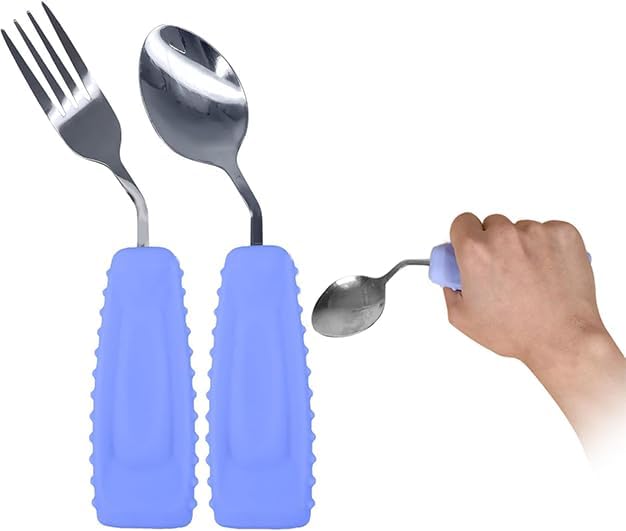
Ehucon’s set focuses on a spoon and fork with fixed angled heads. The angle is intended to reduce the need to bend the wrist or turn the arm while eating. The utensils are weighted, with food-grade stainless-steel heads and silicone handles that have textured particles along the edges for grip.
Unlike a bendable utensil, a fixed-angle design does not need to be repositioned, but the angle may or may not match the user’s preferred movement. The listing offers left- and right-hand options, so selecting the correct version matters. It also lists several handle colors. The spoon and fork are described as dishwasher safe under the stated temperature limit.
This is a more focused choice than the multi-piece Uiifan set: it provides two utensils rather than knives and multiple spoon styles. It may suit someone whose main challenge is wrist positioning, but it is not the best match if you need a full place setting or want a nonweighted option. Confirm the hand orientation and consider whether the weight is comfortable before choosing.
Pros:
- Fixed angle may reduce the need to turn or bend the wrist
- Available in left- and right-hand versions
- Textured silicone handles are designed to help with grip
- Several color choices are listed
Cons:
- Only a spoon and fork are included
- Weighted, fixed-angle design may not suit every person or movement pattern
Verdict: Consider Ehucon if a fixed angle and hand-specific option are priorities, and the user is comfortable with weighted utensils.
How to Choose Eating Utensils for Someone with Dementia
Start with the person’s current abilities
Dementia affects people differently, and eating challenges can change over time. Consider what is difficult right now: gripping a thin handle, moving the wrist, keeping a utensil in the hand, scooping food, or cutting it. Choose a feature that addresses that specific challenge rather than assuming every person with dementia needs the same kind of utensil. A care professional or occupational therapist can help assess the person’s needs.
Compare handle width and texture
A wide handle may be easier to hold than standard narrow silverware, while a textured surface may help provide a more secure-feeling grip. However, handles can also be too bulky or uncomfortable for some hands. If possible, check that the person can grasp and release the utensil without strain. Soft materials, such as silicone, may feel different from harder plastic, so comfort matters as much as size.
Decide whether added weight is appropriate
Some products in this guide are weighted, while others are not. Weight is a personal fit issue, not a feature that is automatically helpful. A heavier utensil may feel steadier to one person but tiring to another, especially if grip strength or endurance is limited. Compare the listed weights when available, and if you are uncertain, ask an occupational therapist before relying on a weighted design.
Choose between bendable and fixed-angle heads
Bendable heads can be adjusted to suit a person’s preferred hand or eating position. Fixed-angle utensils provide a set position and do not require adjustment, but the angle may not work for everyone. Think about whether the user can comfortably bring food to their mouth with a standard utensil. For a bendable product, follow its instructions and check that the head stays in the intended position.
Look for the right pieces and accessories
A spoon and fork may cover basic needs, while a soup spoon, curved knife, rocker knife, cuff, or bib may be useful for specific routines. More pieces can offer flexibility, but they can also add storage and cleaning tasks. Choose accessories based on what the person actually uses, and check the package description carefully when the number of included pieces is important.
Consider color and visual contrast
A utensil or plate that stands out from the table setting may be easier for some people to see. Red is one color option in this group, but the best contrast depends on the plate, food, lighting, and the person’s vision. Try simple changes one at a time and observe whether they make the meal setup easier to understand. Color alone cannot guarantee a change in appetite or food intake.
Check cleaning and everyday handling
Look at the care directions for the utensil heads, handles, and any accessories. Several products here are described as dishwasher safe, while the Celuisiva set also includes a bib with separate cleaning instructions. Consider whether the utensils have grooves or attachments that need extra cleaning, and whether the person or caregiver can manage those steps comfortably.
Frequently Asked Questions
Are adaptive utensils specifically for dementia?
Not necessarily. Adaptive utensils are designed to address practical challenges such as grip, wrist movement, or utensil control. The products in this guide are also described for people with conditions or limitations such as arthritis, Parkinson’s, tremors, or reduced grip strength. The best choice depends on the person’s individual needs, not the diagnosis alone.
Are weighted utensils always better for hand tremors?
No. A weighted utensil may feel more manageable for some people, but added weight can also be tiring or difficult to lift. The person’s comfort and ability to use the utensil matter most. If you are unsure whether weight is appropriate, ask an occupational therapist or another qualified care professional.
What is the difference between a bendable and an angled utensil?
A bendable utensil can be adjusted to a chosen position, while an angled utensil has a set position. Bendable options offer flexibility but may require adjustment. A fixed-angle option is ready to use as designed, but you need to choose the correct hand orientation when the product offers separate left- and right-hand versions.
Can red utensils improve appetite?
The MARS WELLNESS product description refers to research about red dinnerware, but that does not establish that red utensils will improve appetite for every person. Color contrast may make an item easier to distinguish in some settings. Individual response can vary, so treat color as a preference or visual aid rather than a guaranteed solution.
Which option is best if the person has trouble holding a utensil?
The PKPKAUT set includes a universal cuff intended to help hold a utensil in place. Whether it is appropriate depends on comfort, fit, and the person’s ability to use it safely. The MARS WELLNESS, Uiifan, and other sets offer wider handles but do not list the same cuff feature. A care professional can help determine which approach is suitable.
Are these utensils dishwasher safe?
The product descriptions identify the MARS WELLNESS, PKPKAUT, and Celuisiva utensils as dishwasher safe. Ehucon also describes its spoon and fork as dishwasher safe within a stated temperature limit. Check the specific product’s care instructions before washing, especially for items with cuffs, bags, or bibs.
How should I choose the right set?
Start with the main mealtime difficulty, then compare handle size, weight, utensil angle, and included pieces. When possible, let the person try a utensil in a calm, familiar setting and check for discomfort or fatigue. For concerns about safe eating, swallowing, or the person’s ability to use a utensil, seek guidance from a qualified health professional.
Final Recommendation
For a lightweight set with a bendable fork and spoon, the MARS WELLNESS option is a practical starting point. If added weight or a hand cuff is a priority, compare the PKPKAUT and Celuisiva sets carefully, since their weights and accessories differ. Uiifan offers more utensil shapes without added weight, while Ehucon focuses on a fixed angle and left- or right-hand options. The best choice is the one the person can grip, lift, and use comfortably as part of their own mealtime routine.