
Choosing eating utensils for a blind or low-vision person is about more than picking a spoon or fork. The right set should feel secure in the hand and work well with the person’s usual way of finding food, plate edges, and utensil position. The options below are mainly adaptive utensils for limited grip, tremors, or wrist movement—not products with built-in tactile or audio features for blindness. A raised plate edge, consistent place setting, or high-contrast tableware may be just as important as the utensils themselves.
Quick Comparison
| Product | Standout feature | Best suited for |
|---|---|---|
| Defulmi 9-Piece Adaptive Utensils Set | Angled utensils and included plate, bowl, and mats | People who want a coordinated mealtime set |
| Ehucon Angled Spoon and Fork | Choice of left- or right-hand versions | People who need angled utensils and a grippy handle |
| LEGENDONE 4-Piece Adaptive Utensils Set | Non-slip handles in a basic multi-piece set | Shoppers seeking a straightforward adaptive set |
| Uiifan 10-Piece Adaptive Utensils Set | Two sets with a curved knife and varied spoons | Households that want spare utensils or multiple options |
| Rehabilitation Advantage Adjustable Weighted Set | Removable weights and bendable fork and spoons | People who need adjustable weight and utensil angles |
Our Picks: Best Eating Utensils For The Blind reviews
Defulmi 9-Piece Set: Angled Utensils with Tableware Included

The Defulmi set combines adaptive utensils with dishes and a travel wrap. It includes a soup spoon, dinner spoon, fork, rocker knife, spill-proof plate, non-slip bowl, two suction mats, and a storage bag. The spoon and fork have a 45-degree angle, while the utensil heads are stainless steel and the handles are food-grade silicone.
The included plate and bowl may be useful if someone benefits from a defined edge when locating food. The suction mats are intended to help keep dishes in place, which can make a meal easier to manage. These features may support a more consistent setup, but the set does not list tactile markings or other features made specifically to identify food or utensil position by touch.
The product description gives the utensil weight as approximately 2.5 to 2.9 ounces, while the title highlights 2.9 ounces. Added weight may suit someone who prefers a steadier-feeling utensil, but it may be tiring for a person with limited strength. Consider testing the weight and angle in a safe, familiar setting before relying on them for every meal.
Pros:
- Includes utensils, dishes, suction mats, and a storage wrap.
- Angled spoon and fork may help reduce wrist movement.
- Stainless-steel heads and silicone handles are listed as dishwasher-safe.
- Plate and bowl provide more mealtime setup options than a utensil-only set.
Cons:
- Does not list tactile or audio features for blind users.
- The added weight may not suit someone with weak grip or limited endurance.
Verdict: Choose this set if you want angled utensils plus dishes and mats in one package; look elsewhere if your main need is tactile identification or very lightweight silverware.
Ehucon Angled Spoon and Fork: A Hand-Specific Option
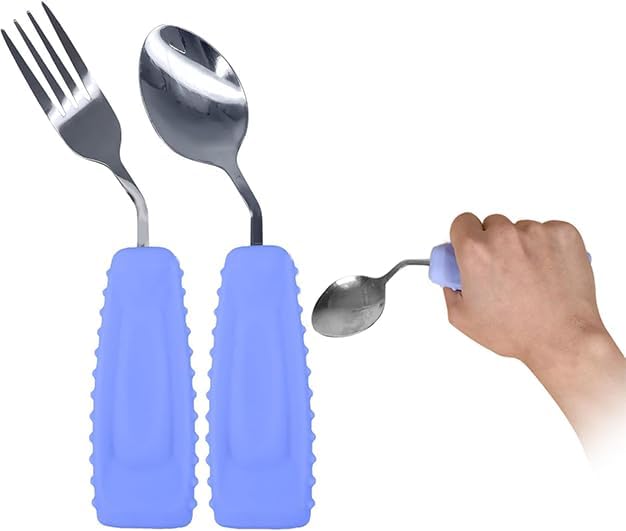
This Ehucon option focuses on an angled spoon and fork for people who find wrist turning or bending difficult. The handles are made from food-grade silicone, with raised particles along the edges to help with grip. The product is offered in bright colors, including purple, orange, pink, and green.
Unlike a general-purpose set, this one is described as available in left- and right-hand versions. That choice may help you find a utensil orientation that feels more natural. The bright color options may also be helpful in a high-contrast place setting for someone with some usable vision, but color alone does not provide a tactile way to tell utensils apart.
The listing emphasizes the spoon and fork, so it is a more focused choice than sets that also include knives or dishes. Check the listing carefully to confirm the configuration you need, especially whether you are selecting the left- or right-hand version. The description says the utensils can go in the dishwasher up to 120°C (248°F).
Pros:
- Left- and right-hand versions are described.
- Angled design may help reduce wrist rotation.
- Silicone handles have textured particles to support grip.
- Bright color choices may help some people with low vision distinguish utensils from tableware.
Cons:
- The set is focused on a spoon and fork rather than a broad collection of utensils.
- Color is not a substitute for tactile identification.
Verdict: This is a practical pick if wrist position and choosing a left- or right-hand angle matter more than getting a full utensil set.
LEGENDONE 4-Piece Set: Simple Non-Slip Handles
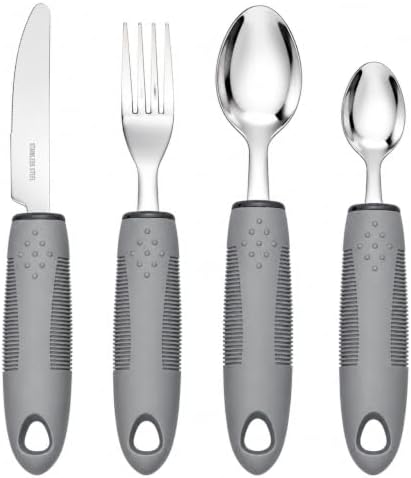
The LEGENDONE set is described as a four-piece collection for people who have trouble with grip strength or dexterity. Its main stated feature is an ergonomic, non-slip handle. The listing mentions a fork, knife, spoon, and additional utensil, but does not specify the complete piece-by-piece contents in the supplied product details.
For a blind or low-vision user, a secure handle can be useful when maintaining a steady grip is part of the challenge. Still, the description does not identify tactile markings, angled shafts, adjustable weight, or a special plate. If those features are important, compare this set with options that list them clearly.
The product description says the set is made from food-safe materials and is dishwasher-safe, but does not provide further detail about handle material, utensil weight, or dimensions. That makes it harder to judge how substantial the handles may feel in the hand. Check the listing for current specifications before ordering.
Pros:
- Non-slip handles are designed for a more secure grip.
- Four-piece format offers more than a single utensil.
- Designed for people with limited strength or dexterity.
- Listed as dishwasher-safe.
Cons:
- The supplied details do not identify every piece in the set.
- Weight, dimensions, and tactile features are not specified.
Verdict: Consider this set for basic grip support, but confirm its contents and handle details first if you need a specific utensil shape or tactile cue.
Uiifan 10-Piece Set: Two Sets with Several Utensil Shapes

The Uiifan listing describes two sets totaling ten pieces. Each set includes a fork, knife, curved knife, dinner spoon, and soup spoon. The utensils are about 7.5 inches long, with silicone and plastic handles and stainless-steel heads. Unlike weighted options, this set is specifically described as non-weighted.
The curved knife is intended for one-handed cutting, and the mix of spoons gives you options for different foods. Having two of each utensil type can be convenient for a household or for keeping a spare set available. For someone who is blind, these varied shapes could be incorporated into a consistent routine, but the product does not say that the pieces have tactile identifiers.
The wider handles are described as non-slip and intended to be easier to grip. Because the utensils are not weighted, this set may be worth considering if heavier handles feel tiring. On the other hand, it does not offer the weight adjustments or angled spoon and fork found in some of the other choices.
Pros:
- Two sets provide a range of utensil shapes and duplicates.
- Includes a curved knife designed for one-handed cutting.
- Non-weighted design may suit people who prefer lighter utensils.
- Stainless-steel heads and silicone-and-plastic handles are specified.
Cons:
- Does not list tactile markers or angled spoon and fork shafts.
- May be more utensils than needed if you only want a spoon and fork.
Verdict: Pick Uiifan if you want a larger supply of lighter adaptive utensils and a curved knife; choose another option if adjustable weight or angled utensils are priorities.
Rehabilitation Advantage Adjustable Set: Customizable Weight and Angle

This four-piece set includes a fork, knife, tablespoon, and teaspoon. Its handles have removable internal washers, allowing the weight to be adjusted from approximately 2 to 8 ounces. The handles are gray plastic with ridges and measure about 1.5 inches in diameter, according to the product details.
The fork and spoons can be bent left or right to create a custom angle; the knife cannot be bent. This combination gives you more ways to adjust the utensil to a person’s grip and preferred movement. For blind users, the ridged handles may offer a physical feature to feel, but the listing does not describe them as utensil-identification markers.
There is an important availability limitation: the supplied product data lists this item as unavailable. The listing may change, so check before planning a purchase. If it becomes available, its adjustable weight and bendable utensils make it the most customizable option in this group, though the large handle diameter and maximum weight may not suit every hand.
Pros:
- Removable washers allow weight adjustment from about 2 to 8 ounces.
- Fork and spoons can be bent left or right for a different eating angle.
- Ridges and a wide handle provide a distinct grip profile.
- Includes both tablespoon and teaspoon, as well as a fork and knife.
Cons:
- The supplied product data lists it as unavailable.
- The knife is not bendable, and the wide handle may not suit all users.
Verdict: This is the strongest fit on paper for someone who needs adjustable weight and utensil angles, but check availability and consider the handle size before choosing it.
How to Choose Eating Utensils for a Blind or Low-Vision User
Look for features that match the person’s actual needs
Blindness alone does not mean someone needs weighted or angled utensils. Start by asking what part of eating is difficult: locating food, keeping a plate steady, gripping a handle, moving the wrist, or cutting food. If the main challenge is vision, tableware placement and tactile organization may matter more than a specialized handle. If the person also has tremors, arthritis, or reduced hand strength, adaptive utensil features may help with those specific challenges.
Consider tactile cues and a consistent routine
None of the products here lists raised labels or tactile markings that identify each utensil. A person may still benefit from choosing utensils with different shapes or handle textures and keeping them in the same place at each meal. Ask the user which cues feel clear and comfortable rather than assuming a particular texture or shape will work. A vision-rehabilitation professional can suggest ways to organize a place setting around the person’s preferences.
Match the handle to grip strength and comfort
Wide, textured, or non-slip handles can be easier for some people to hold, but handle size is personal. A very wide handle may be uncomfortable for a smaller hand, while a heavy utensil may cause fatigue. If possible, compare the handle diameter and weight with utensils the person already uses comfortably. Consider a trial with one utensil before buying a large set.
Choose an angle and weight carefully
Angled utensils may reduce the wrist movement needed to bring food to the mouth. Weighted designs may feel steadier to some people, but the added weight can be tiring for others. Adjustable-weight models offer more flexibility, though they may have larger handles or more parts to manage. The best choice is the one the user can control comfortably throughout a meal.
Think about plate stability and food location
A non-slip mat, suction base, or plate with a raised edge can help keep dishes from moving or food from sliding off. The Defulmi set is the only option here that lists a plate, bowl, and suction mats. Before choosing a dish, check whether it works with the table surface and is easy for the user to locate and clean. A familiar plate and a consistent position can be as useful as a new utensil.
Check cleaning, durability, and set size
Dishwasher instructions and materials vary, so confirm the product listing before cleaning utensils in a dishwasher. A larger set can provide spares and more utensil shapes, while a compact set may be easier to store and identify. If the person uses only a spoon and fork, a specialized pair may be simpler than a collection with several knives and spoons.
Frequently Asked Questions
Are these utensils made specifically for blind users?
The supplied product details describe adaptive utensils for needs such as limited grip, tremors, arthritis, or reduced wrist movement. They do not list features such as braille labels, audio cues, or raised markings designed specifically for blind users.
What features may help someone with low vision?
Some people with low vision may find high-contrast colors easier to see against a plate or table. The Ehucon utensils are offered in several bright colors, but the listing does not say that they are high contrast with any particular dish. Color may help some users, but it will not help someone who relies on touch alone.
Are weighted utensils always better for hand tremors?
No. Added weight may feel steadier to some people, while others may find it tiring. The Defulmi set is described as weighing about 2.5 to 2.9 ounces, and the Rehabilitation Advantage set offers adjustable weight if available. A person’s comfort and control should guide the choice.
Do angled utensils help a blind person eat?
An angle can change the wrist position needed to bring food to the mouth, which may be useful for someone with limited wrist movement. It does not, by itself, help identify food or find items on a plate. The Ehucon and Defulmi sets list angled utensils.
Which option includes dishes as well as utensils?
The Defulmi set includes a spill-proof plate, a non-slip bowl, and two suction mats along with its utensils. The other products in this comparison are described mainly as utensil sets.
Can a blind person use regular eating utensils?
Yes. Many blind people use ordinary utensils and their own preferred methods for locating food and organizing a meal. Adaptive utensils are most relevant when there is an additional need, such as reduced grip strength, tremors, or limited wrist movement.
What should I check before buying an adaptive utensil set?
Check the handle size, utensil weight, angle, included pieces, and cleaning instructions. If the person is blind or has low vision, also consider whether the utensils and dishes can be identified and placed consistently. The user’s own comfort and preferences should be central to the decision.
Final Recommendation
For a coordinated setup with utensils, dishes, and mats, the Defulmi set is the most complete option in this group. Choose Ehucon if you want an angled spoon and fork with a left- or right-hand version, or Uiifan if you prefer a larger, non-weighted assortment. The Rehabilitation Advantage set offers the most adjustable design on paper, but the supplied data lists it as unavailable. None of these products is described as having dedicated tactile features for blindness, so consider them for their grip, angle, weight, and dish-stability features—not as a complete vision-access solution.