
Choosing a first set of knives for culinary school can feel overwhelming. Programs often expect you to arrive with a usable kit, and the wrong set can leave you with dull blades, poor balance, or pieces you never touch. The best option usually balances a sharp, durable main knife with the supporting tools your coursework will demand, plus a case that keeps everything organized and protected. This guide covers five chef knife sets, compares what each one includes, and explains which student might get the most from each. It also walks through the factors that matter most when you shop, so you can make a confident choice.
| Product | Pieces | Storage | Best For |
|---|---|---|---|
| Mercer Culinary Partners in Education 13-Piece Millennia Culinary School Kit | 13 | 7-pocket knife roll | Students who want a complete, foodservice-oriented kit |
| Dfito Chef Knife Sets with Roll Bag, 9 Pieces Professional Knife Set | 9 | Roll bag | Budget-minded students who want a solid core set |
| BoxValley 10-Piece Chef Knife Set with Oxford Carrying Bag | 10 | Oxford carrying bag | Students who want variety and a colorful, portable set |
| XYJ Stainless Steel Professional Japanese Kitchen Knife Set with Bag | 12 items listed (knives plus accessories) | Knife bag and sheath | Students who want sharpening tools included |
| Brewin CHEFILOSOPHI Japanese Chef Knife Set 5 PCS with Red Pakkawood Handle | 5 | Gift packaging | Students who already own storage and tools |
Our Picks: Best Chef Knife Set For Culinary School reviews
Mercer Culinary Partners in Education 13-Piece Millennia Culinary School Kit: The Most Complete Starter Kit

The Mercer Millennia School Kit is designed to give you a full working toolkit from day one. It includes an 8-inch chef’s knife, a 3-inch slim paring knife, a 6-inch boning knife, and an 8-inch wavy-edge bread knife. Alongside the blades, you get a 10-inch steel, a swivel peeler, a pocket thermometer, a copy of Mercer’s rules, and knife guards for several of the blades. Everything fits into a 7-pocket roll case, which makes it easy to carry between classrooms and a practice kitchen.
What stands out most is how thoroughly the set anticipates the needs of a beginning cook. Many budget sets focus on the knives and leave out the sharpening and measuring tools. Here, the steel and thermometer are included, so you can start maintaining your edges and checking temperatures without making extra purchases. The knife guards also matter more than they might seem. In a crowded prep area, protected edges reduce the chance of nicks and make the roll case safer to handle.
In everyday use, the set reads as professional equipment rather than a decorative kit. Mercer positions its products for foodservice operations, and that shows in the straightforward shapes and no-nonsense handles. Students who have trained with commercial-style tools often find this familiar. Some users note that the knives feel more substantial than entry-level options, which can make precise work like dicing onions feel more controlled once you adjust to the weight.
The main trade-off is care. The manufacturer recommends washing by hand with warm water and mild soap, then drying completely. Skipping the dishwasher is easy to commit to in a home kitchen, but it adds a small routine to every session. The set also leans toward general-purpose cutting rather than specialty work, so if your program emphasizes Japanese-style techniques, you may eventually want an additional knife. Still, for a student who needs a reliable, complete kit that will handle core coursework, this is the most practical choice on the list.
Pros:
- Includes a steel, peeler, and thermometer, so you can start maintaining and measuring right away
- Knife guards protect the blades and reduce the risk of damage in storage and transport
- Foodservice-oriented design feels familiar to students training in professional kitchens
- The 7-pocket roll case keeps every piece organized and easy to carry
Cons:
- Hand washing is required, which adds time to cleanup after every session
Verdict: If you want the most complete, ready-to-use kit for culinary school, this Mercer set is the strongest choice. It covers the essentials and the support tools, and the professional build quality justifies its place at the top of this list.
Dfito Chef Knife Set with Roll Bag: A Solid Core Set for Tighter Budgets
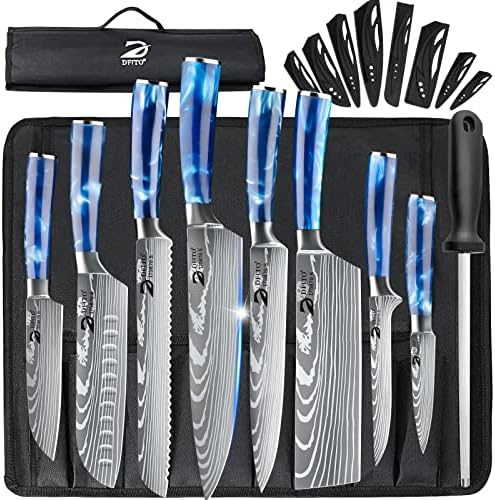
The Dfito set is a nine-piece collection that comes with a roll bag. Its listing describes the blades as German stainless steel with a chromium content of 16 to 18 percent and a carbon content of 0.6 to 0.75 percent, with a stated Rockwell hardness of 56 to 58. Those numbers place it in a reasonable range for everyday kitchen work. Hardness in this range generally means the edge can be sharpened fairly easily and will hold up to regular use, though it may need more frequent honing than a harder steel.
The set is built around a practical core. You get the knives most students reach for first, along with a bag that keeps them together. The handles are described as ergonomic with a finger guard, and the bolster is noted as fairly large. In practice, a larger bolster adds stability at the blade junction and can help you pinch-grip more comfortably. Some owners appreciate that the handles stay secure during longer prep sessions, which is useful when you are working through a full practice menu.
Where this set may fall short is depth. Nine pieces covers the basics, but students who need a dedicated bread knife, a specific paring tool, or a separate utility knife may need to add items later. The listing also leans heavily on marketing language, so you should judge the set by hands-on feel rather than specification sheets alone. The included lifetime warranty mentioned in the listing is a reassuring extra, but you should confirm the terms directly with the seller before purchase.
For a student who wants solid, affordable tools without paying for extra accessories, Dfito makes sense. It is a sensible second option behind Mercer for anyone who values a balance between performance and cost.
Pros:
- Stated steel composition and hardness suggest a durable, practical edge for everyday cutting
- Roll bag keeps the set organized and makes it easy to transport to class
- Ergonomic handles with a finger guard support safer, more controlled cutting
- Generally affordable for a complete nine-piece set
Cons:
- Fewer specialty pieces means you may need to add tools as your coursework expands
Verdict: This set suits budget-conscious students who want a dependable core kit with carrying storage. It may not cover every course requirement, but it gives you a solid foundation for the first semester.
BoxValley 10-Piece Chef Knife Set with Oxford Carrying Bag: Variety in a Portable Package

The BoxValley set includes ten pieces and comes with an Oxford carrying bag. Its listing describes a range of knives that goes beyond the basics: a chef knife, santoku, slicing knife, bread knife, boning knife, paring knife, and several smaller specialty blades. The blades are made from 4CR13 stainless steel, which the listing gives a hardness of 56 HRC. The handles are a red pakkawood design, a visual feature that makes the set stand out in a crowded kitchen.
The main appeal here is variety. A ten-piece set with multiple slicing and utility blades can help you explore different cutting tasks early in your training, especially if your program covers several cuisines. The full-tang construction described in the listing is a meaningful feature, since it generally improves balance and stability. Many students find that a well-balanced knife is easier to control during repetitive tasks like julienne or fine chopping.
The trade-off is steel quality. 4CR13 is a common stainless steel in value-oriented sets. It is a reasonable choice for general kitchen work, but it is not as hard-wearing as some premium steels, and it can require more attention to keep an edge sharp. Some owners appreciate the grip the handles offer even when wet, which is helpful in a fast-moving prep station. Still, you should expect to maintain the edges regularly with a honing rod.
Availability is also worth checking. The listing currently shows the set as unavailable, and stock can change. If you find it in stock and it fits your needs, its variety and bag make it a worthwhile choice. Otherwise, the Mercer and Dfito sets offer a more predictable path for a first culinary kit.
Pros:
- Ten-piece variety covers many cutting tasks, useful for exploring different techniques
- Full-tang construction supports balance and stability during detailed work
- Non-slip handles are described as secure even when wet
- Oxford carrying bag offers simple, portable storage
Cons:
- 4CR13 steel is less durable than premium options and will need regular honing and sharpening
Verdict: This set works well for students who want variety and a portable kit. Accept that the steel will need consistent maintenance, and confirm availability before you commit.
XYJ Stainless Steel Professional Japanese Kitchen Knife Set: Sharpening Tools Included

The XYJ set is one of the most accessory-rich options here. Its listing includes a paring knife, boning knife, santoku, slicing knife, bread knife, and chef knife, along with a knife bag, a sharpening rod, a mini whetstone, a peeler, scissors, and a washing cloth. For a student who is just starting to build a toolkit, having sharpening tools and a bag in the same box removes several shopping decisions.
The knives are described as stainless steel with a V-shaped edge and a seamless-welded handle. The listing emphasizes a light, ergonomic feel, and many buyers note that the handles feel comfortable over longer sessions. A lighter knife can reduce fatigue when you are chopping for an extended period, though it can also feel less planted for dense tasks like breaking down squash. Expect to get used to the balance point.
The listing is written in a heavily promotional style and mentions outdoor and camping use alongside kitchen work. That makes it harder to judge the set on its merits for culinary school. The materials are not described in the same detail as some competitors, so it is wise to pay attention to how the edges hold up in your first few weeks. Like the BoxValley set, availability is listed as unavailable at the time of research, so check before planning around it.
For students who value an all-in-one bundle with sharpening supplies, XYJ is a practical option. Just be prepared to verify quality through hands-on use rather than relying on the marketing copy.
Pros:
- Includes a sharpening rod, mini whetstone, and peeler, so maintenance tools come with the set
- Knife bag and sheath help protect blades during transport
- Light, ergonomic handles can reduce hand fatigue during long prep sessions
- Scissors and washing cloth add useful everyday extras
Cons:
- Listing relies heavily on promotional language, and material details are less specific than some competitors
Verdict: XYJ is a good pick for students who want sharpening tools and storage bundled into one purchase. Verify blade performance in your first weeks of use, and check availability before ordering.
Brewin CHEFILOSOPHI Japanese Chef Knife Set 5 PCS: A Compact, Presentation-Ready Choice

The Brewin CHEFILOSOPHI set is the most focused option on this list, with five knives: two 8-inch knives, a santoku, a 5-inch utility knife, and a smaller paring knife. The listing describes German 1.4116 stainless steel with a Rockwell hardness of 56 or higher, and it features a pakkawood handle with three reinforced anchor points. The set comes in gift packaging, which makes it appealing as a present for a student who is just starting out.
Five knives cover the core cutting tasks well, but the set is noticeably smaller than the others here. It does not include a bread knife, boning knife, sharpening tools, or a dedicated carrying case according to its listing. That means a student who needs a complete kit will likely have to buy those items separately. The pakkawood handles are visually striking and are described as balanced and easier to hold, which many cooks find helpful for precision work.
In practice, this set suits someone who already owns a knife roll, sharpening stone, or other tools and wants a high-quality core group of blades. It is a thoughtful choice for a student who is careful about what they buy and prefers quality over quantity. Some buyers appreciate the premium feel of the packaging and handles, which can make the knives feel special to use.
Pros:
- Focused five-piece lineup covers the most-used knives in a practical way
- Pakkawood handles are visually distinctive and described as well balanced
- Stated steel and hardness suggest a durable, well-made blade
- Gift packaging makes it a strong option for a student’s present
Cons:
- No carrying case or sharpening tools are listed, so you may need to buy storage and maintenance items separately
Verdict: The Brewin set is a good choice for students who already have storage and sharpening tools and want a compact, high-quality core. For a complete first-semester kit, the Mercer set remains the more practical pick.
How to Choose the Right Chef Knife Set for Culinary School
Start With Your Program’s Required Tools
Before you compare individual knives, check what your program expects you to bring. Some schools publish a specific list of knives, guards, and tools, while others simply recommend a general chef’s knife and a paring knife. Following the list avoids the frustration of buying a set that is missing a required piece in the first week. If your school provides guidance, treat it as your starting point and then decide where you want to go beyond it. A set that matches the requirements with a few useful extras is usually a better investment than a large set packed with knives you will rarely use.
Pay Attention to Steel Type and Hardness
Steel determines how sharp a knife gets, how long it holds that edge, and how much work it takes to keep it sharp. Stainless steels with a moderate hardness, roughly in the 56 to 58 range, are common in student sets because they strike a balance between edge retention and ease of sharpening. Harder steels can stay sharp longer but may chip if you use them carelessly on bone or frozen foods. Read the steel description carefully, but also consider how much maintenance you are willing to do. A set with a slightly softer steel will need more frequent honing, while a harder steel may need less frequent but more careful sharpening.
Consider Construction and Balance
Construction affects how a knife feels in your hand over time. Full-tang knives, where the steel runs through the entire handle, generally offer better balance and stability than knives where the blade is attached to a smaller tang. Look for a secure bolster at the blade junction, since it adds stability and protects your fingers during pinch grips. A well-balanced knife reduces fatigue during long prep sessions, which is especially important in culinary school, where you may spend hours on knife work. Hold the knife if you can, and pay attention to whether the weight sits comfortably between the handle and blade.
Think About Handle Comfort and Grip
Handles affect control as much as blade quality does. Ergonomic handles with a slight contour and a non-slip texture help you keep a firm grip during repetitive cuts. Materials like pakkawood look attractive and can feel warm and secure, while other synthetic materials may feel lighter. Because you will likely use these knives for many hours across a semester, comfort matters more than appearance. If possible, choose a handle shape that fits your hand size and that you can hold comfortably for a full practice session.
Evaluate Storage and Portability
Culinary students often carry their tools between classrooms, lockers, and practice kitchens, so storage is more important than it first appears. A roll case or sturdy bag protects edges, keeps the set organized, and makes it easier to find the knife you need quickly. Look for guards or sheaths that cover the blades, and check that the case has enough pockets for the number of pieces in the set. A well-organized roll reduces the chance of damage and makes your workspace easier to manage during timed exercises.
Plan for Sharpening and Maintenance
A sharp knife is safer and more efficient than a dull one, so maintenance should be part of your plan from the start. Some sets include a steel, a sharpening rod, or a whetstone, while others leave you to buy those separately. Honing with a steel between uses keeps the edge aligned, and periodic sharpening restores it when it dulls. Factor the cost and time of maintenance into your decision. If your set does not include sharpening tools, budget for them now so you are not caught without a way to keep your blades working well.
Balance Piece Count Against Quality
More pieces can look like better value, but quality matters more than quantity for most students. A nine- or ten-piece set with several rarely used knives may cost less per piece, but it can still leave you short on the tools you need most. Think about the core techniques your program emphasizes, such as basic chopping, slicing, boning, and peeling, and make sure those knives are strong. Once you have a reliable core, you can add specialty pieces as your coursework and interests develop.
Frequently Asked Questions
What is the most important knife to have for culinary school?
The chef’s knife is the most important piece. It handles the widest range of tasks, from chopping vegetables to breaking down herbs and slicing proteins. Make sure the chef’s knife in any set you consider feels comfortable and balanced, since you will use it more than any other tool in your kit.
Do I need a Japanese-style knife set or a Western-style set?
Either style can work well for culinary school. Western-style knives typically have thicker blades and a curved edge, which many beginners find forgiving. Japanese-style knives are often thinner and harder, which can offer precise cutting but may require more careful handling. Choose based on what your program teaches and what feels comfortable in your hand.
How often do I need to sharpen my knives?
Hone your knives with a steel regularly, often before or after each session, to keep the edge aligned. Sharpening on a stone or with a sharpening system is needed less often, usually when honing no longer restores the edge. How often you sharpen depends on how much you use the knives and the hardness of the steel.
Is a roll bag necessary for a culinary student?
A roll bag or case is strongly recommended. It protects the blades, keeps the set organized, and makes transport safer. Many programs expect students to carry their tools between classes, so a sturdy case is one of the most practical accessories you can have.
Can I hand wash all of these knives?
Hand washing is the safest approach for most knife sets and is the care method described for the Mercer set. Dishwashers can dull edges and damage handles over time. Dry each knife completely after washing to prevent rust and to protect the handle material.
Should I buy a complete set or individual knives?
A complete set is often more economical for a first kit, especially if it includes a roll case and basic tools. Buying individual knives makes sense if you already have some tools or if your program requires specific brands or types. Many students start with a set and add a favorite knife later.
How do I know if a set is still in stock before I buy?
Availability can change, and some listings may show a set as unavailable at certain times. Check the product page directly before planning your purchase, and compare alternatives in case your first choice is not in stock.
Final Recommendation
For most culinary school students, the Mercer Culinary Partners in Education 13-Piece Millennia Culinary School Kit is the best overall choice. It provides a complete, professionally oriented kit with the knives, guards, steel, peeler, and roll case you are likely to need from the start. If you are working with a tighter budget, the Dfito set offers a solid core with a carrying bag. The BoxValley and XYJ sets provide more variety or bundled sharpening tools, but they require closer attention to steel care and availability. The Brewin set is a strong pick for students who already have storage and maintenance tools and want a compact, premium core. Whichever set you choose, match it to your program’s requirements, check the construction and storage details, and plan for regular maintenance so your knives serve you well through the entire program.