
If you run a restaurant, food truck, or busy prep line, you already know how quickly hand-cutting potatoes eats into your shift. A good commercial French fry cutter turns a pile of potatoes into uniform sticks in a fraction of the time, and it keeps portions consistent from batch to batch. The challenge is that many cutters look alike on a product page. Blade options, mounting style, and build materials vary, and those differences matter once you are cutting for a full dinner rush. This guide compares five popular options so you can see which one fits your kitchen, your menu, and your daily volume.
Quick Comparison Table
| Product | Best For | Cut Options | Mounting | Standout Trait |
|---|---|---|---|---|
| VEVOR Commercial French Fry Cutter, 4 Blades Lever Vegetable Chopper | High-volume prep with several cut styles | 1/2″, 3/8″, 1/4″, 6-wedge | Four non-slip feet on the countertop | Four cut options plus two spare blades per set |
| New Star Foodservice Commercial Grade French Fry Cutter | Kitchens that want flexible installation | 1/4″, 3/8″, 1/2″, 6-wedge, 8-wedge | Table or wall mount, suction feet included | Widest blade range in this lineup |
| Mytasuy Commercial French Fry Cutter Stainless Steel Potato Cutter | Cooks who want quick blade changes | 3/8″, 1/2″, 1/4″ | Four suction cups | Red-button blade release and tool-free base removal |
| Commercial French Fry Cutter, Heavy Duty Potato Slicer with Suction Feet | Shoppers who want a simple, detachable design | Interchangeable cutting plates | Four suction cups | I-shaped handle with a detachable blade plate |
| SUNVIVIPRO Commercial French Fry Cutter with 1/2 Inch and 3/8 Inch Blade | Home cooks and light commercial use | 3/8″, 1/2″ | Four suction cups | Open-bottom outlet for placing a plate underneath |
Our Picks: Best French Fry Cutter For Commercial Use reviews
VEVOR Commercial French Fry Cutter With Four Blade Options

The VEVOR cutter is a lever-style chopper built around a stainless steel and aluminum frame. It comes with three straight-cut blades measuring 1/2 inch, 3/8 inch, and 1/4 inch, plus a 6-wedge slicer. The listing also states that each blade set includes two spare blades, which is a useful detail for a kitchen that cuts large quantities every day. Because you can switch between a fry size and a wedge cut without buying a separate tool, this model covers more prep tasks than many single-purpose cutters.
The pull-down handle is the main reason this cutter works well for volume. The lever gives you mechanical advantage, so you do not need to muscle each potato through the blades. Buyers often note that this makes long prep sessions less tiring on the wrist and forearm. The four feet are listed as non-slip and wear-resistant, which helps the unit stay planted while you press down. Still, a heavy push on a dry or slick countertop can cause some shifting, so a clean, flat surface and a steady hand make a real difference.
Cleaning is straightforward because the blades and push block both come out for washing. This matters in a commercial setting, where cutters need to be broken down and reset between batches. The main drawback is that the lever design takes up more counter space than a compact suction-cup model, so it may not fit well in a tight prep station. It also suits kitchens that cut a wide range of produce, not only potatoes. If your menu is mostly fries, a simpler tool may be enough.
Compared with the other choices, the VEVOR offers the most cut variety among the single-lever models in this list, and it includes spare blades out of the box. It is a strong choice for a restaurant that wants one machine for fries, wedges, and salad prep. If you need a model that mounts to a wall or that carries the widest set of blade sizes, look at the New Star option instead.
Pros:
- Four cut options, including three straight sizes and a 6-wedge slicer
- Lever handle reduces the force needed for each cut
- Two spare blades are listed with each blade set
- Blades and push block are removable for cleaning
Cons:
- The lever design takes up more counter space than compact models
- Firm pressure on a slick countertop can cause some movement
Verdict: The VEVOR is a practical pick for a commercial kitchen that needs multiple cut styles and a handle that eases repetitive pressing. If your counter has room and you cut varied produce, it is one of the most versatile options here.
New Star Foodservice Cutter With the Widest Blade Range

The New Star Foodservice cutter is built for professional kitchens that want a full set of cutting options. The listing includes replacement blades in 1/4 inch, 3/8 inch, and 1/2 inch, along with 6-wedge and 8-wedge blades and matching pushing blocks. That range is wider than any other model in this lineup, which makes it a good fit for a menu with several fry styles, wedges, or specialty cuts. The die cast iron body and 18/8 stainless steel parts give it a heavy, planted feel that many commercial buyers look for.
What sets this model apart is installation flexibility. You can mount it to a table or to a wall, and suction feet are included for counter use without drilling. That makes it useful in a kitchen where prep space is shared or where a station may need to be rearranged. A wall-mounted unit can free up counter space, while a table-mounted setup can be moved when you need to reset a line. In everyday use, the weight of the cast iron body helps reduce movement, which is a real advantage when you are pushing through a large batch of potatoes.
The trade-off is setup. Because the cutter is heavier and has more mounting options, you will want to decide where it lives before you install it. Some owners find that the extra parts take a few minutes to organize and that the heavier body is harder to move around a busy line. If you plan to store it away between shifts, the bulk may be a concern. It is also a better match for kitchens that already have a clear prep station than for a home cook who needs a cutter that can be stored in a drawer.
Compared with the VEVOR and Mytasuy models, the New Star option trades some portability and simplicity for stability and mounting options. It is the stronger pick if your kitchen needs a permanent, dependable station that handles many cut sizes. If you want something lighter and easier to move, a suction-cup model from this list may suit you better.
Pros:
- Largest blade range in this lineup, including 6-wedge and 8-wedge options
- Table or wall mounting gives you flexible installation
- Cast iron body feels stable during heavy use
- Suction feet are included for counter mounting without drilling
Cons:
- The heavier body and extra parts make it harder to move and store
Verdict: The New Star Foodservice cutter is a strong choice for a commercial kitchen that wants a permanent, stable station with many cut options. If you value flexibility in mounting and blade styles more than portability, this is one of the best picks here.
Mytasuy Cutter With Tool-Free Base Removal

The Mytasuy cutter is a lever-style French fry cutter with three blades: 3/8 inch, 1/2 inch, and 1/4 inch. The listing describes a stainless steel and aluminum build, with food-grade 304 stainless steel blades and an aluminum alloy handle. It also includes four suction cups to hold the base in place on a work surface. This is a good match for a kitchen that wants a clean, focused tool for fries and similar cuts without a long list of extra shapes.
Where this model shines is in its everyday handling. The listing explains that you turn a red button to release the blade for cleaning, and that the base can be removed by hand. Many owners appreciate that they can swap blades or break the tool down without hunting for a wrench. That convenience can add up during a shift, when a quick reset keeps the line moving. The elongated handle also gives you a comfortable grip and makes each push feel more controlled.
There are a few things to keep in mind. The suction cups hold well on smooth, clean surfaces, but they can lose grip if the counter is dusty or textured, so you should wipe the surface and the cups before each session. The cutter also offers fewer cut styles than the VEVOR or New Star models, so it is less suited to menus that rely on wedges or specialty shapes. For a fries-focused kitchen, though, that narrower scope can be a feature because it keeps the setup simple.
Compared with the other models, the Mytasuy is a sensible middle option. It offers the three most common fry sizes, a quick blade release, and a lighter build than the cast iron New Star unit. It is less versatile than the VEVOR, but it may be easier to manage for a smaller prep team.
Pros:
- Red-button blade release makes cleaning and swapping quick
- Base can be removed by hand without extra tools
- Food-grade 304 stainless steel blades and a lightweight aluminum handle
- Covers the three most common fry thicknesses
Cons:
- Suction cups need a clean, smooth surface to hold well
Verdict: The Mytasuy cutter is a practical, easy-to-manage choice for a kitchen focused on fries and standard fruit and vegetable cuts. If quick blade changes matter to your workflow, it is a strong pick.
Heavy-Duty Potato Slicer With a Simple Detachable Design
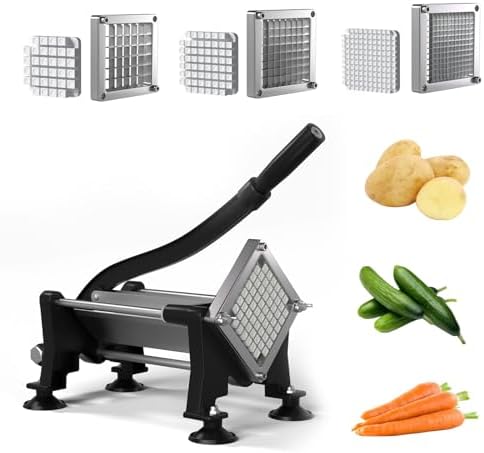
This Awgpd potato slicer uses an I-shaped handle and interchangeable cutting plates to create fries and vegetable sticks. The listing describes a stainless steel and aluminum body with a cast iron handle, and it states that the blade plate and other parts detach for cleaning. It also includes four suction cups for counter mounting. The product is aimed at restaurants, food trucks, cafeterias, and home kitchens, which makes it a flexible pick for mixed-use spaces.
The I-shaped handle gives you a long lever arm, which can make cutting denser potatoes feel less demanding. Because the parts come apart, you can rinse the blade plate and wipe down the body without a complicated teardown. That simplicity is appealing in a small kitchen where cleanup needs to be fast. Some users report that the suction cups hold best when the counter is clean and dry, so it helps to keep the cups free of dust and to test the grip before you start a full batch.
The listing also includes a note about using the cutter on smooth countertops and checking the cups for dust if suction weakens. That detail matters. In a busy kitchen, a cutter that slides during a heavy push can slow you down and create safety concerns. The listing also notes that missing or damaged parts should be reported to the seller, which is a good reminder to check your package carefully on arrival. Because the title references a 1/4-inch cut size but the included cutting options are not fully spelled out in the data, confirm the exact blade set before you buy if a specific size is essential for your menu.
Compared with the VEVOR and New Star models, this cutter is more of a straightforward tool than a full-featured station. It may suit a kitchen that wants a clean, easy-to-clean potato cutter without a lot of extras. For a high-volume line with many cut styles, one of the other picks is likely a better fit.
Pros:
- I-shaped handle provides good leverage for dense produce
- Detachable parts simplify cleaning and storage
- Four suction cups allow counter mounting without drilling
- Suitable for both home and light commercial prep
Cons:
- Suction grip depends on a clean, smooth surface, and the included blade set should be confirmed before purchase
Verdict: The Awgpd slicer is a sensible, easy-to-clean option for a kitchen that needs a dependable potato cutter without a complex setup. Verify the blade sizes you need before ordering, and it can be a good fit for mixed home and commercial use.
SUNVIVIPRO Slicer With an Open-Bottom Plate Outlet

The SUNVIVIPRO cutter is a heavy-duty potato slicer with two replaceable blades, 3/8 inch and 1/2 inch. The listing describes ultra-sharp stainless steel blades and a reinforced aluminum alloy frame. It also includes a long ergonomic handle and four suction cups. A notable design choice is the open-bottom outlet, which lets you place a plate directly under the cutter so finished cuts fall straight into your container. That is a small feature, but it can save a step during prep.
The two-blade setup covers the most common fry thicknesses, which makes this model a good match for a focused menu. The long handle helps you push through firm sweet potatoes and other dense produce with less strain. The listing also points to fruits, vegetables, and salads as additional uses, so the cutter can handle more than just potatoes. For a home cook who wants a reliable fry cutter with a clear drop zone for finished cuts, this is a practical setup.
The main limitation is range. With only two blade sizes, you will not get the wedge or specialty options found on the VEVOR and New Star models. The listing also shows the product as currently unavailable, so you should check Amazon for current stock before you plan around it. Like other suction-cup cutters, it needs a smooth, clean surface to hold firmly, and the cups should be checked for dust if grip weakens.
Compared with the other choices, the SUNVIVIPRO cutter is best viewed as a focused tool. It fits well in a home kitchen or a small prep area that needs only standard fry sizes. For a high-volume commercial station with varied cut needs, one of the broader models is a better fit.
Pros:
- Two replaceable blades cover the most common fry thicknesses
- Open-bottom outlet lets you catch cuts directly on a plate
- Long ergonomic handle reduces strain on dense produce
- Reinforced aluminum frame supports stable operation
Cons:
- Limited to two blade sizes, and the listing currently shows the product as unavailable
Verdict: The SUNVIVIPRO slicer is a good pick for home cooks and small prep setups that only need standard fry sizes. Confirm stock before you buy, and choose a broader model if you need more cut styles for commercial volume.
How to Choose the Right Commercial French Fry Cutter
Choosing a commercial French fry cutter is less about finding the best model on paper and more about matching the tool to your daily workload. A cutter that works well for a family restaurant might frustrate a high-volume fry station, and a heavy station model may be overkill for a food truck. The guidance below walks through the factors that matter most so you can make a confident choice.
Blade Sizes and Cut Styles
The first question to answer is what you need to cut. Most fry programs rely on a thin, medium, or thick cut, which is why 1/4 inch, 3/8 inch, and 1/2 inch blades are so common. If your menu is built around one fry style, two blade sizes may be enough, and a model like the SUNVIVIPRO cutter could serve you well. If you also sell wedges, sweet potato fries, or vegetable sticks, look for a cutter that offers wedge blades. The VEVOR and New Star options both include wedge blades, which can save you from buying a second tool. Think about the menu you run now and the one you may want next year, then choose a blade set that gives you room to grow.
Build Materials and Long-Term Durability
Build quality determines how well a cutter handles years of daily use. Stainless steel blades resist rust and hold an edge better than lower-grade metals, which matters when you clean the blades often. The listings in this guide describe a mix of stainless steel, aluminum alloy, and cast iron construction. Cast iron offers weight and stability, which helps during heavy pushing, but it adds bulk. Aluminum is lighter and easier to move, though it may not feel as planted on its own. Look at where the wear points are, such as the blade holder, handle joint, and base, and consider how each part will hold up under constant use.
Mounting Style and Counter Stability
Mounting determines whether the cutter stays put when you apply force. Suction-cup bases are convenient because they do not require drilling, and they work well on smooth, clean counters. However, they depend on a good seal, so dust, grease, or a textured surface can reduce grip. Table-mounted or wall-mounted options, such as the New Star cutter, add a more permanent layer of stability and can free up counter space when you need it. Before you buy, measure the spot where the cutter will live and check whether your surface is smooth enough for suction feet. A stable cutter protects your hands and keeps your cuts consistent.
Handle Design and Leverage
The handle is where your effort goes, so its design has a big impact on comfort over a long shift. Lever-style and pull-down handles use mechanical advantage to reduce the force needed for each cut. The VEVOR and Mytasuy models both use this approach, and the elongated handle on the Mytasuy is designed to make each push feel more controlled. The I-shaped handle on the Awgpd cutter and the long handle on the SUNVIVIPRO model provide similar leverage. When you compare handles, think about how often you will press the lever and how much wrist and forearm strain you can accept. A comfortable grip can make a noticeable difference in a long prep session.
Cleaning, Blade Changes, and Parts Access
Commercial kitchens need equipment that can be broken down and cleaned quickly between batches. Look for cutters where the blades and push block come out easily, and check whether any parts need special tools. The Mytasuy cutter stands out for its red-button blade release and hand-removable base, which can speed up swaps. The Awgpd and SUNVIVIPRO models also highlight detachable components. Make sure the blades are simple to handle, since sharp edges require care during cleaning. A tool that is easy to take apart is more likely to be cleaned properly, and that supports food safety.
Matching the Cutter to Your Volume
Your daily volume should shape your choice. A small café or food truck that cuts a few pounds of potatoes at a time may do well with a compact suction-cup model. A busy restaurant that prepares large batches each day needs a more stable station with a comfortable handle and a broader blade range. Be honest about how many potatoes you cut in a typical shift and how many people will use the machine. If several staff members share one cutter, ease of cleaning and simple setup become even more important. Matching the tool to your volume helps you avoid buying too little or paying for features you will never use.
Checking Parts, Stock, and Package Condition
Finally, check what is included and what is available. Some listings include spare blades, while others require you to buy replacements separately. The VEVOR listing notes two spare blades per set, and the New Star listing includes a wide range of replacement blades and pushing blocks. Confirm the exact blade sizes before ordering, especially when a title is cut off or a size is not fully stated. Also check stock status, since some listings may show as unavailable at a given time. When your package arrives, inspect it for missing or damaged parts and report any issues to the seller right away.
Frequently Asked Questions
What blade size is best for restaurant French fries?
Most restaurants choose either 3/8 inch or 1/2 inch for a classic fry, with 1/4 inch used for thinner, crispier styles. The best size depends on your menu and your frying equipment. If you plan to offer more than one style, a cutter with several blade options gives you flexibility.
Can a suction-cup cutter handle commercial volume?
A suction-cup cutter can work well for moderate commercial volume, especially in a small kitchen or food truck. Its performance depends on a clean, smooth surface and a firm seal. For very high volume, a table-mounted or wall-mounted station can offer more stability during heavy use.
Do I need a table or wall mount for my cutter?
You do not always need a permanent mount. Suction feet are fine for many kitchens, and they avoid drilling into surfaces. If your prep area is busy or shared, a table or wall mount can keep the cutter steady and free up counter space when it is not in use.
How do I keep a French fry cutter from sliding on the counter?
Clean the countertop and the suction cups before each use, and make sure the surface is smooth and free of grease or dust. If the cutter still shifts, check whether the cups are seated fully. For models with non-slip feet, a dry, flat surface usually provides the best hold.
Can I cut fruits and vegetables other than potatoes?
Yes, most of the cutters in this guide are designed for other produce. Several listings mention carrots, cucumbers, onions, apples, and pears. Softer or very large produce may need extra care, so start with firm items and adjust your pressure as you learn how the tool handles each one.
Is a cast iron or aluminum cutter better for commercial use?
Neither material is automatically better. Cast iron adds weight and stability, which helps during heavy cutting but makes the unit harder to move. Aluminum is lighter and easier to handle, which suits a kitchen that changes its layout often. Choose based on whether you need a permanent station or a tool you can move around easily.
Final Recommendation
For most commercial kitchens, the VEVOR cutter offers the best balance of cut variety, lever-assisted handling, and included spare blades, so it is the most versatile starting point in this lineup. If you want a permanent, stable station with the widest range of blade and wedge options, the New Star Foodservice cutter is the stronger choice. Kitchens that value quick blade changes and easy base removal should look closely at the Mytasuy model. The Awgpd and SUNVIVIPRO cutters are better suited to home cooks or small prep areas that need a simpler setup and a narrower range of cuts. Match your choice to your menu, your counter space, and your daily volume, and you will get a tool that pays for itself in saved time and consistent results.