
Finding the best heat-resistant paint for cookware requires more than checking the temperature rating. The products below are described for automotive parts, grills, stoves, and other metal surfaces—not as coatings for food-contact cookware. None of the supplied product information confirms that the paint is food-safe or suitable for the inside of a pan. If you want to refinish cookware, use only a product whose label specifically permits that use and follow its preparation and curing directions.
For an exterior metal part or other non-food-contact project, these options offer different heat ratings and application styles. The comparison below highlights what the supplied product information does—and does not—establish.
| Product | Stated heat rating | Application and stated use | Availability in supplied data |
|---|---|---|---|
| Rust-Oleum Automotive High Heat Spray Paint, Flat Black | Up to 2,000°F, intermittent heat | Spray; automotive parts and surfaces | Available |
| Rust-Oleum High Heat 5-in-1 Spray Paint, Flat Black | Up to 2,000°F, intermittent heat | Spray with five spray patterns; automotive parts and surfaces | Available |
| Rust-Oleum High Heat Ultra Semi-Gloss Black Spray Paint | Up to 1,200°F, intermittent heat | Spray; grills, stoves, and other high-heat metal surfaces | Available |
| Rust-Oleum High Heat Bar-B-Que Black Protective Enamel Paint | Up to 1,200°F, intermittent heat | Described as spray paint for grills, stoves, and smokers | Listed as unavailable |
| AW Perkins 1400 Deg F Black Stove Paint Brush-On | 1,400°F, according to the product title | Brush-on stove paint; 1-pint size | Listed as unavailable |
Important: A high temperature rating alone does not mean a paint is safe for cookware or food contact. Check the product label and manufacturer’s directions before applying any coating to a cooking item.
Our Picks: Best Heat Resistant Paint For Cookware reviews
1. Rust-Oleum Automotive High Heat Spray Paint: Highest Listed Heat Rating
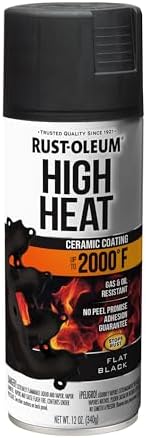
This flat-black aerosol paint is designed for automotive parts and other surfaces exposed to intermittent high heat. Its stated temperature limit is up to 2,000°F, and its Stops Rust formula is intended to help guard against corrosion. The supplied details also list resistance to grease, oil, gas, salt, humidity, and other solvents.
The spray format may be useful for coating metal parts with curves or hard-to-reach areas, though careful masking and ventilation are important with any aerosol. Rust-Oleum says it dries to the touch in about 30 minutes and covers up to 10 square feet per can. Those figures describe drying to the touch and coverage; they should not be treated as instructions for when to heat the coated surface.
For cookware-related projects, the main limitation is the stated intended use: automotive parts and high-heat surfaces. The supplied information does not say that this paint is food-safe or approved for the inside of cookware. Consider it only for a non-food-contact project if the product label confirms that use.
Pros:
- Listed for intermittent heat up to 2,000°F
- Stops Rust formula is intended to protect against corrosion
- Resists several substances, including grease and oil
- Dries to the touch in about 30 minutes, according to the supplied description
Cons:
- Not identified as food-safe or cookware-approved
- Flat-black spray finish may not suit every project
Verdict: Choose this for a non-food-contact metal surface that matches its automotive use and intermittent-heat instructions, not for a cookware interior.
2. Rust-Oleum High Heat 5-in-1: More Control Over Spray Pattern

This Rust-Oleum spray paint is also listed for automotive parts and surfaces subject to intermittent heat up to 2,000°F. Its standout feature is a five-pattern spray dial, with high-output, standard, low-output, vertical-fan, and horizontal-fan settings. The product description also notes that the can sprays from any angle.
The adjustable patterns can give you more control when coating different shapes than a basic spray nozzle. The supplied details describe a ceramic coating with a no-peel promise, fade resistance, and adhesion, along with resistance to gas and oil. It is listed as drying to the touch in about 30 minutes and covering up to 10 square feet per can.
That extra spray control may help with a non-food-contact metal project, but it does not make the paint suitable for cookware. The product information does not establish food-contact safety or compatibility with a pan’s cooking surface. Also, a high heat rating applies to the stated intermittent-use conditions, not every kind of heating or continuous exposure.
Pros:
- Listed for intermittent heat up to 2,000°F
- Five spray patterns offer more application control
- Can sprays from any angle, according to the description
- Stated resistance to gas and oil
Cons:
- Not identified as safe for food contact
- The spray-pattern features may be unnecessary for a small, simple surface
Verdict: This is a strong option to compare for non-food-contact metal jobs where adjustable spray patterns are useful, but it is not a confirmed cookware coating.
3. Rust-Oleum High Heat Ultra: A Semi-Gloss Option for Stoves and Grills

Unlike the first two products, this semi-gloss black spray paint is listed for intermittent heat up to 1,200°F. The supplied description names barbecue grills, wood-burning stoves, radiators, engines, fire pits, and fireplace screens as intended surfaces. It is also described as helping protect metal against rust, corrosion, chipping, and outdoor weathering.
The finish may be a better match than flat black when you want a slight sheen. The product information lists a touch-dry time of about 30 minutes and coverage of roughly 7 to 8 square feet per can. It is designed for high-heat metal surfaces, but those uses do not establish that it can be applied to cooking surfaces or parts that touch food.
Compared with the 2,000°F automotive paints, this option has a lower stated heat limit. In return, its listed use cases more directly include grills and stoves. That makes it a more relevant candidate for an exterior stove or grill restoration, provided the surface and heating conditions match the label.
Pros:
- Listed for intermittent heat up to 1,200°F
- Semi-gloss black finish
- Intended for several high-heat metal surfaces, including grills and stoves
- Helps protect against rust, corrosion, and chipping, according to the description
Cons:
- Lower stated heat limit than the 2,000°F options
- Not identified as food-safe or suitable for cookware interiors
Verdict: Consider this for a non-food-contact grill or stove surface that falls within its label directions; do not use its temperature rating as proof of cookware safety.
4. Rust-Oleum High Heat Bar-B-Que Black: A Grill-Focused Enamel

This black protective enamel is described for high-heat metal surfaces such as grills, stoves, and smokers. The supplied description lists an intermittent heat limit of up to 1,200°F, along with protection against rust, corrosion, chipping, and outdoor weathering. It also gives a touch-dry time of about 30 minutes and coverage of 7 to 8 square feet per can.
The product details resemble those for Rust-Oleum High Heat Ultra, including the temperature rating and listed surface types. The description calls this product a spray paint, but shoppers should check the current packaging and directions to confirm the exact format and application instructions before starting a project.
The supplied product data lists this item as unavailable. Even if you find it elsewhere, the grill-focused use does not make it a cookware coating. There is no supplied confirmation that it is suitable for food-contact areas, so it should not be selected for a pan’s interior or cooking surface.
Pros:
- Listed for intermittent heat up to 1,200°F
- Designed for grills, stoves, and smokers
- Described as protecting metal against rust and outdoor weathering
Cons:
- Listed as unavailable in the supplied product data
- Food-contact safety is not established
Verdict: It may suit an exterior grill or stove project if you can obtain it and its label matches your use, but it is not a cookware-safe choice based on the information provided.
5. AW Perkins Brush-On Stove Paint: A Non-Spray Format

The supplied product title identifies this as black brush-on stove paint rated to 1,400°F and sold in a 1-pint size. A brush-on format can be useful when you prefer to apply paint with a brush rather than spray it, but the provided information does not give details about drying time, coverage, surface preparation, or curing.
Because the product data is limited, confirm the label’s intended surfaces and application directions before buying or using it. The word “stove” and the stated temperature rating do not confirm that it is suitable for cookware or food-contact areas. The supplied data also lists it as unavailable.
Compared with the Rust-Oleum aerosol choices, this product’s main distinction is its brush-on format and its listed 1,400°F rating. It may be worth investigating for a stove-related project if it becomes available, but the limited specifications make it harder to compare for a particular job.
Pros:
- Brush-on format rather than an aerosol spray
- Product title lists a 1,400°F heat rating
- Product title identifies a 1-pint container
Cons:
- Listed as unavailable in the supplied product data
- Supplied details do not confirm coverage, drying time, or cookware safety
Verdict: Consider it only for a stove-paint project after checking the full label; its limited specifications and unavailable status make it a less straightforward choice.
How to Choose Heat-Resistant Paint for a Cookware-Related Project
Confirm the Intended Surface First
Start by deciding exactly what you plan to paint: a cookware interior, an outer wall, a handle, or a separate stove or grill part. The products in this guide are described for automotive parts, grills, stoves, and other metal surfaces. The supplied information does not confirm that any of them is suitable for cookware. For any surface that may touch food, choose only a coating whose manufacturer explicitly approves that use.
Do Not Treat the Heat Rating as a Food-Safety Rating
A rating such as 1,200°F or 2,000°F describes heat resistance under the stated conditions; it does not establish that a coating is safe around food. The first three Rust-Oleum options specify intermittent heat. If your project involves repeated heating, direct flame, or temperatures that may exceed the product’s stated limits, follow the label rather than relying on the number alone.
Match the Paint Format to the Project
Spray paint can cover shaped surfaces, while brush-on paint offers a different way to apply a coating. The products here include aerosol options with different spray patterns and one brush-on stove paint. Consider where overspray might travel, whether you can mask nearby areas, and whether the product’s instructions allow use on the surface you have in mind.
Check Finish, Coverage, and Drying Details
Finish and coverage can affect how practical a product is for your project. The supplied descriptions list flat black and semi-gloss black options, along with coverage figures for several spray products. Drying to the touch is not necessarily the same as being ready for heating. Check the full label for required drying, curing, ventilation, and first-use steps.
Review Surface Preparation and Application Instructions
Before applying paint, read the manufacturer’s directions for cleaning, rust removal, masking, coats, and any required curing process. The supplied data does not provide a complete set of preparation or curing instructions for every product. Do not put a coated item into service until the product label says it is ready for the intended conditions.
Consider Availability and Full Product Details
The supplied data lists the Bar-B-Que enamel and AW Perkins stove paint as unavailable. Availability can change, and product information may vary by listing. Check the product label and current listing details before purchase, especially when the exact application method, coverage, or permitted surface is important.
Frequently Asked Questions
Can I use any of these paints inside a frying pan?
The supplied product information does not identify any of these paints as food-safe or approved for cookware interiors. Do not apply them to a cooking surface unless the manufacturer’s label explicitly permits that use.
Does a 2,000°F rating mean the paint is safe for cookware?
No. A heat rating does not confirm food-contact safety. It also matters whether the rating applies to intermittent heat or another stated condition. Follow the product label for both intended surfaces and temperature limits.
Which option has the highest stated heat rating?
The two Rust-Oleum automotive spray paints are listed for intermittent heat up to 2,000°F. That rating does not make them cookware-approved.
Which product is listed for grills and stoves?
Rust-Oleum High Heat Ultra and Rust-Oleum High Heat Bar-B-Que Black are described for grills and stoves. AW Perkins is identified as stove paint in its title. Check each product’s label to confirm the surface and use conditions before applying it.
Can I heat an item as soon as the paint feels dry?
Not necessarily. A touch-dry time does not tell you when a coating is ready for heating. Follow the product’s full instructions for drying, curing, and first use.
Is spray paint or brush-on paint better?
It depends on the project and the product instructions. Spray options may offer different patterns or easier coverage on shaped surfaces, while the AW Perkins product is identified as brush-on. Choose a format that you can apply safely and that is approved for your specific surface.
Final Recommendation
For a non-food-contact metal surface, Rust-Oleum Automotive High Heat Spray Paint and Rust-Oleum High Heat 5-in-1 have the highest stated temperature limits in this group, while Rust-Oleum High Heat Ultra is specifically described for grills and stoves. However, none of the supplied product details confirms food-contact safety or use on cookware. If your goal is to repaint a pan or pot, do not choose based on heat rating alone—find a product explicitly approved by its manufacturer for cookware and the exact surface you intend to coat.