
A clean sushi-roll slice depends on more than a sharp edge: a long, slim blade can travel through a roll in one smooth stroke, helping keep the rice, filling, and nori together. The knives below are all listed as 10-inch sushi or sashimi knives. They differ in steel, handle design, and edge details, so the right choice depends on whether you want a premium layered-steel design, a more straightforward stainless option, or a blade with a protective coating.
Quick picks: The SHAN ZU stands out on paper for its 9-layer construction and stated 62 HRC hardness. SANMEIHO offers a more maintenance-friendly stainless-steel option, while the KEEMAKE has a coated blade designed to resist rust and food sticking.
| Knife | Blade details | Handle and design | Best fit |
|---|---|---|---|
| SHAN ZU 10-Inch Japanese Sushi Knife | 9-layer construction; 10Cr15MoV core; stated 62 HRC | Octagonal red sandalwood handle; matte blade | Shoppers seeking a premium layered-steel design |
| SANMEIHO 10-Inch Sushi Knife | 5Cr15MoV stainless steel; stated 57 HRC; double-sided 12° edge | Full-tang design; octagonal red sandalwood handle | Home cooks who want a stainless-steel option |
| HOSHANHO 10-Inch 9-Layer Sushi Knife | 9-layer construction; 10Cr15CoMoV core; stated 62 HRC | Octagonal mahogany handle with G10 bolsters | Thin slicing and a layered, textured look |
| HOSHANHO 10-Inch Rosewood Sushi Knife | 8-layer composite steel; 10Cr15CoMoV core; stated 60±2 HRC | Octagonal rosewood handle with G10 material | Versatile slicing of sushi, fish, tofu, and soft cheese |
| KEEMAKE 10-Inch Sashimi Knife | 440C high-carbon stainless steel; stated 58 HRC; black coating | Rosewood handle with G10 bolsters | Shoppers who value a coated blade and easy resharpening |
Our Picks: Best Knife For Cutting Sushi Rolls reviews
1. SHAN ZU 10-Inch Japanese Sushi Knife: Best for Layered-Steel Construction

The SHAN ZU is a 10-inch yanagiba-style sushi and sashimi knife built around a Japanese 10Cr15MoV steel core. Its listed 9-layer forged construction and stated 62 HRC hardness are aimed at edge retention and a firm, precise feel. The company also specifies a 12-degree edge, which is intended to help the blade move smoothly through delicate ingredients.
For sushi rolls, the long blade gives you room to cut across a roll in one controlled draw rather than pressing down repeatedly. Its matte finish is described as helping reduce fingerprints and food residue. The octagonal red sandalwood handle gives the knife a traditional look and a shape that can help you guide the cutting direction.
This is the most feature-rich choice in the group if layered construction, a high stated hardness, and a presentation box matter to you. The trade-off is that a hard, sharp edge calls for careful handling and suitable sharpening. The description does not specify whether the edge is single- or double-beveled, so check the product details if that distinction matters to your technique.
Pros:
- 9-layer construction with a 10Cr15MoV steel core
- Listed 12-degree edge and 62 HRC hardness
- Long blade suited to smooth slicing across sushi rolls
- Octagonal red sandalwood handle and gift box
Cons:
- Hard steel may require more care when sharpening
- Edge bevel details are not stated in the supplied description
Verdict: Choose the SHAN ZU if you want a premium-feeling layered-steel knife and are prepared to care for a hard, sharp edge.
2. SANMEIHO 10-Inch Sushi Knife: Best for a Straightforward Stainless-Steel Option

The SANMEIHO is listed as a 10-inch sushi knife made from 5Cr15MoV Japanese stainless steel. Its stated hardness is 57 HRC, and the description highlights rust resistance, easier resharpening, and a double-sided 12-degree edge. Those details make it a practical option for someone who wants a dedicated slicing knife without choosing one of the harder, layered-steel models.
It has a full-tang construction and an octagonal red sandalwood handle. The long blade can be used for sushi rolls, fish filleting, and larger cuts of steak, according to the product description. For rolls, use a smooth slicing motion and wipe the blade between cuts if rice or filling starts to cling.
Compared with the SHAN ZU and HOSHANHO 9-layer models, the SANMEIHO has a lower stated hardness and simpler steel construction. That may appeal if ease of resharpening and stainless-steel characteristics are more important to you than a premium layered finish. It is still a long, specialized blade, so it may feel like more knife than you need if you only cut small rolls occasionally.
Pros:
- Japanese stainless-steel blade listed at 57 HRC
- Double-sided 12-degree cutting edge
- Full-tang construction and octagonal handle
- Described as suitable for sushi, fish, and larger steaks
Cons:
- Its 10-inch length may be cumbersome in a small kitchen
- Less layered construction than several other picks here
Verdict: Pick the SANMEIHO if you want a versatile stainless-steel sushi knife with a stated double-sided edge and a focus on easier resharpening.
3. HOSHANHO 10-Inch 9-Layer Sushi Knife: Best for Thin, Precise Slices

This HOSHANHO knife is designed for slicing sashimi and sushi with a long, slim blade. The product description lists a 9-layer forged construction, a 10Cr15CoMoV steel core, and a stated hardness of 62 HRC. It also specifies a symmetrical edge sharpened to 12 degrees on each side, a useful detail if you prefer a double-bevel blade.
For cutting rolls, a slim blade and smooth stroke can help limit pressure on the rice and fillings. The handle is octagonal mahogany with G10 bolsters, combining wood with a water-resistant bolster material, according to the listing. Its hammered, darkened finish gives it a distinctive appearance, though the product description does not establish how much the finish reduces sticking during a cut.
It shares a high stated hardness and layered construction with the SHAN ZU, but this HOSHANHO gives a clearer edge specification: a symmetrical 12-degree edge on both sides. That may make it easier to assess if you want a double-bevel knife. As with other hard-steel options, use a suitable sharpening method and avoid treating the slim blade like a heavy chopping knife.
Pros:
- 9-layer construction with a 10Cr15CoMoV core
- Symmetrical 12-degree edge on each side
- Long, slim blade intended for thin slicing
- Octagonal mahogany handle with G10 bolsters
Cons:
- Stated 62 HRC hardness calls for careful edge maintenance
- Its specialized slicing shape is less suited to heavy chopping
Verdict: Choose this HOSHANHO if you want a layered-steel knife with a clearly specified double-bevel edge for precise slicing.
4. HOSHANHO 10-Inch Rosewood Sushi Knife: Best for Versatile Slicing
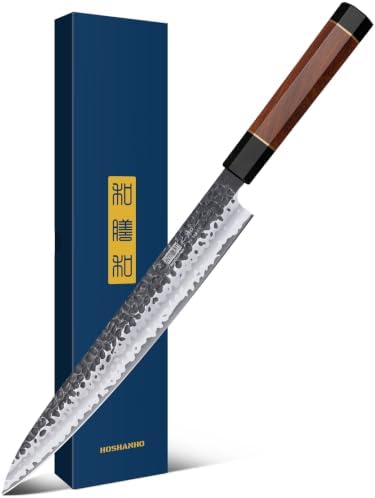
This 10-inch HOSHANHO has a 10Cr15CoMoV steel core protected by 8 layers of composite steel. Its listed hardness is 60±2 HRC, and the product description gives a hand-polished edge of 12 to 15 degrees per side. Unlike the previous HOSHANHO pick, this model is specifically described as double-beveled.
The rosewood handle has an octagonal shape and is paired with G10 material. The knife is intended for fish, sashimi, and sushi rolls, as well as soft foods such as tofu and soft cheese. That broader use may suit a home cook who wants a long slicing knife for several delicate ingredients rather than a tool reserved only for sushi preparation.
Its stated hardness is lower than the 62 HRC models in this group, though the listed range still calls for thoughtful care. The 8-layer build also differs from the 9-layer construction on the other HOSHANHO model. Layer count alone does not determine cutting performance, so the useful distinction here is the stated double bevel and the wider range of suggested uses.
Pros:
- Double-bevel edge listed at 12 to 15 degrees per side
- 8-layer composite steel around a 10Cr15CoMoV core
- Designed for sushi, fish, tofu, and soft cheese
- Octagonal rosewood handle with G10 material
Cons:
- The 10-inch blade may take up more storage space than a general kitchen knife
- The product description does not specify a protective blade coating
Verdict: Choose this HOSHANHO if you want a double-bevel sushi knife that is also described for slicing other soft ingredients.
5. KEEMAKE 10-Inch Sashimi Knife: Best for a Coated Blade

The KEEMAKE is a 10-inch yanagiba-style knife made from 440C high-carbon stainless steel, with a stated hardness of 58 HRC. Its black hydrophobic coating is described as helping resist rust and food sticking. That feature may appeal when you are making repeated cuts through sticky rice or preparing fish, though a coating does not replace proper cleaning and drying.
The handle is made from rosewood and includes G10 bolsters. The listing also describes the knife as balanced at the bolster and notes that the steel is intended to be relatively easy to resharpen. These features make it a practical alternative to the harder, layered-steel options, particularly if you value a coated blade and maintenance that the maker describes as straightforward.
Compared with the SANMEIHO, the KEEMAKE also uses stainless steel, but its stated 58 HRC hardness is higher than the SANMEIHO’s 57 HRC and it adds a coating. The product description does not specify the edge angle or whether the blade is single- or double-beveled, so confirm those details if you have a specific sharpening setup or cutting preference.
Pros:
- 440C high-carbon stainless steel listed at 58 HRC
- Black coating is intended to resist rust and food sticking
- Rosewood handle with G10 bolsters
- Described as durable and relatively easy to resharpen
Cons:
- Edge angle and bevel type are not stated in the supplied description
- The coating may require extra care to avoid damage
Verdict: Pick the KEEMAKE if a coated stainless-steel blade and a rosewood-and-G10 handle are higher priorities than layered-steel construction.
How to Choose a Knife for Cutting Sushi Rolls
Choose a blade length you can control
All five picks are listed as 10-inch knives, a length that gives you room to draw the blade across a roll in one pass. That can help reduce the pressure that may flatten rice or push fillings out of place. A long blade also needs enough counter space and careful storage. If you are new to this style, consider whether you can comfortably guide a knife of this size before choosing one.
Look for a slim, sharp slicing edge
A sushi knife should slice cleanly rather than force you to saw through a roll. The listed edge details vary: the SANMEIHO specifies a double-sided 12-degree edge, the 9-layer HOSHANHO specifies 12 degrees on each side, and the rosewood HOSHANHO lists 12 to 15 degrees per side. The supplied descriptions do not give a bevel type or angle for the SHAN ZU or KEEMAKE. Check those specifications if you prefer a particular edge style.
Match steel and hardness to your maintenance habits
Hardness can affect how a blade holds its edge and how carefully it needs to be handled and sharpened. The listed hardness ranges from 57 HRC for the SANMEIHO to 62 HRC for the SHAN ZU and one HOSHANHO. The KEEMAKE is listed at 58 HRC, and the other HOSHANHO at 60±2 HRC. These are manufacturer specifications, not a guarantee of how long a knife will stay sharp in your kitchen. Regardless of steel, clean and dry the blade after use and follow suitable sharpening guidance.
Consider coatings and layered construction carefully
Several knives use layered steel, while the KEEMAKE has a black coating intended to resist rust and food sticking. A layered appearance can be appealing, but it should not be the only reason to choose a knife; the edge, handle, and care requirements matter more to your daily use. A coating may help with release, but it still needs gentle care. Avoid assuming that a coated blade never needs cleaning or that food will not cling to it.
Pick a handle shape that feels secure
Each knife in this group has a wood handle, and several use an octagonal shape. The SANMEIHO describes a full-tang design, while the KEEMAKE and HOSHANHO models combine wood with G10 material at the bolster. Handle shape and balance affect control, especially during repeated cuts. If possible, consider how the handle dimensions and materials fit your grip, and keep the handle dry and clean according to the maker’s instructions.
Use the knife for slicing, not heavy chopping
These are long sushi or sashimi knives designed mainly for slicing. Use a smooth draw across the roll and avoid twisting the blade or striking hard surfaces. A specialized slicing knife is not a substitute for a heavier chef’s knife when you need to chop dense ingredients. Rinse or wipe the blade as needed between cuts, then clean and dry it before storing it safely.
Frequently Asked Questions
What kind of knife is best for cutting sushi rolls?
A long, sharp slicing knife can help you cut through a roll in a smooth stroke. The five options here are listed as 10-inch sushi or sashimi knives, and each is designed for slicing. Choose based on edge style, steel, handle, and how much maintenance you are comfortable doing.
Can I use a yanagiba to cut sushi rolls?
Yes. The knives in this guide are described as sushi or sashimi knives, and several product descriptions specifically mention sushi rolls. Use a controlled slicing motion rather than pressing straight down repeatedly, which can compress the roll.
Should I choose a single-bevel or double-bevel knife?
That depends on your cutting style and sharpening experience. A double-bevel knife has an edge on both sides, and some models in this guide state that they use a double-sided or symmetrical edge. The supplied details do not identify the bevel type for every knife, so check the product specifications before buying if this is important to you.
Is a 10-inch sushi knife too long for home use?
Not necessarily, but it takes more space to use and store than a shorter kitchen knife. The length can help you slice across a roll in one pass. Make sure you have room to work safely and a secure place to store the blade.
How do I keep rice from sticking to the blade?
Use a clean blade and wipe it between cuts when rice or filling builds up. The KEEMAKE has a coating described as helping resist food sticking, but no blade is guaranteed to stay clean during use. Follow the maker’s care instructions and avoid rough cleaning methods that could damage a finish.
Are these knives suitable for raw fish as well as rolls?
Yes. The product descriptions identify the knives as sashimi or fish-slicing knives, and several mention filleting or slicing fish. Their long, slim profiles are intended for slicing delicate ingredients. For handling raw fish safely, keep the knife and work surface clean and follow safe food-handling practices.
Final Recommendation
For a feature-rich option, the SHAN ZU stands out with its listed 9-layer construction, 10Cr15MoV core, and stated 62 HRC hardness. Choose the SANMEIHO if you prefer a stainless-steel knife with a clearly stated double-sided edge and easier resharpening as a focus. The HOSHANHO 9-layer model is a strong fit if you want a specified symmetrical edge, while the KEEMAKE is worth considering for its coated blade. Match your choice to your maintenance habits and make sure a 10-inch blade feels manageable in your kitchen.