
Choosing a 4K drone with obstacle avoidance means balancing camera quality, flight assistance, battery life, and ease of use. The five options below range from simple GPS models with built-in screens to advanced drones with a stabilized gimbal and high-resolution video. Keep in mind that obstacle sensing can help reduce collision risk, but it does not replace careful piloting. The feature details here reflect the supplied product listings, so check the listing for current specifications and availability before you buy.
Quick Comparison
| Drone | Camera and stabilization | Obstacle avoidance and flight support | Battery and controller |
|---|---|---|---|
| Zoiskn GPS Drone | 4K camera; adjustable angle | 360° avoidance, GPS return, optical-flow hover | Three batteries; built-in screen controller |
| KUNRUN GPS Drone | 4K camera; brushless motors | 360° avoidance, GPS support, Follow Me and waypoint flight | Three batteries; large-screen controller |
| SKYROVER X1 | 4K/60fps HDR video, 48MP photos, 3-axis gimbal | 360° sensing, Smart Return to Home, tracking modes | Up to 96 minutes with three batteries; touchscreen controller |
| GXTDL V918 MAX | 8K camera claim; video resolution not specified | 360° avoidance, GPS return, Follow Me and waypoint modes | Up to 90 minutes with three batteries; screen controller |
| DJI Mini 5 Pro Fly More Combo | 1-inch sensor, 4K/60fps HDR, 3-axis gimbal | Omnidirectional sensing, ActiveTrack 360°, return-to-home support | Up to 36 minutes per battery; DJI RC 2 controller |
Our Picks: Best 4K Drones With Obstacle Avoidance reviews
1. Zoiskn GPS Drone: A Beginner-Friendly Pick With a Screen Controller

The Zoiskn combines a 4K camera with GPS flight assistance and a controller that has a built-in screen. That screen is useful if you would rather not attach a phone just to see the live view. The camera angle can be adjusted remotely, so you can change your framing while the drone is in the air.
Its listed flight aids include 360° obstacle avoidance, GPS return-to-home, and optical-flow hover. The return function is designed to bring the drone back if it loses signal or runs low on battery, while optical flow is intended to help it hold position when GPS reception is weak. These are helpful safeguards, not a guarantee that the drone will avoid every obstacle or return safely in every situation.
Three batteries are included, with up to 25 minutes of flight time claimed per battery. The listing says some functions, including gesture photography, intelligent following, and surround shooting, require a phone. That makes this a practical option if you want a screen-equipped controller but still expect to use an app for certain creative modes.
Pros:
- Built-in screen lets you fly without using a phone for the live view.
- GPS return and optical-flow hover add useful flight assistance.
- Three batteries are listed, with up to 75 minutes of combined flight time.
- Remote camera-angle adjustment helps with framing in flight.
Cons:
- Some listed shooting and tracking features require a phone.
- Obstacle avoidance should not be treated as a substitute for attentive flying.
Verdict: Choose the Zoiskn if a built-in screen, beginner-oriented flight aids, and several included batteries matter more to you than advanced camera stabilization.
2. KUNRUN GPS Drone: A Foldable Travel Option With Smart Flight Modes

The KUNRUN is described as a foldable, under-249g drone for travel and casual outdoor flying. It pairs a 4K camera with a large-screen controller, GPS assistance, and 360° obstacle avoidance. Its listed smart modes include Follow Me and waypoint flight, although Follow Me must be operated through the mobile app.
Three batteries are said to provide up to 75 minutes of combined flight time. The product description also names brushless motors, which the listing presents as a design choice for smoother performance and outdoor stability. Those claims may appeal if you want a compact drone for trips and longer flying sessions, but the listed total is a combined maximum across batteries, not one uninterrupted flight.
There is one important buying caveat: the supplied product data marks this item as unavailable. Availability can change, so check the product page before making plans around this model. If it is available when you shop, compare its app-dependent tracking with the other options here, especially if you prefer to control everything from the included screen controller.
Pros:
- Foldable design is intended to make packing and carrying easier.
- Includes a large-screen controller and a 4K camera.
- Three batteries are listed, with up to 75 minutes of combined flight time.
- GPS support, Follow Me, and waypoint flight add options for outdoor use.
Cons:
- The supplied listing data marks the product as unavailable.
- Follow Me requires the mobile app.
Verdict: The KUNRUN could suit travelers seeking a foldable drone with app-based tracking, but confirm that it is available before considering it alongside the other picks.
3. SKYROVER X1: The Strongest Camera and Stabilization Package

The SKYROVER X1 stands out for its camera specifications. The listing describes 4K/60fps HDR video, 48MP photos, a 1/1.32-inch CMOS sensor, and a 3-axis gimbal. The gimbal is a key distinction from the simpler adjustable-angle cameras on several other options: it is designed to keep footage steady as the drone moves.
Its 5.5-inch touchscreen controller has a stated brightness of 700 nits, and the listing says it can be used without a phone. Other features include 360° obstacle sensing, Smart Return to Home, AI Auto Track, Smart Spotlight, Dual Tracking, and vertical shooting. That mix makes the X1 the most feature-rich choice here for people who want a ready-to-use controller and creative shooting modes.
The product description claims up to 96 minutes of flight time with three batteries and transmission up to 9.32 miles. Treat those as listing specifications, not a promise of real-world flight duration or a reason to fly beyond legal line-of-sight requirements. The X1 is also a better fit for someone who values camera control and stabilization than for a shopper focused mainly on simple, low-cost practice flights.
Pros:
- 4K/60fps HDR video and 48MP photo specifications.
- 3-axis gimbal is designed to provide steadier footage.
- Bright touchscreen controller works without a phone, according to the listing.
- Three batteries are listed, with up to 96 minutes of combined flight time.
Cons:
- Its advanced camera and tracking features may be more than a beginner needs.
- Obstacle sensing and transmission claims do not remove the need for careful, legal flying.
Verdict: Pick the SKYROVER X1 if video quality, gimbal stabilization, and an all-in-one screen controller are your top priorities.
4. GXTDL V918 MAX: A GPS Drone With Long Listed Battery Life
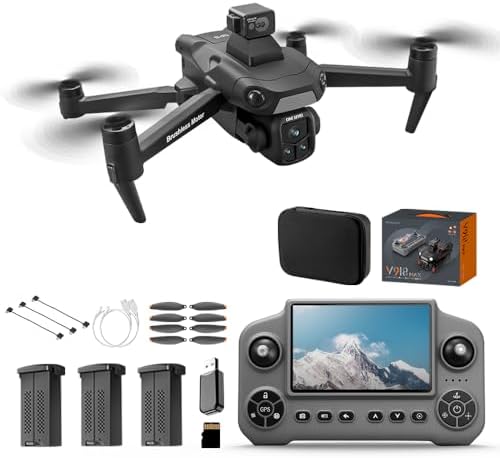
The V918 MAX is a GPS-equipped drone with a screen controller, 360° obstacle avoidance, and several automated flight modes. Its listing advertises an 8K camera, but it does not specify a 4K video frame rate or clearly state the video resolution. If smooth 4K footage is a must-have, check the product details carefully rather than assuming that the 8K camera claim means 8K or 4K video recording.
The supplied description lists GPS return-to-home, Follow Me, waypoint flight, and Circle-Fly. It says the drone should acquire at least nine GPS satellites before takeoff to save the home point for return-to-home use. Some advanced shooting functions require the mobile app, even though the controller has a built-in display.
Three batteries are listed, with up to 90 minutes of total flight time. The screen size is inconsistent in the supplied information: the product title says 4.5 inches, while the description says 5 inches. Confirm the controller size and camera details on the listing if those features will determine your choice. This model is aimed at shoppers who value GPS features and long combined battery time, but its specifications need more checking than the clearer camera descriptions of the SKYROVER and DJI.
Pros:
- GPS return-to-home and several automated flight modes are listed.
- Three batteries are said to provide up to 90 minutes of combined flight time.
- Includes a screen controller, so a phone may not be needed for basic viewing.
- The listing describes brushless motors and a lightweight design.
Cons:
- The description does not clearly specify 4K video recording.
- The listed controller screen size differs between the title and description.
Verdict: Consider the V918 MAX if its GPS modes and battery bundle appeal to you, but verify the camera-video and screen specifications before buying.
5. DJI Mini 5 Pro Fly More Combo: A Premium Compact Drone With Omnidirectional Sensing

The DJI Mini 5 Pro has the most detailed camera and stabilization specifications in this group: a 1-inch CMOS sensor, 4K/60fps HDR video, and a 3-axis gimbal. It also offers true vertical filming and 225° roll rotation, giving creators more options for framing shots. The included DJI RC 2 controller has a built-in screen, and the bundle lists three batteries and a charging hub.
Its obstacle feature is described as omnidirectional sensing, with forward-facing LiDAR and vision sensors for obstacle detection. The product also lists Nightscape sensing and ActiveTrack 360°. These advanced features may suit creators who want automated subject tracking and more control over camera movement, though they do not make night flying risk-free.
Pay close attention to the weight information. The listing gives an approximate weight of 249.9g, with a stated variation of ±4g. That means the drone may be at or above the 250g threshold, depending on the unit and configuration. Registration and operating rules depend on how and where you fly, so do not rely on the “Mini” name or a near-250g weight alone to determine what rules apply.
The listing claims up to 36 minutes of flight per battery. This is less combined time than the three-battery bundles listed for several other drones here, but DJI offers stronger camera details and stabilization. The listing also notes that the DJI Fly app is not available through Google Play and directs users to DJI’s official website for the app.
Pros:
- 1-inch sensor and 4K/60fps HDR video are clearly specified.
- 3-axis gimbal is designed to produce smooth footage.
- Omnidirectional sensing and ActiveTrack 360° add advanced flight and tracking tools.
- Fly More bundle includes three batteries, a screen controller, and charging accessories.
Cons:
- Listed weight is close to 250g and can vary, so check applicable rules and the actual configuration.
- The listing says Android users may need to download the DJI Fly app from DJI’s website.
Verdict: Choose the DJI Mini 5 Pro if you want the strongest stated camera and gimbal package in this roundup and are comfortable checking the app and weight-related requirements.
How to Choose a 4K Drone With Obstacle Avoidance
Check what “4K” means for the camera
A camera’s headline resolution does not tell you everything about the footage it records. Look for the actual video resolution and frame rate, along with details about the sensor and stabilization. In this group, the SKYROVER X1 and DJI Mini 5 Pro specify 4K/60fps video, while other listings provide fewer details about recording modes. A claim such as “8K camera” is not enough to confirm the video resolution if the listing does not spell it out.
Compare obstacle sensing with the other safety features
Terms such as “360°” and “omnidirectional” describe broad obstacle-sensing coverage, but the exact system can differ between drones. GPS return-to-home and hovering assistance are separate features that can help with positioning or recovery. None of these systems guarantees that a drone will detect and avoid every object. Keep a clear view of the aircraft, learn the controls in an open area, and follow the manual’s guidance.
Look for a gimbal if steady video matters
A remote-adjustable camera angle is useful for changing the view, but it is not the same as a multi-axis gimbal. A gimbal is designed to steady the camera as the drone moves. The SKYROVER X1 and DJI Mini 5 Pro list 3-axis gimbals, while the Zoiskn description focuses on camera-angle adjustment. If smooth moving footage is central to your plans, compare stabilization details before focusing on resolution alone.
Understand battery-time claims
When a product says it offers up to 75, 90, or 96 minutes, that figure may describe total time across several batteries. It does not mean one uninterrupted flight. Consider how many batteries are included, the stated time per battery, and whether the bundle includes a charging hub. Actual time in the air can vary, so leave a safe reserve to bring the drone back and land.
Choose a controller that fits how you fly
A built-in-screen controller can make it easier to see the live view without attaching a phone. App-based features, such as some tracking or creative modes, may still require a phone. Check which functions work from the controller alone, whether the screen size is clearly stated, and whether the required app is compatible with your device.
Verify weight and local flight rules
Several listings describe their drones as under 249g, but weight can depend on the exact model and setup. The DJI listing gives a weight of about 249.9g with a stated variation, so some units may be at or above 250g. In the United States, applicable FAA requirements depend on factors such as weight and whether you fly recreationally or for business. Check current FAA guidance and local restrictions before flying; a lightweight label does not automatically exempt every flight from rules.
Think about portability and the places you plan to fly
Foldable designs and compact bodies can make a drone easier to carry on hikes or trips. But portability is only one part of the decision. Consider how you will transport spare batteries, whether the controller fits your bag, and whether the drone’s camera and flight modes match your intended use. Always fly in permitted areas and avoid relying on obstacle sensing in tight or unfamiliar spaces.
Frequently Asked Questions
Does obstacle avoidance make a drone safe to fly near anything?
No. Obstacle avoidance can help a drone detect objects, but it cannot guarantee that every obstacle will be detected or avoided. You should still keep the drone in view, leave room to maneuver, and follow the operating instructions.
Is a 4K camera the same as 4K video?
Not necessarily. A listing may advertise a camera with a high-resolution photo claim without clearly specifying its video recording resolution. Check the video resolution and frame rate in the product details if you need 4K footage.
Which option has a 3-axis gimbal?
The supplied descriptions list a 3-axis gimbal on the SKYROVER X1 and DJI Mini 5 Pro. A gimbal is designed to help stabilize the camera, which can be useful for smoother footage.
Can I use these drones without a smartphone?
The Zoiskn, SKYROVER X1, GXTDL V918 MAX, and DJI Mini 5 Pro descriptions include controllers with screens. However, some modes may still require a phone app. The KUNRUN’s Follow Me feature specifically requires its mobile app.
Do the listed flight times mean one long flight?
No. For products that include multiple batteries, the total is the claimed combined flight time across those batteries. The actual duration of a single flight can vary, and you should plan to land with enough battery remaining for a safe return.
Are drones under 249g exempt from all registration rules?
No. Weight is only one part of the rules. Requirements can depend on the type of operation and other factors, and a drone near the 250g threshold may weigh more than expected. Check FAA guidance and local restrictions before flying.
Conclusion
For the clearest stated mix of 4K video, gimbal stabilization, and a screen controller, the SKYROVER X1 is a strong all-around choice. The DJI Mini 5 Pro is the better fit if its larger listed sensor, tracking tools, and camera controls matter most, while the Zoiskn offers a simpler screen-equipped setup with GPS assistance. Before choosing any model, confirm its current listing details, especially camera resolution, app requirements, controller specifications, and weight.