
Choosing the best air mattress for a hospital bed depends on more than size. You’ll want to consider the type of pressure relief, pump noise, ease of adjustment, cover design, and whether the mattress fits your bed. The options below range from thin overlays for use on an existing mattress to full-height systems with features such as alternating pressure and low-air-loss airflow. Ask a health care professional which type is appropriate for the person using it, especially if they have a pressure injury or a high risk of developing one.
Quick Comparison
| Product | Type and standout features | Size or capacity listed |
|---|---|---|
| MedVance Medical Alternating Air Mattress | Alternating air mattress with digital pump, cell-on-cell design, and CPR release | 80 x 36 x 8 inches; 450 lb capacity |
| Vive 8-Inch Low Air Loss Mattress | Low-air-loss mattress with alternating pressure and lateral rotation | 8 inches thick; other dimensions and capacity not provided |
| Careboda Alternating Pressure Mattress | Thin air overlay with adjustable pump and sealed air chambers | 75 x 35 x 2.8 inches; 350 lb capacity |
| ProHeal Low Air Loss Alternating Pressure Mattress | Cell-on-cell mattress with low-air-loss ventilation, alarms, and multiple cycles | 36 x 80 x 8 inches |
| TenderGentle Low Air Loss Mattress | Alternating and static modes with a vapor-permeable cover | 36 x 80 inches; 350 lb capacity; listing information marks it unavailable |
Our Picks: Best Air Matress For Hospital Bed reviews
MedVance Medical Alternating Air Mattress: Best for a Full-Height System

The MedVance is an 8-inch-tall alternating air mattress made to fit most standard hospital beds. Its cell-on-cell construction keeps air in the lower layer during a power outage, and the company says it can provide up to 24 hours of protection against the mattress bottoming out. That extra height and layered design set it apart from thinner overlays that sit on top of another mattress.
The digital pump has an LED screen for weight and pressure settings, along with diagnostic alarms. A pillow function keeps the three cells at the head of the bed inflated in static mode. For emergencies, a red-tag CPR release is designed to deflate the mattress quickly. The quilted, water-resistant cover has an anti-slip coating and adjustable straps for securing it to the bed frame.
The pump is described as operating below 20 dB, but actual sound can depend on the room and setup. The mattress measures 80 by 36 inches and has a listed weight capacity of 450 pounds. Confirm that those measurements fit your bed and that the pump’s settings suit the person using it. It is a more feature-rich choice than the Careboda overlay, though its larger size and electronic controls may be more than some households need.
Pros:
- Full-height, 8-inch cell-on-cell design
- Digital controls, pressure display, and diagnostic alarms
- CPR release and head-of-bed pillow function
- Water-resistant cover with adjustable securing straps
Cons:
- Requires space for the mattress and its pump
- More controls and features to manage than a basic overlay
Verdict: Choose the MedVance if you want a full-height alternating system with a digital pump, emergency release, and a listed 450-pound capacity.
Vive 8-Inch Low Air Loss Mattress: For Multiple Support Features

The Vive mattress is described as an 8-inch low-air-loss system with alternating pressure, a pump, and lateral rotation. Its surface is made of sealed air bubbles designed to spread weight across the mattress. Those features make it a candidate for shoppers looking for more than a basic inflatable pad, particularly if lateral rotation is part of the care plan.
The available product details do not explain the rotation settings, how the pump is adjusted, or how the low-air-loss feature works in practice. They also do not provide the mattress dimensions or a weight capacity. Before buying, check the listing and contact the seller for those specifications, then compare them with your bed frame and the user’s needs.
Compared with the MedVance and ProHeal, the Vive’s supplied details are less specific about safety features, cover materials, and controls. That does not establish that it lacks those features; it means you should verify them before deciding. A health care professional can also help determine whether alternating pressure and lateral rotation are suitable.
Pros:
- Combines low-air-loss and alternating-pressure features
- Includes a pump
- Lists lateral rotation as a feature
- Air-bubble surface is designed to distribute weight
Cons:
- Dimensions and weight capacity are not provided in the supplied details
- Control, cover, and safety features need confirmation
Verdict: Consider the Vive if low air loss, alternating pressure, and lateral rotation match your care needs, but verify its fit and operating details before ordering.
Careboda Alternating Pressure Mattress: A Slim Overlay for an Existing Bed
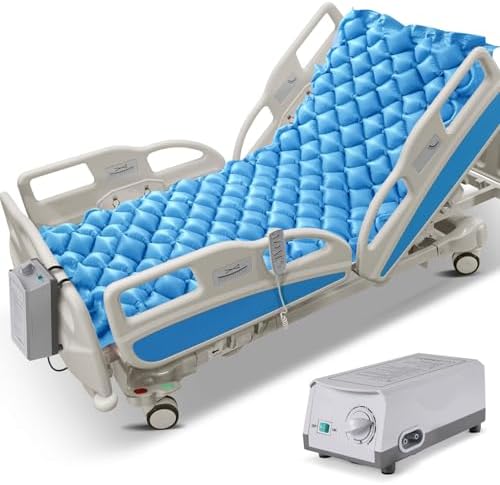
The Careboda is a thin, 2.8-inch alternating-pressure overlay designed to go on an existing mattress or frame. Multiple sealed air chambers inflate and deflate through a pump, and multi-level settings let caregivers adjust pressure. Its 75-by-35-inch size is smaller than a standard 80-by-36-inch mattress, so measure the bed carefully before buying.
The overlay is made from medical-grade PVC described as waterproof and easy to clean. Its extended sections tuck under the mattress to help reduce slipping, while hooks on the pump allow it to hang at the foot of the bed. The product information lists a 350-pound capacity and describes the pump as operating below 40 dB.
Because this is an overlay rather than a full-height mattress, it may be a practical option when you want to keep the existing mattress underneath. It does not have the listed cell-on-cell base of the MedVance or ProHeal, and the product details do not describe a power-failure backup or alarm system. Check with a clinician to see whether an overlay is appropriate for the person’s condition.
Pros:
- Thin design installs on an existing mattress or frame
- Adjustable pump settings and alternating air chambers
- Waterproof PVC surface is described as easy to clean
- Extended sections tuck under the mattress to help limit movement
Cons:
- Smaller than an 80-by-36-inch hospital bed mattress
- No power-failure backup or alarm details are provided
Verdict: Pick the Careboda if you need a slim overlay for an existing bed and its dimensions and 350-pound capacity meet your requirements.
ProHeal Low Air Loss Mattress: A Feature-Rich Cell-on-Cell Option

The ProHeal is a full-size, 8-inch mattress with 20 individual air bladders and a cell-on-cell base. Its alternating cycle can be set to 10, 15, 20, or 25 minutes. The lower four inches are designed to retain air during a power failure, a useful distinction from systems without a listed backup layer.
This model also combines alternating pressure with low-air-loss ventilation. Eighteen small openings are described as helping move moisture and heat away from the surface. The system has static and auto-firm modes, plus an LED panel with pressure settings. Three audible and visual alarms are listed for low pressure, power failure, and alternating failure.
A removable, fluid-resistant stretch-nylon cover and CPR valve round out the feature set. At 36 by 80 inches, it is sized for a standard hospital bed, but confirm that your bed and user are compatible. Its range of modes and alarms may suit a caregiver who needs more control than the basic Careboda overlay offers. More features can also mean more setup and settings to understand.
Pros:
- Cell-on-cell construction with a lower air-retaining layer
- Four alternating cycle choices, plus static and auto-firm modes
- Low-air-loss ventilation and removable fluid-resistant cover
- CPR valve and alarms for several system issues
Cons:
- Multiple modes and settings may take time to learn
- Weight capacity is not provided in the supplied details
Verdict: The ProHeal is a strong option to compare if you want a full-height mattress with low-air-loss ventilation, several operating modes, and listed alarms.
TenderGentle Low Air Loss Mattress: Alternating and Static Modes

The TenderGentle is listed as a 36-by-80-inch low-air-loss mattress with alternating and static modes. Its product details describe continuous airflow beneath the user to help manage heat and moisture, along with a vapor-permeable, fluid-resistant cover. A pump with a pressure adjustment knob is intended to let caregivers change firmness.
The static mode is described as providing a stable surface for transfers and routine care, while alternating mode cycles pressure across the mattress. The listed capacity is 350 pounds. These features may appeal to people who want both a stable setting and a changing-pressure option, but the supplied details do not list alarms, a CPR release, or a power-failure backup layer.
The product data marks this item as unavailable, so check the listing before planning a purchase. If it becomes available, compare its controls and safety features with the ProHeal and MedVance, which have more detailed information about alarms or emergency functions.
Pros:
- Alternating and static operating modes
- Low-air-loss airflow is designed to reduce heat and moisture buildup
- Vapor-permeable, fluid-resistant cover
- 36-by-80-inch size and 350-pound capacity are listed
Cons:
- Product data marks the listing as unavailable
- Backup and alarm features are not specified in the supplied details
Verdict: Keep the TenderGentle on your comparison list if its modes and airflow suit your needs, but confirm availability and ask about backup and safety features before choosing it.
How to Choose an Air Mattress for a Hospital Bed
Choose a full mattress or an overlay
A full-height mattress, such as the MedVance or ProHeal, is designed to serve as the bed’s main mattress. A thinner overlay, such as the Careboda, sits on top of an existing mattress. Check what your bed already has and whether the product is intended to replace it or rest on top. The right choice depends on the bed setup and the care plan.
Measure the bed and check capacity
Compare the mattress length and width with the bed frame, not just a general “hospital bed” label. A small size difference can affect fit and stability. Also confirm the listed weight capacity for the specific model. In the product details here, capacities vary where provided, and some products do not list one.
Understand the pressure-relief features
Alternating-pressure systems change which air chambers are inflated over time. Low-air-loss designs add airflow intended to help manage heat and moisture. Cell-on-cell construction uses a lower air layer beneath the cycling cells. These features are not interchangeable, and the best setup depends on the person’s needs. Ask a health care professional which therapy is suitable rather than relying on product descriptions alone.
Consider the pump, controls, and alarms
The pump affects setup and everyday use. Look for clear controls and check whether the system has adjustable pressure, selectable cycles, or alarms. If multiple caregivers will use the mattress, simpler controls may be easier to manage. If you are considering a feature-rich model, make sure someone can learn how to adjust it and respond to alerts.
Check power-failure and emergency features
Some models describe an air-retaining lower layer or a rapid-deflation CPR release. Others do not provide details about power-failure protection or emergency controls. If these features matter for your situation, confirm them with the manufacturer or seller before ordering. Do not assume one mattress has a feature just because another model does.
Look at the cover and cleaning needs
A fluid-resistant or waterproof cover can make routine cleaning easier, while a removable cover may be more convenient to maintain. Check the care instructions and materials before purchase. Also consider how the mattress attaches to the frame and whether the cover or straps could interfere with bed adjustments.
Match the mattress to clinical advice
An air mattress can be part of a care plan, but it does not replace regular skin checks, repositioning guidance, or medical care. If the person has a pressure injury, fragile skin, limited mobility, or special transfer needs, ask a clinician about the right surface and settings. Follow the mattress maker’s instructions for setup and use.
Frequently Asked Questions
What is the difference between an air mattress and an air overlay?
A full air mattress is designed to function as the bed’s mattress, while an overlay is placed on top of an existing mattress. The Careboda is described as an overlay that can go on an existing mattress or frame. Check each product’s instructions to confirm how it should be installed.
What does alternating pressure mean?
An alternating-pressure system changes inflation across its air chambers in cycles. This changes the areas supporting the body over time. Cycle options and controls differ by model, so follow the product instructions and any guidance from a health care professional.
What does low air loss mean?
Low-air-loss designs use airflow intended to help manage heat and moisture around the body. The specific design differs between products. Ask the manufacturer how the system works and consult a clinician about whether it fits the user’s needs.
Can I use one of these mattresses on any hospital bed?
Do not assume that every model fits every bed. Compare the mattress dimensions with the bed frame and check how the product attaches. For an adjustable bed, confirm that the mattress is suitable for the bed’s movement and follow the manufacturer’s setup directions.
What happens if the power goes out?
Power-failure protection varies by model. The MedVance describes a cell-on-cell design intended to retain air for up to 24 hours, and the ProHeal describes a lower layer that retains air during a power failure. The other supplied product details do not provide the same backup information. Check the manufacturer’s instructions for the exact model you are considering.
Should I choose a mattress with more modes and alarms?
More features can provide additional options, but they may also require more setup and caregiver training. Consider which functions are needed for the care plan and whether caregivers can use them correctly. A clinician can help you decide what features matter most.
Can an air mattress prevent or treat pressure injuries on its own?
No mattress should be treated as a stand-alone solution. Pressure-injury prevention and care may involve regular repositioning, skin checks, moisture management, and clinical treatment. Ask a health care professional for a plan tailored to the person’s condition.
Final Recommendation
For a full-height option with detailed pump controls, a CPR release, and a listed 450-pound capacity, the MedVance is the most clearly specified choice in this group. The ProHeal is worth comparing if low-air-loss airflow, multiple cycles, alarms, and a cell-on-cell base are priorities. If you need a thinner overlay for an existing mattress, consider the Careboda after checking its smaller dimensions. Before buying any model, confirm fit, capacity, and features, and ask a health care professional whether its pressure-relief system is appropriate for the person who will use it.