
If someone spends long periods in bed, an alternating air pressure mattress pad can help shift pressure across the sleeping surface while making daily care easier. The right choice depends on practical details such as pump noise, pressure settings, fit, weight capacity, and whether you need a simple overlay or a more feature-rich system. These five options range from straightforward bubble-cell pads to a dual-layer system; none should replace a clinician’s advice or a care plan for preventing or treating pressure injuries.
Quick Comparison
| Product | Standout features | Best suited for |
|---|---|---|
| KEKOY Alternating Air Pressure Mattress Pad | 130 air cells, five pressure levels, pump listed under 28 dBA | People seeking a basic pad with several pressure settings |
| Alcedo Alternating Air Pressure Mattress Pad | Five pressure settings, 300-pound capacity, 75-by-35-inch inflated bubble area | Shoppers who want stated dimensions and capacity |
| MedVance Premium Alternating Air Pressure Mattress Pad | Digital pump with alarms, six-minute cycle, pump listed under 20 dB | People prioritizing a digital control panel and quiet operation |
| VOCIC Alternating Air Pressure Mattress System | Dual-layer design, three modes, 507-pound capacity, washable cover | Shoppers looking for a more substantial system with added functions |
| FOMMOF Alternating Air Pressure Mattress Pad | Digital display, remote, stated 350-pound capacity | People who prefer remote pressure adjustments |
Our Picks: Best Alternating Air Pressure Mattress Pad Pump And System reviews
KEKOY: A 130-Cell Pad with Five Pressure Settings
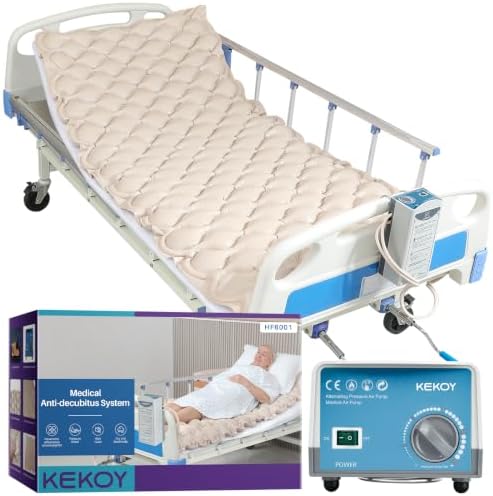
The KEKOY is an alternating-pressure overlay with 130 bubble-style air cells and a pump designed for ongoing use. Its cells inflate and deflate in a repeating cycle, which the manufacturer says takes about 10 to 12 minutes. The pump has five pressure levels, giving caregivers a range of settings to try for comfort.
KEKOY lists the pump noise level as below 28 dBA and describes the pad surface as waterproof and easy to clean. Those details may matter in a bedroom where the system will run for long stretches or where spills and moisture are a concern. The product is also listed as FSA- and HSA-eligible; check with your plan administrator about eligibility and reimbursement rules.
This is a relatively straightforward option compared with the dual-layer VOCIC system. One limitation is that the supplied product information does not give a weight capacity or pad dimensions, so confirm the fit and load requirements with the seller before buying. Pressure-redistribution equipment is not a substitute for a care professional’s guidance, especially if skin damage is already present.
Pros:
- 130 air cells for alternating pressure support
- Five adjustable pressure levels
- Pump noise is listed below 28 dBA
- Waterproof surface is described as easy to clean
Cons:
- Weight capacity and dimensions are not provided in the supplied product details
- The stated cycle is longer than MedVance’s six-minute cycle
Verdict: Choose the KEKOY if you want a conventional alternating-cell pad with several firmness settings, but verify its size and capacity before placing it on a bed.
Alcedo: A Pad with Stated Dimensions and Weight Capacity

The Alcedo is a bubble-style alternating pressure pad intended for home or hospital-bed use. Its inflated bubble area is listed as 75 by 35 inches, and the stated weight capacity is 300 pounds. The product description says the uninflated portion should be tucked beneath the mattress, so plan the setup around the bed’s size and construction.
The pump has five pressure settings and metal hooks for hanging it on a bed. Alcedo describes the surface as breathable and waterproof, with reinforced seams and high-density materials. These features speak to everyday setup and care, though they do not establish how the pad will fit every bed or meet every user’s clinical needs.
Compared with the KEKOY, Alcedo provides clearer size and capacity information. It does not list a cycle time or a specific noise level in the supplied details, so shoppers who need those specifications should confirm them before choosing. Make sure the stated capacity works for the person using the bed, rather than relying on the pad’s appearance alone.
Pros:
- Stated inflated bubble area of 75 by 35 inches
- Listed capacity of up to 300 pounds
- Five pressure settings and pump-hanging hooks
- Waterproof surface and reinforced seams are described in the product information
Cons:
- No cycle duration or specific pump noise figure is supplied
- Capacity is lower than the VOCIC system’s listed 507-pound limit
Verdict: The Alcedo is a practical option if clear pad dimensions and a stated 300-pound capacity are priorities, provided its size suits the bed.
MedVance: Digital Controls and a Short Alternating Cycle

The MedVance pad pairs an alternating-pressure overlay with a digital pump. The manufacturer describes a six-minute cycle, dual pump cores, and a control panel with alarms. Its pump is listed as operating under 20 dB, making quiet operation a key point of comparison with the other options in this guide.
The pad is made from waterproof medical-grade vinyl, according to the product description, and is intended for use on standard hospital beds. A digital panel may be useful if you prefer controls and alerts over a basic dial, but confirm what each alarm signals and how to respond before relying on it.
The supplied details do not state a weight limit or exact dimensions. That makes it harder to compare fit and load capacity with the Alcedo or VOCIC. The shorter listed cycle and digital controls may appeal to shoppers seeking those features, but the right settings and care routine should be confirmed with a healthcare professional.
Pros:
- Six-minute alternating cycle is specified
- Digital control panel includes alarms
- Pump is listed as operating under 20 dB
- Waterproof vinyl surface is described as easy to maintain
Cons:
- Weight capacity and exact dimensions are not provided in the supplied details
- Its alarm functions may require caregivers to learn the controls
Verdict: Consider the MedVance if a digital panel, alarms, and a stated six-minute cycle matter more to you than having a published capacity figure.
VOCIC: A Dual-Layer System with Multiple Modes

The VOCIC is more than a simple bubble overlay: it uses a dual-layer air cushion with 20 molded tubes and an 8-inch stated depth. Its pump has three alternating-intensity levels, plus static mode and a sitting-support mode. The system also has an alarm for air leakage or power failure and a CPR quick-release channel, according to the product description.
The listed inflated dimensions are 79 by 33 by 8 inches, and the stated capacity is up to 507 pounds. The system includes a zippered, washable cover and a surface described as waterproof. Its pump is listed at 45 dB, which is higher than the noise figures stated for KEKOY and MedVance, so noise-sensitive households may want to compare that specification carefully.
The added modes and larger capacity may suit a user who needs more than a basic pad, but they also mean more functions to understand. The supplied product data lists this item as unavailable, so check its current listing status before planning around it. Its features do not remove the need to follow clinical guidance for positioning, skin checks, and care.
Pros:
- Dual-layer design with 20 molded tubes and an 8-inch stated depth
- Three alternating levels, static mode, and sitting-support mode
- Listed capacity of up to 507 pounds
- Includes a washable cover and rapid-release channel
Cons:
- Listed pump noise level of 45 dB is higher than the figures given for KEKOY and MedVance
- Product data indicates it may be unavailable
Verdict: The VOCIC offers the most functions and the highest stated capacity here, but check availability and consider its more involved design and listed pump noise before choosing it.
FOMMOF: Digital Adjustments with a Remote

The FOMMOF pad includes a digital display and remote for adjusting airflow and pressure. The product description says it has a gas-lift design and supports up to 350 pounds. It also describes setup as connecting the tubing and inflating the pad without tools, though the actual setup time can depend on the bed and the person installing it.
The remote may be convenient if the pump controls are not easy to reach. FOMMOF also describes the pad as durable vinyl and lists a one-year warranty. The supplied information does not specify pad dimensions, pump noise, pressure levels, or the alternating cycle time, so there are important details to confirm before purchase.
Compared with MedVance, FOMMOF offers a remote but does not provide the same specific cycle and pump-noise figures in the supplied data. If those numbers are important for a bedroom or care routine, ask the seller for clarification. Do not rely on a mattress pad alone to diagnose or treat skin concerns.
Pros:
- Digital display and remote for adjustments
- Listed capacity of up to 350 pounds
- Product description says setup requires no tools
- One-year warranty is listed
Cons:
- Dimensions, cycle time, pressure levels, and pump noise are not specified in the supplied details
- It provides fewer verifiable technical details than several competing options
Verdict: The FOMMOF may suit shoppers who value remote controls, but get the missing fit and pump specifications before deciding.
How to Choose an Alternating Air Pressure Mattress Pad and Pump
Match the system to the care plan
Alternating air systems are designed to change pressure across the support surface, but they are not a universal treatment. Ask a clinician which type of surface is appropriate for the person’s skin condition, mobility, and care needs. If there is a pressure injury, persistent redness, pain, or a change in skin, seek professional guidance rather than relying on a product description.
Check the fit and weight capacity
Compare the inflated dimensions with the bed and the area the pad is meant to cover. A pad that is too short or narrow may not provide the intended coverage. Check the product’s stated weight limit as well: Alcedo lists 300 pounds, FOMMOF lists 350 pounds, and VOCIC lists 507 pounds. The supplied information does not state a capacity for KEKOY or MedVance, so confirm it directly with the seller.
Compare pump noise and cycle information
The pump runs as part of the system, so its sound can matter in a bedroom or shared space. The listed figures vary: KEKOY specifies below 28 dBA, MedVance below 20 dB, and VOCIC 45 dB. These are manufacturer-provided figures and may not be measured under identical conditions. Cycle times are also not consistent: KEKOY lists about 10 to 12 minutes and MedVance lists six minutes, while the other supplied descriptions do not give a cycle time.
Choose controls you can use reliably
Basic pressure settings may be enough for some households, while digital controls, alarms, or a remote may be useful in others. KEKOY and Alcedo list five pressure settings; VOCIC lists three intensity levels plus static and sitting-support modes; MedVance has a digital panel with alarms; and FOMMOF lists a remote. Before buying, make sure the person or caregiver can understand the controls and knows what to do if an alarm sounds.
Consider cleaning and moisture protection
Waterproof surfaces can make routine cleanup easier, but check how the cover or pad should be cleaned and whether it can be removed. VOCIC lists a zippered, machine-washable cover. KEKOY, Alcedo, and MedVance describe waterproof surfaces, while FOMMOF describes a vinyl construction. Follow the manufacturer’s care instructions to avoid damaging the material or pump connections.
Think about setup and bed compatibility
Confirm how the pad sits on the bed, how the pump attaches, and where the tubing needs to run. Alcedo says the extra uninflated portion should be tucked beneath the mattress; MedVance says it is designed for most standard hospital beds. Check the listing for the exact bed type and setup details, and ensure the pump can be placed securely with tubing arranged safely.
Review availability, warranty, and payment eligibility
Product availability can change, and the supplied data lists the VOCIC as unavailable. Check the current listing before planning a purchase. FOMMOF lists a one-year warranty, while KEKOY and Alcedo are described as FSA/HSA eligible. Eligibility and warranty terms can depend on your plan and the seller’s current conditions, so confirm details before checkout.
Frequently Asked Questions
What does an alternating air pressure mattress pad do?
It uses an electric pump to inflate and deflate air cells in a repeating pattern, changing pressure across parts of the surface. The products in this guide are intended to support pressure redistribution, but the right system and care routine depend on the individual. Ask a clinician for guidance, especially if skin damage is present.
Can an alternating air pad prevent or heal pressure injuries on its own?
No product should be treated as a guarantee or a stand-alone solution. Skin checks, repositioning, moisture care, nutrition, and other steps may be part of a care plan. A clinician can recommend an appropriate surface and explain how to use it safely.
Can these pads go on a regular mattress?
Some are described for home use, while the MedVance is described as fitting most standard hospital beds. Fit depends on the specific bed and pad dimensions. Check the manufacturer’s instructions and measurements before placing an order.
How do I choose the right pressure setting?
Follow the product instructions and the guidance of the person’s healthcare professional. A higher or lower setting is not automatically better; comfort, body size, position, and care needs all matter. Do not change a clinician-directed plan without checking first.
Are the pumps quiet enough for overnight use?
Noise specifications vary by model, and manufacturers may use different testing methods. KEKOY lists below 28 dBA, MedVance lists below 20 dB, and VOCIC lists 45 dB. If noise is a major concern, check the current product details and consider the pump’s placement in the room.
Do these systems need to stay plugged in?
They use powered pumps to maintain and cycle air, so they generally need a power source during use. Follow the product’s instructions for operation and what to do during a power interruption. The VOCIC description lists an alarm for power failure or air leakage, but the other supplied descriptions do not specify an equivalent alert.
Which option is best for a higher weight capacity?
Among the products with a stated capacity in the supplied information, VOCIC lists up to 507 pounds, FOMMOF lists up to 350 pounds, and Alcedo lists up to 300 pounds. Verify the current manufacturer specifications and choose a system that meets the user’s needs with an appropriate margin.
Final Recommendation
For a straightforward pad with five pressure settings and a stated quiet-pump figure, the KEKOY is a reasonable starting point, though its dimensions and weight capacity should be confirmed. Alcedo is easier to compare for size and capacity, while MedVance stands out for its digital controls and listed six-minute cycle. VOCIC offers the broadest feature set and highest stated capacity, but its supplied availability status is a drawback. Before buying any system, confirm bed fit, capacity, cleaning instructions, and suitability with a healthcare professional.