
Choosing the best alternating pressure mattress with pump depends on more than the pump’s noise level. You’ll want to check the mattress size, weight capacity, air-cell design, fit on your bed, and how easily a caregiver can adjust it. The options below range from basic bubble-style pads to a deeper dual-layer system, so compare the specifications with your care needs—and ask a health professional which type of support is appropriate.
| Product | Best for | Key details | Availability note |
|---|---|---|---|
| VOCIC Alternating Air Pressure Mattress System | More support and pump controls | Dual-layer, 8-inch height, up to 507 lb, alarm and CPR release | Supplied listing data marks it unavailable; check the listing |
| Careboda Alternating Pressure Mattress | A straightforward, low-profile pad | 75 × 35 × 2.8 inches, up to 350 lb, pump under 40 dB | Check the listing for current availability |
| Vaunn Medical Cloud Air Mattress Topper | A twin-size topper with many air cells | 130 cells, 36 × 78 × 3 inches, up to 300 lb | Check the listing for current availability |
| JorWystia Alternating Air Pressure Mattress | Adjustable pressure settings | 130 air cells, five settings, up to 300 lb | Supplied listing data marks it unavailable; check the listing |
| Kigley Alternating Pressure Mattress | A long pad with extended end sections | Two-channel mode, 12-minute cycle, max user weight 130 kg | Check the listing for current availability |
Important: Alternating pressure mattresses are support surfaces, not a replacement for a care plan. If the person using one has a pressure injury, fragile skin, limited mobility, or other medical needs, ask a clinician about the right surface and repositioning routine.
Our Picks: Best Alternating Pressure Mattress With Pump reviews
1. VOCIC Alternating Air Pressure Mattress System: Feature-Rich Dual-Layer Support

The VOCIC system is the most feature-heavy option in this group. Its dual-layer design uses 20 molded tubes and measures 79 × 33 × 8 inches when inflated. The listed weight capacity is 507 pounds, higher than the capacities provided for the other products here.
The smart pump offers three intensity levels, a static mode intended to firm the surface, and a sitting-support mode. A built-in alarm is designed to alert you to air leakage or power failure. The pump is listed at 45 dB, so it is not the quietest model by the stated specifications; the Careboda, for comparison, is listed below 40 dB.
Practical details include a rapid-deflation channel for CPR, micro-ventilation across the back, and a zippered, washable cover. The product description also specifies TPU air tubes and a waterproof PVC cover, so check the care instructions and materials if you have particular cleaning or skin-contact requirements. At 8 inches high, this system may feel more substantial than a thin topper, but you should confirm that its dimensions and height work with your bed and transfer routine.
The supplied product data marks this listing as unavailable, so verify that it can be purchased before choosing it. Its broad set of controls and higher listed capacity make it a strong option on paper, but the extra features may be unnecessary if you only need a simple pad.
Pros:
- Dual-layer design with a listed 8-inch inflated height
- Three intensity levels, static mode, and sitting-support mode
- Built-in alarm and rapid-deflation channel
- Listed capacity of up to 507 pounds
Cons:
- Supplied listing data marks it unavailable
- Its listed 45 dB pump is louder than the Careboda’s stated noise level
Verdict: Consider the VOCIC if you need a deeper, adjustable system with additional safety-oriented features, but confirm availability and fit before planning around it.
2. Careboda Alternating Pressure Mattress: A Simple, Low-Profile Choice
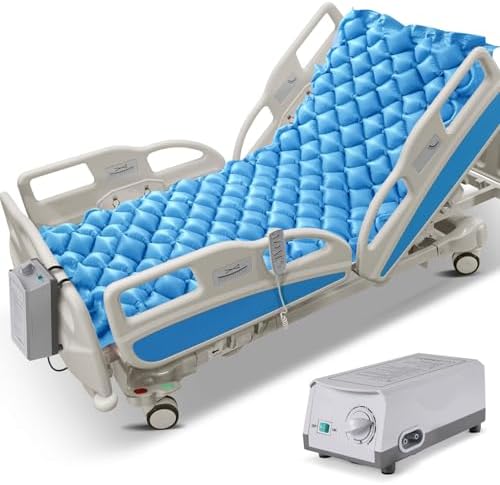
The Careboda is a basic alternating-pressure pad designed to sit on an existing mattress or frame. Its inflated dimensions are 75 × 35 × 2.8 inches, and its listed capacity is 350 pounds. That low profile may be useful if you want an air pad without adding the height of a full replacement mattress.
The pump has multiple adjustable settings and is described as operating below 40 dB. It includes hooks for hanging at the foot of the bed, while the pad has extended sections that tuck under the mattress to help hold it in place. These details can make setup more manageable, though you should still check the pad’s dimensions against your bed before ordering.
The pad is made from medical-grade PVC described as waterproof and easy to clean. Its air chambers alternate to redistribute pressure, but the product data does not specify the number of chambers or the length of each cycle. If those details matter to your care plan, ask the seller or a clinician before buying.
Compared with the deeper VOCIC system, the Careboda is simpler and thinner. It has a lower stated noise level, but it does not list the same alarm, static mode, or CPR release features. It is a practical candidate for someone seeking a basic overlay, provided its dimensions and capacity are suitable.
Pros:
- Low-profile design at 2.8 inches when inflated
- Pump is listed as operating below 40 dB
- Hooks and tuck-under sections help with placement
- Listed capacity of up to 350 pounds
Cons:
- Does not list the air-cell count or cycle duration
- Fewer special pump features than the VOCIC system
Verdict: Choose the Careboda if you want a straightforward overlay with a quieter stated pump and a moderate weight capacity.
3. Vaunn Medical Cloud Air Mattress Topper: 130-Cell Twin-Size Design

The Vaunn Medical Cloud is a twin-size air topper with 130 pre-programmed air cells. Its listed inflated size is 36 × 78 × 3 inches, and it supports up to 300 pounds. Top and bottom flaps help secure it to the bed, which is a useful design detail for an overlay that needs to stay aligned.
The pump provides adjustable pressure settings and is described as whisper-quiet, though the supplied specifications do not give a decibel figure. The topper uses a waterproof medical-grade vinyl surface that is described as easy to clean. Vaunn also lists a standard U.S. 110-volt plug, which makes the intended outlet type clear.
The product description presents the air-cell cycle as a way to redistribute pressure and keep the surface cool. Those are manufacturer claims, not a substitute for a clinician’s assessment or a guarantee of a medical outcome. For care planning, ask whether this type of topper is appropriate and how it should be used alongside repositioning and skin checks.
Compared with the Careboda, the Vaunn provides a stated cell count and a slightly wider, longer listed size. Its capacity is lower, so check the user’s weight and the bed dimensions carefully. It is a focused option if you want a twin-size topper with many cells and simple adjustable pump controls.
Pros:
- 130 pre-programmed air cells
- Twin-size dimensions are clearly listed
- Waterproof vinyl surface and securing flaps
- Adjustable pump settings and U.S. 110-volt plug
Cons:
- Listed capacity is 300 pounds
- No specific pump noise measurement is provided
Verdict: The Vaunn is a good fit to consider when you need a twin-size topper with a stated 130-cell design and a clearly specified U.S. plug.
4. JorWystia Alternating Air Pressure Mattress: Five Pump Settings

The JorWystia is a bubble-style pressure pad with 130 air cells and a pump with five pressure settings. The product description says each cycle lasts about six minutes. Its high-strength PVC construction is described as waterproof and easy to maintain, and the listed weight capacity is 300 pounds.
A built-in metal hook is intended to help keep the pump in place on the bed. The pad is described for use with hospital beds, home-care beds, and standard beds. Since the supplied specifications do not give the mattress dimensions, check the product listing and measure your bed before purchasing.
The five settings offer more adjustment choices than the Careboda’s unspecified multi-level controls, while the stated cycle length gives caregivers a clearer idea of its operation. However, the product description does not provide a pump noise level or a detailed fit range. The listing data supplied for this article marks the product unavailable, so confirm that it is offered before comparing it with the other choices.
As with any pressure-relief surface, the pad’s description should not be treated as proof that it will prevent or heal a pressure injury. Ask a health professional whether this pad’s design and cycle are suitable for the person who will use it.
Pros:
- 130 air cells and five pump settings
- Cycle duration is listed at approximately six minutes
- Metal pump hook supports convenient placement
- Waterproof PVC construction is described as easy to maintain
Cons:
- Supplied listing data marks it unavailable
- Dimensions and pump noise level are not provided in the supplied details
Verdict: Consider the JorWystia if you value five adjustment levels and a stated cycle time, but verify availability, fit, and pump noise before choosing it.
5. Kigley Alternating Pressure Mattress: Two-Channel Pad with Extended Ends

The Kigley comes with an electric pump and a two-channel alternating mode. Its product description states that the channels alternate every 12 minutes. The PVC pad is water-resistant and has a spherical chamber design, while extended sections at the head and foot are intended to help keep it from sliding.
The listed dimensions are 114.96 × 35.43 inches, including those extended sections. Because that length is much greater than the other listed pad dimensions, measure the bed and check how the ends are meant to tuck or sit before ordering. The maximum user weight is given as 130 kg; use that listed limit rather than assuming it will suit every bed or care setup.
The pad is described as easy to clean, and the package includes the pump. The product information says the pump does not contain batteries, so it should not be treated as a battery-powered backup system. Compared with the Vaunn, the Kigley emphasizes extended length and a defined two-channel cycle rather than a listed count of 130 cells.
Pros:
- Two-channel alternating mode with a stated 12-minute interval
- Extended head and foot sections help limit shifting
- Pump is included in the package
- Water-resistant PVC surface is described as easy to clean
Cons:
- Unusually long listed dimensions require careful bed measurement
- Product information says batteries are not included
Verdict: The Kigley may suit a setup that can accommodate its extended dimensions and two-channel cycle, but confirm the fit and power arrangement before buying.
How to Choose an Alternating Pressure Mattress With Pump
Confirm the mattress type and care needs
These products are generally overlays that sit on an existing mattress, rather than full replacement mattresses. Their intended use and features differ, so start by asking the person’s clinician or care team what kind of support surface is appropriate. A pump-powered pad does not replace a care plan, skin checks, or repositioning guidance.
Measure the bed and check the pad’s height
Compare the pad’s length and width with the surface it will cover. Allow for any flaps or tuck-under sections, and consider whether the inflated height could affect transfers, bed rails, or the way the person gets in and out of bed. The listed sizes here vary substantially, from low-profile pads to the VOCIC’s 8-inch system and the Kigley’s extended length.
Match the weight capacity to the user
Check the stated maximum user weight and follow the manufacturer’s instructions. The products in this group list capacities from 300 pounds to 507 pounds, while the Kigley specifies 130 kg. Do not assume that a pad’s capacity also confirms that the existing bed frame is suitable for that load.
Compare air cells, channels, and cycle details
Air-cell count and alternating patterns can help you understand how a pad is designed, but more cells do not automatically mean a better fit for every person. Vaunn and JorWystia list 130 cells; Kigley specifies a two-channel mode and a 12-minute interval. Ask the care team whether a particular cycle or surface type meets the person’s needs.
Consider pump noise and controls
The pump runs as part of the system, so its noise may matter in a quiet bedroom. Careboda lists a level below 40 dB, while VOCIC lists 45 dB; the other descriptions do not provide a specific measurement. Also consider whether you need simple pressure adjustments or added functions such as a static mode, sitting support, or an alarm.
Think about setup, cleaning, and power
Look for practical details that fit your routine, such as pump hooks, securing flaps, washable covers, or a surface that can be wiped clean. Check whether the pad requires a particular outlet and how the hoses should be arranged. The Kigley description says batteries are not included, and the Vaunn specifies a U.S. 110-volt plug.
Check availability and verify product details
Product listings and stock can change. Two options in the supplied product data—VOCIC and JorWystia—are marked unavailable, so confirm their current status before making a plan. Before ordering any model, verify its dimensions, included parts, care instructions, weight limit, and return terms on the listing.
Frequently Asked Questions
What does an alternating pressure mattress do?
It uses a pump to inflate and deflate air chambers in a repeating pattern. This changes how the body is supported across the surface. The specific pattern and controls vary by model, and a clinician can help determine whether a particular system is suitable.
Is an alternating pressure pad the same as a replacement mattress?
Not necessarily. The products here are described as pads or toppers that go on an existing bed. Check the product dimensions and installation instructions to confirm whether the model is designed for your mattress, frame, or hospital bed.
Can these mattresses prevent or treat pressure sores?
Product descriptions may make pressure-relief or sore-prevention claims, but an air mattress alone cannot guarantee prevention or treatment. If someone has a pressure injury or is at risk, ask a clinician for an appropriate care plan, including guidance on repositioning and skin care.
Which option has the quietest stated pump?
Careboda lists its pump at less than 40 dB, the lowest specific noise figure provided for these five products. VOCIC lists 45 dB. The other product descriptions do not give a numerical noise level, so confirm the details with the seller if pump sound is a major concern.
How do I know whether the pad will fit?
Measure the bed’s length and width, then compare those measurements with the product’s inflated dimensions. Pay attention to extra flaps or extended ends. The Kigley, for example, lists an overall length of 114.96 inches, which makes careful measuring especially important.
Do alternating pressure mattresses need to stay plugged in?
These systems rely on an electric pump to cycle air through the pad. Check the instructions for each model and ask the seller or care team about power needs and what to do during an outage. The supplied Kigley information specifically says batteries are not included.
Final Recommendation
For shoppers who need a simple overlay, the Careboda stands out for its listed low profile, stated pump noise below 40 dB, and 350-pound capacity. The Vaunn offers a clearly specified twin-size fit and 130 air cells, while VOCIC has the most extensive listed controls and a higher stated capacity but is marked unavailable in the supplied data. Measure carefully, confirm current product details, and consult a health professional before choosing a pressure-support surface for medical care.