
A blanket lifter creates a raised space at the foot of your bed so sheets and blankets don’t rest directly on your feet. It can be useful if your toes are sensitive, you’re recovering from surgery, or you simply prefer less weight on your feet. The options below vary in height, width, stability features, and storage convenience. Before choosing one, check your mattress setup and whether the lifter is compatible with your bed.
Quick Comparison
| Product | Height range | Standout feature | Best for |
|---|---|---|---|
| NorBeng Blanket Lifter for Feet | 22.8–30.7 in. | Aluminum frame, four clips, non-slip pad | Basic height-adjustable support |
| AKIMRABY Adjustable Blanket Lifter | 24–33 in. | Adjustable height and width; stated 50 lb capacity | More fit adjustment and heavier covers |
| TAKUMARK Foldable Blanket Lifter | 26–34 in. | Folds flat for storage | Small rooms and portable use |
| JFNoraiva Extra-Wide Blanket Lifter | 24–31.4 in. | Adjustable width of 27.5–35.5 in. | More room across the foot of the bed |
| Fewener Extra-Wide Blanket Lifter | 24–31.4 in. | Adjustable width and tool-free assembly | Wide support with quick setup |
Our Picks: Best Blanket Lifter For Foot Of Bed reviews
1. NorBeng Blanket Lifter: A Simple, Adjustable Aluminum Option

The NorBeng is a height-adjustable blanket support made from aluminum alloy. Its L-shaped frame is designed to sit at the foot of the bed and hold bedding above your feet. The listed height range is 22.8 to 30.7 inches, adjusted with a push-button lock.
A frosted non-slip pad and four clips help keep the bedding in place. The clips are useful if sheets or a comforter tend to slide off the support, though they also mean you’ll need to arrange and secure your bedding rather than simply drape it over the frame.
This is a straightforward option if you want a portable support with adjustable height but don’t need the width adjustment offered by some other picks. The listed instructions say it is not compatible with articulated beds, so check your bed style before ordering. The product details don’t give a weight capacity, so avoid assuming it is suitable for especially heavy bedding.
Pros:
- Adjustable height from 22.8 to 30.7 inches
- Aluminum alloy frame with an L-shaped design
- Four clips and a non-slip pad help secure bedding
- Described as lightweight and portable
Cons:
- Not compatible with articulated beds
- No weight capacity is specified in the product details
Verdict: Choose the NorBeng if you want a basic, height-adjustable aluminum lifter and your bed is not articulated.
2. AKIMRABY Adjustable Blanket Lifter: More Ways to Fit Your Bed

The AKIMRABY combines an adjustable aluminum frame with both vertical and horizontal fit adjustments. Its listed height range is 24 to 33 inches, and the width adjusts from 15 to 19 inches. The product information says it is designed for mattresses 6 to 18 inches thick.
Four clips and anti-slip pads are included to help hold the bedding in place. The frame uses lock-screw connections, and the listing says tools and instructions are included. This connection style may appeal if you want a more firmly fastened assembly, though you’ll need to decide on your preferred setup before tightening the screws.
The stated load capacity is up to 50 pounds, which makes this the clearest choice in this group for shoppers comparing listed capacity. That figure is a product specification, not a guarantee for every bed setup; use the lifter as directed. Like the NorBeng, it is not compatible with articulated beds.
Pros:
- Adjustable height and width offer more fitting options
- Designed for mattresses 6 to 18 inches thick
- Four clips and anti-slip pads help reduce bedding movement
- Product details state a load capacity of up to 50 pounds
Cons:
- Assembly involves tightening lock screws
- Not compatible with articulated beds
Verdict: The AKIMRABY is a strong match if you want width and height adjustments plus a stated load capacity, and your bed is a compatible stationary style.
3. TAKUMARK Foldable Blanket Lifter: A Storage-Friendly Design

The TAKUMARK stands out for folding flat, which can make it easier to store when you don’t need the lift. The product is aimed at spaces where keeping a frame set up all the time may be inconvenient, such as a dorm, apartment, or RV.
Its listed height range is 26 to 34 inches, and the product details say it fits mattresses 6 to 18 inches thick. The frame is described as aircraft-grade aluminum alloy. Assembly uses a spring button and is advertised as tool-free, while four anti-slip clips come in two sizes for thinner and thicker blankets.
Compared with the NorBeng, this model offers a higher maximum listed height and a folding design, but it does not list a width adjustment or a specific load capacity. If your main concern is storage, those trade-offs may be reasonable. Confirm the fit and assembly details on the product listing before buying.
Pros:
- Folds flat for storage
- Adjustable height from 26 to 34 inches
- Tool-free spring-button assembly is described
- Includes four clips in two sizes
Cons:
- No specific load capacity is listed in the supplied details
- No width adjustment is specified
Verdict: Pick the TAKUMARK if compact storage is a priority and its height range suits your bed and bedding.
4. JFNoraiva Extra-Wide Blanket Lifter: Adjustable Space Across the Bed
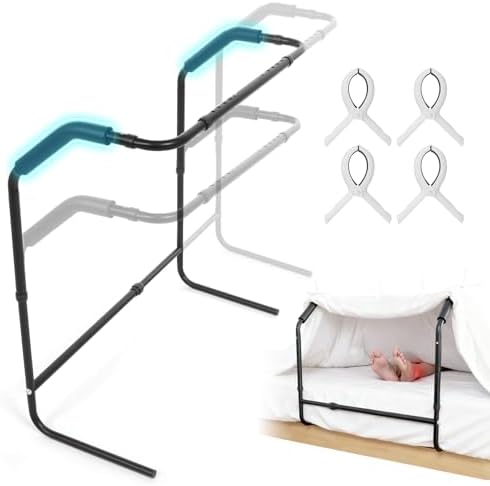
This JFNoraiva blanket lifter is designed for shoppers who want a wider support area. Its width adjusts from 27.5 to 35.5 inches, while its height adjusts from 24 to 31.4 inches. The listing describes placing the assembled frame between the mattress and box spring.
The L-shaped support uses a spring-button lock and includes four clips and non-slip foam to help keep bedding from shifting. The product details describe the frame as suitable for heavier blankets, but they don’t provide a specific weight limit. That makes it harder to compare its capacity directly with the AKIMRABY.
Its under-mattress placement may provide a simple way to position the lifter, but the bed needs to have a compatible mattress and base arrangement. Compared with the Fewener, the core listed dimensions and features are very similar, so check the current listing for assembly details and material information before choosing between them.
Pros:
- Width adjusts from 27.5 to 35.5 inches
- Height adjusts from 24 to 31.4 inches
- Four clips and non-slip foam help secure covers
- Designed to fit between a mattress and box spring
Cons:
- Requires a compatible under-mattress setup
- No specific weight limit is given
Verdict: Consider the JFNoraiva if you want a wide, adjustable support and can place it securely under your mattress.
5. Fewener Extra-Wide Blanket Lifter: Wide Support with Quick Assembly
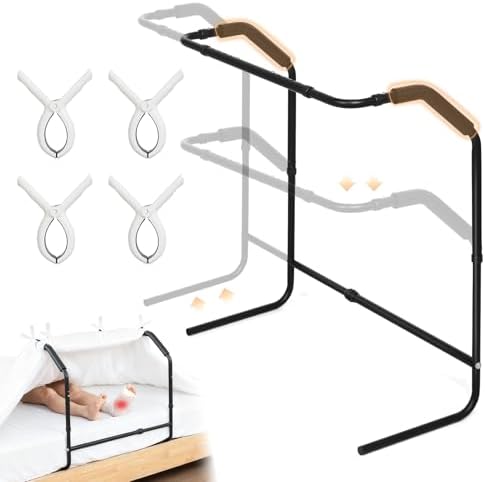
The Fewener is another wide blanket support that sits between the mattress and box spring. Its listed width range is 27.5 to 35.5 inches, with a height range of 24 to 31.4 inches. The product details describe the frame as heavy-duty alloy steel and say it is intended to support heavier blankets.
Assembly is described as tool-free, with a spring-button lock. Non-slip foam and four clips are included to help keep sheets and blankets from shifting. These details make it similar in layout to the JFNoraiva, so bed compatibility and the fit you need are key points to check rather than assuming the two are interchangeable in every setup.
The listing does not state a specific weight capacity. If you want a wide frame and quick assembly, this may suit your needs, but shoppers who need a clearly stated load limit may prefer a model that provides one. The product is intended to reduce direct blanket contact with feet; it is not a substitute for medical advice or treatment.
Pros:
- Adjustable width from 27.5 to 35.5 inches
- Adjustable height from 24 to 31.4 inches
- Tool-free assembly is described
- Includes four clips and non-slip foam
Cons:
- Requires a compatible mattress-and-box-spring setup
- No specific weight capacity is listed
Verdict: Choose the Fewener if you want a wide under-mattress design with tool-free assembly and don’t require a stated weight limit.
How to Choose a Blanket Lifter for the Foot of Your Bed
Measure the space you want to create
Check how high the bedding needs to sit above your feet, then compare that measurement with the lifter’s height range. Remember that a product’s maximum height does not tell you how much usable clearance you’ll have once it is installed and covered with bedding. If you’re unsure, measure from the bed surface to the clearance you want and compare it with the product dimensions.
Check mattress thickness and bed construction
Some lifters tuck between the mattress and box spring, while others list mattress-thickness ranges or specific installation requirements. Measure your mattress and confirm that the support can be positioned securely. Also check whether your bed is articulated or adjustable: the NorBeng and AKIMRABY listings specifically say they are not compatible with articulated beds.
Decide whether you need width adjustment
A wider frame can create more room across the foot of the bed, while a narrower support may be enough if you only need clearance around your feet. The JFNoraiva and Fewener list adjustable widths of 27.5 to 35.5 inches. The AKIMRABY lists horizontal adjustment from 15 to 19 inches. Compare the actual dimensions with your bed and intended sleeping position.
Match the frame to your bedding
Heavy or bulky bedding can put more demand on a support than a light sheet. Look for a clearly stated weight capacity if that information matters to your setup; among these options, the AKIMRABY lists a capacity of up to 50 pounds. Other product descriptions mention support for heavier covers without giving a specific limit, so don’t assume they have the same capacity.
Look at how the bedding stays in place
Clips and non-slip pads or foam can help stop sheets and comforters from sliding. Consider whether the included clips suit your bedding thickness and whether you’re comfortable attaching them. If the bedding shifts often, secure attachment points may be just as important as the frame’s height.
Consider setup and storage
If you plan to remove the support during the day, consider how quickly it comes apart and where you’ll store it. TAKUMARK specifically describes a fold-flat design. Other options are described as portable or easy to assemble, but compare the assembly method and included hardware in the product listing before deciding.
Frequently Asked Questions
What does a blanket lifter do?
A blanket lifter holds bedding above part of the bed, often the foot area, to reduce direct contact between sheets or blankets and your feet. It may be useful when bedding feels uncomfortable against sensitive toes or feet.
Can a blanket lifter help after foot surgery?
These products are described as options for people recovering from surgery, including those with casts. However, fit and safe use depend on your bed and medical needs. Ask your healthcare provider whether a blanket lifter is appropriate for your recovery.
Will these lifters work with an adjustable bed?
Compatibility depends on the design. The NorBeng and AKIMRABY listings say they are not compatible with articulated beds. For other models, check the listing and confirm how the frame attaches before using it with an adjustable base.
How do I know which height to choose?
Measure the clearance you want above your feet and compare it with the lifter’s adjustment range. Also account for how the frame sits on or under your bed, since mattress thickness and installation style can affect the final fit.
Can I use a blanket lifter with a heavy comforter?
Check the product’s stated capacity and follow its instructions. The AKIMRABY lists a capacity of up to 50 pounds. The other products describe support for heavier bedding but do not provide a specific limit in the details supplied here.
Do blanket lifters work with all bed sizes?
Not necessarily. Some designs have a fixed width, while others allow width adjustment. Measure your bed and compare it with the frame’s listed dimensions. Also confirm that the support can be installed securely with your mattress and bed base.
Final Recommendation
For the most fitting flexibility and a clearly stated load capacity, the AKIMRABY is the strongest choice in this group, provided your bed is not articulated. If you need a wider support, compare the JFNoraiva and Fewener dimensions against your bed. The TAKUMARK is worth considering when flat storage matters most, while the NorBeng offers a simpler adjustable-height design. In every case, verify bed compatibility and measurements before ordering.