
A good bread knife should bite through a firm crust without crushing the soft center underneath. For crusty sourdough, baguettes, and homemade loaves, a long serrated blade is often the most useful choice. These five knives add different features, from resharpenable edges to offset handles and full-tang construction, so you can choose the design that best fits your kitchen and baking habits.
Quick Comparison
| Bread Knife | Blade Length | Standout Feature | Best For |
|---|---|---|---|
| Piklohas Resharpenable Bread Knife | 10 inches | Resharpenable serrated edge and offset handle | Home bakers who want added finger clearance |
| imarku German Stainless Steel Bread Knife | 10 inches | High-carbon stainless steel blade and wood handle | Bread and cake slicing |
| CoquusAid Resharpenable Bread Knife | 10.6 inches | Long blade with a flat, wavy edge | Large loaves and other oversized foods |
| PAUDIN Serrated Bread Knife | 10 inches | German high-carbon steel blade | Everyday bread and pastry slicing |
| Albert&Grace Serrated Bread Knife | 10.5 inches | Full-tang blade and pakkawood handle | Those who value a substantial handle and balanced feel |
Our Picks: Best Bread Knife For Crusty Bread reviews
Best for Resharpening: Piklohas 10-Inch Bread Knife

The Piklohas is a 10-inch serrated knife designed for homemade loaves, sourdough, bagels, and softer bread. Its most distinctive feature is the resharpenable edge: the product description says you can restore its cutting performance with a regular honing rod. That makes it worth considering if you want an alternative to replacing a bread knife when its edge loses bite.
The offset handle raises your hand above the cutting board, giving your fingers more clearance while you slice. That shape may be especially helpful when cutting through a wide loaf or making repeated slices. Grooves on both sides of the blade are intended to help food release, which can be useful with moist bread and other tender foods.
Compared with the other picks, the Piklohas combines the resharpening feature with an offset handle. The tradeoff is that this handle shape may feel different from a conventional straight-handle knife, and the listing does not provide details about how to sharpen each serration. Check the maker’s guidance before sharpening to help preserve the edge.
Pros:
- Product description says the serrated edge can be resharpened with a regular honing rod.
- Offset handle provides added clearance above the cutting board.
- Double-sided grooves are designed to help food release from the blade.
- Suitable for crusty loaves, soft bread, bagels, and some firm-skinned produce.
Cons:
- The offset handle may take some adjustment if you prefer a traditional knife shape.
- Sharpening guidance for the serrations is not detailed in the supplied description.
Verdict: Choose the Piklohas if resharpening and finger clearance matter more to you than a traditional handle design.
Best for Bread and Cake: imarku 10-Inch Serrated Knife

This imarku knife pairs a 10-inch serrated blade with high-carbon stainless steel made with German materials. It is described for cutting both crusty sourdough and soft foods such as brioche and angel food cake. The long blade gives you room to work across a wide loaf, while the serrations are intended to cut through the outside without tearing delicate interiors.
The FSC-certified wood handle is designed for a comfortable grip and use by left- or right-handed cooks. The polished blade surface is described as easy to rinse and wipe clean. It also comes in gift packaging, which may suit someone looking for a practical kitchen present.
Unlike the Piklohas and CoquusAid, the imarku listing does not describe a resharpenable edge. Its appeal is a more conventional bread-knife setup that is also meant for cakes and other soft baked goods. If extending edge life through sharpening is a priority, compare its maintenance details with the resharpenable options before choosing.
Pros:
- 10-inch serrated blade is intended for crusty bread and soft cakes.
- High-carbon stainless steel blade is described as corrosion-resistant.
- Wood handle is designed for a comfortable grip for left- and right-handed users.
- Polished blade is described as easy to rinse and wipe clean.
Cons:
- The supplied description does not specify that the serrated edge can be resharpened.
- Its wood handle may not suit shoppers who prefer an all-metal design.
Verdict: The imarku is a practical option if you want one serrated knife for both crusty loaves and delicate cakes.
Best for Large Loaves: CoquusAid 10.6-Inch Bread Knife
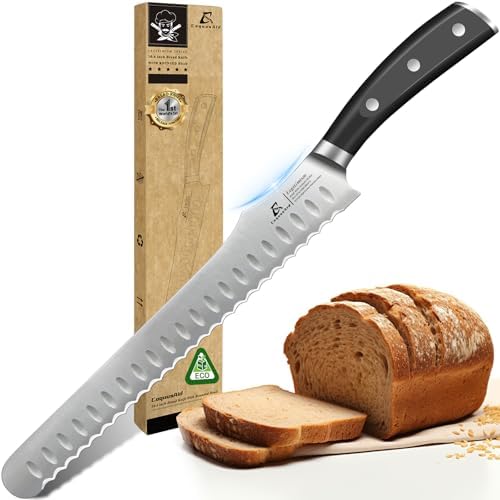
At 10.6 inches, the CoquusAid has the longest blade among these five picks. Its extra reach can be useful when slicing a large round loaf or cutting through a broad fruit. The maker describes its edge as flat and wavy, with an 18-degree polished edge intended to move through a firm crust or skin while leaving the softer interior intact.
The blade is made from German high-carbon stainless steel, and its single-edged design is paired with hollow dimples intended to reduce sticking. The full-tang construction and curved handle are described as supporting control and comfort. The product description also says the knife can be resharpened, which may appeal to bakers who regularly slice homemade bread.
The longer blade offers more reach than the 10-inch options, but it may feel oversized if you mostly cut small loaves or have limited drawer space. Its distinctive edge geometry also makes it sensible to follow the manufacturer’s sharpening instructions rather than assume that every sharpening method will suit it.
Pros:
- Longest blade in this comparison at 10.6 inches.
- Described as resharpenable.
- Hollow dimples are designed to help reduce food sticking to the blade.
- Full-tang construction and curved handle are designed for control.
Cons:
- The longer blade may be more knife than needed for small loaves and light use.
- The distinctive edge design makes it important to check sharpening guidance.
Verdict: Pick the CoquusAid if you often slice large loaves or want the extra reach of a longer, resharpenable blade.
Best for Everyday Use: PAUDIN 10-Inch Bread Knife

The PAUDIN is a 10-inch serrated knife made with German high-carbon steel. Its blade is listed at a Rockwell hardness of 56+, and the product description presents it as a tool for crusty artisan bread, soft pastries, cakes, and sandwiches. That range makes it a straightforward choice for a kitchen where one bread knife needs to handle several kinds of slicing.
The ergonomic handle is designed for a secure grip and control. The stainless steel blade is described as resistant to corrosion, rust, and stains. Its gift packaging is another useful detail if you are buying for a home baker.
Compared with the Piklohas and CoquusAid, the PAUDIN listing does not mention a resharpenable serrated edge. It also does not specify a handle material in the supplied description. If those details matter to you, the other picks offer more information on edge maintenance or construction.
Pros:
- 10-inch serrated blade is intended for crusty bread, cakes, and sandwiches.
- German high-carbon steel is listed at a Rockwell hardness of 56+.
- Ergonomic handle is designed for a secure grip and control.
- Blade is described as resistant to corrosion, rust, and stains.
Cons:
- The supplied description does not specify that the serrated edge is resharpenable.
- Handle material is not stated in the supplied product details.
Verdict: The PAUDIN is a solid match if you want a standard-length serrated knife for bread, cakes, and sandwiches.
Best Full-Tang Design: Albert&Grace 10.5-Inch Bread Knife

The Albert&Grace has a 10.5-inch serrated blade made from high-carbon stainless steel. Its full-tang construction means the blade extends through the handle, a design intended to provide strength and balance. The pakkawood handle is shaped for a comfortable, stable grip when slicing round boules, batards, and other large loaves.
The knife is designed for both crusty and soft bread, with cakes also listed as a possible use. Its blade length comes close to the CoquusAid’s, making it another choice for wider loaves. The product title also identifies a sheath, but the supplied description does not give further details about its design.
This pick may suit you if handle feel and full-tang construction matter more than a resharpening feature. The supplied information does not say whether its serrated edge can be resharpened, so it is worth checking the maker’s care guidance if long-term edge maintenance is a key concern.
Pros:
- 10.5-inch serrated blade is designed for crusty and soft bread.
- Full-tang construction is intended to support strength and balance.
- Pakkawood handle is designed for a stable, comfortable grip.
- Suitable for loaves, bagels, and cakes according to the product description.
Cons:
- The supplied description does not state whether the serrated edge can be resharpened.
- At 10.5 inches, the blade may feel large for small loaves or compact storage spaces.
Verdict: Choose the Albert&Grace if you want a longer bread knife with full-tang construction and a pakkawood handle.
How to Choose a Bread Knife for Crusty Bread
Choose a Blade Length That Fits Your Loaves
A longer blade can make it easier to cut through a wide boule or a tall loaf in fewer strokes. The knives here range from 10 to 10.6 inches. If you usually bake large sourdough loaves, the longer CoquusAid or Albert&Grace may give you more reach. For smaller loaves and everyday use, a 10-inch blade may be easier to handle and store.
Look for Serrations That Match Your Slicing Needs
Serrations are useful because they can catch on a hard crust while helping you slice through the softer bread inside. Think about what else you plan to cut. Some knives in this group are also described for cakes, bagels, fruit, or other foods with a firm exterior and tender center. A bread knife is not a substitute for every kitchen knife, but versatile use can make it more useful day to day.
Consider How You Will Maintain the Edge
Serrated edges can be more involved to sharpen than straight edges. The Piklohas and CoquusAid are specifically described as resharpenable, though their edge designs differ. If you choose one of them, check the maker’s sharpening instructions and use a method suited to the serrations. For the other knives, the supplied details do not say that the edges can be resharpened.
Check the Handle Shape and Construction
A comfortable grip helps you guide the blade through a loaf without pressing down too hard. The Piklohas has an offset handle for added finger clearance, while the imarku has a wood handle and the Albert&Grace has a pakkawood handle with full-tang construction. The CoquusAid also describes a full-tang design and curved handle. Consider which shape feels natural to you and how much space your hand needs above the cutting board.
Think About Storage and Care
Blades around 10 inches or longer need enough drawer or knife-block space, and a sheath can be useful for covering an edge during storage. The Albert&Grace product title lists a sheath, while the other supplied descriptions do not mention one. For care, follow the specific maker’s instructions, especially for the serrated edge and any wood or pakkawood handle.
Frequently Asked Questions
What makes a bread knife useful for crusty sourdough?
A serrated edge can grip a firm crust as you slice, helping you work through it without relying only on downward pressure. A long blade can also help you cut across a broad loaf more evenly.
Is a 10-inch bread knife long enough for homemade loaves?
For many loaves, a 10-inch blade offers useful reach. If you often bake especially large or wide loaves, a longer option such as the 10.5-inch Albert&Grace or 10.6-inch CoquusAid may suit you better.
Can you sharpen a serrated bread knife?
Some serrated knives can be resharpened with a suitable method, but the process depends on the edge design. The Piklohas and CoquusAid are described as resharpenable. Check the maker’s directions before sharpening any serrated blade.
Can a bread knife cut cake?
Yes. Several knives in this group are described for cakes as well as bread. A serrated blade can be helpful when the outside is firm but the inside is soft, though a gentle sawing motion can help keep delicate layers from compressing.
Is a longer bread knife always better?
Not necessarily. A longer blade can cover more of a wide loaf, but it may be less convenient to store or handle if you mostly slice small bread. Choose a length that fits both the food you cut and your kitchen space.
What does full-tang mean on a bread knife?
Full-tang means the blade extends through the handle. The Albert&Grace and CoquusAid descriptions identify this construction. It is often chosen for a more connected feel between the blade and handle, though grip comfort still depends on the handle’s shape and material.
Final Recommendation
For crusty bread, the best choice depends on how you bake and what you value in a knife. The Piklohas stands out for its resharpenable edge and offset handle, while the CoquusAid offers the longest blade in this group. If you want a more conventional option for both bread and cake, consider the imarku or PAUDIN. For full-tang construction and a pakkawood handle, the Albert&Grace is the clearest fit. Compare blade length, handle shape, and edge-care details before choosing the one that suits your kitchen.