
If you’re searching for the best bread maker with a stainless steel pan, check the pan material carefully: a stainless steel exterior does not mean the baking pan is stainless steel. The machines below mostly pair stainless steel bodies with ceramic or other nonstick pans. The KITCHENARM listing does not specify its pan material, so it is worth checking the product details before buying if a stainless steel pan is a must-have.
Our picks focus on practical differences that affect everyday baking, including loaf size, programs, timers, automatic ingredient dispensers, and the information provided about each pan.
Quick Comparison
| Product | Pan information | Loaf size | Standout feature |
|---|---|---|---|
| KBS Pro 710W 17-in-1 Bread Maker | Ceramic pan and paddle | 1, 1.5, or 2.2 lb | Automatic ingredient dispenser |
| Neretva 20-in-1 Bread Maker | Ceramic pan | 1.65 or 2 lb | Dual heaters |
| KITCHENARM 29-in-1 Smart Bread Machine | Pan material not specified | 1, 1.5, or 2 lb | Customizable homemade cycles |
| KBS Premium 2.2LB Convection Bread Maker | Ceramic pan | 1, 1.5, or 2.2 lb | Convection baking and automatic dispenser |
| NEWBULIG 20-in-1 Bread Maker | Ceramic nonstick pan | 1, 1.5, or 2 lb | Simple one-touch operation |
Our Picks: Best Bread Maker Stainless Steel Pan reviews
1. KBS Pro 710W Bread Maker: Best Feature-Rich Pick

The KBS Pro is a versatile bread machine for households that want several loaf sizes and plenty of preset options. Its listed 17 programs cover common choices such as basic, French, whole wheat, gluten-free, sourdough, cake, jam, yogurt, and dough. It also has a custom setting for adjusting baking time and temperature.
Its stainless steel exterior is paired with a ceramic pan and paddle, not a stainless steel baking pan. The maker also includes an automatic stainless steel dispenser for mix-ins, which can add ingredients during the cycle without requiring you to wait nearby. A 710W motor, 360-degree convection heating, and a viewing window round out the main baking features.
You can choose 1-, 1.5-, or 2.2-pound loaves and light, medium, or dark crusts. The 15-hour delay timer and one-hour keep-warm function suit planned or overnight baking. A 15-minute power interruption backup is also listed. The number of options is useful, but it may feel like more machine than you need if you only plan to make basic loaves.
Pros:
- Three loaf sizes and three crust settings
- Automatic dispenser for adding ingredients
- Custom setting offers more control over baking
- Ceramic pan and paddle are specified in the product details
Cons:
- The baking pan is ceramic, not stainless steel
- The many programs may be unnecessary for simple bread routines
Verdict: Choose the KBS Pro if you want a broad menu of baking options and an automatic mix-in dispenser, but not if a stainless steel baking pan is essential.
2. Neretva 20-in-1 Bread Maker: Best for Dual-Heat Baking

The Neretva is a stainless steel-bodied bread maker with 20 automatic programs. Its menu includes standard bread types, gluten-free, quick, cake, dough, jam, yogurt, and specialty options such as potato and corn bread. It offers 1.65- and 2-pound loaf sizes, which makes it a practical fit for families or anyone who prefers medium-to-large loaves.
The baking pan is described as ceramic, not stainless steel. Neretva pairs it with heaters at the top and bottom of the pan and 360-degree surrounding baking. The product description says the dual heaters help distribute heat around the loaf. It also lists three crust levels, a 15-hour delay timer, one-hour keep-warm setting, and 15-minute power interruption recovery.
The machine’s 550W rating is lower than the 710W KBS models in this group, though wattage alone does not tell you how a finished loaf will turn out. One operating detail to note: the controls lock after the machine starts, and the instructions say to hold the start, pause, or stop button for three seconds to unlock them.
Pros:
- 20 programs include several bread and non-bread options
- Dual heaters and surrounding baking are designed for even heating
- Two loaf sizes and three crust settings
- Includes a delay timer and keep-warm function
Cons:
- The pan is ceramic rather than stainless steel
- It does not offer a 1-pound loaf size
Verdict: The Neretva is a good match if you want a stainless steel exterior, ceramic pan, dual-heater design, and a wide range of preset menus.
3. KITCHENARM 29-in-1: Best for Custom Recipes
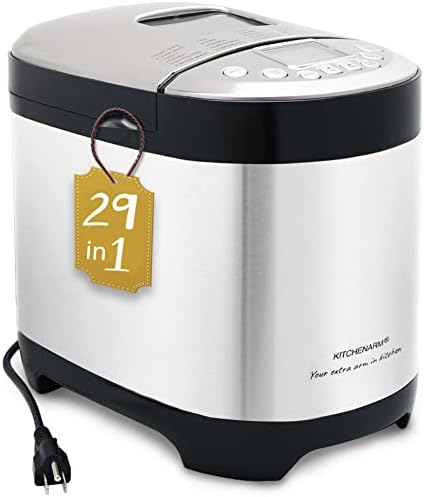
The KITCHENARM stands out for menu variety and cycle-level control. Its 29 automatic menus include bread types such as sourdough, ciabatta, brioche, dark rye, gluten-free, and keto, along with non-bread settings such as cake and jam. The homemade menu lets you set steps such as kneading, resting, rising, and baking, with up to four personalized menus.
The product information lists 1-, 1.5-, and 2-pound loaves, three crust colors, a 15-hour delay timer, a one-hour keep-warm setting, and 15-minute power interruption recovery. It also describes saved settings for repeat baking, plus alarms for adding nuts or removing the paddle. These features make it more flexible than simpler machines, though the controls may take some learning if you are new to bread makers.
Unlike several other picks here, the supplied product details do not identify the pan material. That makes this a less certain choice if you specifically want a stainless steel pan—or need confirmation of any particular coating. Check the current listing and product documentation before purchasing. The machine is described as ETL certified for the US and Canada.
Pros:
- Wide menu that includes several specialty bread options
- Up to four customizable menus for personal recipes
- Three loaf sizes and three crust colors
- Saved settings can simplify repeat recipes
Cons:
- The supplied details do not specify the pan material
- Extensive customization may be more than a beginner needs
Verdict: Pick the KITCHENARM if recipe control matters most, but confirm the pan material directly if stainless steel is a requirement.
4. KBS Premium Convection Bread Maker: Best for Larger Loaves

This KBS model combines a stainless steel body with a ceramic baking pan. Its 17 programs cover common bread types and other tasks such as dough, cake, jam, and yogurt. The machine supports 1-, 1.5-, and 2.2-pound loaves, so it can handle smaller batches as well as larger family-sized baking.
The product description highlights a 710W motor, dual temperature control, dual heaters, and 360-degree convection baking. It also includes an automatic dispenser for mix-ins, a viewing window, and a touchscreen panel. The ceramic pan is described as a horizontal design, which the listing presents as suited to rectangular loaves. The product details describe the pan as ceramic rather than stainless steel.
For scheduling, the KBS Premium has a 15-hour timer, one-hour keep-warm function, and 15-minute power recovery. Its range of settings is similar to the KBS Pro, but this listing emphasizes dual heaters and convection baking. Keep in mind that the product’s baking-time claims are manufacturer descriptions, not a guarantee that every recipe will finish on the same schedule.
Pros:
- Three loaf sizes, including a 2.2-pound option
- Dual heaters and convection baking are designed to distribute heat
- Automatic dispenser adds mix-ins during the cycle
- Includes a ceramic pan and a touchscreen control panel
Cons:
- The baking pan is ceramic, not stainless steel
- The feature set may be excessive if you only bake basic bread
Verdict: Choose the KBS Premium for larger loaf capacity and its listed convection and dual-heater features, provided a ceramic pan works for you.
5. NEWBULIG 20-in-1 Bread Maker: Best for Straightforward Operation

The NEWBULIG is a relatively simple option for home bakers who want a one-touch process: add ingredients, select a cycle, and start the machine. It has 20 menu options according to the product title and description, though the supplied details do not list every program. Check the manual or listing for the exact cycles you plan to use.
Its stainless steel exterior is paired with a ceramic nonstick pan, not a stainless steel baking pan. You can select 1-, 1.5-, or 2-pound loaves and light, medium, or dark crusts. A 12-hour delay timer lets you schedule baking, and the listing describes the machine as operating at up to 60 dB.
The description also says the machine can prepare dough for items such as dumpling wrappers, noodles, and steamed buns. That makes it useful beyond standard loaves, but the available details provide less information about heating design and custom cycle controls than the KBS and KITCHENARM models. It may suit shoppers who favor basic operation over extensive recipe adjustments.
Pros:
- Three loaf sizes and three crust settings
- Ceramic nonstick pan is specified
- One-touch operation and a 12-hour delay timer
- Can prepare some specialty doughs as well as bread
Cons:
- The pan is ceramic, not stainless steel
- The supplied details do not describe the full program list or heating system
Verdict: Consider the NEWBULIG if you want a simple machine with several loaf sizes, but look elsewhere if you need a stainless steel pan or detailed cycle customization.
How to Choose a Bread Maker with the Right Pan
Confirm the baking pan material
Look beyond phrases such as “stainless steel bread maker.” Those often describe the machine’s outer body, not the pan that holds the dough. In this group, KBS, Neretva, and NEWBULIG specify ceramic pans, while the KITCHENARM details provided here do not identify the pan material. If you want a stainless steel pan specifically, confirm that exact part in the listing or manual before you buy.
Match loaf capacity to your household
Think about how much bread you will use before choosing the largest capacity. A 1-pound loaf may be enough for one or two people, while larger households may prefer a machine that can make a 2- or 2.2-pound loaf. Options for multiple sizes give you more room to adjust the batch to your needs and avoid making more bread than you can use.
Choose programs you will actually use
Basic, whole wheat, dough, and gluten-free settings are common useful choices, but specialty programs vary. If you plan to make sourdough, yogurt, cake, jam, or specialty dough, check that the machine lists the specific cycle you need. A high program count can be helpful, but only when it includes functions you will use.
Consider how much control you want
Preset cycles keep baking simple, while custom menus let you adjust steps such as kneading, rising, and baking. The KITCHENARM offers particularly detailed customization; the KBS Pro also lists a custom setting. If you are new to bread making, straightforward presets may be easier to learn. If you already adapt recipes, more control can be useful.
Look at timers and mix-in features
A delay timer can help you plan when a loaf starts, while a keep-warm setting can hold bread after baking. Automatic dispensers add ingredients such as nuts or fruit during the cycle and reduce the need to monitor the machine. Compare the exact timer length and dispenser features rather than assuming every bread maker includes them.
Check cleaning and care instructions
Pan material and coating affect how you handle and clean the baking pan. Follow the manufacturer’s care instructions, especially for nonstick or ceramic surfaces, and avoid assuming that every pan or paddle is dishwasher-safe. Also check whether the kneading paddle is removable and whether a tool is supplied to help take it out of the loaf.
Frequently Asked Questions
Do these bread makers have stainless steel baking pans?
Most of the listed machines do not. The KBS Pro, Neretva, KBS Premium, and NEWBULIG descriptions specify ceramic pans. The supplied KITCHENARM details do not specify its pan material. Their stainless steel descriptions refer to the machine body or dispenser, not necessarily the baking pan.
What is the difference between a stainless steel body and a stainless steel pan?
The body is the machine’s outer housing. The pan is the removable container where the bread is mixed and baked. A bread maker can have a stainless steel exterior and a ceramic or other nonstick pan, so check the pan specification separately.
Which pick offers the most custom recipe control?
The KITCHENARM offers a homemade menu with customizable cycle steps and up to four personalized menus. The KBS Pro also lists a custom setting, but its description provides less cycle-by-cycle detail.
Which models have an automatic ingredient dispenser?
The KBS Pro and KBS Premium descriptions specify automatic dispensers for mix-ins. The other product details provided here do not list that feature.
How large a loaf should I choose?
Choose a capacity based on how much bread your household can use while it is fresh. The KBS models offer sizes up to 2.2 pounds, while the Neretva offers 1.65- and 2-pound options. KITCHENARM and NEWBULIG offer 1-, 1.5-, and 2-pound choices.
Can a bread maker also make dough for other foods?
Yes. Several models list dough programs, and the NEWBULIG description specifically mentions dough for noodles, dumpling wrappers, and steamed buns. Program availability varies, so check the menu for the machine you are considering.
Final Recommendation
For a feature-rich machine with multiple loaf sizes and an automatic mix-in dispenser, the KBS Pro is a strong overall option. The KBS Premium is another good choice if you value its listed convection and dual-heater features, while the KITCHENARM is better suited to bakers who want detailed recipe controls. However, none of the supplied product details clearly identify a stainless steel baking pan. If that material is non-negotiable, verify the pan itself before ordering rather than relying on a stainless steel exterior description.