
The best cleaning solution for an ultrasonic cleaner depends on what you plan to clean. Automotive concentrates are made for grease, varnish, and carbon on metal parts, while a jewelry formula is a better fit for delicate accessories. Before buying, check the dilution instructions and confirm the solution is suitable for both your cleaner and the materials you intend to wash.
These five options cover common jobs, from carburetors and engine parts to jewelry and eyeglasses. The picks below are compared by intended use, stated dilution, material compatibility, and practical trade-offs.
Quick Comparison
| Product | Best For | Stated Mixing Guidance | Notable Detail |
|---|---|---|---|
| Tillbrook Ultrasonic Cleaner Solution | Automotive and metal parts | 16 oz concentrate per gallon of solution | Made in the USA; listed as making 8 gallons |
| HORHIZA Ultrasonic Cleaner Solution | Auto engine parts | 14 oz concentrate per gallon of solution | Listed as making 9 gallons |
| Durabasics Ultrasonic Cleaner Solution | Heavy-duty parts cleaning | 1 part concentrate to 5 parts water | Fragrance-free formula |
| Sylvan Hills Carburetor & Parts Cleaner | Frequent automotive cleaning | 1:250 ratio with water | 32 oz bottle; listed as making up to 50 gallons |
| Sylvan Hills Jewelry Cleaner Solution | Jewelry, glasses, and accessories | 1:250 ratio with water | Non-ammoniated formula; includes a cloth |
Our Picks: Best Cleaning Solution For Ultrasonic Cleaner reviews
1. Tillbrook Ultrasonic Cleaner Solution: A Versatile Pick for Metal Parts

Tillbrook is a concentrated ultrasonic solution aimed at carburetors, injection parts, and other metal components. Its stated cleaning targets include dirt, varnish, gum, and other residue found on engine parts and heat exchangers. The brand lists compatibility with a broad range of metals, including aluminum, brass, copper, cast iron, and zinc.
The mixing instructions call for 16 ounces of concentrate per gallon of cleaning solution, and the product is listed as making eight gallons. That clear ratio is useful if you clean parts regularly and want to prepare a larger batch. The solution is made in the USA, according to the product information.
Its broad metal compatibility makes it a flexible choice for a home workshop, but it is still an automotive parts formula rather than a general-purpose cleaner for every household item. Confirm that a part’s material and finish are suitable before soaking it, and follow the instructions for your ultrasonic machine.
Pros:
- Designed for carburetors, injection parts, and engine components
- Targets varnish, gums, and other accumulated residue
- Lists compatibility with several common metals
- Concentrated formula is listed as making eight gallons
Cons:
- Requires careful measuring and dilution before use
- Its automotive focus is less suited to jewelry or delicate household items
Verdict: Choose Tillbrook if you want one concentrated solution for a range of automotive metal parts and are comfortable mixing it to the stated ratio.
2. HORHIZA Ultrasonic Cleaner Solution: Concentrate for Engine Cleaning

HORHIZA is formulated for automotive parts and is described as helping remove grease, stains, carbon deposits, and residue. Its suggested uses include carburetors, pistons, rocker arms, nozzles, valves, and other engine components, making it a focused option for mechanical maintenance rather than a multipurpose household cleaner.
The product information says to add 14 ounces of concentrate per gallon of solution and lists the bottle as making nine gallons. It also states that the formula is suitable for metals such as iron, steel, aluminum, copper, and zinc. As with any concentrated cleaner, measure the mixture carefully instead of assuming a stronger solution will clean better.
Compared with Tillbrook, HORHIZA has a similar automotive focus but gives a different dilution amount and listed yield. Those differences make it important to follow the specific label for the bottle you have. If your projects include materials beyond the listed metals, check compatibility before cleaning.
Pros:
- Designed for grease, carbon deposits, and automotive residue
- Lists uses across several engine and motorcycle parts
- States compatibility with common metals, including aluminum and copper
- Concentrate is listed as making nine gallons of solution
Cons:
- Its stated dilution is different from several other options here
- Not presented as a solution for jewelry or delicate personal items
Verdict: HORHIZA is a practical candidate for auto and motorcycle parts when its stated dilution and listed metal compatibility match your cleaning job.
3. Durabasics Ultrasonic Cleaner Solution: Heavy-Duty Parts Formula
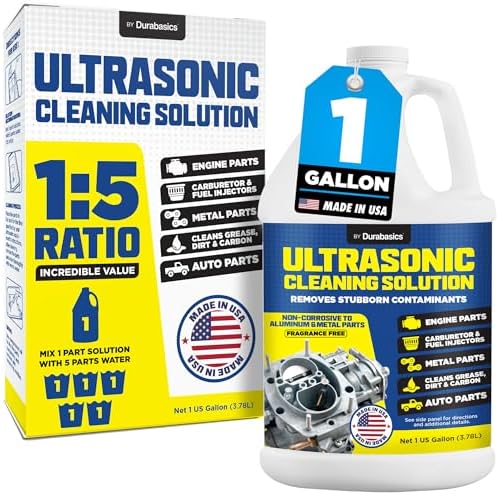
Durabasics is a heavy-duty cleaner intended for ultrasonic and immersion washers. Its listed applications include carburetors, valves, heat exchangers, engine components, and motorcycle parts. The product description focuses on stubborn dirt, varnish, and gum, making it relevant for restoration and workshop tasks.
This formula is mixed at one part solution to five parts water. It is described as fragrance-free and suitable for aluminum, brass, copper, and cast iron. The gallon-size container may suit a workshop that uses parts cleaner often, though the product information does not state a total prepared-solution yield.
Compared with Tillbrook and HORHIZA, Durabasics gives a more concentrated mixing ratio in parts rather than a specific number of ounces per gallon. That can be straightforward once measured, but you will need to calculate the amount for your tank. It is a focused cleaner, not the right pick if your main goal is cleaning jewelry or eyewear.
Pros:
- Made for both ultrasonic and immersion cleaning
- Targets varnish, gums, and stubborn residue on mechanical parts
- Lists compatibility with aluminum, brass, copper, and cast iron
- Fragrance-free formula
Cons:
- Requires calculating the mixture for your tank size
- Product information does not specify a total diluted yield
Verdict: Consider Durabasics for regular workshop cleaning if you want a heavy-duty formula and its one-to-five mixing ratio works for your setup.
4. Sylvan Hills Carburetor & Parts Cleaner: High-Yield Automotive Concentrate

This 32-ounce concentrate is designed for carburetors, engine parts, small metal components, and tools. Sylvan Hills says it can make up to 50 gallons when mixed at a 1:250 ratio with water. Its listed uses also include fuel injectors, bolts, motorcycle parts, and gun components.
The product description lists aluminum, brass, copper, and steel among the compatible metals. It also says the formula has no harsh fumes or corrosive additives, and includes a microfiber cloth for drying parts. The high stated yield may appeal if you clean often, but a very small concentrate-to-water ratio calls for accurate measuring.
Compared with the automotive concentrates above, this option emphasizes a large diluted yield rather than a heavy-duty mixture measured in ounces per gallon. Its suitability still depends on the part, finish, and cleaner instructions. The cloth is a useful extra, but it does not replace rinsing and drying parts as appropriate for the material.
Pros:
- Listed as making up to 50 gallons from a 32-ounce bottle
- Designed for carburetors, engine hardware, and small metal parts
- Lists compatibility with aluminum, brass, copper, and steel
- Includes a microfiber cleaning cloth
Cons:
- The 1:250 dilution requires precise measuring
- Its automotive focus may not suit delicate jewelry or other sensitive items
Verdict: Sylvan Hills is worth considering if you want an automotive concentrate with a high stated yield and are prepared to measure its dilute mixture carefully.
5. Sylvan Hills Jewelry Cleaner: A Separate Formula for Delicate Accessories

Unlike the other products in this list, this Sylvan Hills concentrate is intended for jewelry, glasses, and accessories rather than automotive parts. The product description lists gold, silver, diamonds, and gemstones, as well as eyeglasses, metal frames, and wristwatches. It is described as non-ammoniated and non-abrasive, and comes with a polishing cloth.
The stated dilution is 1:250 with water, with the 32-ounce bottle listed as making more than 50 gallons. The long stated yield may be appealing for occasional at-home cleaning, but the small amount of concentrate per batch means you will need a reliable way to measure it.
This product’s specific purpose is its main advantage over the automotive solutions. Still, not every stone, setting, coating, lens, or watch is suitable for ultrasonic cleaning. Check the item maker’s care guidance first, especially for pieces with fragile or treated materials, and do not assume that a formula described for jewelry makes every piece safe to immerse.
Pros:
- Designed for jewelry, glasses, and accessories rather than engine parts
- Listed for use with gold, silver, diamonds, and gemstones
- Non-ammoniated formula described as free of abrasives
- Includes a polishing cloth and has a high stated yield
Cons:
- Not intended for automotive parts cleaning
- Some jewelry and watches may not be suitable for ultrasonic cleaning
Verdict: Pick this formula for suitable jewelry and accessories, but check each item’s care instructions before placing it in an ultrasonic cleaner.
How to Choose an Ultrasonic Cleaner Solution
Match the formula to what you are cleaning
Start with the item, not the bottle size. Automotive formulas in this guide are aimed at parts such as carburetors, valves, and engine components. The Sylvan Hills jewelry formula is designed for jewelry, glasses, and accessories. A product intended for one type of job is not automatically suitable for another, so use the formula that fits your task.
Check material and finish compatibility
Metal compatibility can vary between formulas. Read the product information for the specific metals it lists, then check the care instructions for the item itself. Coatings, finishes, stones, lens treatments, and assembled parts can have different needs from the base material. When compatibility is unclear, contact the item’s maker before cleaning.
Understand the dilution before you buy
Concentrates use different mixing instructions. Some list a number of ounces per gallon, while others give a parts-based ratio such as one part solution to five parts water or 1:250. Compare the instructions with the amount of solution you need and make sure you can measure the concentrate accurately. Do not assume that different products use the same ratio.
Consider how often you will clean
If you clean parts regularly, a concentrate with a larger stated yield may be convenient. For occasional cleaning, a smaller prepared batch may be easier to manage. Remember that the stated yield is not the only consideration: the formula must also be suitable for the parts you clean and for the way your machine is used.
Follow your ultrasonic cleaner’s instructions
Check the machine manual for approved liquids, fill levels, and operating guidance. The solution does not replace good handling practices: use the concentration specified by its manufacturer, avoid placing unsuitable items in the tank, and follow appropriate rinsing and drying steps for the material. Replace or refresh the solution according to its instructions and condition.
Choose a formula for the soil you need to remove
For engine parts, look for a product that specifically addresses the buildup you are dealing with, such as grease, carbon deposits, varnish, or gum. For jewelry and eyewear, choose a formula made for those items and verify that each piece can tolerate ultrasonic cleaning. Matching the cleaner to the job is more useful than choosing a product based on broad claims alone.
Frequently Asked Questions
Can I use any cleaning solution in an ultrasonic cleaner?
No. Use a solution that is intended for ultrasonic cleaning and compatible with both your machine and the items you are cleaning. Check the cleaner manual and the solution’s instructions before filling the tank.
What is the best solution for cleaning carburetors?
Several options here are made for carburetors and related engine parts, including Tillbrook, HORHIZA, Durabasics, and Sylvan Hills Carburetor & Parts Cleaner. Compare their stated materials and dilution instructions with your parts and cleaner.
Can I use an automotive parts solution on jewelry?
These automotive products are described for metal parts such as engine components and carburetors, not for jewelry. Choose a formula specifically intended for jewelry, and check whether the individual piece is suitable for ultrasonic cleaning.
How much concentrate should I add?
Follow the specific product’s mixing instructions. The options in this guide use different ratios, so do not transfer one product’s dilution guidance to another. Measure carefully, especially for formulas that use a small amount of concentrate per gallon.
Are all metals safe to clean in an ultrasonic machine?
No single compatibility statement covers every metal, finish, or assembled part. Check the cleaner and solution instructions, and verify that the item’s material and finish are appropriate for ultrasonic cleaning before use.
Should I rinse parts after ultrasonic cleaning?
Follow the solution instructions and the care guidance for the item. Some parts may need rinsing and drying after cleaning; the correct approach can depend on the material and intended use.
Which option is best for glasses and jewelry?
The Sylvan Hills Jewelry Cleaner is the only product in this selection specifically described for jewelry, glasses, and accessories. Even so, check the manufacturer’s care instructions for each item, since some lenses, stones, settings, or watches may not be suitable for ultrasonic cleaning.
Final Recommendation
For automotive parts, Tillbrook is a strong all-around choice if you want a concentrated formula with stated compatibility across several metals and a clear mixing instruction. Durabasics is another option for workshop use, while Sylvan Hills Carburetor & Parts Cleaner emphasizes a high stated yield. For jewelry and glasses, choose the separate Sylvan Hills jewelry formula rather than an automotive cleaner, and confirm that the item itself can be cleaned ultrasonically.