
Choosing the best coffee roaster machine for a small business starts with matching batch size to your sales—not simply buying the largest machine you can fit. A sample roaster can help you compare green coffees, while a production roaster is better suited to making sellable batches. The options below range from a 50-gram sample machine to larger drum roasters, with important differences in heat source, controls, and availability.
Quick Comparison
| Product | Listed capacity | Heat and controls | Best fit |
|---|---|---|---|
| 1kg Commercial Electric Coffee Roaster | 1kg / 2lb | 240V electric; preset profiles and Artisan compatibility | Small businesses seeking batch roasting and profile control |
| IKAWA GO50 Sample Coffee Roaster | 50g | Electric; app-controlled profiles | Sampling and green-coffee evaluation |
| HNZXIB Commercial Electric Coffee Roaster | 4.4lb or 8.8lb models | Electric drum; microcomputer temperature and timer controls | Higher-volume roasting, if available |
| HENGCMM Electric Drum Coffee Roaster | About 2kg or 4kg, depending on type | Electric drum; temperature and timer controls | Businesses comparing larger drum capacities, if available |
| YIYIBYUS Drum-Type Coffee Roaster | 300–1,200g | Gas stovetop heat; powered rotating drum | Small batches where a suitable stovetop is available |
Our Picks: Best Coffee Roaster Machine For Small Business reviews
1. 1kg Commercial Electric Coffee Roaster: Best for Profile Control

This electric roaster is listed with a 1kg or 2lb capacity and a 240V, 2000W electrical specification. Its combination of automatic profiles and Artisan compatibility makes it the most feature-rich choice here for a small business that wants to repeat and adjust roast curves.
The built-in system includes 10 preset profiles, and the listing says you can save manual profiles and connect with Artisan software to import and export curves. A 10.1-inch LCD displays temperature and roasting information. The metal front panel, upgraded bearing motor, and exhaust fan are presented as features for regular use. The product description claims daily capacity of up to 20kg, but your actual output will depend on batch size, roast time, cooling, and your workflow.
The main trade-off is the electrical requirement: 240V may not match the power available in every small shop or home workspace. Confirm your electrical setup before ordering. This is a better match for a business ready to plan around a dedicated electric machine than for someone who needs a compact, plug-in sample roaster.
Pros:
- Listed 1kg / 2lb batch capacity suits small production runs.
- Includes 10 preset profiles and manual profile saving.
- Artisan compatibility supports roast-curve work.
- Large LCD provides a visual view of the roasting process.
Cons:
- The 240V, 2000W requirement may need electrical planning.
- Its production-scale features may be more than a sample-only operation needs.
Verdict: Choose this model if you need a small commercial batch roaster with profile tools and have suitable 240V power available.
2. IKAWA GO50 Sample Roaster: Best for Comparing Green Coffee

The GO50 is a dedicated sample roaster, not a machine for producing café-sized batches. It roasts up to 50g at a time and is designed to let you run one small sample after another without a wait between batches. That makes it useful for evaluating different coffees or exploring how a bean responds to a roast profile.
Control is handled through an app, with access to profiles created by coffee experts. The anodized aluminum body has a simple industrial look, and the included items are listed as a metal collection jar and power cord. Its compact sample-focused format can make it a practical companion to a larger production roaster, but the small capacity limits its role as a source of retail or café inventory.
For a business, the value is in learning and selection: you can use small batches to compare green coffee before committing to larger production runs. If you need one machine to roast all the coffee you sell, the 1kg or larger drum options are a more relevant starting point.
Pros:
- Designed for repeated 50g sample batches.
- App control provides access to roast profiles.
- Compact format is suited to sampling in limited space.
- Useful as a sample tool alongside a production roaster.
Cons:
- 50g capacity is too small for regular production roasting.
- App-based operation may not suit buyers who prefer onboard controls.
Verdict: Pick the GO50 for sample roasting and coffee evaluation, not as your primary machine for filling customer orders.
3. HNZXIB Commercial Drum Roaster: Best Listed Capacity for Larger Runs
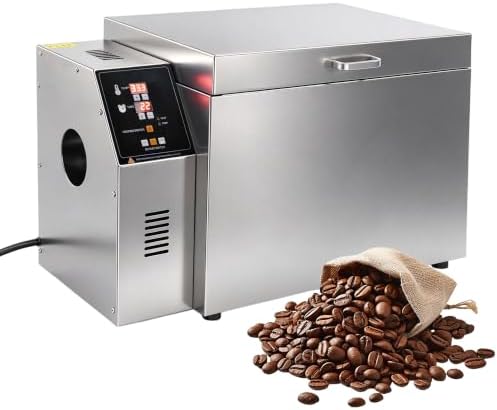
This electric drum roaster is listed in 4.4lb and 8.8lb versions. The rotating drum is designed to turn beans during roasting, while the control panel provides temperature adjustment and a timer. The stated temperature range is 86–572°F, and the listing describes settings for different roast levels as well as slower roasting for nuts and grains.
The stainless-steel construction and removable inner drum are practical design points for a machine intended for repeated use and cleaning. The listing also describes it as a multi-purpose roaster for nuts, seeds, beans, and grains. If your business plans to roast coffee and other products, that flexibility may be useful, though it also means you should consider cleaning between ingredients to manage residue and flavor carryover.
The supplied product information marks this item as unavailable. Treat it as a capacity and feature reference rather than an option you can count on buying now, and confirm availability before making plans around it. The listing also cautions against continuous heating for more than four hours.
Pros:
- Two listed sizes cover small-batch and higher-volume needs.
- Rotating drum is designed to heat beans evenly.
- Temperature and timer controls allow adjustments to the roast process.
- Removable inner drum is intended to make cleaning easier.
Cons:
- The supplied listing information marks it as unavailable.
- The stated limit is no more than four hours of continuous heating.
Verdict: Consider this model only if it becomes available and its larger drum capacity suits your planned volume.
4. HENGCMM Electric Drum Roaster: Best for Businesses Comparing Two Drum Sizes

HENGCMM lists two versions of this stainless-steel electric drum roaster: Type 5 at about 2kg and Type 10 at about 4kg. A rotating drum turns the beans, and an industrial-style control panel offers temperature adjustment from 30–300°C along with a timer. Those features make it a potential fit for a shop that wants a larger batch format than a sample roaster.
The removable inner drum is intended to make cleaning easier, and the machine is also described for roasting nuts, seeds, grains, and rice. That versatility may appeal to businesses that want to experiment with more than coffee, but a multi-use machine still needs thoughtful cleaning between products. The listing does not provide the same roast-profile software details as the first pick, so buyers focused on curve tracking may prefer a model with explicit profile tools.
The supplied product information marks this item as unavailable. Check its status and confirm which type is offered before considering it; the two listed capacities are not interchangeable, and your expected batch size should guide the choice.
Pros:
- Two listed capacities offer a choice between about 2kg and 4kg.
- Temperature and timer controls support adjustable roasting.
- Stainless-steel construction and a removable inner drum are specified.
- Designed for roasting coffee and several other ingredients.
Cons:
- The supplied listing information marks it as unavailable.
- Profile software or curve import features are not specified.
Verdict: This may suit a business seeking a larger, straightforward drum roaster, but verify availability and model size before choosing it.
5. YIYIBYUS Drum-Type Roaster: Best for Stovetop-Based Small Batches

This model uses a rotating drum driven by a 25W DC geared motor, but the heat comes from a gas stovetop rather than a built-in electric heating system. Its listed capacity is 300–1,200g, and it includes a thermometer to help monitor temperature. The drum also has baffles to move the material and holes intended to support air circulation.
Because the heat source is not built into the machine, you need a suitable gas stove or small electric ceramic stove, which is not included. The compact dimensions and vertical design may help in a space-conscious setup, but the operator controls the heat at the stove and the drum speed separately. That setup differs from an electric roaster with onboard temperature profiles and may require more hands-on attention.
The listing describes it for coffee as well as peanuts, seeds, nuts, and soybeans. For a small business, it is best viewed as a lower-cost, hands-on approach to small batches—not a direct substitute for a commercial roaster with integrated heating and profile controls.
Pros:
- Listed capacity ranges from 300g to 1,200g.
- Drum rotation speed is adjustable.
- Includes a thermometer for temperature monitoring.
- Compact design can fit over a suitable stovetop.
Cons:
- Gas stovetop heat is required and is not included.
- Heat and rotation require more hands-on operation than an integrated electric roaster.
Verdict: Choose this roaster if you want small batches and already have a suitable stovetop; look elsewhere for a self-contained commercial electric machine.
How to Choose a Coffee Roaster Machine for a Small Business
Match Batch Size to Your Sales
Estimate how much roasted coffee you need to produce in a normal work period, then compare that amount with the listed batch capacity. A 50g sample roaster is useful for testing beans but is not built for making full production batches. A 1kg-class machine may suit a small operation with modest output, while the listed 2kg and 4kg drum options are aimed at larger runs. Remember that the listed capacity alone does not tell you how quickly you can finish a day’s production.
Decide Whether You Need a Sample or Production Roaster
These machines serve different jobs. Sample roasting helps you compare green coffees and make sourcing decisions in small quantities. Production roasting is about turning a larger quantity of green coffee into inventory. Some businesses may benefit from having both types, but if you are buying one machine, choose based on the task you need it to perform most often.
Check the Heat Source and Electrical Requirements
Confirm how the machine gets hot before ordering. The 1kg model lists a 240V, 2000W electric requirement, while the YIYIBYUS model relies on a separate gas stovetop or small electric ceramic stove. Other listed models are electric drum roasters. Make sure your workspace can support the specified power or heat source, and account for any electrical work or equipment that is not included.
Consider Your Desired Level of Control
Preset profiles can make it easier to repeat a roast, while adjustable temperature controls let you change the process. If you want to save, import, or compare roast curves, the first model specifically lists manual profile saving and Artisan compatibility. The sample roaster uses app control and profile access. Other drum models list temperature and timer controls, but do not specify the same profile-management features.
Plan for Workspace, Venting, and Daily Workflow
Consider where the roaster will sit, how you will handle smoke and exhaust, and how you will move beans through roasting and cooling. The first model lists an exhaust fan, but the product details do not establish the full ventilation needs for your space. Check the machine dimensions, installation instructions, and local requirements before setting up a commercial roasting area.
Think About Cleaning and Product Separation
Some of the drum models have removable inner drums, which can help with access for cleaning. If you plan to roast nuts, grains, or other ingredients as well as coffee, consider how you will clean the machine between uses. Residue can affect the next batch, so review the manufacturer’s cleaning guidance and decide whether a dedicated coffee-only machine is a better fit.
Verify Availability and Model Details
Availability can change, and two listings in this selection are marked unavailable in the supplied product information. For machines with multiple versions, confirm the exact capacity and type being offered. Also check the product page for current specifications, included accessories, delivery details, and any setup requirements before making a purchase decision.
Frequently Asked Questions
What capacity should a small coffee business look for?
It depends on your expected output. A 50g machine is intended for sampling, while the other options list capacities from 300g up to about 4kg. Start with how much roasted coffee you need per production run, then consider how many batches your team can manage.
Can a sample roaster be used to produce coffee for sale?
A sample roaster can roast coffee, but the GO50 is limited to 50g per batch. That makes it more practical for testing and comparison than for producing regular customer inventory.
Is the YIYIBYUS roaster fully electric?
No. Its drum uses an electric motor, but the listing says heat comes from a gas stovetop, which is not included. The listing also mentions use with a small electric ceramic stove.
Which option lists Artisan compatibility?
The 1kg Commercial Electric Coffee Roaster specifically lists a connection with Artisan software, along with manual profile saving and profile import and export.
Do these roasters also handle foods other than coffee?
Several listings describe use with ingredients such as nuts, seeds, beans, grains, or rice. Check the machine’s instructions and cleaning guidance before switching between coffee and other products.
What should I check before buying a 240V roaster?
Confirm that your workspace has compatible electrical service for the listed 240V, 2000W requirement. If you are unsure, ask a qualified electrician to check your setup before purchasing or installing the machine.
Final Recommendation
For a small business that wants to roast production batches and work with repeatable roast profiles, the 1kg Commercial Electric Coffee Roaster is the strongest fit in this group—provided your workspace supports its 240V requirement. Choose the IKAWA GO50 if your priority is sampling rather than production. The larger HNZXIB and HENGCMM drum roasters may fit higher-volume needs, but the supplied information marks them unavailable, so confirm their status before planning around them. The YIYIBYUS is a more hands-on option for small batches if you already have a suitable stovetop.