
The best cold brew machine for an office depends on how many people you serve and how much time you have to brew. A large-batch steeping brewer can keep a team supplied, while an electric or slow-drip model may suit a smaller office that values a quicker cup. Here are five options, from a compact brewer to a five-gallon commercial setup, plus the key trade-offs to consider before choosing.
Quick Comparison
| Product | Capacity | Brewing style | Best for |
|---|---|---|---|
| Brezi Cold Brew Coffee Maker | Up to 880 ml (29.7 oz) | Continuous cold drip | Small offices seeking several brew modes |
| QHH 64 oz Cold Brew Pitcher | 64 oz | Immersion-style brewing with a mesh filter | Simple, batch-ahead office brewing |
| Yama Cold Brew Maker | 32 oz; listed for 6–8 cups | Slow drip | Offices that want a display-worthy glass brewer |
| Snap! 5 Gallon Commercial Cold Brew Maker | 5 gallons; up to approximately 3.5 gallons of concentrate per batch | Large-batch cold steeping | Busy offices, events, and food-service settings |
| VINCI Express Electric Cold Brew Maker | 47 oz (1.4 L) | Electric circulation extraction | Smaller teams that want cold brew quickly |
Our Picks: Best Cold Brew Machine For Office reviews
Brezi Cold Brew Coffee Maker: Compact, Adjustable Cold Drip

The Brezi uses continuous cold-drip extraction rather than a long overnight steep. It can brew up to 880 ml (29.7 oz) at a time, making it a better match for a small team or a shared office station than for serving a large crowd all at once.
Its aluminum alloy body, magnetic stainless-steel dripper, and adjustable temperature and flow controls give it a more specialized setup than a basic jar brewer. Five modes cover cold brew, concentrate, Japanese-style slow drip, tea, and custom brewing. The product description also lists detachable parts and an auto-clean cycle, which may help with routine upkeep in a shared space.
The main trade-off is capacity: you may need to brew more than one batch if several coworkers want a serving at the same time. Its controls and range of modes may also be more than an office needs if the goal is simply to make a pitcher ahead of time. The listing is marked unavailable in the supplied product data, so check the product page before planning around this option.
Pros:
- Five modes offer flexibility for coffee and tea.
- Adjustable temperature and flow allow more control over brewing.
- Aluminum body and stainless-steel dripper avoid an all-plastic design.
- Auto-clean cycle and detachable parts are intended to simplify cleanup.
Cons:
- Its 880 ml batch size may be small for a busy office.
- The supplied product data marks the listing as unavailable.
Verdict: Choose the Brezi if your office is small and values adjustable cold-drip brewing, but confirm that it is available and consider whether its batch size will meet your needs.
QHH 64 oz Cold Brew Pitcher: Straightforward Batch Brewing

This 64-ounce glass pitcher is a simple option for making a batch of cold brew to share or serve later. Coffee grounds sit in a stainless-steel mesh filter, which lifts out when brewing is finished. The pitcher can also be used for other drinks when the filter is removed.
A handle, pour spout, and silicone sealing ring make it practical to carry and pour in a shared kitchen. The fine mesh is designed to hold back coffee grounds, and the included cleaning brush gives you a tool for washing the filter. Its straightforward format may suit an office that can prepare drinks ahead of time and does not need an electric or drip-style machine.
The glass requires careful handling. The product instructions warn against pouring boiling water into it, set a maximum safe operating temperature of 140°F, and caution against sudden temperature changes. It also lacks the larger capacity and dispensing setup of the commercial Snap! model.
Pros:
- 64-ounce capacity works for making a batch ahead.
- Removable stainless-steel filter can also strain tea and other beverages.
- Pour spout, handle, and sealing ring support carrying and storage.
- Wide-mouth design and included brush help with filling and cleaning.
Cons:
- Glass needs careful handling and must not undergo sudden temperature changes.
- It is a basic pitcher rather than a fast electric or high-volume dispenser.
Verdict: The QHH is a practical pick for an office that wants an affordable-style, low-complexity pitcher format and can handle glass with care.
Yama Cold Brew Maker: Slow-Drip Brewing in a Glass Tower

The Yama uses an ice-water reservoir and slow-drip system to make a 32-ounce batch, listed as about 6–8 cups. Its product description gives a brewing time of three to four hours, shorter than the 16–24 hours it describes for immersion-style brewing. That makes it a possible middle ground for an office that wants drip extraction without waiting overnight.
Hand-blown borosilicate glass forms the brewing vessels, while the wooden tower gives the setup a distinctive look. The glass is described as non-porous and resistant to absorbing odors or chemicals. Because the brewer requires assembly and uses a tower-style setup, it needs a suitable place to stand and a little more attention than a jar pitcher.
Its capacity is modest beside the five-gallon Snap! system, and the glass components need thoughtful handling in a busy shared kitchen. The Yama is most compelling when the brewing process and presentation matter, rather than when the office needs the easiest possible dispensing setup.
Pros:
- Slow-drip system is designed to brew in three to four hours.
- 32-ounce capacity is suited to smaller batches.
- Borosilicate glass and a real-wood tower give it a distinctive design.
- Product description says the glass does not absorb odors or chemicals.
Cons:
- Requires assembly and more counter space than a simple pitcher.
- Glass parts may be less convenient in a high-traffic office kitchen.
Verdict: Pick the Yama if you want a visible slow-drip brewer for a small office and are comfortable with assembly and careful handling.
Snap! 5 Gallon Commercial Brewer: High-Capacity Office Batches

The Snap! is built for large batches, with a five-gallon container and space to prepare up to approximately 3.5 gallons of concentrate per batch. Its scale makes it the clearest fit here for a busy office, catering setup, or event where a small pitcher would need frequent refills.
It uses a PLA brew filter plus a replaceable spigot filter to reduce fine sediment. The offset spigot is designed to help more liquid drain from the container, while the wide access and manual operation support filling, steeping, draining, and cleaning. This is a bulk-brewing system, not a compact countertop appliance with automated extraction.
The large capacity is also the main drawback for smaller workplaces: it may take up more room and produce more coffee than a small team needs. The listed process is manual cold steeping, so planning ahead is important rather than expecting a quick cup on demand.
Pros:
- Five-gallon capacity is suited to high-volume brewing.
- Can prepare up to approximately 3.5 gallons of concentrate per batch.
- Dual-stage filtration is designed to reduce grounds and fine sediment.
- Offset spigot supports dispensing and helps limit leftover liquid.
Cons:
- Its size may be excessive for a small office.
- Manual cold steeping requires advance planning.
Verdict: Choose the Snap! for a large team or regular office events; for a small group, its capacity and manual batch process may be more than you need.
VINCI Express: Electric Cold Brew with Three Strength Settings
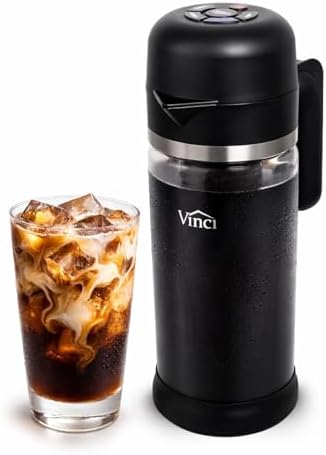
The VINCI Express is an electric brewer designed to make cold brew in less time than a traditional overnight steep. Its Circle Flow system circulates water through the grounds, with three settings: Light at 10 minutes, Medium at 15 minutes, and Bold at 25 minutes. That speed can be useful when an office wants a fresh batch without planning a day ahead.
It brews in a 47-ounce glass carafe that can also be used to serve and store the coffee. A separate serving lid is included for airtight refrigerator storage. The maker also has a self-cleaning cycle that flushes the internal brew path with fresh water using the included cleaning cup.
The 47-ounce capacity is much smaller than the Snap! commercial container, so it is better suited to a modest group or a shared station that can make repeat batches. It also relies on electricity, unlike the manual pitcher and steeping options. Its listed strength settings give it useful flexibility, but it does not offer the Brezi’s broader range of brew modes.
Pros:
- Three brew-strength settings offer different extraction times.
- Electric circulation is designed to produce cold brew in minutes.
- Glass carafe works for brewing, serving, and storage.
- Self-cleaning cycle flushes the internal brew path.
Cons:
- 47-ounce capacity may require repeat batches for a larger team.
- Requires an electrical outlet.
Verdict: The VINCI Express is a strong fit for a small or midsize office that values quick brewing and simple strength controls over large-batch capacity.
How to Choose a Cold Brew Machine for Your Office
Match capacity to the number of coffee drinkers
Start by estimating how much cold brew your team will actually use between batches. The QHH and VINCI make smaller batches, while the Yama is listed at 32 ounces. Brezi makes up to 880 ml, and the Snap! is designed for much larger quantities. A bigger brewer can reduce how often you prepare coffee, but it may be awkward or wasteful if only a few people use it.
Decide how far ahead you can brew
Some options rely on steeping or slow dripping, which means you need to plan ahead. The Yama lists a three-to-four-hour brew time, while the Snap! is a manual steeping system. The VINCI has settings from 10 to 25 minutes, and the Brezi uses continuous cold drip without a specific brew time stated in its product details. Choose a method that fits your team’s routine rather than assuming every machine is ready on demand.
Consider who will handle cleanup
A machine in a shared kitchen needs a clear cleaning routine. The QHH has a removable filter and included brush; the Brezi lists detachable parts and an auto-clean cycle; and the VINCI has a cycle that flushes its internal brew path. The Snap! is described as having wide access for cleaning, while the Yama’s assembled glass tower may require more care. Think about who will wash the parts and how often they will be used.
Check counter space and dispensing needs
Measure the space where the brewer will sit, including room to fill it, remove filters, and pour or dispense coffee. A pitcher is easy to move and store, while a tower-style brewer needs a stable spot. The Snap!’s spigot is designed for dispensing larger batches, which can be useful for a shared station. Smaller brewers may need to be refilled or brewed again when more people want coffee.
Choose the right level of control
If coworkers like different strengths, settings can be useful. The VINCI offers three strength options, and the Brezi provides adjustable temperature and flow controls plus several brew modes. Simpler pitchers have fewer steps and less to configure. Consider whether your office will use those adjustments or whether an easy fill-and-steep routine is a better fit.
Think about materials and handling
Glass pitchers and carafes can be useful for serving and storage, but they need care in a busy office. The QHH specifically warns against boiling water and sudden temperature changes. The Yama also uses glass components. The Brezi has an aluminum alloy body and stainless-steel dripper, while the Snap! is described as a durable large-batch container. Check the care instructions and choose a setup coworkers can handle safely.
Decide whether you need concentrate or ready-to-serve coffee
Some office setups prefer concentrate that can be portioned and prepared for individual drinks; others need ready-to-pour cold brew. The Snap! is described as making up to approximately 3.5 gallons of concentrate per batch, and the Brezi includes a concentrate mode. Before buying, consider how your team will serve the coffee and whether it wants a larger batch for different drinks or a smaller amount ready to pour.
Frequently Asked Questions
What is the best cold brew machine for a large office?
The Snap! is the largest option in this list, with a five-gallon capacity and space to prepare up to approximately 3.5 gallons of concentrate per batch. It is the most suitable choice here for high-volume use, though a small office may prefer a pitcher or compact brewer.
Which option makes cold brew the fastest?
The VINCI Express lists brewing settings of 10, 15, and 25 minutes. The Yama lists a three-to-four-hour slow-drip process, while the other product details do not give a specific total brew time.
Can I make cold brew ahead of time?
Yes. The pitcher-style QHH is designed for beverage storage, and the VINCI includes a serving lid for airtight refrigerator storage. For any option, follow its care and storage instructions and prepare batches according to your office’s needs.
Which machine is easiest to use in a shared office kitchen?
A simple pitcher such as the QHH has fewer controls than an electric or tower-style brewer, though it still needs to be filled, steeped, and cleaned. The VINCI adds quick settings and a cleaning cycle, while the Snap! is intended for large manual batches. The easiest choice depends on how much coffee you need and who will maintain it.
Is the QHH pitcher safe for hot water?
The product instructions say not to pour boiling water directly into the pitcher and set a maximum safe operating temperature of 140°F. They also warn against sudden temperature shifts that could crack the glass.
Which cold brew maker is best for a small office?
The VINCI, QHH, and Yama are all smaller than the Snap! commercial brewer. The VINCI is designed for quicker brewing, the QHH offers a straightforward 64-ounce pitcher, and the Yama provides slow-drip brewing in a 32-ounce batch. Choose based on whether speed, simplicity, or brewing style matters most.
Final Recommendation
For a busy office that needs to serve many people, the Snap! 5 Gallon Commercial Cold Brew Maker is the clearest capacity pick. For a smaller team that wants cold brew without an overnight steep, consider the VINCI Express. If simplicity matters most, the QHH pitcher is a straightforward batch-brewing option. Compare batch size, available counter space, and cleanup needs before deciding—and check current product listings for availability and details.