
Celery is fibrous, so a juicer needs to handle long, stringy stalks without constant clogging or extra prep. A slow masticating model can be a practical choice for celery juice, but the options differ in chute design, cleanup, pulp control, and versatility. Below, we compare five cold press juicers and explain which features matter most for your routine.
Quick Comparison
| Juicer | Best For | Notable Features |
|---|---|---|
| Omega Celery Juicer and Nutrition System | Celery-focused juicing | Celery-specific end cap, 80 RPM, multipurpose attachments |
| Ninja NeverClog Cold Press Juicer | Easy cleanup and pulp choice | Two pulp filters, reverse function, dishwasher-safe parts |
| BRECIOUS Slow Masticating Juicer | Quiet operation and adjustable modes | Soft, hard, and reverse settings; compact feed chute |
| SIFENE Mini Slow Masticating Juicer | Small kitchens | Dual feed chutes, reverse function, compact design |
| Kismile Cold Press Juicer | Less chopping | Wide feed chute, 60 RPM, reverse function |
Our Picks: Best Cold Press Juicer For Celery reviews
Omega Celery Juicer: A Specialized Pick for Celery Stalks

The Omega stands out because it includes an end cap made specifically for celery. The product description says this attachment is designed to squeeze celery for longer, with the goal of extracting more juice and leaving less waste. For other fruits and vegetables, you need to switch to the standard end cap; the celery end cap is not intended for other produce.
Its slow masticating system runs at 80 RPM, and the triple-stage design is intended to process produce in stages. The machine is also described as a nutrition system, with functions for tasks such as making nut butter, pasta, baby food, and frozen desserts. Those extra uses may be useful if you want one appliance for more than juice, though they also mean there are more functions to consider than with a basic juicer.
The main trade-off is its specialized setup. You’ll need to use the right end cap for the ingredient, and the celery-focused attachment does not replace the standard one for everyday mixed-produce juicing. The supplied product information also marks this listing as unavailable, so check the listing before making plans to buy it.
Pros:
- Includes an end cap designed specifically for celery.
- Slow 80 RPM operation.
- Offers several food-preparation functions beyond juicing.
- Includes a standard end cap for other produce.
Cons:
- The celery end cap is not intended for other fruits or vegetables.
- The supplied product information lists it as unavailable.
Verdict: Choose the Omega if celery-specific extraction is your main priority and you can confirm the product is available; for a simpler everyday option, consider the Ninja or BRECIOUS.
Ninja NeverClog: A Convenient Juicer with Pulp Options

The Ninja NeverClog is a general-purpose cold press juicer built to process produce such as celery, carrots, apples, and leafy greens. Its 150-watt high-torque motor powers a low-speed auger, while the reverse setting is there to help clear jams. That combination makes it a practical candidate if you plan to juice fibrous stalks along with other produce.
Two interchangeable pulp filters let you choose between less pulp and more pulp. The juicer also has simple Start/Stop and Reverse programs, a 24-ounce juice jug, and a 36-ounce pulp container. Its compact design is intended to fit under kitchen cabinets, and an anti-drip lever helps reduce spills when you pause to pour.
Cleanup is a particular strength: the product information says all juice-contact parts are dishwasher safe. The capacity may suit a household making a few servings at a time, but it is worth checking the jug and pulp-container sizes against your usual batch. Unlike the Omega, it does not come with a celery-specific end cap.
Pros:
- Designed to handle celery and other fibrous produce.
- Two filters provide a choice of pulp texture.
- Reverse function can help address jams.
- Juice-contact parts are dishwasher safe.
Cons:
- Does not include a celery-specific end cap.
- The included juice jug holds 24 ounces, which may be small for larger batches.
Verdict: The Ninja is a strong fit if you want a straightforward, compact juicer with adjustable pulp and easier cleanup rather than a celery-only design.
BRECIOUS Slow Juicer: Quiet Operation with Ingredient Modes
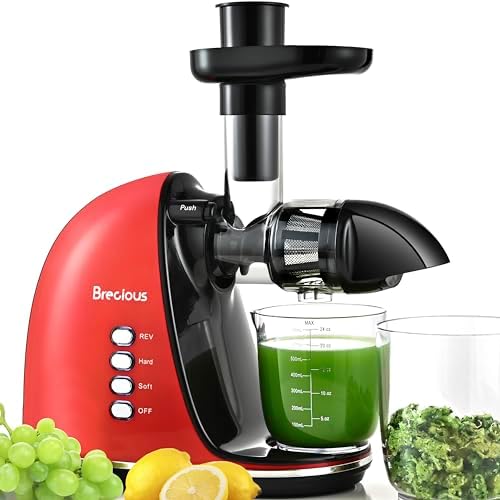
The BRECIOUS uses a seven-stage auger and offers Soft, Hard, and Reverse modes. These settings give you a way to adjust the machine for different ingredients, while Reverse is intended to help clear clogs. For celery, the ability to switch modes may be useful if your juicing routine also includes softer fruit or firmer vegetables.
The product description lists operating noise below 60 dB and a 1.8-inch feed chute. That narrower opening means you should expect to prepare ingredients to fit rather than relying on a wide chute for whole produce. The machine includes a triple-layer filter, a cleaning brush, and detachable parts described as dishwasher safe.
BRECIOUS claims a juice yield of up to 90%, but actual results can vary with the produce and how it is prepared. Compared with the Ninja, this model offers more ingredient modes; compared with the SIFENE, it does not list a dual feed chute. Its small chute is the main practical compromise, especially if minimizing prep time is important to you.
Pros:
- Soft, Hard, and Reverse modes offer adjustable operation.
- Quiet motor is listed as operating below 60 dB.
- Includes a cleaning brush and detachable dishwasher-safe parts.
- Triple-layer filtration is designed for a smooth juice texture.
Cons:
- The 1.8-inch chute may require more cutting and preparation.
- Yield claims are not a guarantee of results with every ingredient.
Verdict: Pick the BRECIOUS if quiet operation and multiple modes matter more to you than feeding long or large pieces with minimal prep.
SIFENE Mini Juicer: A Compact Choice with Dual Feed Chutes

The SIFENE is a mini slow masticating juicer aimed at smaller kitchens, apartments, dorms, and RV setups. Its dual feed chutes are designed for different kinds of ingredients: one opening accommodates long items such as celery, while the other is for fruit pieces. That layout may make prep more convenient if your juice recipes mix stalks with smaller ingredients.
A high-torque motor and reverse function are intended to help process fibrous produce and address jams. The product information also describes the design as quiet and lists BPA-free food-contact parts. Removable parts are dishwasher safe, and a cleaning brush is included for areas that need a more direct scrub.
The compact format is appealing when counter space is limited, but a smaller machine may not be the best match if you regularly make large quantities. The listing does not provide a specific motor speed or juice-container capacity, so compare those details on the product page if they matter to your routine. It also lacks the celery-only attachment offered by the Omega.
Pros:
- Compact format suited to kitchens with limited space.
- Dual chutes accommodate long stalks and fruit pieces.
- Reverse function is included to help with fibrous ingredients.
- Dishwasher-safe removable parts and a cleaning brush support cleanup.
Cons:
- The supplied details do not specify motor speed or container capacity.
- Compact size may be less convenient for large batches.
Verdict: The SIFENE is worth considering if storage space and a separate opening for long celery stalks are more important than a documented batch capacity.
Kismile Cold Press Juicer: A Wide-Chute Option for Less Prep

The Kismile has a 5.6-inch-wide feed chute, a feature intended to reduce chopping for ingredients that fit through the opening. It uses slow masticating extraction at 60 RPM and has a reverse function to help clear jams. Those details make it an option for people who want a cold press juicer with less ingredient preparation and a way to address blockages.
The included containers hold 1 liter of juice and 1.2 liters of pulp, which gives you a clear reference for planning a batch. The product information also lists a 300-watt motor, a dual safety lock, and noise below 60 dB. Kismile’s description claims up to 99% juice extraction, but that is a manufacturer claim rather than a guaranteed result; produce type and preparation can affect what you get.
A wide chute can help with prep, but it does not mean every celery stalk or other ingredient can be added whole. Check the chute opening and the product instructions before feeding long or bulky pieces. Compared with the SIFENE, the Kismile offers a much wider stated chute and listed container capacities; the SIFENE emphasizes a compact body and separate openings for long items and fruit.
Pros:
- Wide 5.6-inch chute is designed to reduce chopping.
- Slow 60 RPM extraction with a reverse function.
- Includes 1-liter juice and 1.2-liter pulp containers.
- Product information lists noise below 60 dB.
Cons:
- Wide chute does not ensure that every ingredient can be fed whole.
- The high extraction figure is a claim, not a guaranteed yield.
Verdict: Choose the Kismile if a wide chute and clearly stated container sizes are high priorities, but check the instructions for preparing celery and other long produce.
How to Choose a Cold Press Juicer for Celery
Look for a design suited to fibrous stalks
Celery has long, stringy fibers that can wrap around or slow down some juicers. A masticating juicer with a reverse function can help when ingredients begin to jam. If a model includes a celery-specific attachment, check whether it works only with celery or can also handle other produce. That detail affects how often you may need to change parts during a mixed-juice session.
Consider the feed chute and prep time
A wide chute can reduce chopping, while a separate opening designed for long ingredients may make celery easier to feed. Chute size alone does not tell you whether whole stalks are recommended, so follow the machine’s instructions. If a juicer has a narrow opening, plan to cut ingredients to fit before starting.
Check the speed settings and controls
Some models offer one basic operation, while others include settings for softer and firmer produce. A reverse control is useful to look for when juicing fibrous vegetables, since it is intended to help clear a blockage. More controls can add flexibility, but simple Start/Stop operation may be preferable if you want fewer choices.
Match the capacity to your usual batch
Container size affects how often you need to stop and empty the juice or pulp. For example, the Ninja includes a 24-ounce juice jug, while the Kismile lists a 1-liter juice cup and a 1.2-liter pulp container. If you usually make one glass, a large collection container may not matter; for bigger batches, capacity is worth comparing before you buy.
Think about cleanup before choosing
Celery fibers and pulp can collect around filters and other juice-contact parts. Removable components, dishwasher-safe parts, and an included cleaning brush can make the cleanup process easier. Check which pieces can go in the dishwasher and which areas need hand cleaning, since the exact instructions vary by model.
Measure your storage and counter space
A compact juicer may be easier to keep on the counter or store in a small kitchen, but its footprint does not tell the whole story. Leave room for the juice and pulp containers, and consider how much space you have to assemble and clean the parts. If you plan to use the juicer often, easy access may matter as much as the machine’s size.
Separate stated specifications from yield claims
Manufacturers may describe a juicer as high-yield or provide a maximum extraction figure. Treat those figures as claims, not a promise of what every batch will produce. Results can depend on the celery itself, how it is prepared, and the juicer’s setup. Comparing practical details such as speed, chute design, filters, and container size can give you a clearer picture of fit.
Frequently Asked Questions
Is a cold press juicer a good choice for celery?
A slow masticating juicer can be a useful choice for celery because several models in this guide are designed to process fibrous produce. Look for a reverse function, a feed opening suited to stalks, or a celery-specific attachment if you want a more specialized setup.
Do you need to cut celery before juicing it?
That depends on the juicer. The Omega description says to feed fresh, cold, whole celery stalks through its press chute, while other models have different chute designs and instructions. Check the specific product guidance rather than assuming every juicer handles whole stalks the same way.
Which option is designed specifically for celery?
The Omega includes a specialized celery end cap. Its product information says that attachment is not meant for other fruits or vegetables, so use the standard end cap when juicing other produce.
Which juicer is easiest to clean?
The Ninja’s juice-contact parts are described as dishwasher safe. The BRECIOUS and SIFENE also list dishwasher-safe removable parts, and the BRECIOUS and SIFENE include cleaning brushes. Always check the product instructions to see which components are safe to put in the dishwasher.
Can these juicers handle produce besides celery?
Yes. The Ninja is described for produce including apples, carrots, and leafy greens, while the BRECIOUS offers modes for different ingredient types. The Omega has a standard end cap for other produce, but its celery-specific end cap should only be used for celery.
Is a wider chute always better for celery?
Not necessarily. A wide chute may reduce chopping for ingredients that fit, while a dual-chute design may offer a dedicated opening for long stalks. Check the product instructions and the actual opening before deciding how much prep your routine will require.
Conclusion
For a celery-centered routine, the Omega is the most specialized choice because it includes a celery-specific end cap, though its supplied listing information indicates that availability should be checked. If you want a more flexible everyday machine, the Ninja combines a reverse function, pulp options, and dishwasher-safe juice-contact parts. The BRECIOUS suits shoppers who value quiet operation and multiple modes, while the compact SIFENE and wide-chute Kismile address different prep and space needs. Choose based on how often you juice celery, how much prep you are willing to do, and how much cleanup and storage space your kitchen can accommodate.