
Choosing the best compostable liners for food waste starts with matching the bag to your bin and checking where you plan to compost. Small countertop caddies need different liners than large outdoor containers, and a compostable certification does not guarantee that every local composting program will accept a bag. The options below include compact liners for kitchen scraps and a much larger liner for tall bins.
Quick Comparison: Best Compostable Liners For Food Waste
| Product | Size and count | Certification or approval listed | Best for |
|---|---|---|---|
| Generation earth 1.6-Gallon Tie-Handle Liners | 1.6 gallons; 120 bags | BPI certified; ASTM D6400 | Small countertop caddies and easy carrying |
| UNNI 2.6-Gallon Compostable Bags | 2.6 gallons; 100 bags | BPI, CMA, and OK compost HOME | Small bins and home-compost certification |
| BioBag 2.6-Gallon Food Scrap Bags | 2.6 gallons; 100 bags | BPI certified; ASTM D6400; CMA approved | Kitchen pails and composting options |
| BioBag 64-Gallon Food Waste Bags | 64 gallons; 60 bags | BPI certified; ASTM D6400 | Large, tall bins |
| YORJA 1.6-Gallon Tie-Handle Liners | 1.6 gallons; 120 bags | EN 13432; TÜV AUSTRIA OK compost HOME | Small caddies and home composting |
Our Picks: Best Compostable Liners For Food Waste reviews
Generation earth: Tie-Handle Liners for Small Countertop Bins

Generation earth’s liners are sized for 1.6-gallon countertop compost bins and come in a 120-bag pack. Their tie handles give you a way to close the bag before lifting it out of the caddy, a useful detail when you’re carrying damp scraps to another compost container.
The bags are BPI certified and listed as meeting ASTM D6400 for commercial composting environments. The product description also highlights a star-sealed bottom and thicker, leak-resistant material. Those features are intended to help the liner hold everyday wet scraps, though compostable bags are still best used promptly rather than left to sit with moisture for long periods.
This is a practical match if your bin is on the smaller side and you want handles for carrying. Compared with the similar-sized YORJA liners, Generation earth emphasizes BPI certification and a star-sealed base; YORJA lists home-compost certification and specific bag measurements.
Pros:
- Fits small 1.6-gallon countertop caddies
- Tie handles help close and carry a full liner
- BPI certified and meets ASTM D6400
- Star-sealed base is designed for added leak protection
Cons:
- Commercial composting certification does not mean every local program accepts the bags
- Smaller capacity may require more frequent emptying than a 2.6-gallon liner
Verdict: Choose Generation earth if your caddy holds about 1.6 gallons and you value tie handles and a reinforced base.
UNNI: A Certified 2.6-Gallon Option for Compact Bins

UNNI’s 2.6-gallon bags are made for compact kitchen compost bins and measure 16.3 by 16.5 inches. The listed thickness is 0.71 mil, and the pack contains 100 liners. That larger capacity may suit households that would rather collect more scraps before emptying the bin than a 1.6-gallon liner allows.
The product is listed as certified by BPI to ASTM D6400, CMA field-tested in operating facilities, and OK compost HOME by TÜV AUSTRIA. These are distinct certifications and approvals, so check your local collection service’s rules before putting a liner in its food-scrap stream. UNNI also advises storing the bags in a cool, dry place and using them within nine months for best performance.
Unlike the two 1.6-gallon options in this list, UNNI does not advertise tie handles. Its strongest selling point is the mix of listed certifications across commercial and home composting contexts, paired with a familiar small-bin size.
Pros:
- 2.6-gallon capacity for compact kitchen bins
- Listed BPI, CMA, and OK compost HOME certifications or approvals
- 0.71-mil material thickness is specified
- Suitable for kitchens, bathrooms, and offices according to the product description
Cons:
- No tie handles are listed in the product details
- Best performance guidance calls for use within nine months and cool, dry storage
Verdict: UNNI is a strong option if you need a 2.6-gallon liner and want certifications that include a home-compost designation.
BioBag: 2.6-Gallon Liners for Kitchen Scrap Pails

These BioBag food scrap liners measure 16 by 17 inches and hold about 2.6 gallons. The 100-count pack is designed to fit most kitchen compost pails and bins, with a listed thickness of 0.64 mil. BioBag says the bags are made from plant starches, vegetable oils, and compostable polymers.
The bags are BPI certified to meet ASTM D6400 standards, and the product description also identifies them as Compost Manufacturing Alliance approved. It describes them as home compostable as well. Since acceptance can vary by facility and composting setup, confirm the requirements where you plan to dispose of the filled bag.
Compared with UNNI’s similarly sized option, BioBag lists a slightly thinner material and highlights its compostable resin and CMA approval. It may suit someone who wants a simple kitchen-pail liner without needing a larger outdoor-bag format. The supplied details do not list tie handles, so you’ll need to gather or lift the bag in another way.
Pros:
- 2.6-gallon size is intended for most kitchen compost pails
- BPI certified to ASTM D6400
- CMA approval is listed
- Made with plant-based ingredients and compostable polymers, according to the product description
Cons:
- At 0.64 mil, it has a thinner listed material than the UNNI option
- No handles are listed for tying or carrying
Verdict: Pick this BioBag option if you want a standard 2.6-gallon kitchen-pail liner with BPI certification and CMA approval.
BioBag: Large 64-Gallon Liners for Tall Bins

This BioBag product is a different kind of liner from the small kitchen-caddy bags: it is a 64-gallon bag measuring 47 by 60 inches. The 60-count pack is intended for large, tall trash cans and containers, making it a better fit for larger-scale food-waste collection than for a countertop pail.
The bags are listed as 0.80 mil thick, with a star-sealed bottom for added strength. BioBag says the liners protect containers from debris and are BPI certified to meet ASTM D6400 standards. That certification is relevant to composting, but it’s still important to confirm that your local facility accepts this size and type of liner.
Among the picks here, this is the clear choice for a large container; it is not a substitute for a small caddy liner. Measure your bin before buying, since the bag’s dimensions—not just its gallon capacity—determine how well it will fit and fold over the rim.
Pros:
- Large 64-gallon capacity for tall bins
- 0.80-mil thickness is listed
- Star-sealed bottom is designed for added strength
- BPI certified to meet ASTM D6400 standards
Cons:
- Too large for typical countertop compost caddies
- Local composting services may have specific rules about liner acceptance
Verdict: Choose this BioBag only if you need a large liner and have measured a tall bin that can accommodate its 47-by-60-inch dimensions.
YORJA: Home-Compost-Certified Liners with Tie Handles
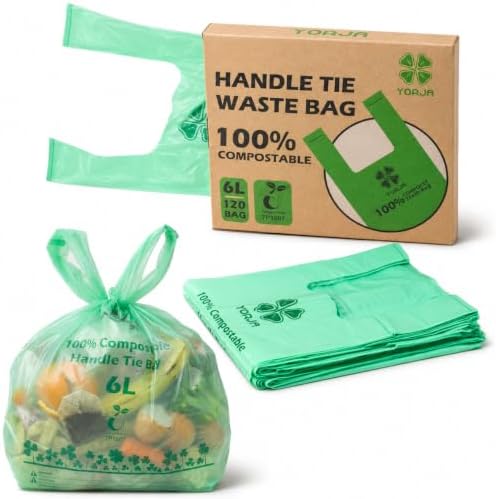
YORJA’s 1.6-gallon liners are sized for small countertop compost bins and come in a 120-count pack. Each bag has a 28.3-inch opening circumference, a 13.8-inch length, and 4.7-inch tie handles. The specified 0.71-mil material is intended for everyday food scraps such as peels and coffee grounds.
The bags are described as made from cornstarch and PBAT and certified to EN 13432 and TÜV AUSTRIA OK compost HOME. Their handles make it easier to gather the opening and carry a filled liner. For storage, the product details recommend a cool, dark, dry place away from heat, sunlight, and moisture, and suggest using the bags within 18 months of purchase for best performance.
Compared with Generation earth’s 1.6-gallon bags, YORJA provides specific dimensions and a home-compost certification, while Generation earth lists BPI certification and a star-sealed base. The best choice depends on your preferred certification, your caddy’s fit, and whether you want to prioritize a clearly specified bag size.
Pros:
- 1.6-gallon size for small countertop bins
- Tie handles help close and carry the bag
- OK compost HOME certification is listed
- Bag dimensions and thickness are provided
Cons:
- Small capacity may not suit households that collect scraps for several days
- Storage guidance calls for keeping bags away from heat, light, and moisture
Verdict: YORJA is a good fit if you have a small caddy, want tie handles, and are looking for a liner with a home-compost certification.
How to Choose Compostable Liners for Food Waste
Match the bag capacity to your bin
Start with your caddy’s stated capacity, then check the liner’s width and length when those measurements are available. A bag that is too small may slip inside the bin, while an oversized liner can bunch up and get in the way. The 1.6-gallon options here are intended for small countertop caddies, while the 2.6-gallon bags offer more room. The 64-gallon BioBag is meant for a much larger container.
Check which composting certifications matter for your setup
Look for the certification or approval that matches your disposal plan. Some products list certifications for commercial composting, while others also list a home-compost designation. A certification does not guarantee that every municipal or private facility accepts the bag, so check your local program’s rules before adding it to a food-scrap bin.
Consider handles and the way you empty the caddy
Tie handles can help you close a liner and carry it to an outdoor bin or collection point. Generation earth and YORJA list tie handles; handles are not specified for the UNNI or BioBag kitchen liners. If you empty scraps directly into another container, handles may matter less than getting a close fit.
Think about wet scraps and liner strength
Food scraps can release moisture, so thickness and construction are worth considering. The listed thicknesses range from 0.64 to 0.71 mil for the compact liners, while the large BioBag is listed at 0.80 mil. Generation earth and the large BioBag also describe a star-sealed base. These details can help you compare construction, but they are not a guarantee against leaks or tears. Emptying the bag regularly can help avoid leaving wet scraps in it for too long.
Plan for storage and how quickly you use the bags
Compostable liners can need more care in storage than conventional plastic bags. UNNI recommends cool, dry storage and use within nine months for best performance. YORJA recommends a cool, dark, dry place and use within 18 months of purchase. Keep the product’s own storage guidance in mind, especially if you buy a large pack and use only a few liners each week.
Choose a pack size that fits your routine
The compact options come in packs of 100 or 120, while the large BioBag pack contains 60. Consider how often you empty your caddy and how much storage space you have. A larger count can mean fewer restocks, but only if you can store the liners as directed and use them within the recommended period when one is provided.
Frequently Asked Questions
Can compostable food-waste bags go in any compost bin?
No. A bag’s certification or composting claims do not mean every home compost pile or local facility will accept it. Check the rules for the specific program or composting setup you use.
What is the difference between a 1.6-gallon and a 2.6-gallon liner?
The 1.6-gallon liners are intended for smaller countertop caddies. A 2.6-gallon liner holds more scraps, but you should still compare its measurements with your bin to make sure it fits securely.
Are all the liners in this list certified for home composting?
No. UNNI lists OK compost HOME certification, and YORJA lists TÜV AUSTRIA OK compost HOME certification. The other products list different certifications or approvals; check each product’s details and your composting program’s requirements.
Do tie handles make a compostable liner stronger?
Handles are mainly a way to close and carry a bag. They do not by themselves establish how strong the liner is. Compare the listed material thickness and construction details, and carry filled bags carefully.
How should I store compostable liners?
Follow the storage instructions for the specific product. The listed guidance for UNNI and YORJA calls for cool, dry storage, with YORJA also specifying a dark place away from heat, sunlight, and moisture.
Which option is best for a large food-waste container?
The 64-gallon BioBag is the only large-format option in this group. Its listed dimensions are 47 by 60 inches, so measure your container before choosing it.
Which compostable liner is best for a small countertop caddy?
For a 1.6-gallon caddy, compare Generation earth and YORJA. Both list tie handles, while YORJA provides specific bag dimensions and a home-compost certification, and Generation earth lists BPI certification and a star-sealed base.
Final Recommendation
For a small countertop bin, Generation earth and YORJA stand out for their 1.6-gallon fit and tie handles. Choose UNNI or the 2.6-gallon BioBag if your caddy needs more capacity; UNNI lists a home-compost certification, while BioBag lists BPI certification and CMA approval. For a large container, the 64-gallon BioBag is the specialized choice. Before buying, confirm the bag fits your bin and check whether your composting service or home setup accepts that type of liner.