
The best cool lunch box for work depends on what your day looks like. A rigid cooler can double as a seat on a job site, while a soft-sided bag is easier to carry into an office. Capacity, insulation, pocket layout, and how long your lunch needs to stay cool all matter. These five options cover a range of work routines, from compact meals to larger loads.
| Lunch Box | Capacity | Standout Feature | Best For |
|---|---|---|---|
| Klein Tools 55600 Work Cooler | 17 quarts; up to 18 cans | Rigid cooler that supports up to 300 pounds | Tradespeople and outdoor work |
| Carhartt Camping Cooler Worksite Lunchbox | 10 × 8.5 × 4 inches | Two compartments in a rugged soft-sided design | Smaller work lunches and daily carry |
| Carhartt Insulated Lunch Cooler | Holds up to 4 cans | Compact, fully insulated compartment | Light meals and snacks |
| Lifewit Insulated Lunch Box | 15 liters; up to 24 cans | Wide-opening top and water-resistant exterior | Large lunches and meal containers |
| MIER 15L Insulated Lunchbox | 15 liters; up to 24 cans | Multiple storage pockets and padded insulation | Long shifts and organized packing |
Our Picks: Best Cool Lunch Boxes For Work reviews
1. Klein Tools 55600: A Rigid Cooler That Doubles as a Seat

The Klein Tools 55600 is built for workdays where a soft lunch bag may not be enough. Its rigid 17-quart compartment holds up to 18 cans, and its sturdy design supports up to 300 pounds, so it can serve as an extra place to sit during a break.
The lid opens a full 180 degrees for access to the main compartment and stays open at 90 degrees when you need to reach inside. A separate storage area in the lid can hold small essentials such as keys, napkins, utensils, or medicine. The stainless steel hinge is recessed to make room for a 1-liter water bottle.
Klein says the cooler keeps contents cool for up to 30 hours. That figure makes it the strongest option here for extended cooling needs, though actual results can depend on what you pack and the conditions around the cooler. The trade-off is its rigid form: it takes up more space than a soft lunch bag and may be more cooler than you need for a small office lunch.
Pros:
- 17-quart capacity holds up to 18 cans.
- Designed to support up to 300 pounds and double as a seat.
- Lid storage keeps small items separate from food.
- Shoulder strap holds the lid in place while carrying and can convert to a handle.
Cons:
- Rigid construction is less compact than a soft-sided lunch bag.
- Its size and seat-focused design may be unnecessary for a light office lunch.
Verdict: Choose the Klein Tools cooler if you need a tough, high-capacity option for a job site and value having a sturdy place to sit.
2. Carhartt Camping Cooler: A Rugged Soft-Sided Work Lunchbox
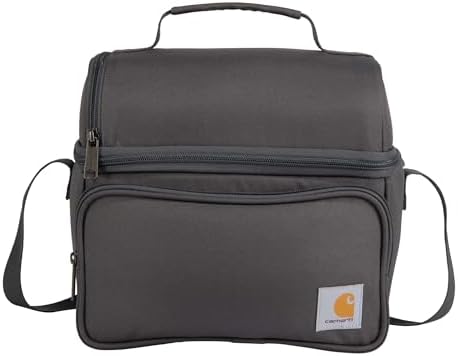
This Carhartt soft-sided lunchbox is aimed at work and outdoor use. It measures 10 by 8.5 by 4 inches, making it a more compact choice than the large coolers in this lineup. Its dual compartments help separate food and drinks, which can make a packed lunch easier to organize.
The design pairs a tough exterior with insulated compartments and sturdy carrying handles. That combination suits a daily commute, a worksite, or an outing where a soft bag is more practical than a rigid cooler. Its shape is also easier to fit into a vehicle or carry alongside other gear.
Its relatively shallow dimensions are the key limitation. It may work well for a sandwich, snacks, or a smaller packed meal, but it is not the pick for someone who needs space for a full day’s food and several drinks. The supplied product details do not specify a cooling time, so consider it when portability and a rugged build matter more than a stated extended-cooling claim.
Pros:
- Compact soft-sided design is convenient to carry.
- Dual compartments help separate food and beverages.
- Sturdy handles suit work and outdoor use.
- More portable than a rigid, seat-style cooler.
Cons:
- Its 4-inch depth limits what you can pack.
- No specific cooling-duration claim is provided.
Verdict: Pick this Carhartt if you want a rugged, compact lunchbox for a modest meal rather than a large cooler for a full shift.
3. Carhartt 4-Can Lunch Cooler: A Compact Pick for Simple Meals

This smaller Carhartt cooler is designed for a light lunch, a few snacks, or drinks for one person. It holds up to four cans and measures 10 by 8.5 by 4 inches. The fully insulated zippered compartment has a wide opening, so you can load it from the top without wrestling with a narrow opening.
The exterior is made from 600-denier polyester and has a Rain Defender finish. Inside, a mesh pocket provides space for small items such as utensils, condiments, or snacks. The easy-access handle and compact shape make it a practical choice if you prefer carrying a small lunch rather than a larger bag.
Capacity is the main trade-off. Four cans describe a compact cooler, not a roomy meal bag, so a large food container may leave little space for anything else. Carhartt recommends pre-cooling the lunch cooler for extended cooling, which is worth considering if you pack food that needs to stay cold for several hours.
Pros:
- Compact size is suited to a simple, individual lunch.
- Fully insulated compartment has a wide zippered opening.
- Mesh pocket keeps small items separate.
- 600-denier polyester exterior has a Rain Defender finish.
Cons:
- Four-can capacity is limited for larger meals or multiple containers.
- Pre-cooling is recommended for extended cooling.
Verdict: Choose this Carhartt model if you want a small, easy-to-carry cooler for a compact lunch and do not need much extra capacity.
4. Lifewit Insulated Lunch Box: Roomy Storage for Meal Prep

The Lifewit lunch bag offers a roomy main compartment for packed meals, snacks, fruit, and drinks. Its listed capacity is 15 liters, with space for up to 24 standard cans. The wide-opening lid makes it easier to place food containers inside vertically and take them out without tipping them sideways.
The interior uses food-grade PEVA lining and 3 mm EPE foam, while the exterior is made from water-resistant, dirt-resistant Oxford fabric. The lining is designed to be easy to clean, and the bag has a front pocket and side pocket for smaller items. A shoulder strap and tough handles give you more than one way to carry it.
Lifewit states that the bag can keep food and drinks cool or warm for more than 5.5 hours. Treat that as a guide rather than a guarantee, since results can vary with the contents and conditions. This bag is a strong fit for meal prep, but its large capacity may feel bulky if you only bring a sandwich and a drink.
Pros:
- 15-liter capacity offers generous room for a workday meal.
- Wide-opening lid accommodates food containers more easily.
- Food-grade PEVA lining is designed for easy cleaning.
- Front and side pockets provide extra storage for small items.
Cons:
- The large capacity may be more bag than a small lunch requires.
- Its stated cooling time is not a guarantee for every packing setup or environment.
Verdict: Choose the Lifewit if you regularly pack a full meal, several snacks, and drinks in one roomy soft-sided bag.
5. MIER 15L Lunchbox: Extra Pockets for a Well-Organized Workday

The MIER lunchbox has a 15-liter main compartment that can hold up to 24 cans, along with a number of pockets for separating smaller items. Its storage includes a mesh pocket under the flap, a front zipper pocket, two side mesh pockets, and a rear pocket with a hook-and-loop closure. A bungee cord on top gives you another place to secure accessories.
Inside, food-grade PEVA lining is paired with 8 mm EPE foam padding. The liner has heat-welded seams, and the bag uses reinforced stitching, two-way zippers, and strong buckles. It weighs 1.35 pounds and includes an adjustable, removable padded shoulder strap as well as handles, giving you a choice of carrying styles.
MIER states that the bag can keep contents hot, fresh, or cold for 6 to 8 hours, depending on the contents and working conditions. Its combination of insulation, pockets, and carrying options makes it useful for a longer shift or a day away from the office. The extra compartments are helpful for organization, though they may be unnecessary if you want the simplest possible lunch bag.
Pros:
- 15-liter main compartment offers space for a larger lunch.
- Multiple pockets keep smaller essentials organized.
- 8 mm foam padding and food-grade PEVA lining add insulation and a cleanable interior.
- Removable padded shoulder strap and carry handles offer flexible transport.
Cons:
- Its many pockets may be more than you need for a basic lunch.
- The stated 6-to-8-hour insulation time depends on the contents and conditions.
Verdict: Pick the MIER if you want a large soft-sided lunchbox with plenty of organization and several ways to carry it.
How to Choose a Cool Lunch Box for Work
Match the capacity to your usual lunch
Think about everything you carry on a typical workday, not just the main meal. A compact bag may be enough for a sandwich and drink, while meal prep, snacks, and extra beverages call for more room. Capacity figures can be useful for comparison, but also check the listed dimensions if you pack food containers that need to sit flat or upright.
Consider how long your food needs to stay cool
Compare the stated insulation claims, but remember that they are not guarantees for every situation. The type and temperature of the food, how often you open the bag, and the surrounding conditions can all affect results. If you need food to stay cold for an extended shift, look for a product with a clear cooling-time claim and follow its packing guidance.
Choose between rigid and soft-sided construction
A rigid cooler can offer structure and, in the case of the Klein Tools model, a seat-like surface that supports a stated weight. It also takes up space even when empty. Soft-sided bags are easier to carry and may fit better alongside other work gear, but their capacity and shape depend on the bag’s design.
Check how the bag opens and organizes food
A wide-opening lid can make loading containers easier, while a top or side pocket can keep utensils and small items away from the main compartment. If you carry drinks separately from food, a divided design may help. Choose pocket storage that matches what you actually bring so extra compartments do not add clutter.
Think about cleaning and carrying comfort
Food-grade PEVA linings and insulated interiors are common features in the soft-sided options here. Consider how easily the interior can be wiped clean, especially if you carry foods that may spill. For commuting or longer walks, look at handle placement, shoulder straps, and whether a strap is padded or removable.
Be realistic about portability
A high-capacity lunchbox can be useful, but it may be awkward if you carry it with a backpack or have limited storage at work. Compare the dimensions and weight when available, and consider whether a smaller bag would handle your regular lunch more comfortably. A compact cooler is easier to carry, but it leaves less room for extra food and drinks.
Frequently Asked Questions
Which lunch box in this list has the largest capacity?
The Klein Tools cooler has a 17-quart capacity. The Lifewit and MIER soft-sided bags each list a 15-liter capacity, with room for up to 24 cans according to their product details.
Which option is best for a small lunch?
The Carhartt 4-can lunch cooler is the most compact choice in this group. It is designed for a light meal, snacks, or a few drinks rather than a large meal-prep load.
Can I use these lunch boxes for hot food?
The Lifewit and MIER product details mention keeping food warm as well as cool. The Klein Tools description focuses on cooling, while the Carhartt descriptions do not give a specific hot-food performance claim. Always follow the product’s care and packing instructions.
Which lunch box is designed to double as a seat?
The Klein Tools 55600 is designed to support up to 300 pounds and can double as a place to sit. It is the most job-site-focused option in this selection.
How long can these lunch boxes keep food cool?
The supplied details state up to 30 hours for the Klein Tools cooler, more than 5.5 hours for the Lifewit, and 6 to 8 hours for the MIER, with the MIER’s performance depending on contents and working conditions. The Carhartt models do not list a specific cooling duration in the supplied information. Actual results can vary with packing and use.
Are these lunch boxes leakproof?
The Lifewit description says the bag can hold water and ice without leaking, and the MIER description notes heat-welded seams that help prevent liner leaks. The other supplied product details do not make a comparable leakproof claim. For any soft-sided cooler, keep food containers closed and upright when possible.
What should I pack to help food stay cool?
Follow the lunchbox maker’s instructions, and consider pre-cooling the cooler when recommended. Pack food in closed containers and limit how often you open the compartment. The Carhartt 4-can model specifically recommends cooling the lunch cooler first for extended cooling.
Final Recommendation
For demanding workdays and outdoor jobs, the Klein Tools 55600 stands out for its rigid construction, large capacity, and seat-like design. If you want a roomy soft-sided bag, the Lifewit is a practical choice for meal prep, while the MIER adds more pockets and carrying options. For a smaller daily lunch, choose between the two compact Carhartt models based on whether you need dual compartments or the smallest four-can format.