
Smoking calls for steady temperature checks over hours, but not every cook needs the same kind of thermometer. An instant-read model is useful for checking doneness quickly, while a leave-in probe can track food as it cooks. For longer sessions, alarms or app alerts may help you catch temperature changes without staying beside the smoker. Here are five options, from simple instant-read tools to multi-probe systems.
Quick Comparison
| Product | Thermometer type | Standout feature | Best for |
|---|---|---|---|
| ONFIKY Instant-Read Digital Meat Thermometer | Handheld instant-read | 1–2 second readings and IP67 rating | Quick spot checks |
| TempPro TempTrack Single-Probe Thermometer | Leave-in wired probe | Programmable alarm and long timer | Tracking one cut during a long cook |
| TempPro TempTrack Dual-Probe Thermometer | Two-probe thermometer | High/low smoker temperature alerts | Monitoring two temperatures at once |
| Govee WiFi Meat Thermometer | Four-probe WiFi system | App notifications over 2.4GHz WiFi | Remote monitoring and multiple foods |
| TempPro TempTrack Backlit Probe Thermometer | Leave-in wired probe | Custom alerts and a long countdown timer | Long cooks with a simple display |
Our Picks: Best Digital Meat Thermometer For Smoking reviews
ONFIKY Instant-Read Thermometer: Best for Fast Spot Checks

The ONFIKY is a handheld instant-read thermometer for checking food when you open the smoker. It is designed to return a reading in 1–2 seconds, with stated accuracy of ±1°F and a temperature range from -58°F to 572°F. Its bright backlit display is useful when checking food in dim light.
Rather than staying in the meat during the cook, this model is meant for quick checks. That makes it a simpler choice than the wired and app-connected options here, but you will need to open the smoker and take a reading each time. Its listing describes the thermometer as IP67-rated and says it can be rinsed under running water. It also has a magnetic back, auto-sleep, and motion-activated wake.
This is a good fit if you want a straightforward tool to check doneness near the end of a cook or to use for grilling, baking, and other kitchen tasks. It does not offer a leave-in probe, smoker-temperature alarm, timer, or remote notifications, so it is less suited to hands-off monitoring during a long smoke.
Pros:
- Fast stated response time of 1–2 seconds
- Bright backlit display and °C/°F switching
- IP67 rating and magnetic storage
- Useful for smoking and a range of other cooking tasks
Cons:
- Requires you to open the smoker for each check
- No continuous monitoring, timer, or alarm feature is listed
Verdict: Choose the ONFIKY if you want a quick, compact spot-check tool rather than a thermometer that monitors food throughout the smoking session.
TempPro TempTrack Single-Probe: Best for Simple Leave-In Monitoring

This TempPro TempTrack pairs a digital base with a stainless-steel probe and a 40-inch cable. The probe can stay in the food while the base remains outside the oven or smoker, so you can check the temperature without repeatedly opening the lid. The listing gives a cooking range of 32°F to 572°F and says the probe and wire can withstand up to 716°F.
The thermometer includes USDA preset temperature settings that can be adjusted, along with a programmable alarm and a timer that runs up to 99 hours and 59 minutes. A magnetic back, hanging hole, and tabletop stand give you a few ways to place the base. This is a practical arrangement for cooks who want a local readout and an alert, without adding an app or multiple probes.
Its main limitation is that it monitors one food temperature at a time. The listed features do not include a high/low alarm for the smoker itself, so it is not as flexible for tracking both the cooking environment and more than one piece of meat as the dual-probe model.
Pros:
- Leave-in probe with a 40-inch cable
- Adjustable presets, alarm, and long timer
- Probe and cable rated to withstand up to 716°F
- Magnet, stand, and hanging hole for flexible placement
Cons:
- One probe limits it to one food temperature at a time
- No smoker-range alarm or app monitoring is listed
Verdict: This is a sensible pick if you want to monitor one cut with a wired probe and a timer, without paying for multi-probe or WiFi features.
TempPro TempTrack Dual-Probe: Best for Tracking Two Temperatures

This TempPro TempTrack has two probes, letting you monitor two food temperatures at once or use the probes for food and smoker temperatures. That flexibility is handy when you have different cuts cooking together or want to keep an eye on the smoker as well as the meat. Its large backlit display shows food and oven, grill, or smoker temperatures, along with a timer.
The standout feature for smoking is its high/low temperature range alarm. Set a range for the smoker and the unit flashes and beeps if the temperature moves outside it. The listing also specifies USDA presets, manual temperature settings, and probe accuracy of ±1.8°F. A magnetic back and flip-out stand make it easier to position the display near your cooking area.
Unlike the WiFi model, this is a local-monitoring setup: the listing describes a flashing and beeping alarm but does not specify app notifications or remote access. It also gives a temperature range of 14°F to 572°F, so check that range against your intended use. For most smoking setups, its two-probe design and range alert make it more capable than a single-probe unit.
Pros:
- Two probes can track separate temperatures at once
- High/low alert is designed for smokers and grills
- Large backlit display includes a timer
- USDA presets can be adjusted manually
Cons:
- No app or remote monitoring is listed
- Stated accuracy is ±1.8°F, not as tight as the ONFIKY’s stated accuracy
Verdict: Pick this model if you want to watch both food and smoker temperatures on one display and want an audible alert when the smoker leaves your set range.
Govee WiFi Thermometer: Best for Remote, Multi-Food Monitoring

The Govee system is built for monitoring several food temperatures at once, with four probes and notifications through the Govee Home app. You can set temperature targets and receive an alert if a reading goes outside them. That can be useful when smoking multiple cuts or when you want to check readings without standing beside the smoker.
The system includes 28 USDA meat presets and has a stated measuring range of 32°F to 572°F with ±1.8°F accuracy. Its rechargeable 3,000mAh battery is listed for up to 40 hours of use per charge. The WiFi connection is limited to 2.4GHz, so it is not compatible with a 5GHz-only network according to the product information.
Remote access is its biggest advantage over the TempPro models, but it also brings extra setup compared with a basic display-and-probe thermometer. The product information warns against exposing the probes to open flames or water immersion. If you mainly want to check one cut at the smoker, a simpler wired model may be easier to use; if you value app alerts and several simultaneous readings, Govee offers more flexibility.
Pros:
- Four probes for monitoring multiple food temperatures
- App notifications when readings move outside presets
- Includes 28 USDA meat presets
- Rechargeable battery is listed for up to 40 hours per charge
Cons:
- Requires a 2.4GHz WiFi connection; 5GHz is not supported
- Probes should not be exposed to open flames or immersed in water
Verdict: Choose the Govee if remote app alerts and tracking several foods matter more to you than the simplicity of a single-probe, on-device thermometer.
TempPro TempTrack Backlit: Best for Long Cooks and Custom Alerts
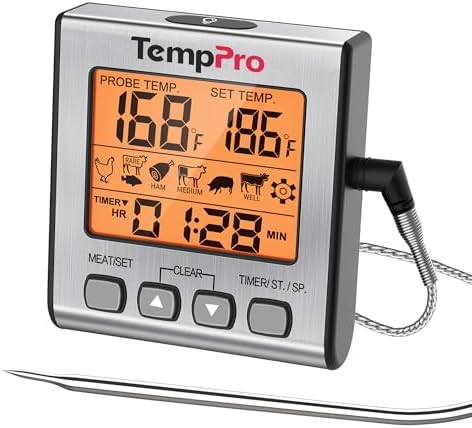
This TempPro model uses a wired probe for continuous monitoring, with a 40-inch heat-resistant cable connecting it to the display. It is listed for use from 14°F to 572°F, with stated accuracy of ±1.8°F. Its backlit screen and one-touch orange backlight are designed to make readings easier to see in low light.
You can choose from six meat presets or set a custom target temperature, then use the alert to know when the food reaches your setting. The countdown timer runs up to 99 hours and 59 minutes, which suits extended smoking sessions. The unit also has a magnet, stand, and hanging hole for different storage and display setups.
This model is a more focused alternative to the dual-probe TempPro: it offers a long timer and custom food alerts but does not list a second probe or a high/low smoker-temperature alarm. Its stated 1–2 second update speed refers to how quickly readings update; it is still a leave-in probe model, not a handheld instant-read tool.
Pros:
- 40-inch cable for keeping the display outside the smoker
- Custom temperature setting and six meat presets
- Countdown timer runs up to 99 hours and 59 minutes
- Backlight, magnet, stand, and hanging hole
Cons:
- Single probe monitors one temperature at a time
- No app notifications or smoker high/low alarm is listed
Verdict: This is a good match if you want a straightforward leave-in probe with custom food alerts and a long timer, but do not need dual-probe or app features.
How to Choose a Digital Meat Thermometer for Smoking
Decide Between Instant-Read and Leave-In
An instant-read thermometer gives you a quick spot check when you insert it into the food, but you must open the smoker to take each reading. A leave-in probe stays in place during the cook and sends readings to a display, so you can monitor progress without checking the meat by hand each time. Choose based on whether you want quick checks or continuous tracking.
Consider How Many Temperatures You Need to Track
A single probe can be enough when you are cooking one cut and only need to watch its internal temperature. Two probes let you keep track of two readings at once, while a four-probe setup is useful when cooking several foods. If you also want to monitor the smoker’s temperature, check that the model supports that use and has the alert features you need.
Look at Alerts and Timers
For a long smoke, an alarm can tell you when food reaches your target temperature. A high/low range alarm is different: it can notify you when the smoker temperature moves outside a set range. A timer helps track cook time, but it does not replace temperature monitoring. Choose the alerts that fit how closely you plan to supervise your cook.
Check Probe, Cable, and Temperature Limits
Compare the stated temperature range and cable rating with your cooking setup. Some models list a maximum temperature for the probe and cable that differs from the thermometer’s measurement range. Follow the product instructions, keep probes away from direct flames where required, and do not assume a probe or cable can withstand conditions that are not specified.
Choose the Right Display or Connection
A large backlit display can help when you are cooking outside or checking readings in low light. Magnetic backs and stands can make the base easier to position. WiFi and app alerts can let you monitor readings remotely, but they require a compatible network; the Govee model here supports 2.4GHz WiFi and not 5GHz.
Match the Features to Your Cooking Routine
If you mostly grill and only need to check doneness, an instant-read model may be all you need. For long smoking sessions, a leave-in probe and alarm can reduce the need to open the lid. If you cook several cuts at once or want notifications away from the smoker, consider a multi-probe option. Extra features are useful only when they solve a real need in your setup.
FAQs
Is an instant-read thermometer suitable for smoking meat?
Yes. An instant-read model can check the internal temperature during a cook, but you need to open the smoker for each check. A leave-in probe is better suited to continuous monitoring without repeated spot checks.
What is the difference between a food-temperature alarm and a smoker-temperature alarm?
A food-temperature alarm alerts you when the meat reaches a set target. A high/low smoker-temperature alarm alerts you when the cooking environment moves outside a set range. The dual-probe TempPro listing specifically describes a high/low range alarm for smokers and grills.
Can I leave a wired probe in the smoker?
The TempPro leave-in models are designed with probes and cables for cooking use, and their listings specify cable or probe heat limits. Follow each product’s instructions and keep the probe and cable within the stated limits.
Can I use the Govee thermometer with a 5GHz WiFi network?
No. The supplied product information says the Govee thermometer supports 2.4GHz WiFi and does not support 5GHz.
Can the Govee probes go in water or over an open flame?
The product information says to avoid water immersion and exposure to open flames. Follow those limits when positioning and cleaning the probes.
Which thermometer is best for monitoring several cuts?
The Govee has four probes and is designed to monitor multiple food temperatures. The dual-probe TempPro can monitor two readings at once, while the other listed probe models have one probe.
Final Recommendation
For most smoking setups that need ongoing temperature checks, the TempPro TempTrack Dual-Probe stands out for its two readings and smoker high/low alarm. Choose the Govee if app notifications and four probes are more important, or a single-probe TempPro if you want a simpler leave-in setup with a timer. If you only need quick spot checks, the ONFIKY is the most direct option.