
The best drain racks for kitchen sinks make use of space you already have: the sink basin, the area above it, or both. Before choosing one, measure your sink and decide whether you want a sturdy rack that stays in place or a roll-up design you can put away. These five options cover compact in-sink drying, adjustable over-sink use, and flexible counter space.
Quick Comparison
| Product | Style | Standout feature | Best for |
|---|---|---|---|
| JASIWAY In-Sink Expandable Dish Rack | In-sink or over-sink | Adjustable support bars and dedicated dish, cup, and utensil storage | Small kitchens that need flexible placement |
| Sweet Home Collection Dish Drying Rack Set | In-sink | Removable utensil holder and rubberized base | Simple, compact everyday drying |
| Sakugi Expandable Dish Rack | In-sink or over-sink | Three cup holders and a removable cutlery holder | Organized drying in a small kitchen |
| Better Houseware In-Sink Dish Rack | In-sink | Coated steel frame and removable utensil caddy | Keeping the counter clear beside a double-basin sink |
| MECHEER Roll-Up Dish Drying Rack | Over-sink roll-up | Folds away and has several uses beyond drying dishes | Flexible workspace and easy storage |
Our Picks: Best Drain Racks For Kitchen Sinks reviews
JASIWAY In-Sink Rack: A Flexible Pick for Small Kitchens
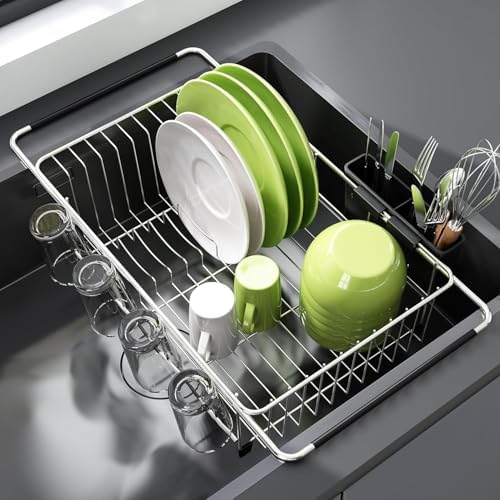
The JASIWAY is an adjustable metal rack designed to sit inside a sink or span it. Its support bars extend from 15.5 to 23.2 inches, while the rack itself measures 15.5 by 11 by 4.8 inches. That gives you a way to move drying off the counter and adapt the rack to different sink widths—provided your sink dimensions match.
Its layout includes slots for plates, a utensil holder, and space for cups. The listed capacity is up to 12 dishes, 10 bowls, and 4 cups, along with silverware. Stainless steel construction, silicone-covered handles, and an open grid are intended to support dishes while letting water drain into the basin. The product listing also gives a load capacity of up to 70 pounds; that is a stated maximum, not a reason to overload the rack.
The main advantage over a fixed in-sink drainer is the choice of in-sink or over-sink placement. That flexibility can be useful if your sink setup or daily washing routine changes. On the other hand, the rack’s dimensions still matter: an adjustable bar does not guarantee a secure fit in every sink. Check both the basin and the usable span before buying.
Pros:
- Can be used inside or over the sink.
- Adjustable support bars fit a range of sink widths.
- Includes dedicated space for plates, cups, and utensils.
- Open design directs water into the sink rather than onto a counter tray.
Cons:
- Its 15.5-inch rack length may be limiting for larger dish loads.
- Requires careful measuring to confirm a stable fit.
Verdict: Choose the JASIWAY if you want one rack that can sit in the basin or extend across it, and your measurements fall within its size range.
Sweet Home Collection: A Straightforward Compact In-Sink Set

This two-piece set keeps its footprint inside the sink, so it does not need a countertop drip tray. The rack is made from chrome-plated steel, and its rubberized undercoating is designed to help it stay put. A separate utensil holder lifts out for easier handling and cleaning.
Its simple layout suits people who want a basic drainer for everyday plates and cutlery rather than an adjustable rack with several add-ons. The product is offered in several colors, which can help it blend with different kitchen styles. The listing describes it as fitting most standard sinks, but sink shapes and usable basin space vary, so measure before ordering.
Compared with the JASIWAY and Sakugi, this rack does not offer an over-sink mode or adjustable support bars. That simpler design may be a plus if you want a rack that stays in one basin, but it offers less flexibility when you need to free up the sink or dry a larger batch of dishes.
Pros:
- Compact in-sink design keeps drying off the counter.
- Removable utensil holder makes it easier to rinse and empty.
- Rubberized base is designed to reduce shifting.
- Available in a range of colors.
Cons:
- No adjustable or over-sink setup.
- Check the rack dimensions against your sink before purchase.
Verdict: This is a practical option if you want a simple in-sink rack with a removable cutlery caddy and do not need expandable features.
Sakugi Expandable Rack: Organized Drying with Cup Holders

The Sakugi is a compact stainless steel rack that can sit in the sink or extend across it. It measures 15.4 by 9.8 by 3 inches, with support bars that adjust from 15.4 to 24 inches. Rubber covers on the bars are designed to help hold the rack in place and protect contact surfaces.
Organization is a key part of its design. The rack has a removable cutlery holder and three dedicated cup holders, along with space for dishes and other kitchen items. The open structure drains into the sink, and the listing says it can also be used as a colander for rinsing fruit and vegetables.
Its smaller footprint makes it worth considering for apartments, RVs, and kitchens with limited counter space. The listed rack width is narrower than some other options here, so it may not suit anyone who regularly dries a large number of bulky items at once. Like the JASIWAY, it offers both placement styles, but its dedicated cup holders give it a more organized setup for mugs and glasses.
Pros:
- Works in the sink or across it with adjustable support bars.
- Includes three cup holders and a removable cutlery holder.
- Compact dimensions suit smaller kitchens.
- Can also be used to rinse fruits and vegetables.
Cons:
- The compact width may limit room for larger dish loads.
- Sink measurements should be checked to confirm a stable fit.
Verdict: Pick the Sakugi if you want an adjustable rack with dedicated cup storage and a compact footprint.
Better Houseware: A Fixed Rack for One Sink Basin

The Better Houseware rack sits inside the sink rather than spanning it. Its 14.5-by-13-by-5-inch frame has divided wire slots to hold plates upright, with an open center area for bowls and cups. Water drains directly into the basin, so there is no separate tray to empty.
The two-piece set includes a removable, open utensil caddy that clips onto the side. Coated steel, rubber feet, and coated handles are intended to make the rack easier to lift and help protect the sink surface. The open wire design also leaves space for air to circulate around dishes as they dry.
This option is a good match for a standard double-basin sink if you want to use one side for drying and keep the other available for washing. Its fixed dimensions are less adaptable than an expandable rack, however, and it takes up a meaningful share of the basin. Measure the sink and consider how much room you need for washing before choosing it.
Pros:
- Drains directly into the sink without a countertop tray.
- Plate dividers help keep dishes upright.
- Removable utensil caddy lifts off for rinsing.
- Rubber feet and coated handles are designed for grip and surface protection.
Cons:
- Fixed dimensions do not adjust to different sink widths.
- Occupies one sink area while in use.
Verdict: Choose the Better Houseware if you have enough basin space and prefer a sturdy, fixed in-sink layout with a removable utensil caddy.
MECHEER Roll-Up Rack: Flexible Drying That Stores Away

Unlike the framed racks, the MECHEER is made from stainless steel pipes joined with silicone. It measures 17.5 by 11.8 inches and rests across the sink. When you are finished using it, you can roll it up for storage instead of leaving a rack in the basin or on the counter.
The listing describes several uses: drying dishes, holding washed produce, supporting hot cookware, and providing a surface for food preparation. It states that the rack supports up to 33 pounds and is heat-resistant up to 400°F. The materials are described as food-safe, and the rack is listed as dishwasher-safe. Measure your sink carefully, since the stated dimensions need to work with the span and resting edges of your setup.
This design is the most versatile choice for reclaiming counter space when the rack is not in use. It does not have plate dividers, a utensil caddy, or cup holders, so it is less organized for drying a mixed load of dishes than the JASIWAY or Sakugi. It is better suited to people who value a removable work surface and flexible storage.
Pros:
- Rolls up for compact storage when not in use.
- Can serve as a dish-drying surface, produce holder, or cooling rack.
- Stainless steel pipes are joined with silicone.
- Listed as heat-resistant up to 400°F and dishwasher-safe.
Cons:
- Does not include dividers or a separate utensil holder.
- Its fixed 17.5-by-11.8-inch size may not suit every sink.
Verdict: The MECHEER is a strong fit if you want an over-sink drying surface that rolls away and can handle more than dishes.
How to Choose a Drain Rack for Your Kitchen Sink
Measure the sink before choosing a style
Check the inside width and depth of the basin, along with the distance between the edges where an over-sink rack would rest. For expandable models, compare your measurements with both the rack’s minimum and maximum span. Also consider whether faucet placement, sink dividers, or nearby fixtures could interfere with the rack.
Decide between in-sink, over-sink, and roll-up designs
An in-sink rack keeps water contained and leaves the countertop clear, but it uses part of the basin. An over-sink rack can create drying space above the sink, though it needs secure support on both sides. A roll-up style is easy to put away and can double as a work surface, but it generally offers less built-in organization than a framed rack.
Match the rack’s capacity to your routine
Think about what you usually wash by hand. If you often dry plates, bowls, cups, and cutlery together, look for dividers, cup holders, or a removable utensil caddy. If you mostly need somewhere to set a few items, a simpler compact rack may be easier to manage. A stated weight limit can help with planning, but it does not tell you how many dishes will fit comfortably.
Check materials and contact points
Metal frames can offer a firm structure, while coatings or rubber components can help protect sink surfaces and limit movement. Look at the rack’s feet, handles, and support bars as well as the main frame. For a roll-up rack, consider how the flexible connections feel and whether its listed care instructions fit your routine.
Consider drainage and cleaning
Racks that sit inside the sink let water run directly into the basin, while countertop designs may need a tray that you empty and clean. Open layouts allow airflow around dishes and are easier to rinse than designs with hard-to-reach corners. Removable utensil holders can also be simpler to wash separately.
Think about storage when the rack is not in use
A fixed rack is ready to use but occupies space in the sink or on the counter. Expandable racks can adapt to different placements but still need somewhere to go when you are not washing dishes. A roll-up rack is designed to store compactly, which may matter in a small kitchen, RV, or shared space.
Frequently Asked Questions
Are in-sink dish racks better than countertop racks?
It depends on your space and washing habits. An in-sink rack directs water into the basin and keeps the counter open, but it takes up part of the sink. A countertop rack leaves the basin free but may need more counter room and a tray to catch water.
How do I know if an expandable rack will fit my sink?
Measure the distance across the sink where the rack’s support bars will sit, then compare it with the product’s adjustment range. Also check the rack’s own length and width. An adjustable span alone does not ensure the rack will fit the basin shape or clear nearby fixtures.
Can I use an over-sink rack with a double-basin sink?
It may work if the rack’s support points can rest securely across the sink and its span matches the available width. Check the dimensions and how the rack is intended to sit before buying. Some in-sink models may fit one side of a double basin more easily than an over-sink design.
Do roll-up dish racks take less storage space?
They are designed to roll up when you are not using them, which can make them easier to store than a fixed frame. They still need a storage spot, and their size when open must match your sink or work surface.
What features help keep dishes organized?
Plate slots help separate dishes and hold them upright. Cup holders provide a dedicated place for glasses, while a removable utensil caddy keeps cutlery together. If your dish load is small, a basic open rack may be enough.
How should I clean a sink drain rack?
Follow the care instructions for the specific rack. Open frames can often be rinsed or wiped down, while removable holders can be cleaned separately. Drying the rack after cleaning may help keep it looking its best, particularly around joints and coated areas.
Final Recommendation
For the most placement flexibility, the JASIWAY and Sakugi can be used in the sink or over it, with adjustable support bars and built-in organization. The Better Houseware is a sensible fixed in-sink choice, while the Sweet Home Collection keeps things simple with a compact rack and removable caddy. If you want a drying surface that stores away and serves other kitchen tasks, consider the MECHEER roll-up rack. Whichever style you choose, measure your sink before ordering.