
Large properties need more than a basic door chime: a driveway alarm has to cover the approach, send a signal to where you’ll hear it, and suit the kind of traffic you want to detect. The picks below use different approaches, from long-range motion and vehicle sensors to a solar-powered alert and a hose-based system. Compare the sensing method and installation needs—not just the advertised range—to find the right fit for your property.
Quick Comparison
| Driveway alarm | Detection method | Stated wireless range | Best suited for |
|---|---|---|---|
| Dakota Alert DCMA-4K Plus | Motion sensor | Up to 1 mile | Long approaches and flexible sensor placement |
| Dakota Alert DCPA-4K Plus | Vehicle probe | Up to 1 mile | Vehicle detection with fewer alerts from animals |
| TECKNET Solar RGB Wireless Alarm | PIR motion sensor | Up to 2,600 feet | Solar charging and visual alerts |
| YoLink Outdoor Motion Sensor Kit | Outdoor PIR motion sensors | Up to 2,034 feet in open air | App alerts and smart-home expansion |
| MILTON’S BELLS Wireless Hose Alarm | Drive-over hose | Up to 2,500 feet stated coverage | Vehicle traffic across a defined entrance |
Our Picks: Best Driveway Alarm Systems For Large Homes reviews
1. Dakota Alert DCMA-4K Plus: Long-Range Motion Detection

The DCMA-4K Plus is a wireless motion-sensor kit built for properties where the receiver may need to be far from the monitored approach. Dakota Alert states a wireless range of up to one mile, a useful margin for a large lot. That figure is a best-case range, though; buildings, terrain, and other obstructions can affect the signal at your property.
The sensor runs on one 9V battery, which the product information says can last a year or more. The receiver offers four volume levels, and the system can pair up to 16 sensors with one receiver. You can also pair an unlimited number of receivers with one sensor, which can help if you need alerts in more than one part of the home.
Because it detects motion rather than only vehicles, it can monitor a broader area, but that also means moving animals or people may trigger it. It’s a practical choice when early warning matters more than distinguishing a car from other movement. If you mainly want vehicle-only alerts, the Dakota Alert vehicle-probe kit below is a better match.
Pros:
- Stated wireless range of up to one mile
- Four receiver volume levels
- Supports up to 16 sensors per receiver
- One 9V sensor battery is rated to last a year or more
Cons:
- Motion detection may respond to non-vehicle movement
- Real-world signal range can be reduced by obstructions
Verdict: Choose the DCMA-4K Plus if you want a long-range, expandable motion alarm and can accept alerts for movement beyond vehicles.
2. Dakota Alert DCPA-4K Plus: A Vehicle-Focused Sensor

Unlike a motion detector, the DCPA-4K Plus uses a vehicle probe to sense vehicles. That makes it a strong option if animal movement near your driveway would otherwise cause unwanted alerts. The kit has a stated wireless range of up to one mile between the sensor and receiver, though your actual range will depend on the layout and obstructions on your property.
The receiver offers 16 alert tunes, which can help you distinguish this sensor’s signal from other alerts. It can pair with up to 16 sensors, while one sensor can be paired with an unlimited number of receivers. The sensor uses three CR-123 batteries, included with the kit; the supplied product information says they typically last a year or more. Two form C relay outputs and a 12 VDC output are also listed for compatible accessories.
This design is less flexible than a motion sensor for monitoring people or general activity, since it is intended to detect vehicles. It also requires the probe to be placed where it can sense the traffic you care about. For a long driveway where vehicle detection is the priority, that trade-off may be worthwhile.
Pros:
- Vehicle-focused detection helps limit alerts from non-vehicle sources
- Stated wireless range of up to one mile
- 16 receiver tunes and support for multiple sensors
- Includes three CR-123 sensor batteries
Cons:
- Not designed for general motion alerts such as people walking through an area
- Probe placement is important for monitoring the intended vehicle path
Verdict: Pick the DCPA-4K Plus if you want a long-range driveway alert focused on vehicles rather than general motion.
3. TECKNET Solar RGB Alarm: Adjustable Motion Alerts
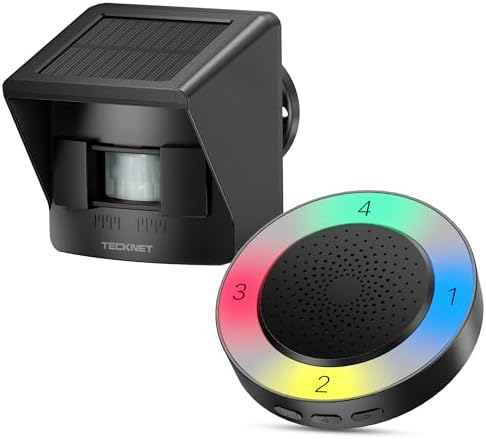
TECKNET’s system pairs a PIR motion sensor with a receiver that provides both sound and colored light alerts. Its listed wireless range is up to 2,600 feet, or about half a mile, which may suit a large property when the sensor and receiver have a reasonably clear signal path. The sensor has two sensitivity settings: the product information lists detection distances of 16 feet on low and 33 feet on high.
The sensor’s battery is charged by its solar panel, so the design can reduce the need for routine battery replacement. The kit is described as IPX5-rated and intended for outdoor use, with a listed operating temperature range of -15°C to 50°C. A rotating bracket helps you aim the sensor, while the receiver offers five volume levels, 36 melodies, four alert zones, and colored LEDs.
Those adjustable alerts can be useful if you want different sounds or visual signals for several monitored areas. The trade-off is that this remains a motion-based system, so it may respond to animals or other movement. Solar charging also makes placement important: choose a spot where the panel can receive light, and test the signal from the receiver’s intended location.
Pros:
- Solar-charged sensor battery
- Adjustable sensitivity and sensor angle
- Five volume levels, 36 melodies, and four alert zones
- Colored receiver lights provide visual alerts
Cons:
- Motion detection can include movement beyond vehicles
- Solar charging depends on suitable placement for the panel
Verdict: Consider TECKNET if you want solar charging and customizable sound and light alerts in a motion-sensor system.
4. YoLink Outdoor Motion Sensor Kit: App and Smart-Home Alerts

This YoLink starter kit includes two outdoor motion sensors and a hub for connecting them to the YoLink system. The listed open-air wireless range is up to 2,034 feet, making it an option for gates, driveways, and outbuildings where standard Wi-Fi may not reach. The kit also supports app push, email, and SMS alerts, and can connect with Alexa routines and other YoLink devices.
The SpeakerHub provides audible alerts, while app notifications offer another way to receive a signal. The hub can support more than 300 devices, so the kit can fit into a broader YoLink setup. The product information says the sensors use included AA batteries that may last five years or more under typical use; actual battery life can vary with conditions and use.
One important placement caveat: the sensors are described as designed for outdoor use but not waterproof. They should be kept away from direct rain, standing water, condensation, and excessive moisture. This makes the kit less suited to exposed mounting than a weatherproof sensor. Choose a protected location and consider whether you want app-based alerts and room to expand your smart-home system.
Pros:
- Includes two sensors and a hub for a multi-point setup
- App, email, and SMS notification options
- Can connect with Alexa routines and other YoLink devices
- Product information lists long typical battery life and no alert subscription fees
Cons:
- Sensors are not waterproof and need a protected installation spot
- Motion sensing may trigger on movement other than vehicles
Verdict: Choose YoLink if app notifications and smart-home expansion matter more to you than placing sensors in fully exposed locations.
5. MILTON’S BELLS Hose Alarm: A Defined Vehicle-Entry Trigger

MILTON’S BELLS takes a different approach from motion sensors and probes: vehicles trigger the system by driving over a hose across the entrance. The kit includes a 25-foot driveway signal hose, a transmitter, and a wireless chime. Its stated coverage is up to 2,500 feet, and the system is designed for residential driveways as well as service areas and other vehicle entrances.
The hose is made from industrial-grade, weather- and water-resistant rubber, according to the product description. The chime and bells should be kept indoors or under a building overhang rather than exposed to direct rain or snow. The system can be extended with more hose, up to 150 feet, and a Y-connector to cover additional driveways or bays.
This setup is best when you can place a hose across the exact route vehicles use. It is not a general-purpose motion detector, and installation involves laying the hose across the driveway rather than simply mounting a sensor. The supplied product data marks this item unavailable, so check the listing before planning around it.
Pros:
- Vehicle passage over the hose triggers the alert
- Includes a 25-foot hose and wireless chime components
- Hose system can be expanded up to 150 feet with compatible parts
- Useful for monitoring a defined driveway or entry lane
Cons:
- Requires the hose to cross the vehicle path
- Chime and bells need protection from direct rain and snow
- Supplied product data marks the listing unavailable
Verdict: This is worth considering if you want a vehicle-triggered hose system and can install it across a defined entrance, but verify availability first.
How to Choose a Driveway Alarm for a Large Property
Match the sensor to the alert you want
Motion sensors can detect movement from people, vehicles, and animals, depending on their placement and sensitivity. That broad coverage is useful for monitoring an approach or gate, but it may also mean more alerts. Vehicle probes and drive-over hoses focus on traffic that passes over or near a specific point, making them a better fit when you mainly care about cars and trucks.
Think about real-world range, not just the maximum
Wireless range figures are commonly stated as maximum or open-air distances. Walls, trees, terrain, and other obstructions can reduce the signal between the sensor and receiver. For a large property, consider where each unit will sit and whether the route is clear. If possible, test the signal at the intended locations before settling on a permanent installation.
Plan sensor and receiver locations
Choose a sensor location that covers the approach without pointing at areas where everyday movement will cause unwanted alerts. Then place the receiver where you can hear or notice it. Systems that support multiple sensors or receivers can help cover more than one entrance or alert people in different parts of a large home.
Consider power and upkeep
Battery-powered sensors avoid the need for a wired power connection, but batteries eventually need attention. Solar-charged models can reduce battery changes but need an appropriate location for the panel. Check the power method and the manufacturer’s stated battery life, and remember that actual performance depends on use and conditions.
Check weather limits before mounting outdoors
Outdoor sensors do not all have the same moisture protection. A weather-rated unit may offer more flexibility, while a device that is not waterproof needs a sheltered location away from rain, standing water, and condensation. Also check where the receiver or chime can be placed; some systems require those components to stay indoors or under cover.
Decide whether you need smart-home features
A basic receiver with an audible chime may be enough if you want a simple local alert. App notifications, text or email alerts, and smart-home connections can add flexibility, but they may require a hub and setup through a compatible platform. Choose these features only if you expect to use them.
Frequently Asked Questions
What type of driveway alarm works best for a long driveway?
Look for a system with a stated range that gives you room for your property layout, then consider obstructions between the sensor and receiver. The Dakota Alert DCMA-4K Plus and DCPA-4K Plus list ranges of up to one mile, but actual signal reach can vary from one property to another.
Should I choose a motion sensor or a vehicle sensor?
A motion sensor can cover movement from more than just vehicles, which is helpful if you want to monitor people or a broader area. A vehicle-focused probe or hose is more specific to traffic and may be preferable if you want to reduce alerts from animals or other movement.
Will a wireless driveway alarm work through trees or buildings?
It may, but obstacles can reduce the signal and the maximum listed range is not a guarantee for every property. Test the system between the planned sensor and receiver locations, especially if the route includes walls, dense trees, or changes in terrain.
Can I monitor more than one entrance?
Some kits support multiple sensors, receivers, or both. For example, the Dakota Alert systems listed here support up to 16 sensors per receiver, while the YoLink kit includes two sensors. Check each system’s pairing limits and alert options before adding more coverage.
Are all outdoor driveway sensors waterproof?
No. Outdoor use does not always mean a device can be exposed to rain or standing water. The YoLink sensors in this roundup are specifically described as not waterproof and should be installed in a protected location. Check the product’s stated weather limits before mounting any sensor.
What should I do if I want alerts in more than one room?
Look for a system that lets one sensor pair with multiple receivers or supports an expanding network. Dakota Alert’s product information says one sensor can be paired with an unlimited number of receivers. Confirm the setup requirements and where you can place each receiver.
Conclusion
For a large property, the right driveway alarm depends on what you need to detect and where you can place the equipment. The Dakota Alert DCMA-4K Plus is a strong fit for long-range motion monitoring, while the DCPA-4K Plus is the more targeted choice for vehicle alerts. TECKNET adds solar charging and customizable visual alerts, and YoLink is the option to consider for app notifications and smart-home connections—provided you can protect its sensors from moisture. MILTON’S BELLS offers a hose-based approach for a defined vehicle entrance, though the supplied product data marks its listing unavailable. Compare those trade-offs with your property layout before choosing.