
A dual dash cam with night-focused imaging can record both the road ahead and what happens behind you, with features such as larger apertures, HDR, or low-light sensors intended to help in dim conditions. The right choice depends on more than a “night vision” label: check each camera’s actual resolution, how its rear camera performs, and whether parking-mode recording needs extra wiring. Here are five front-and-rear options, with their key differences and trade-offs.
Quick Comparison
| Dash cam | Front / rear video | Night-focused features | Notable extras |
|---|---|---|---|
| Nipotop 4K Dual Dash Cam | 4K / 1440p | Starlight sensor, f/1.5 aperture, WDR | 64GB card, fast Wi-Fi, parking mode with hardwire kit |
| ROVE R2-4K Dual Dash Cam | 2.5K upscaled to 4K / 1080p | STARVIS 2 sensor, f/1.5 front aperture, HDR | 128GB card, GPS, fast Wi-Fi |
| VIOFO A229 Pro | 4K / 1440p | STARVIS 2 sensors, HDR on front and rear | Voice control, GPS, three parking modes |
| Aputeta 4K+4K Dual Dash Cam | 4K / 4K | Starlight sensor, f/1.5 aperture, WDR | 128GB card, GPS, parking mode with hardwire kit |
| BOTSLAB G300H Plus | 4K / 1080p | STARVIS 2, HDR, f/1.5 front aperture | 64GB card, GPS, voice control, parking monitor |
Our Picks: Best Dual Dash Cams With Night Vision reviews
1. Nipotop 4K Dual Dash Cam: A strong resolution balance front and rear

The Nipotop records 4K video in front and 1440p video from the rear camera. That rear resolution is higher than the 1080p rear video offered by several options here, which may be useful if you want more detail from both directions. Its wide-angle lenses cover 170 degrees up front and 150 degrees at the rear.
For dim roads and changing light, the listed features include a starlight sensor, an f/1.5 front aperture, and WDR. These features are intended to help the camera handle low light and balance bright and dark areas, but they cannot guarantee that every plate will be readable—especially when a vehicle is moving quickly or glare is strong.
A 64GB card is included, though the product description says about 40GB is available for recordings after space is reserved for system use. Loop recording overwrites older footage as storage fills, while the G-sensor can lock event clips. Time-lapse parking monitoring is available with a separately required hardwire kit.
This is a sensible pick if you want better-than-Full-HD rear recording without moving to a 4K rear camera. One limitation is that its parking feature needs an additional kit, and the included card offers less recording space than the 128GB cards bundled with some alternatives.
Pros:
- 4K front and 1440p rear recording
- Starlight sensor, f/1.5 aperture, and WDR for low-light scenes
- 64GB card included with loop recording
- Fast Wi-Fi for viewing and transferring clips
Cons:
- Parking mode requires a separate hardwire kit
- Less included storage than the 128GB-card options
Verdict: Choose the Nipotop if you want a good front-and-rear resolution balance and useful night-focused features, and you are comfortable buying a hardwire kit separately for parking monitoring.
2. ROVE R2-4K Dual Dash Cam: A convenient package with GPS and extra storage

The ROVE R2-4K records the front at 2.5K and upscales the footage to 4K for playback. That is not native 4K capture, an important distinction if you are comparing resolution labels. The rear camera records at 1080p, so the front view gets more detail than the rear.
Its front camera uses a Sony STARVIS 2 sensor, an f/1.5 aperture, and HDR. Together, these features are designed to improve low-light capture and manage bright highlights against darker areas. The rear camera has an f/1.8 aperture, according to the product information, but its lower resolution remains a trade-off compared with 1440p or 4K rear-camera options.
The package includes a 128GB card and built-in GPS. GPS data can add speed, route, and location details to recordings, and the app supports video playback and downloads over Wi-Fi. The product description also lists motion detection, a G-sensor, loop recording, and emergency video locking.
This model suits drivers who value bundled storage, GPS, and app-based access. Its “4K” description needs context: the front capture is upscaled from 2.5K, and the rear is Full HD. Consider another pick if native 4K front recording or a higher-resolution rear view is your priority.
Pros:
- STARVIS 2 front sensor, f/1.5 aperture, and HDR
- 128GB card included
- Built-in GPS adds route and speed information to video
- Wi-Fi app supports viewing and downloading recordings
Cons:
- Front video is captured at 2.5K and upscaled to 4K
- Rear camera records at 1080p
Verdict: The ROVE is a practical choice if you want GPS and a larger included card, as long as you understand that its front 4K output is upscaled and its rear footage is 1080p.
3. VIOFO A229 Pro: High-detail recording and flexible parking modes
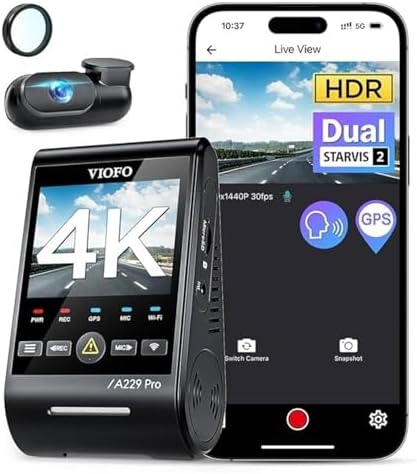
The VIOFO A229 Pro records in 4K at the front and 1440p at the rear. Its front and rear cameras use STARVIS 2 sensors, and the product description specifies HDR for both channels. That combination makes this one of the more capable choices in the group for recording detail across front and rear views, including in challenging light.
HDR is intended to preserve detail across bright and dark parts of a scene, which can matter when headlights, streetlights, and shadowed areas appear together. It is not a guarantee that fast-moving or distant license plates will always be legible, so careful camera placement and a clean windshield still matter.
The A229 Pro offers three parking modes: automatic event detection, low-bitrate recording, and time-lapse. Its buffered event detection saves footage from before and after a detected event, based on the supplied product details. A hardwire kit is not included, so check what is needed for the parking mode you plan to use. Other features include voice commands, GPS logging, and 5GHz Wi-Fi.
This model is a good fit if you want detailed rear footage, HDR on both cameras, and more control over parked-car monitoring. Its main practical drawback is that the parking setup may require an additional purchase, and the supplied information does not specify an included memory card.
Pros:
- 4K front and 1440p rear recording
- STARVIS 2 sensors and HDR for both front and rear cameras
- Three parking modes, including buffered event detection
- Voice control, GPS logging, and 5GHz Wi-Fi
Cons:
- Hardwire kit for parking use is not included
- Supplied product details do not list an included memory card
Verdict: Pick the VIOFO if you want strong front-and-rear recording specifications and flexible parking options, and you are prepared to sort out the memory card and hardwire setup yourself.
4. Aputeta 4K+4K Dual Dash Cam: Matching high resolution front and rear

The Aputeta stands out for its listed 4K recording from both front and rear cameras. The front lens has a 170-degree field of view, while the rear lens has a 160-degree field of view. That makes it the clearest match for shoppers who want the same headline resolution from both directions rather than a sharper front view paired with a lower-resolution rear camera.
For low-light driving, the product information lists a starlight-level sensor, an f/1.5 aperture, a five-element optical lens, and WDR. The camera also includes GPS positioning and an app for viewing and downloading clips over Wi-Fi. A 128GB card is included, giving it more bundled storage than the 64GB-card options in this comparison.
Parking monitoring uses time-lapse recording, and the collision sensor can lock an event clip. This feature requires a separate hardwire kit. The product also lists loop recording, emergency video locking, and voice guidance. As with any dash cam, real-world plate capture can vary with speed, distance, lighting, and the angle of the camera.
This is an appealing choice if equal 4K resolution front and rear is your main goal. However, the supplied specifications describe the resolution and low-light features but do not provide detailed sensor model information, so shoppers who prefer a named sensor may favor the VIOFO, ROVE, or BOTSLAB.
Pros:
- 4K recording from both front and rear cameras
- Starlight sensor, f/1.5 aperture, and WDR
- 128GB memory card included
- GPS, Wi-Fi app access, and event locking
Cons:
- Parking mode requires a separate hardwire kit
- Supplied specifications do not name the image sensor model
Verdict: Choose the Aputeta if 4K footage from both cameras and a 128GB included card matter more to you than a named sensor specification.
5. BOTSLAB G300H Plus: Night-focused features with voice control

The BOTSLAB G300H Plus records 4K video in front and 1080p video at the rear. Its front camera uses a STARVIS 2 sensor with an f/1.5 aperture, and HDR is listed as a night-vision feature. This combination is aimed at improving low-light detail and handling glare, while the wide 170-degree front lens captures a broad view of the road.
The camera includes GPS, a 64GB card, Wi-Fi, and voice commands. Those commands can help you operate supported functions without reaching for the camera, though you should still keep your attention on driving. The product description also lists parking monitoring; a hardware kit is required for that feature.
One compatibility issue is worth noting for some iPhone owners: the supplied details state that the dash cam and CarPlay cannot use Wi-Fi at the same time on an iPhone. If you rely on wireless CarPlay, check whether this limitation fits your routine before choosing this model.
Compared with the ROVE, the BOTSLAB also has a 1080p rear camera, but its product details specifically list STARVIS 2 and HDR. It suits drivers who value those features and voice control more than a higher-resolution rear view.
Pros:
- STARVIS 2 front sensor, f/1.5 aperture, and HDR
- 4K front recording and a wide front field of view
- GPS, voice control, and a 64GB card included
- Parking monitoring available with a hardware kit
Cons:
- Rear camera records at 1080p
- iPhone Wi-Fi connection may conflict with wireless CarPlay
Verdict: The BOTSLAB is worth considering if you want STARVIS 2, HDR, and voice control, but look elsewhere if you need a higher-resolution rear camera or simultaneous wireless CarPlay and dash-cam Wi-Fi on an iPhone.
How to Choose a Dual Dash Cam With Night Vision
Look beyond the “night vision” label
For these dash cams, night-focused performance comes from features such as a larger aperture, a low-light sensor, and HDR or WDR. A larger aperture can let more light reach the sensor, while HDR and WDR are designed to balance bright and dark areas. These technologies can help in low light, but they do not make every scene clear or guarantee readable plates in all conditions.
Compare the actual front and rear resolutions
Check the listed resolution for each camera separately. Some models have 4K front video with 1080p rear video, while others offer 1440p or 4K at the rear. Also distinguish native capture from upscaled output: the ROVE’s front video is captured at 2.5K and upscaled to 4K. If evidence from behind your vehicle matters, rear resolution deserves as much attention as the front camera’s headline number.
Consider sensor and HDR details together
A named sensor can make specifications easier to compare, but it is only one part of image quality. Lens aperture, HDR or WDR, camera placement, and lighting all affect the final clip. The VIOFO lists STARVIS 2 sensors for both cameras and HDR on both channels; the ROVE and BOTSLAB list STARVIS 2 for the front camera. Compare the full setup rather than relying on one feature name.
Decide whether you need parking-mode recording
Parking features may require a hardwire or hardware kit, which is not included with several models here. Before buying, check which parking mode you want and what installation it needs. The options vary: some list time-lapse recording, while the VIOFO also lists automatic event detection and low-bitrate recording.
Check included storage and recording behavior
Included card capacity affects how much footage you can keep before loop recording replaces older files. The Nipotop includes a 64GB card and notes that some space is reserved for system use; the ROVE and Aputeta include 128GB cards, while the BOTSLAB includes 64GB. The supplied VIOFO details do not state that a card is included, so confirm the storage requirements before setup.
Think about how you will access clips
Wi-Fi apps can make it easier to preview and transfer video, while built-in GPS can add route or speed information to recordings. Check whether the app features fit your phone and driving habits. In particular, the BOTSLAB product details note a Wi-Fi conflict with wireless CarPlay on iPhones, which may affect how some drivers use it.
Frequently Asked Questions
What does night vision mean on a dash cam?
In these models, “night vision” generally refers to camera features intended to improve low-light footage, such as a larger aperture, a low-light sensor, and HDR or WDR. It does not mean that a dash cam can clearly record every dark scene or identify every plate.
Is native 4K better than upscaled 4K?
Native 4K means the camera captures video at 4K resolution. Upscaled 4K means lower-resolution footage is enlarged for 4K playback. The ROVE captures front video at 2.5K and upscales it, while the other listed models specify 4K front recording.
Which option has the highest listed rear-camera resolution?
The Aputeta lists 4K rear recording. The Nipotop and VIOFO list 1440p rear video, while the ROVE and BOTSLAB list 1080p rear video.
Do these dash cams record while the car is parked?
Several list parking monitoring, but the modes and power requirements differ. Nipotop and Aputeta require a separate hardwire kit for their listed time-lapse parking modes. The VIOFO offers three parking modes, and its hardwire kit is not included. Check each product’s installation requirements before relying on parked-car recording.
Do I need to buy a memory card separately?
Not for the Nipotop, ROVE, Aputeta, or BOTSLAB based on the supplied product details; each lists an included card. The supplied VIOFO details do not specify an included card, so plan to verify that before purchase.
Can a dash cam guarantee that a license plate will be readable at night?
No. Resolution and low-light features can help capture detail, but readability depends on factors such as distance, movement, glare, weather, and camera angle. Night-vision claims should be treated as a performance goal, not a guarantee.
Final Recommendation
For a strong balance of front and rear detail, the VIOFO A229 Pro stands out with 4K front recording, 1440p rear recording, STARVIS 2 sensors, and HDR for both cameras. If you want 4K resolution from both directions, consider the Aputeta, while the Nipotop offers a capable 1440p rear view with an included card. The best choice depends on your rear-camera needs, storage preference, phone setup, and whether you are willing to add the wiring needed for parking mode.