
If your recording room has bare walls, a hard floor, or other sources of background noise, a dynamic XLR microphone can help keep your voice in focus. The right choice still depends on close placement, your speaking style, and an interface or mixer with an XLR input. Here are five options, from straightforward vocal mics to broadcast-focused designs, with the trade-offs that matter in an untreated room.
Quick Comparison
| Microphone | Best suited for | Standout feature | Setup note |
|---|---|---|---|
| RØDE PodMic | Podcasting and spoken-word recording | Built-in pop protection and shock mounting | Requires an XLR interface or mixer |
| Shure SM58 | Vocals, presentations, and general recording | Cardioid pickup and integrated pop protection | Traditional handheld vocal-mic format |
| Shure SM7B | Podcasting, streaming, and voiceover | Built-in pop filtering and shock isolation | XLR connection to an interface or mixer |
| Shure SM58S | Live vocals and presentations | Integrated on/off switch | Cardioid vocal mic with a handheld design |
| Elgato Wave DX | Streaming and speech recording | Speech-focused capsule and room-noise rejection | Works with an XLR preamp or audio interface |
Our Picks: Best Dynamic Xlr Microphones For Untreated Rooms reviews
RØDE PodMic: A Broadcast-Focused Pick with Built-In Pop Control

The PodMic is a dynamic XLR microphone designed with speech and broadcast-style recording in mind. Its cardioid capsule is described as tuned for speech and suited to rejecting room noise in untreated spaces, making it a natural fit if your recording area is not acoustically treated.
Its internal pop filter and shock mounting help tame plosives and desk thumps without requiring those accessories as separate purchases. The all-metal body is built for regular use, and the integrated swing mount gives you a way to position the mic. You will still need an audio interface, mixer, or RØDECaster with an XLR input; this is not a USB mic.
Compared with the SM58, the PodMic is more clearly aimed at a fixed podcast or broadcast setup. Its built-in mounting and pop-control features make it a convenient starting point for spoken-word recording. The trade-off is that you need an XLR recording setup, and a cardioid mic still works best when you speak close to it and point its front toward your voice.
Pros:
- Speech-focused dynamic capsule with cardioid pickup
- Internal pop filter and shock mounting are built in
- Integrated swing mount helps with positioning
- All-metal body
Cons:
- Requires an XLR interface or mixer
- Its broadcast-style format is less suited to a simple handheld setup
Verdict: Choose the PodMic if you want a speech-oriented XLR mic with pop protection and mounting features built in.
Shure SM58: A Versatile Vocal Mic for Home and Live Use

The SM58 is a cardioid dynamic vocal microphone made for studio and live performance use. Its tuned frequency response includes a subtle midrange lift intended to help vocals stay clear and present. The cardioid pattern focuses on sound from the front while helping reduce background pickup, which can be useful when your room is noisy or reflective.
A spherical grille and built-in filter help reduce plosives, breath, and wind noise. Its rugged metal construction and reinforced stand adapter suit frequent use, whether you are recording at home, rehearsing, or performing. Unlike the PodMic and SM7B, it does not have the same broadcast-style built-in shock mounting described for those models, so your stand and mic placement matter.
The SM58 is a flexible choice if you want one microphone for both voice recording and live performance. It is less tailored to a desk-based podcast setup than the PodMic or SM7B, but its focused pickup and integrated pop protection make it a practical option for close-miked speech.
Pros:
- Cardioid pickup helps focus on sound from the front
- Built-in filter and grille help control plosives and breath noise
- Works for recording, podcasting, broadcast use, and live performance
- Rugged metal construction
Cons:
- Handheld vocal-mic design may be less convenient for a fixed desk setup
- Does not include the PodMic’s integrated swing mount
Verdict: Pick the SM58 if you want a sturdy, versatile vocal mic that can move between home recording and live use.
Shure SM7B: A Broadcast-Style Mic with Extensive Pop Control
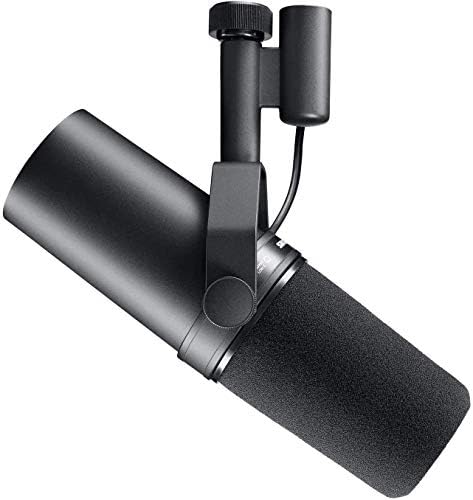
The SM7B is a dynamic XLR microphone built for spoken-word recording, podcasting, streaming, voiceover, and singing. Its wide-range frequency response is intended to capture balanced vocals, while its cardioid pickup pattern helps keep attention on the voice in front of the mic.
Air suspension shock isolation helps limit handling vibrations, and the built-in pop filtering plus detachable windscreen help manage plosives, breath, and wind noise. The rugged metal build and electromagnetic shielding add to its studio-oriented design. As with any XLR mic, you will need an audio interface or mixer, and you should check that your chosen setup can provide the input level you need.
Compared with the PodMic, the SM7B offers a more customizable XLR workflow and detachable windscreen, while the PodMic includes an integrated swing mount. The SM7B may be more than you need if your goal is a simple voice setup, but its combination of pop filtering and shock isolation makes it a strong option when you want a dedicated broadcast-style microphone.
Pros:
- Cardioid pickup and air suspension shock isolation
- Built-in pop filtering with a detachable windscreen
- Suited to podcasting, streaming, voiceover, and singing
- Rugged metal construction with electromagnetic shielding
Cons:
- Requires an XLR interface or mixer
- More specialized than a basic handheld vocal mic
Verdict: Choose the SM7B if you want a broadcast-style XLR mic with built-in pop control and shock isolation for close-miked voice work.
Shure SM58S: A Cardioid Vocal Mic with a Handy Mute Switch

The SM58S pairs the familiar cardioid dynamic vocal-mic design of the SM58 with an integrated on/off switch. That switch lets you mute the microphone between speakers, songs, or recording takes without unplugging it, which can be useful in a presentation or rehearsal setup.
Its tuned response is designed to keep vocals clear and present, while the cardioid pattern focuses on sound from the front and helps limit off-axis noise. The hardened grille and internal filtering help reduce plosives, breath noise, and handling sounds. Like the standard SM58, it is a handheld-style mic that can also be used with a stand.
The switch is the main difference to weigh against the standard SM58. It adds convenient local control, but it may not be useful if you prefer to manage muting from your mixer or recording software. For untreated rooms, its focused pickup can help, but you will still want to keep the mic close and avoid aiming it toward reflective surfaces or unwanted noise.
Pros:
- Integrated on/off switch for quick muting
- Cardioid pickup helps focus on the voice in front
- Internal filtering and grille help reduce plosives and breath noise
- Suitable for live vocals, presentations, and rehearsal use
Cons:
- The switch may be unnecessary if you mute through your recording setup
- Handheld design is less purpose-built for a fixed broadcast arm setup
Verdict: The SM58S is a sensible choice if you want the practical vocal-mic format of the SM58 and value a physical mute switch.
Elgato Wave DX: A Speech-Tuned XLR Mic for Streaming Desks

The Wave DX is a dynamic XLR microphone with a capsule optimized for speech. Its cardioid pattern is described as having a wide, forgiving acceptance angle, which can help if you shift your position while speaking. The product is also designed to reduce unwanted room noise, a useful focus for streaming or recording in a space without acoustic treatment.
It works with an XLR preamp or audio interface and does not require a signal booster, according to the supplied product details. The included mono swivel mount accepts common mic-stand thread sizes with the included adapters, and its design lets you adjust the mic position without jamming the cable.
Compared with the PodMic, the Wave DX emphasizes a forgiving speaking angle and broad stand compatibility, while the PodMic includes an integrated swing mount and built-in pop filter. The Wave DX may suit a desk-based creator who wants flexible positioning, but you will need to provide the XLR interface or preamp and a compatible stand.
Pros:
- Speech-optimized dynamic capsule
- Cardioid pattern with a wide, forgiving acceptance angle
- Works with an XLR preamp or audio interface without a signal booster
- Swivel mount includes thread adapters for common stand sizes
Cons:
- Requires a separate XLR preamp or interface
- Does not include the PodMic’s integrated pop filter and shock mounting
Verdict: Consider the Wave DX if you want a speech-focused XLR mic with flexible positioning and a forgiving pickup angle for a streaming or recording desk.
How to Choose a Dynamic XLR Microphone for an Untreated Room
Look for a Cardioid Pickup Pattern
All five picks use a cardioid pattern, which is designed to focus on sound from the front of the microphone and reduce pickup from other directions. This can help when you are recording in a room with background noise, but it does not remove every reflection or sound in the space. Aim the front of the mic toward your mouth and keep unwanted noise behind it when possible.
Match the Mic to Your Recording Style
For podcasting and broadcast-style speech, the PodMic and SM7B offer features aimed at close voice recording, including built-in pop control. The Wave DX is also speech-focused and has a wide, forgiving acceptance angle. If you want a mic that can also work for live vocals or presentations, the SM58 and SM58S offer a more traditional handheld vocal-mic format.
Check Your XLR Setup Before You Buy
These are XLR microphones, not USB microphones. You will need an audio interface, mixer, or compatible preamp with an XLR input to connect one to your recording setup. The Wave DX is specified to work without a signal booster, but the other product descriptions do not make that claim. Check the requirements of your particular interface or mixer before choosing.
Consider Pop Protection and Vibration Control
Plosive sounds from words with strong “p” and “b” sounds can be distracting in close-mic recording. The PodMic has an internal pop filter and shock mounting, while the SM7B has built-in pop filtering and air suspension shock isolation. The SM58 and SM58S have built-in filtering and a grille, and the Wave DX’s supplied details focus on its capsule, pickup, and mount rather than built-in pop protection.
Think About Mounting and Mic Position
Your mic should be easy to position close to your mouth without blocking your workflow. The PodMic includes an integrated swing mount, and the Wave DX comes with a swivel mount and thread adapters. The SM58 models use a handheld vocal-mic design and include a stand adapter. Check what mounting hardware you already own so you know whether you will need additional gear.
Use Placement to Get Better Results
A dynamic mic can help keep your voice prominent, but good placement still matters in an untreated room. Speaking close to the mic can make your voice clearer relative to distant room sound. Avoid placing it near a loud computer or other noise source, and experiment with its direction and distance. No microphone can fully correct a highly reflective room on its own.
Frequently Asked Questions
Are dynamic XLR microphones good for untreated rooms?
They can be a useful choice because close placement and a directional pickup pattern can help keep attention on your voice. They do not eliminate room reflections or background noise, so mic position and recording technique still matter.
Do these microphones connect directly to a computer?
No. These models use XLR connections, so you need an audio interface, mixer, or compatible preamp with an XLR input to connect them to a computer-based recording setup.
Which pick has the most built-in pop control?
The PodMic has an internal pop filter, while the SM7B has built-in pop filtering and a detachable windscreen. Both are designed to help manage plosives and breath noise during close-miked speech.
Which microphone is best for a podcast desk?
The PodMic and SM7B are both aimed at broadcast-style voice work. The PodMic includes an integrated swing mount, while the SM7B offers built-in pop filtering and shock isolation. Your choice may depend on which features best fit your stand and recording setup.
What is the difference between the SM58 and SM58S?
The SM58S includes an integrated on/off switch. The standard SM58 does not list that switch in its supplied product details. Both are cardioid dynamic vocal microphones with built-in pop protection.
Can a cardioid microphone remove all room echo?
No. Cardioid pickup can reduce sound coming from other directions, but it cannot erase reflections that reach the microphone. Close placement and a quieter, less reflective recording position can help, but the room still affects the sound.
Final Recommendation
For a speech-focused setup in an untreated room, the RØDE PodMic is a strong all-around choice if you want built-in pop protection, shock mounting, and an integrated swing mount. Choose the Shure SM7B if you want a more customizable broadcast-style mic with pop filtering and shock isolation. The SM58 is the most versatile traditional vocal-mic option, while the SM58S adds a physical mute switch. The Elgato Wave DX is worth considering for a desk setup where a forgiving speaking angle and included mount adapters are priorities. Before buying, make sure your interface or mixer has the XLR input you need.