
Arthritis can make gripping, turning, and lifting ordinary cutlery uncomfortable. The right eating utensils may help by offering a thicker handle, a more secure grip, a bent shape that reduces wrist movement, or added weight for steadier control. The best choice depends on what feels difficult for you: a heavy utensil may help with tremors but feel tiring, while an angled utensil may be more useful when wrist motion is limited.
Below, we compare five adaptive utensil sets, from traditional weighted flatware to bendable options with straps. Check the handle shape, weight, angle, and cleaning instructions before choosing. If you are unsure what will work with your hand or wrist needs, an occupational therapist can help you assess options.
Quick Comparison
| Product | Standout feature | Best suited for | Set includes |
|---|---|---|---|
| Shop Square Weighted Utensils | Heavy, traditional-style stainless steel | People who want extra weight and familiar shapes | Knife, fork, tablespoon, soup spoon, travel bag |
| Carex Adaptive Utensils | Wide, ribbed handles | People who want a built-up grip | Knife, fork, small spoon, large spoon |
| Ehucon Angled Adaptive Utensils | Angled spoon and fork with non-slip handles | People with limited wrist movement | Fork and spoon |
| zhenzizai Strap-Handle Utensils | Adjustable strap and angled design | People who need help keeping a utensil in hand | Spoon and fork |
| HoEase Bendable Adaptive Utensils | Flexible angle and rubber straps | People who want to adjust utensil position | Fork and spoon |
Our Picks: Best Eating Utensils For Arthritic Hands reviews
1. Shop Square Weighted Utensils: Heavy, Familiar Flatware

This set takes a straightforward approach: it uses the familiar shape of standard silverware but adds substantial weight. Each piece weighs at least 7 ounces, and the set includes a knife, fork, tablespoon, soup spoon, and travel bag. The utensils are made from polished stainless steel.
Extra weight may help some people steady small hand shakes, but it is not a solution for every kind of hand difficulty. Arthritis can make lifting or holding heavy objects tiring, so the listed weight is an important detail to consider. If your hands fatigue easily, a shorter meal or a lighter utensil may be more comfortable than using these throughout the day.
Compared with the other picks, this set offers the most conventional appearance and a fuller range of pieces, including a knife. It does not have a built-up handle, strap, or angled head, so it may be less suitable if your main challenge is gripping a narrow handle or positioning your wrist.
Pros:
- Includes four types of utensils plus a travel bag
- Traditional silverware shapes may feel familiar
- Heavy stainless steel construction
- Added weight may help steady small shakes
Cons:
- At least 7 ounces per piece may feel tiring for some users
- Hand wash only
Verdict: Choose this set if you want traditional-looking utensils with substantial weight and can comfortably lift them; consider a lighter, built-up, or angled option if grip strain or fatigue is your main concern.
2. Carex Adaptive Utensils: Ribbed Handles for a Fuller Grip

Carex combines a built-up handle with weighted stainless steel utensils. The wide, ribbed grip is designed to provide a more secure hold than a slim, smooth handle. For arthritic hands, a thicker handle can be easier to grasp when closing the fingers tightly around standard cutlery is uncomfortable.
The four-piece set includes a knife, fork, small spoon, and large spoon. It covers common meal needs without adding an angled head or strap. The description identifies the utensils as dishwasher safe, which may be helpful if hand washing is difficult.
The set is described as weighted, but the product information does not give a specific weight. If you need a precise weight to judge whether a utensil will be manageable, check the product details before ordering. Compared with the Shop Square set, Carex puts more emphasis on handle shape and less on a clearly stated amount of weight.
Pros:
- Wide, ribbed handles are designed for a fuller grip
- Includes a knife, fork, and two spoon sizes
- Stainless steel construction
- Listed as dishwasher safe
Cons:
- Specific utensil weights are not provided in the supplied product details
- Does not offer an angled design or adjustable strap
Verdict: Carex is a practical option if a thicker, textured handle is your priority and you want a complete set for everyday meals.
3. Ehucon Angled Utensils: Aims to Reduce Wrist Turning
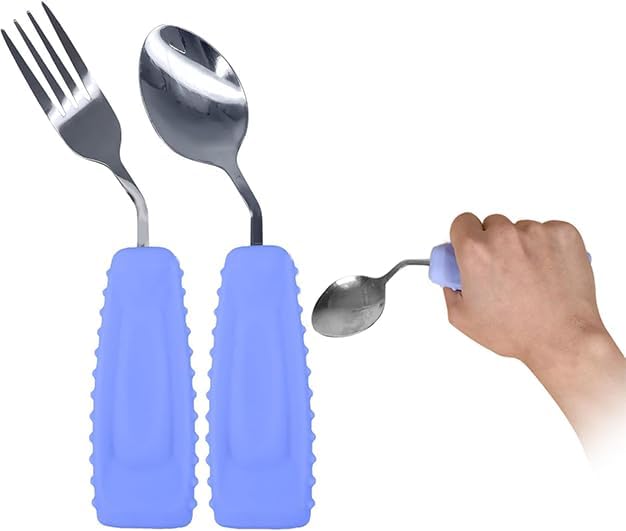
Ehucon’s set includes an angled fork and spoon intended to help people eat without bending the arm or turning the wrist as much. The handles are made from silicone and have small grip points along the edges. The product is offered in several colors and in left- or right-hand versions, so it is important to select the configuration that matches your needs.
The utensils are described as weighted, with the aim of balancing control and comfort. No exact weight is listed, so you cannot compare their load directly with the Shop Square set. Their angled heads and silicone handles make them a more targeted choice for limited wrist movement or a slippery grip than standard-shape weighted silverware.
This is a two-piece set, not a full flatware collection. It includes only a fork and spoon, and the product information says they can be cleaned in a dishwasher below 120°C (248°F). The fixed angled design may be helpful for some people, but it offers less flexibility than utensils that can be bent to a chosen position.
Pros:
- Angled heads are designed to reduce wrist turning
- Silicone handles include non-slip grip details
- Left- and right-hand options are available
- Dishwasher cleaning is listed below the stated temperature limit
Cons:
- Includes only a fork and spoon
- The angle is not described as adjustable
Verdict: Choose Ehucon if wrist positioning is a key challenge and you want an angled fork and spoon with a grippy handle; look elsewhere if you need a knife or a flexible, adjustable shape.
4. zhenzizai Strap-Handle Set: Support for a Less Secure Grip

This two-piece set pairs a non-slip handle with an adjustable strap that fits over the palm. The strap is designed to help keep the utensil in place, which may be useful when gripping and holding a standard handle is difficult. The product description says the strap supports 360-degree rotation and can be used with either hand.
The spoon and fork are also described as having an adjustable 90-degree angle. That gives the set two features to consider: support for keeping hold of the utensil and a shape intended to accommodate limited wrist or elbow movement. Its food-grade stainless steel heads are described as rust-resistant and 1.2 millimeters thick.
Because the strap and adjustable angle add setup choices, this set may take more adjustment than simple flatware. It includes just a spoon and fork, and the supplied details do not state cleaning instructions. Compared with the HoEase set, it specifically describes a 90-degree design and 360-degree strap rotation, while HoEase emphasizes bending the utensils to different angles.
Pros:
- Adjustable strap is designed to help keep the utensil in place
- Designed for use with either hand
- Adjustable angled design may help with limited wrist or elbow movement
- Stainless steel utensils are described as rust-resistant
Cons:
- Only a spoon and fork are included
- Cleaning instructions are not specified in the supplied product details
Verdict: Consider this set if you need both a strap for hand support and an angled utensil, but check that the strap and adjustment style feel comfortable for you.
5. HoEase Bendable Utensils: Flexible Positioning with Straps
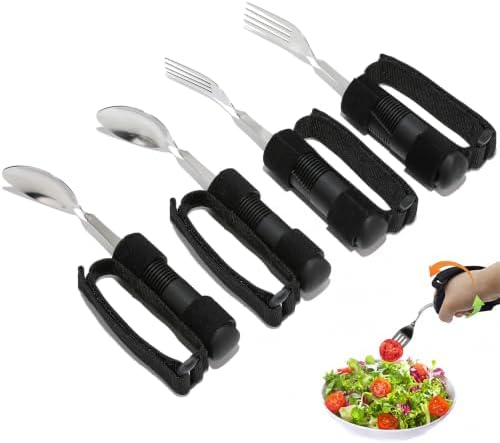
HoEase offers a fork and spoon with bendable heads, non-slip handles, and adjustable rubber straps. The bendable design allows the utensil angle to be changed to suit the user, while the strap is intended to provide more support for a weak or shaky grip. This combination may be worth considering if a fixed utensil angle does not match how your wrist moves.
The utensils are made from stainless steel and rubber, and the product description identifies the materials as food-grade. The set is listed as dishwasher safe. It does not include a knife, and no exact utensil weight is given, so it is less useful if you are specifically shopping for a known weighted set.
Compared with Ehucon, HoEase emphasizes bendable positioning and includes straps rather than a fixed angled design with silicone grip details. Compared with zhenzizai, it describes adjustment to different angles rather than a specific 90-degree design. If you choose a bendable set, make sure the adjusted position feels natural and stable for your hand.
Pros:
- Bendable design allows you to change the utensil angle
- Adjustable straps are intended to support weak or shaky hands
- Non-slip handles
- Dishwasher safe
Cons:
- Includes only a fork and spoon
- No specific utensil weight is provided
Verdict: HoEase is a good option to consider if you want an adjustable angle and a strap, especially when a fixed bend may not suit your wrist position.
How to Choose Eating Utensils for Arthritic Hands
Start with the movement that feels hardest
Think about what makes meals difficult for you. If holding a slim handle is uncomfortable, a wide or ribbed grip may be a better starting point. If your wrist is stiff, an angled utensil may reduce the need to turn it. If your hand has trouble keeping hold of cutlery, a strap may offer extra support. For shaking hands, added weight may help with steadiness, but it can also make lifting more tiring.
Match the handle to your grip
A built-up handle gives your fingers a wider surface to hold, while a textured or non-slip grip is designed to reduce slipping. Straps work differently: they help keep the utensil positioned against the hand rather than relying only on a tight grasp. Consider whether you can put on and adjust a strap comfortably, or whether a simple wide handle would be easier for you to manage.
Consider weight carefully
Weight can be a trade-off. A heavier utensil may feel steadier for some people, but lifting it repeatedly can add strain if your hands or wrists tire easily. Only one set here gives a specific weight: the Shop Square utensils weigh at least 7 ounces each. For the other weighted options, the supplied details do not specify an exact weight. If possible, compare the listed product details with what you can comfortably lift.
Choose the right angle and flexibility
Angled utensils are intended to make eating easier when wrist or arm movement is limited. Some have a set angle, while bendable designs let you adjust the position. A fixed angle may be simpler, but it may not fit every user. An adjustable utensil offers more positioning choices, though you will need to set it to a stable, comfortable position.
Check what comes in the set
A fork and spoon may cover many meals, but a knife and different spoon sizes can be useful if you want a closer match to everyday flatware. The Shop Square and Carex sets include four pieces, while the other picks include a fork and spoon. If a certain utensil is important to you, check the package contents rather than assuming it is included.
Review cleaning instructions
Cleaning details vary. Carex and HoEase are listed as dishwasher safe, while Ehucon’s description gives a dishwasher temperature limit. Shop Square specifies hand washing. Cleaning instructions are not provided in the supplied details for zhenzizai. Check the product information before placing any utensil in a dishwasher, especially if it has rubber or silicone parts.
Try the least complicated option that meets your needs
More features do not always mean a better fit. A wide handle may be enough if your main issue is grasping. An angled utensil may be more useful if wrist motion is limited, while a strap can help when holding the utensil is difficult. If you are uncertain, ask an occupational therapist to help you compare handle size, weight, and angle.
Frequently Asked Questions
What type of eating utensil is best for arthritic hands?
It depends on the movement that is difficult. A wide or textured handle may help with gripping, an angled utensil may suit limited wrist movement, and a strap may offer extra support for keeping hold of the utensil. There is no single design that fits everyone.
Are weighted utensils a good choice for arthritis?
They may help some people feel more control, particularly when hand shaking is also a concern. However, extra weight can make lifting more tiring, especially if your grip or wrist strength is limited. Consider the utensil’s stated weight and your own comfort.
Do angled utensils reduce the need to move your wrist?
They are designed to help you eat with less wrist turning or arm bending. The amount of help depends on the utensil angle and your range of motion. A fixed-angle design and a bendable design may feel different, so compare their adjustment options.
What is the difference between a built-up handle and a strap?
A built-up handle provides a thicker surface to grasp. A strap helps hold the utensil against your hand, which may be useful if maintaining a grip is difficult. Some sets combine a non-slip handle with an adjustable strap.
Are adaptive utensils dishwasher safe?
Some are listed as dishwasher safe, while others have specific limits or require hand washing. Follow the cleaning directions for the exact product you choose. Do not assume that every metal utensil or every rubber or silicone part can be cleaned the same way.
Can I use adaptive utensils with either hand?
Some sets are described as suitable for either hand, while Ehucon offers separate left- and right-hand options. Check the product details before ordering, particularly if the utensil has a fixed angle or a hand-specific design.
Final Recommendation
For a familiar-looking set with a clearly stated heavy weight and a travel bag, consider Shop Square—but keep its 7-ounce minimum weight in mind if fatigue is a concern. Carex is worth considering if you want a fuller, ribbed handle and four utensils. If wrist movement is your main challenge, compare Ehucon’s angled set with the bendable HoEase option. For added hand support, zhenzizai and HoEase both include straps. Choose based on the feature that matches your daily needs, and ask an occupational therapist for guidance if you are unsure about fit or safe use.