
Choosing the best front bicycle seat for a toddler means balancing a secure fit, comfortable seating, and compatibility with your bike. A front-mounted seat keeps your child in view, but these models do not fit every frame, and their age and weight limits differ. Compare the mounting requirements and adjustability below before you buy.
Quick Comparison
| Product | Age or weight guidance | Notable features and fit |
|---|---|---|
| VSIOBTE Front-Mounted Toddler Bike Seat | Ages 1–4; up to 55 lb | Enclosed guardrail, adjustable foot pedals; crossbar up to 2 inches in diameter |
| FRTUI Fully Enclosed Child Bike Seat | Listing gives ages 2–5 in the title and 2–4 in the description | Enclosed rail, adjustable pedals and handlebars; intended for many crossbar-style mountain bikes |
| WEEROCK Front Seat with Backrest | Ages 1–3 | Safety belt, backrest and adjustable footrest; listed for several bike styles |
| KCEASUA Toddler Seat with Protective Guardrail | Ages 2–5; up to 55 lb | Surrounding handrail and foldable footrest; not for step-through frames or recommended for mountain biking |
| Qcdou Detachable Front-Mounted Child Bike Seat | No age or weight range specified in the supplied description | Three height settings and full-surround guardrail; requires a compatible crossbar profile |
Our Picks: Best Front Bicycle Seat For Toddler reviews
VSIOBTE: Enclosed Seat with Adjustable Foot Pedals
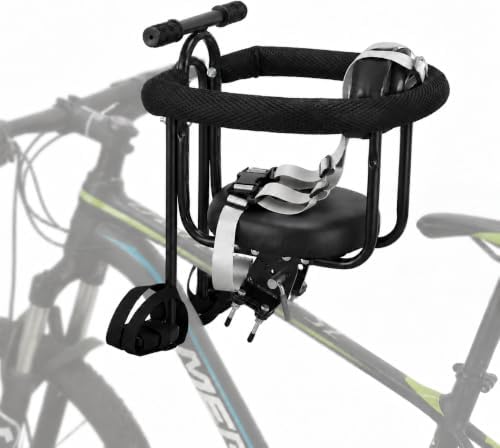
The VSIOBTE is a front-mounted seat designed for children ages 1–4, with a stated maximum weight of 55 pounds. Its full enclosure guardrail, backrest, and foot straps make it the most feature-rich option here for parents who want multiple points of support around the child.
The seat has a foam cushion and four foot-pedal height settings, so you can adjust the foot position as your child grows. Its description also calls out metal components, lock nuts, and protective pads at the frame contact points. Those details are useful considerations for a seat exposed to bike vibration, though careful installation and regular checks are still important.
Compatibility is a key limitation: the supplied information says it fits most bikes with crossbars up to 2 inches in diameter. Confirm your frame dimensions and the mounting instructions before ordering. The product includes tools and installation guidance, but an included tool kit does not guarantee a fit on every bike.
Pros:
- Stated age range of 1–4 years and weight limit of 55 pounds
- Full enclosure guardrail, backrest, and foot straps
- Four foot-pedal height settings
- Metal construction and included installation tools
Cons:
- Requires a compatible crossbar no larger than the stated 2-inch diameter
- The enclosed structure may feel bulky compared with simpler seats
Verdict: Choose the VSIOBTE if its crossbar requirement matches your bike and you want an enclosed design with several adjustable features.
FRTUI: Fully Enclosed Seat with Adjustable Handlebars

The FRTUI seat is a front-mounted option with an enclosed safety rail, child handlebars, and foot pedals. Its padded seat uses PU leather over high-density foam, according to the product description. The handlebars and pedals are adjustable, giving you more ways to set up the seating position for your child.
There is an age-range mismatch in the listing: the title says ages 2–5, while the description says the seat is intended for children ages 2–4. Check the product information and any manufacturer guidance before buying, and do not rely on the title alone to decide whether your child is a suitable fit.
The description says the seat is compatible with most mountain bikes with a crossbar, but also advises checking compatibility carefully. It does not provide a weight limit or specific crossbar dimensions in the supplied information. Compared with the VSIOBTE, it includes adjustable handlebars but offers fewer stated details about footrest positions and frame protection.
Pros:
- Enclosed rail with child handlebars and foot pedals
- Adjustable handlebars and pedals
- Padded seat described as PU leather over high-density foam
- Installation instructions and accessories are included
Cons:
- Listing gives conflicting age guidance
- The supplied description does not state a weight limit or crossbar dimensions
Verdict: Consider the FRTUI if its frame fit and age guidance are confirmed for your setup; the conflicting age information makes checking the listing especially important.
WEEROCK: Backrest and Safety Belt for Younger Children

The WEEROCK is listed for children ages 1–3 and has a wide plastic backrest, a soft cushion, a safety belt, and a semi-wrap handlebar. Its seat position and footrest height can be adjusted, which may help you set up the fit as your child grows within the stated age range.
The supplied compatibility information covers 24–29-inch mountain bikes, cruisers, commuter bikes, and 16–26-inch folding bikes. Those size ranges are not a substitute for checking how the mount attaches to your particular frame. The description does not specify a maximum child weight, so confirm that information with the manufacturer before use.
This model has a safety belt rather than the full enclosure guardrail featured on the VSIOBTE, FRTUI, and Qcdou options. It could suit a buyer who prefers a backrest-and-belt layout, but the supplied product data marks it as unavailable. Availability can change, so check the listing before making it your choice.
Pros:
- Listed for children ages 1–3
- Includes a backrest, cushion, safety belt, and semi-wrap handlebar
- Seat position and footrest height are adjustable
- Compatibility information covers several bike styles and sizes
Cons:
- Supplied product information marks it unavailable
- No maximum child weight is provided in the description
Verdict: The WEEROCK is worth considering if its belt-and-backrest design suits your needs and it becomes available, but confirm the weight limit and bike fit first.
KCEASUA: Guardrail Seat with a Foldable Footrest

The KCEASUA is listed for ages 2–5, with a maximum weight of 55 pounds. It combines a padded seat and backrest with a 360-degree protective handrail and anti-slip handgrips. Its footrest adjusts in height and folds flat when not in use.
The product description specifies a clamp-on mount for standard crossbar-style adult bikes and says the seat is not suitable for step-through frames. It is also not recommended for mountain biking. That makes it a more limited choice than options whose descriptions list several bike types, so check your frame and intended riding before purchasing.
The seat is described as removable, which may be useful if you do not want it attached all the time. The listing mentions a reinforced metal bracket and included mounting hardware, but installation still needs to be checked for a secure, stable fit before every ride.
Pros:
- Stated age range of 2–5 and maximum weight of 55 pounds
- Surrounding handrail, padded backrest, and anti-slip handgrips
- Adjustable footrest folds flat
- Described as removable, with mounting hardware included
Cons:
- Not suitable for step-through frames
- Not recommended for mountain biking
Verdict: Pick the KCEASUA for a compatible crossbar-style bike used for neighborhood rides, but skip it if you have a step-through frame or need a seat recommended for mountain biking.
Qcdou: Detachable Seat with a Full-Surround Guardrail

The Qcdou seat is a front-mounted model with a full-surround guardrail, a padded seat and backrest, and three height settings. The listing describes its upholstery as leather over high-density foam and its frame as high-carbon steel with reinforced welded joints. The supplied description does not give an age range or maximum child weight, so ask the seller or manufacturer for those limits before choosing it.
Its main fit warning is specific: the seat is designed for bicycles with a crossbar and is not compatible with round or cylindrical top tubes. The description lists mountain bikes, urban commuter bikes, and casual cruisers, but frame shape still matters. Check the tube profile and mounting instructions rather than relying on the bike category alone.
The instructions call for checking and tightening the screws before each ride. That is a useful reminder for any clamp-mounted seat, especially one you remove and reinstall. Compared with the VSIOBTE, the Qcdou has three stated height settings instead of four, and its description provides less detail about foot straps or a child footrest.
Pros:
- Full-surround guardrail with padded seat and backrest
- Three height settings
- Described as detachable and compatible with several bicycle categories
- Listing provides a clear warning about incompatible top-tube shapes
Cons:
- No age range or maximum child weight is stated in the supplied description
- Not compatible with round or cylindrical top tubes
Verdict: The Qcdou may suit you if your bike has the required crossbar profile, but confirm the child weight and age limits before buying.
How to Choose a Front Bicycle Seat for a Toddler
Check the age and weight limits
Start with the limits supplied by the seat maker, not just your child’s age. The options here have different stated age ranges, and some provide no weight limit. The FRTUI listing also gives two different age ranges. If a limit is missing or unclear, get confirmation before purchasing, and do not exceed the manufacturer’s stated limits.
Confirm your bike’s frame and mounting points
Compatibility is often the deciding factor. Check the required crossbar or top-tube shape, dimensions, and mounting location against your bike. Some seats exclude step-through frames, while the Qcdou description specifically rules out round or cylindrical top tubes. If the product instructions do not clearly cover your frame, ask the manufacturer before ordering.
Consider the seat’s support and restraint design
These models use different combinations of guardrails, belts, backrests, and child handlebars. Compare the actual features and how they fit your child rather than assuming every front seat has the same type of restraint. Follow the product’s instructions for securing your child, and make sure the seat does not interfere with your ability to steer or operate the bike.
Look for footrest adjustment
Adjustable pedals or footrests can help position a child’s feet as they grow. Check how many height settings are provided and whether the design includes straps or another way to keep feet from moving toward the wheels. Before riding, confirm that your child’s feet and legs are positioned as the seat maker directs.
Think about installation and regular checks
Review the installation steps before you buy. Included tools and instructions can help, but they do not replace checking that the seat fits your specific bike. Tighten and inspect the mounting hardware as directed, and check for movement, loose parts, or frame contact before each ride. If you cannot get a stable installation, do not carry a child in the seat.
Match the seat to your planned rides
Consider where you intend to ride and follow the seat maker’s recommendations. The KCEASUA listing, for example, says it is not recommended for mountain biking, while other descriptions name several bike styles. A compatible seat should also leave enough room for you to pedal, steer, and control the bicycle comfortably.
Frequently Asked Questions
What age can a child use a front bicycle seat?
It depends on the specific seat. The supplied products list ranges from ages 1–3 to ages 2–5, and one listing has conflicting age guidance. Check the exact model’s instructions and confirm any unclear limits before use.
Do these front-mounted seats fit every adult bicycle?
No. Fit depends on the frame and mounting points. Some models require a crossbar, and some list specific exclusions or dimensions. Check your bike against the seat’s installation information before buying.
Which seat has the highest stated weight limit?
The VSIOBTE and KCEASUA descriptions each state a maximum weight of 55 pounds. The supplied descriptions for the other options do not state a maximum child weight, so confirm those limits with the manufacturer.
What is the difference between a guardrail and a safety belt?
The listed designs vary: some use a surrounding guardrail, while the WEEROCK description specifies a safety belt and semi-wrap handlebar. Check the instructions for how the specific seat secures a child; a feature name alone does not establish that a seat is suitable for every child.
Can I use a front child seat on a mountain bike?
It depends on both the seat and the bike frame. Several listings mention mountain-bike compatibility, but the KCEASUA is specifically not recommended for mountain biking. Verify the exact fit and follow the manufacturer’s riding guidance.
Should I check the mounting hardware before every ride?
Yes. Follow the seat maker’s inspection instructions and check that the mount is secure and the seat does not shift. The Qcdou description specifically advises checking and tightening its screws before every ride.
Final Recommendation
For the most complete set of stated features, the VSIOBTE stands out with its enclosed guardrail, foot straps, four-position foot pedals, and 55-pound limit—provided your bike meets its crossbar requirement. The KCEASUA is another clearly specified option for compatible crossbar bikes and neighborhood rides. Whichever seat you choose, verify the child limits and frame fit, install it exactly as directed, and do not ride with your child until the seat is secure.