
Choosing the best hot water container for catering depends on how much you need to serve, how quickly guests need access, and whether you want a pump or a spigot. The options below range from compact 3-liter airpots for coffee stations to larger insulated dispensers for buffets and events. These are insulated containers, not electric heaters, so fill them with water that is already hot and check that the selected model suits your service setup.
Quick Comparison
| Product | Capacity | Dispensing Style | Best For |
|---|---|---|---|
| Gezoss 102-Ounce Pump Airpot | 102 oz / 3 L | Pump; rotating base | Small catering stations and meetings |
| CRESIMO 102-Ounce Pump Airpot | 102 oz / 3 L | Pump | Hot drink service with straightforward cleanup |
| TOMAKEIT 3-Liter Pump Airpot | 102 oz / 3 L | Lever pump; rotating base | Meetings and events serving several drink choices |
| JIVGDN 3.5-Gallon Insulated Dispenser | 3.5 gal / 13 L | Spigot | Buffets and higher-volume drink service |
| PYY 5-Gallon Insulated Beverage Dispenser | 5 gal / 19 L | Spigot | Large gatherings and bulk beverage service |
Our Picks: Best Hot Water Container For Catering reviews
Gezoss 102-Ounce Airpot: A Versatile Pick for Smaller Service Stations

This 3-liter airpot is designed for a self-serve table where guests need hot water or another drink without lifting and tipping a heavy container. Its pump top dispenses into a cup, while the 360-degree rotating base lets people approach from different sides.
The body is described as food-grade 18/8 stainless steel, with vacuum insulation claimed to keep drinks hot for up to 24 hours or cold for up to 36 hours. A wide opening helps with filling and cleaning, and the listing says a cleaning brush is included. The maker also lists a removable pump cover, which may help when you need to clean beyond the main opening.
At 102 ounces, this is a practical size for a meeting, small buffet, or drink station with moderate demand. It is much easier to place on a table than a multi-gallon dispenser, but it will need refilling sooner at a busy event. The stated temperature-retention times are manufacturer claims; actual results can vary with starting temperature, how often the lid is opened, and the surrounding conditions.
Pros:
- Pump dispensing avoids lifting or tilting the filled carafe.
- Rotating base supports access from different directions.
- Wide opening and included brush are useful for cleaning.
- Suitable for hot water, coffee, tea, and cold drinks.
Cons:
- Three liters may be too little for a large or fast-moving catering line.
- It stores hot liquid but does not heat or electrically maintain it.
Verdict: Choose the Gezoss if you want a compact, pump-style airpot with a rotating base for a smaller catering station.
CRESIMO 102-Ounce Airpot: A Simple Option for Hot Drink Service

The CRESIMO airpot holds 102 ounces and uses a pump top to dispense drinks. Its capacity makes it a fit for smaller catering setups, office meetings, and hot chocolate stations where you want guests to serve themselves without handling a full carafe.
The listing states that it keeps drinks hot for up to 12 hours and cold for up to 36 hours. It is described as resistant to stains, scratches, and cracks, and its top opens for cleaning with a sponge. The company also describes its products as designed in the United States and offers a lifetime promise, though you should check the seller’s current terms for details about coverage.
Compared with the Gezoss, the CRESIMO has a shorter stated hot-retention period and does not list a rotating base or included cleaning brush. Its appeal is a straightforward pump design and an easy-to-open top. As with any insulated airpot, the 3-liter capacity is the main limit if guests are pouring often or you are serving a large crowd.
Pros:
- Pump top provides self-serve dispensing without tipping.
- Useful capacity for meetings and small drink stations.
- Top opens for access when cleaning.
- Listed for both hot and cold beverages.
Cons:
- Its stated hot-retention time is shorter than the other 3-liter airpots here.
- No rotating base or cleaning brush is listed in the supplied product details.
Verdict: The CRESIMO is a reasonable choice when you want a basic 3-liter pump airpot and do not need the extra listed features of the Gezoss or TOMAKEIT.
TOMAKEIT 3-Liter Airpot: Pump Dispensing with Drink Labels

This 3-liter airpot uses a lever pump so guests can dispense a drink without lifting or tilting the container. The listing also describes a 360-degree rotating base, which can make the carafe easier to use when people are gathered around a table.
The dispenser is described as having double-wall, food-grade stainless steel vacuum insulation and BPA-free materials. The maker claims it can keep drinks hot or cold for up to 24 hours. A wide opening, removable internal straw, and included cleaning brush are intended to make filling and washing simpler. It also comes with a removable hang tag and six interchangeable stickers to identify the drink.
Those labeling extras can be useful if you set out more than one airpot for hot water, tea, or coffee. Still, its capacity is the same as the other 3-liter models, so it is best for moderate service rather than a high-volume line. The stated retention period is a product claim, not a guarantee of the temperature your drink will reach throughout service.
Pros:
- Lever pump and rotating base suit self-serve tables.
- Drink stickers and a hang tag help identify contents.
- Wide opening, removable straw, and brush support cleaning.
- Listed for hot and cold drinks.
Cons:
- Three-liter capacity may require frequent refills at busy events.
- The pump and internal straw add parts to rinse and maintain.
Verdict: Pick the TOMAKEIT if you want a compact airpot with drink-identification accessories for a meeting or small catering setup.
JIVGDN 3.5-Gallon Dispenser: More Capacity for a Buffet or Event
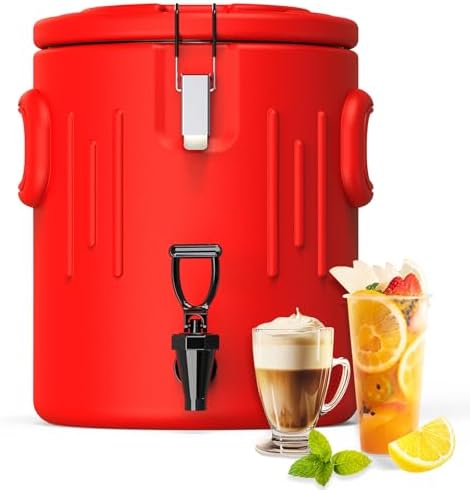
With a listed capacity of 3.5 gallons, or 13 liters, this dispenser is built for a higher-volume setup than the airpots above. It has a spigot for serving and a wide opening for filling. The product details describe a food-grade 18/8 stainless steel interior and a molded plastic outer shell.
The maker says the insulated container can hold hot or cold drinks for hours and describes its foam insulation as 40% thicker. No specific hot-retention duration is provided, so it is difficult to compare its heat performance directly with the airpots. Its larger capacity and spigot make it better suited to a buffet, restaurant, or event table where guests need repeated access.
This model is also described as suitable for a range of drinks and foods, including coffee, tea, juice, soup, and porridge. That versatility may be useful for catering, but consider the serving texture and spigot design before using it for anything thicker than a drink. A filled 13-liter container will also take up more space than a countertop airpot, so plan where it will sit and how you will refill it.
Pros:
- More than four times the stated capacity of a 3-liter airpot.
- Spigot allows guests to serve from a stationary container.
- Stainless steel interior is listed for hot and cold drinks.
- Wide opening is useful for filling and access.
Cons:
- No specific hot-retention duration is stated in the supplied details.
- Its larger size takes more room than a compact pump airpot.
Verdict: Choose the JIVGDN when a buffet needs more capacity than a 3-liter airpot can provide and you prefer spigot service.
PYY 5-Gallon Dispenser: A Bulk-Serving Choice for Larger Events

The PYY is the largest option in this roundup, with a listed capacity of 5 gallons, or 19 liters. It is an insulated beverage container with a drip-resistant, leak-resistant spigot, an exhaust cover, and handles at the top for carrying. Its size is aimed at bulk service rather than a small coffee table.
The listing describes a seamless double-wall construction, a 20 mm polyurethane insulation layer, and food-grade LLDPE material. It also gives a specific heat-retention claim: in an environment at 20°C ±5°C, 100°C water loses 2°C per hour. Treat that as a stated test condition from the product information, not as a promise for every setup. The product is also described as stackable with other buckets of different volumes.
At the listed dimensions of 16.7 by 10 by 25.6 inches, this dispenser needs a dedicated place during service and storage. Its larger volume can reduce refill interruptions, but a full container is a substantial load to move. For a catering team, it makes the most sense when you can fill it near its serving location and leave it in place.
Pros:
- Largest stated capacity in this comparison at 5 gallons.
- Spigot, sealed design, and exhaust cover are intended to reduce drips and leaks.
- Handles support carrying, and the design is described as stackable.
- Product details provide a heat-retention claim with stated test conditions.
Cons:
- Its size and filled weight make it less convenient to move than an airpot.
- Requires more storage and serving space than the smaller options.
Verdict: The PYY is the strongest fit here for high-volume service when capacity matters more than compact size and you can keep the dispenser stationary.
How to Choose a Hot Water Container for Catering
Match Capacity to the Number of Guests
Start with how much water or other hot drink you expect to serve before you can refill. The 3-liter airpots are easier to fit on a small table, but they hold far less than the 13-liter JIVGDN or 19-liter PYY. For a short meeting or a modest drink station, a smaller airpot may be easier to handle. For a buffet or a busy event, a larger dispenser can reduce the need for frequent refills.
Choose a Dispensing Style That Fits Your Service
Pump airpots dispense from the top and are designed for guests to serve without lifting the container. They work well on a table where space is limited and people take one cup at a time. Spigot dispensers offer a different approach: they stay in place while guests fill cups from the tap. Make sure the spigot can sit over the cup or serving area without crowding the table.
Check Heat-Retention Details Carefully
Compare the maker’s stated heat-retention information, but look at how it was measured and whether the product provides a specific duration. The airpot listings give different claimed hot-holding times, while the PYY lists a heat-loss claim under stated conditions and the JIVGDN gives no exact duration. In practice, starting temperature, how often the container is opened, and room conditions can affect results. None of these models is an electric heater.
Consider Materials and Cleaning Access
A wide opening can make it easier to fill and clean a container. Look for details that matter to your routine, such as removable parts, an included brush, or a top that opens for access. The products in this roundup have different constructions: the smaller airpots are described as stainless steel insulated models, while the larger options combine a stainless steel interior or food-grade plastic with insulated outer construction. Follow the manufacturer’s cleaning instructions for the specific model you choose.
Plan for Transport and Placement
A compact airpot is easier to place on a small serving table, while a multi-gallon dispenser needs more room. Think about where you will fill it, how far you will carry it, and whether it can stay in one place during service. The PYY includes top handles, but its full capacity is large; filling it near its serving location can help avoid moving a heavy container.
Think About What You Will Serve
These products are described for use with drinks such as hot water, coffee, tea, and hot chocolate, with some also listed for cold drinks. If you plan to serve soup or another thicker item, check whether the opening and spigot suit that use. For hot water service, label each container clearly when you set out more than one beverage, and follow applicable food-safety procedures for your event.
Frequently Asked Questions
Do these containers heat water?
No. These are insulated dispensers, not electric kettles or heaters. You need to add water that is already hot, and the containers are designed to help retain its temperature.
Which option holds the most?
The PYY has the largest listed capacity at 5 gallons, or 19 liters. The JIVGDN is listed at 3.5 gallons, or 13 liters, while the three airpots each hold 102 ounces, or 3 liters.
Is a pump airpot or a spigot better for catering?
A pump airpot is compact and lets guests dispense drinks without tipping the container. A spigot dispenser holds more and can suit a buffet line, but it needs enough space underneath the tap for cups. Choose based on your serving volume and table layout.
Can I use these for drinks other than hot water?
The supplied product details list uses such as coffee, tea, hot chocolate, and cold drinks. Some also list foods such as soup or porridge. Check the product instructions and spigot suitability before serving anything thicker than a beverage.
How long will hot water stay hot?
It depends on the product and conditions. The listings give different manufacturer claims, and the PYY describes a heat-loss result under specific conditions. Frequent dispensing, starting temperature, and the surrounding environment can affect how well any insulated container retains heat.
Which model is best for a small meeting?
Any of the 3-liter airpots can suit a smaller meeting. The Gezoss lists a rotating base and cleaning brush, the TOMAKEIT includes drink labels and a removable straw, and the CRESIMO offers a simpler pump design. Choose the features that best match your setup.
Final Recommendation
For a compact self-serve station, the Gezoss stands out for its pump, rotating base, wide opening, and included cleaning brush. If your catering event needs substantially more volume, the JIVGDN provides a larger spigot-style option, while the PYY is the best match for bulk service among these picks. Choose capacity and dispensing style first, then compare cleaning access and the manufacturer’s heat-retention information for your needs.