
Choosing the best ice packs for cooler bags comes down to matching the pack’s shape and cooling capacity to your bag and what you’re carrying. Slim packs fit beside lunch containers, while larger packs cover more area in a roomy cooler. The five options below include reusable hard packs and flexible packs, with sizes and features suited to different kinds of outings.
Quick Comparison
| Product | Pack type | Size or quantity | Best for |
|---|---|---|---|
| Cool Coolers XL Slim Ice Packs | Rigid, slim | 4 pack; 4.75 × 0.5 × 7 inches each | Lunch bags and taller cooler bags |
| Cool Coolers Slim Ice Packs | Rigid, slim | 4 pack; 5 × 0.5 × 4.75 inches each | Compact lunch bags |
| SUNLUG Cooler Ice Packs | Rigid, fill-and-freeze | 5 pack; 9.75 × 9.75 × 1 inches each | Larger coolers and outdoor trips |
| RIDGECOOL Reusable Ice Packs | Rigid | 4 pack; 7 × 6.5 inches each | Lunch boxes and smaller coolers |
| Cool Coolers Soft Ice Packs | Flexible | 2 pack; 6.5 × 4.25 × 0.5 inches each | Odd-shaped spaces and close contact with food |
Our Picks: Best Ice Packs For Cooler Bags reviews
Best Slim XL Packs: Cool Coolers by Fit & Fresh 4-Pack
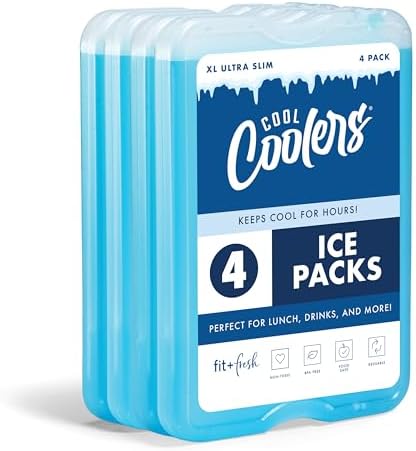
This four-pack is designed for people who want cooling without giving up much room inside a lunch bag. Each rigid pack measures 4.75 by 0.5 by 7 inches, so its narrow profile can slide beside food containers or along the inside of a cooler bag.
The packs are made with BPA-free plastic and are described as leakproof and break-resistant. Their slim shape is useful when you need to keep a meal and drink together, but it offers less coverage than a broad, square pack. For a larger cooler, you may want to use several packs or pair them with other cooling materials.
Compared with the smaller Fit & Fresh option below, this version is longer and may suit taller bags or spaces along a container’s side. It’s a practical choice for daily lunches, travel, and grocery totes where space is tight.
Pros:
- Thin profile takes up little bag space.
- Four packs offer flexibility in how you arrange them.
- BPA-free plastic and a stated leakproof design.
- Suitable for lunch bags, coolers, picnic baskets, and totes.
Cons:
- The narrow shape covers less surface area than a larger, flat pack.
- Rigid packs may be less convenient around unusually shaped items.
Verdict: Choose this set if you want slim, reusable packs that can fit alongside food in a lunch bag without taking up much room.
Best Compact Slim Packs: Cool Coolers by Fit & Fresh 4-Pack

These four rigid packs are also half an inch thick, but each measures 5 by 4.75 inches. That more compact footprint can be easier to position in a small lunch bag or between containers when the longer XL packs would be awkward.
Fit & Fresh describes the packs as quick-freezing and made for everyday use. The BPA-free plastic is designed to be durable and leakproof, and the smooth, flat shape is easy to rinse and dry. As with any small pack, how well it cools a full bag depends on how many packs you use and how the bag is packed.
These are a sensible alternative to the XL set if your bag has limited height or you want more placement options. They’re less suited to covering a broad area in a large cooler, where bigger packs may be more convenient.
Pros:
- Compact shape fits smaller lunch bags.
- Four-pack lets you place packs in different areas.
- BPA-free, leakproof design according to the product description.
- Works for lunch bags, cooler bags, and picnic totes.
Cons:
- Smaller dimensions provide less coverage than the XL or SUNLUG packs.
- Rigid construction won’t bend around bottles or oddly shaped items.
Verdict: Pick this set for compact bags and lunches where you need several small packs rather than one large cooling surface.
Best for Larger Coolers: SUNLUG Five-Pack Cooler Ice Packs

SUNLUG’s five packs are much larger than the lunch-bag options here, with each measuring 9.75 by 9.75 by 1 inch. Their broad, flat shape makes them a better fit for roomier cooler bags, where you can place a pack alongside food and drinks rather than squeezing it into a narrow pocket.
These packs require a little setup: add water through the funnel, shake, screw on the cap, and freeze before use. The product description says they freeze into solid blocks and reach 18°F (-8°C). Their reusable design is intended to replace loose ice, but the solid shape may be less flexible when packing a crowded bag.
Compared with the smaller packs, SUNLUG’s size can make it easier to cover a larger area, but it also needs more freezer and cooler space. Consider your bag’s interior dimensions before choosing this set.
Pros:
- Large, flat packs suit roomy cooler bags.
- Five-pack provides several placement options.
- Reusable design avoids the wet mess of loose ice.
- BPA-free materials according to the product description.
Cons:
- Requires filling with water before the first freeze.
- Its large footprint may crowd a lunch bag or compact cooler.
Verdict: Choose SUNLUG if you have a larger cooler bag and don’t mind filling the packs before their first use.
Best Mid-Size Hard Packs: RIDGECOOL Reusable Ice Packs

Each RIDGECOOL pack measures 7 by 6.5 inches, putting it between the small Fit & Fresh packs and the larger SUNLUG blocks. That size can work well in a lunch box, insulated bag, or compact cooler when you want more coverage than a slim pack provides.
The product is described as BPA-free, leakproof, and reusable. Its rigid, flat design is intended to keep food cold without the wet mess associated with loose ice. Because the pack is wider than the slim options, check that your bag can accommodate it alongside your containers.
This four-pack is a straightforward choice if you want a set of medium-sized packs for meals, drinks, and snacks. It doesn’t offer the flexibility of a soft pack, and the product details don’t specify a cooling duration, so don’t rely on a precise time estimate.
Pros:
- Mid-size shape offers more coverage than slim lunch packs.
- Four packs let you spread cooling across a bag.
- BPA-free and leakproof according to the product description.
- Designed for lunch bags, snack bags, and smaller coolers.
Cons:
- Wider packs may not fit narrow lunch bags.
- Rigid shape cannot flex around food containers.
Verdict: Consider RIDGECOOL if you want medium-sized hard packs for a lunch bag or small cooler and have room for their wider shape.
Best Flexible Option: Cool Coolers by Fit & Fresh Soft Ice Packs

These two soft packs measure 6.5 by 4.25 by 0.5 inches and are made with nylon and gel. Unlike the rigid packs in this guide, they’re described as staying flexible when frozen, so they can sit more closely against a bottle, food container, or other item in your bag.
The nylon exterior is described as tear-resistant and designed to help protect the cooler or lunch bag from condensation. The product is also listed as BPA-free and non-toxic. For more cooling power, the manufacturer recommends stacking multiple packs and freezing them overnight.
The trade-off is quantity: this set has two packs, while several alternatives include four or five. It may be a better fit when flexibility matters most, but those packing a larger cooler may prefer more packs or a larger format.
Pros:
- Flexible design can fit around items more easily than a hard pack.
- Nylon exterior is described as tear-resistant.
- BPA-free and non-toxic according to the product description.
- Suitable for lunch bags, coolers, beach bags, and day trips.
Cons:
- Two-pack provides fewer pieces than the other sets in this guide.
- Small dimensions may not be enough for a larger cooler by themselves.
Verdict: Choose the soft packs if you value a flexible shape that can sit close to food and drinks more than a larger pack count.
How to Choose Ice Packs for Cooler Bags
Match the pack size to your bag
Measure the cooler bag’s interior and compare it with the pack dimensions, leaving space for food, drinks, and containers. Slim packs are easier to fit beside lunch items, while broader packs cover more area but can take up more of the available space. If your bag is small, avoid choosing a pack based only on its cooling claims.
Choose rigid or flexible packs
Rigid packs hold a flat shape and can work well against the side or bottom of a cooler bag. Flexible packs can sit more closely around items and may be easier to fit into irregular spaces. Think about the containers you carry and whether you need the ice pack to bend around them.
Consider how much coverage you need
A single small pack may make sense for one lunch, while a larger bag may need several packs placed around its contents. Sets with multiple pieces let you arrange cooling in different parts of the bag. For the SUNLUG packs, remember that you need to add water before freezing them for use.
Check the material and care details
Look for details that matter for repeated use, such as BPA-free materials, a leakproof design, and instructions for cleaning. If you plan to place a pack near unpackaged food, confirm that the product is labeled as safe for that use and follow its care directions. The products in this guide vary in construction, so choose based on the features specified for the pack you’re considering.
Plan for the full trip
Cooling performance depends on the pack, the insulated bag, how full it is, and the conditions around it. Freeze packs fully before packing, and arrange them close to the items you want to keep cold. For long outings, consider whether your bag and number of packs suit the amount of food and the length of your trip rather than assuming one small pack will be enough.
Frequently Asked Questions
Are slim ice packs a good choice for cooler bags?
They can be a good fit when space is limited. Slim packs slide beside containers and take up less room than broad blocks, but they provide less surface coverage. For a larger bag, use enough packs to suit the amount you’re carrying.
What is the difference between hard and soft ice packs?
Hard packs keep their shape, which can make them easy to position against a flat side of a bag. Soft packs are designed to remain flexible when frozen, so they can fit more closely around some items. Your choice depends on bag space and how you pack food and drinks.
Do all the packs in this guide need water added?
No. The SUNLUG product description says to add water through its funnel before freezing. The other listed packs are described as ready-to-freeze reusable packs and don’t include that filling step in the supplied product details.
How many ice packs should I put in a cooler bag?
There isn’t one number that fits every bag. Consider the bag’s size, the amount of food, and how long you’ll be carrying it. Multiple packs can be arranged around the contents, while a compact lunch bag may need fewer than a roomy cooler.
Can I put an ice pack directly next to food?
Check the product’s instructions and material details first. Some packs are described as non-toxic or safe to pack with unpackaged food; follow the specific product guidance and clean the pack as directed.
How should I prepare reusable ice packs?
Freeze packs before use and follow the manufacturer’s instructions. For the SUNLUG packs, add water, shake, secure the cap, and freeze. The soft Fit & Fresh packs are recommended to be frozen overnight for best results.
Final Recommendation
For most lunch bags, the Cool Coolers XL Slim Ice Packs offer a useful mix of a low-profile shape and a four-pack quantity. Choose the smaller Fit & Fresh set for tighter bags, RIDGECOOL for wider mid-size packs, or SUNLUG for a roomier cooler. If flexibility is your priority, the Cool Coolers soft packs are the most suitable option in this group.