
Your refrigerator’s water and ice taste better when the water going into it is clean. An inline water filter is a small cartridge that sits in the water line behind your fridge, so it can clean the water before it reaches the dispenser and ice maker. The choice can be confusing, though. Filters differ in lifespan, certifications, size, and the type of water line they fit. This guide walks you through five popular options so you can match a filter to your kitchen and your water.
Quick Comparison: Five Inline Filters at a Glance
| Product | Rated Filter Life | Certification Details in Listing | Best Fit |
|---|---|---|---|
| AQUA CREST INL 5 Years Inline Water Filter | 5 years or 5,000 gallons | BPA-free and lead-free materials stated | Budget-minded buyers who want long filter life |
| Clearly Filtered Inline Water Filter | 365 gallons | Listed as tested to NSF/ANSI 42, 53, 401, and 473 | Stainless steel lines and broad contaminant coverage |
| Waterdrop INL Inline Water Filter | 1 year | NSF 42 for chlorine, taste, and odor; NSF 372 for lead-free material | Taste and chlorine improvement with simple installation |
| Frizzlife Inline Water Filter System (MS99) | Up to 2 years | IAPMO R&T certified to NSF/ANSI 42 and 53 | Compact setups and quick cartridge changes |
| AQUA CREST INL-PLUS 5 Years Inline Water Filter | 5 years (varies by water quality) | BPA-free and lead-free materials stated | All-in-one kit with tubing and fittings included |
Our Picks: Best In Line Water Filter For Refrigerator reviews
AQUA CREST INL: Long-Lasting Basic Protection for Most Fridges

The AQUA CREST INL is a straightforward inline filter built for refrigerators and ice makers. Its main selling point is a rated life of 5 years or 5,000 gallons, which is much longer than many basic filters. The listing says that actual life depends on your local water conditions, so your results may be shorter or longer depending on your supply.
The filter uses a polyester membrane along with a 0.5 micron coconut shell activated carbon block. The listing says this combination helps reduce fluoride, chlorine, taste and odor, rust, suspended solids, and colloids. It is important to know that the filter does not reduce Total Dissolved Solids (TDS). If your main concern is dissolved minerals or salts, this is not the right tool.
The fittings are one of its more practical features. The kit includes both 1/4-inch compression and push-to-connect fittings, so it can work with plastic or copper water lines. Many owners appreciate that the filter can be installed with a single twist and without cutting the tubing. The listing notes an important setup step: the PE tube must be inserted into the filter cartridge by 20mm to prevent leaks. Skipping this step is the most likely cause of a problem during installation.
In everyday use, this filter suits people who want a low-maintenance option and do not want to change cartridges every year. Its compatibility list is broad, and the listing says it can be used in refrigerators, ice makers, coffee makers, water coolers, RV systems, and RO systems. Compared with the Waterdrop option below, it offers a much longer filter life. Compared with the Clearly Filtered model, it covers fewer contaminants by the brand’s own claims but is simpler to install on a standard plastic or copper line.
Pros:
- Rated for up to 5 years or 5,000 gallons, which means fewer replacements
- Includes both compression and push-to-connect fittings for plastic or copper lines
- Simple single-twist installation without cutting the tubing
- Broad listed compatibility with many refrigerator and appliance uses
Cons:
- Does not reduce Total Dissolved Solids, so it will not address dissolved minerals or salts
Verdict: The AQUA CREST INL is a strong choice if you want long filter life and an easy install for basic taste and chlorine improvement. It is a practical default for most standard fridge setups, but it is not the best pick if you need broader contaminant removal.
Clearly Filtered Inline Filter: Broad Contaminant Coverage for Stainless Lines
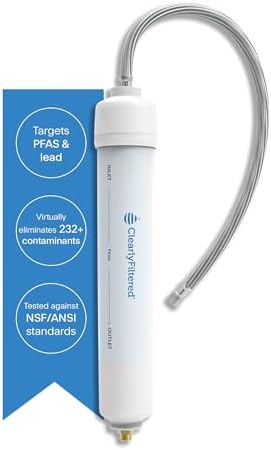
The Clearly Filtered Inline Filter is built around a much wider claim than most options in this group. The listing says it targets up to 232 contaminants, including fluoride, lead, BPA, PFAS and PFOA, and arsenic, and that it does not target beneficial minerals. The brand also points to third-party testing against several NSF/ANSI standards, including 42, 53, 401, and 473. Certification claims should always be checked against the brand’s published data, and the listing directs you to that data for removal rates.
The biggest limitation is the water line. The listing states that this filter is designed for stainless steel lines only and is not compatible with vinyl or plastic lines. Before you order, look behind your refrigerator to see what type of line you have. If you are unsure, check the connection and tubing material. Buying the wrong filter for your line is one of the most common frustrations shoppers face.
The filter is also described as ultra-slim and designed for a fast setup, with optional wall mounting. Buyers often note that the slim profile helps when space behind the fridge is tight. The listing gives a 365-gallon life and suggests that most households replace the filter one to two times per year, depending on local contamination levels. That means the cost of ownership depends heavily on your water, so plan on a yearly replacement budget.
Compared with the AQUA CREST options, this filter aims for more comprehensive contaminant coverage, but its shorter cartridge life and stainless-only requirement make it less flexible. It is a better fit for households with stainless lines that want more than basic taste and chlorine reduction.
Pros:
- Broad claimed coverage that includes heavy metals, pharmaceuticals, and PFAS per the listing
- Third-party testing against several NSF/ANSI standards is stated
- Slim design and optional wall mount help in cramped spaces
- Publicly available performance data is referenced for removal rates
Cons:
- Only compatible with stainless steel water lines, which limits who can use it
- Shorter 365-gallon life may mean more frequent replacements in some homes
Verdict: The Clearly Filtered Inline Filter is a strong option if your refrigerator has a stainless steel water line and you want wide contaminant coverage. If your line is plastic or vinyl, skip it and choose a filter that fits your setup.
Waterdrop INL: Certified Chlorine and Taste Reduction at a Simple Fit

The Waterdrop INL is a clear, specific product. Its listing highlights NSF 42 certification for the reduction of chlorine, taste, and odor, and NSF 372 certification for lead-free materials. If your main complaint is the chlorine smell or a flat, off taste in your ice and water, these certifications speak directly to that concern. The listing describes the water as free of unpleasant odors or aftertaste, though your results will depend on your starting water.
Setup is designed to be quick. The filter comes with 1/4-inch compression and push-to-connect fittings, plus a 7/16-inch adapter, for plastic or copper water lines. The listing says you can have the filter running in about five minutes. As with other inline filters, the tubing must be pushed in by 20mm to avoid leaks. Take your time with that step, because a small leak can cause a mess behind the fridge.
The filter is made from coconut shell activated carbon with a 0.5 micron rating, and the listing says it can reduce fluoride, rust, and colloids. Its rated life is one year, which is much shorter than the AQUA CREST models. This means the Waterdrop INL has a higher long-term replacement cost, but the upfront simplicity and certification details may appeal to shoppers who value clear performance claims.
The product is also listed as compatible with a wide group of refrigerator brands and many replacement part numbers. As with any compatibility claim, confirm that your fridge or line matches the listing before you buy. The listing also notes that this system does not reduce Total Dissolved Solids, which is an important limit for anyone expecting full mineral removal.
Pros:
- NSF 42 certification is listed for chlorine, taste, and odor reduction
- NSF 372 certification is listed for lead-free material
- Fast installation with compression and push-to-connect fittings included
- Clear focus on the taste and smell issues that most households notice first
Cons:
- One-year rated life means more frequent replacements and higher long-term cost
Verdict: The Waterdrop INL is a solid pick if you want certified chlorine and taste improvement with a simple install. Budget for yearly replacements, and keep in mind it does not reduce dissolved solids.
Frizzlife MS99: Compact Housing With Easy Cartridge Swaps

The Frizzlife MS99 is different from the other filters here because it is a full filter system rather than just a basic inline cartridge. It measures 5 by 5 by 13.5 inches, according to the listing. That size is useful to know before you buy, since the listing recommends keeping about 6 inches of clearance if you mount it behind the refrigerator. It can also be placed under the sink, inside a cabinet, or in a pantry, which gives you more options if the space behind your fridge is tight.
The system is certified by IAPMO R&T against NSF/ANSI 42 and 53, according to the listing. The cartridge is described as a compound filter designed to reduce lead, chlorine, taste and odor, and particulates while keeping essential minerals in the water. For shoppers who want a certified system with a clear description of what it does, this is a practical point in its favor.
Cartridge changes are one of its strongest features. The listing describes a twist-in design that allows a quick filter swap, and it says there is no need to shut off the water supply during replacement. Many owners appreciate that they can change the inner cartridge in seconds using the included wrench. The listing also says the system connects to either an under-sink angle valve or a refrigerator angle valve and can fit both PEX and flexible copper tubing.
The MS99 is rated for up to 2 years of filtration per cartridge, which sits between the one-year Waterdrop option and the five-year AQUA CREST models. The listing says water flow is fast and stable, filling a 330 ml cup in about three seconds. That kind of flow matters if you use your dispenser often. The main trade-off is size: the MS99 takes up more room than a slim inline cartridge, so it may not suit a very cramped installation.
Pros:
- Certified by IAPMO R&T against NSF/ANSI 42 and 53, as listed
- Cartridge swaps can be done quickly without shutting off the water
- Flexible placement options, including under the sink and in cabinets
- Up to 2 years of filtration per cartridge
Cons:
- At 13.5 inches tall, it takes up more space than a slim inline filter
Verdict: The Frizzlife MS99 is a good choice if you have room for a compact housing and want certified performance with easy cartridge changes. If you need the smallest possible footprint behind a tight fridge, a slimmer inline model may serve you better.
AQUA CREST INL-PLUS: Five-Year Filter Life With Everything in the Box

The AQUA CREST INL-PLUS shares the long five-year filter life of the standard INL model, but its main appeal is the complete kit. The listing says the box includes a 1/4-inch compression and push-to-connect fitting set, a compression hex nut, a sleeve, an insert, and 1/4-inch PE tubing. For a shopper who does not want to hunt down missing parts, that all-in-one approach removes a common source of delays.
The filter uses granular activated carbon made from natural coconut shell, and the listing says it is designed for high filtration accuracy. It is said to reduce chlorine, taste and odor, rust, suspended solids, and colloids. Like the other AQUA CREST model, it does not reduce Total Dissolved Solids, so you should set realistic expectations about what it can improve.
The listing describes it as compatible with a long list of refrigerator and ice maker part numbers, including several filter models from GE, Samsung, Whirlpool, and Culligan. In practice, this kind of compatibility list helps you check whether the filter matches your setup, but you should still confirm the match for your specific appliance. The listing also repeats the 20mm PE tube insertion step, which helps prevent leaks during installation.
Compared with the standard AQUA CREST INL, the INL-PLUS makes the most sense if you are setting up a new connection and want everything in one package. Compared with the Frizzlife MS99, it is a smaller and simpler inline cartridge with a longer rated life, but it lacks the certification details and quick-swap housing of that system.
Pros:
- Rated for up to 5 years, which keeps replacement costs low over time
- Comes with a full set of fittings, tubing, sleeve, and insert
- Listed compatibility with many common refrigerator filter models
- Simple single-twist installation without cutting the tubing
Cons:
- Does not reduce dissolved solids, so it is not a full-purification solution
Verdict: The AQUA CREST INL-PLUS is a strong pick for buyers who want a long-life filter and a complete kit in one box. It is especially useful for first-time installs, but confirm your appliance and tubing match the listing before you buy.
How to Choose the Right Inline Water Filter for Your Refrigerator
Choosing an inline filter is less about finding the single best product and more about matching a filter to your plumbing, your water, and your budget. The five options above cover a wide range of needs, but the right one for your kitchen depends on a few practical factors. The sections below explain what to check before you buy.
Confirm Your Water Line Type
Before anything else, look at the water line behind your refrigerator. Most setups use plastic, copper, PEX, or stainless steel tubing. Some filters are made for specific materials, and the Clearly Filtered model, for example, is listed for stainless steel lines only. Buying the wrong type can mean returning the item or paying for a special adapter. Take a quick look, note the material, and compare it to the product listing before you add anything to your cart.
Understand What Certifications Actually Cover
Certifications tell you what a filter has been tested to do, but they do not cover everything. NSF/ANSI 42 is commonly associated with taste, odor, and chlorine reduction, while NSF/ANSI 53 deals with health-related contaminants such as lead. Some listings in this group mention NSF 401, NSF 473, or NSF 372, which relate to other contaminant groups or to material safety. Read the certification names carefully and match them to your main concern. A filter with broad certifications may be a better fit if you are worried about contaminants, while a filter with basic certification may be enough if you mainly want better-tasting water.
Know What Inline Filters Do Not Remove
Several of these products state clearly that they do not reduce Total Dissolved Solids. TDS refers to minerals and salts dissolved in water. If you want to lower TDS, you usually need a different system, such as reverse osmosis. Knowing this limit helps you avoid disappointment. An inline filter is best viewed as a tool for improving taste, odor, chlorine, and some particles, not as a complete water treatment solution.
Compare Filter Life and Long-Term Cost
Filter life varies a lot in this group. The Waterdrop INL is rated for one year, the Clearly Filtered model for 365 gallons, the Frizzlife MS99 for up to two years, and the AQUA CREST models for up to five years or 5,000 gallons. A cheaper filter that needs yearly replacement can cost more over time than a pricier filter that lasts five years. Also remember that the listings note local water conditions can shorten or extend filter life. If your water has high levels of sediment or contaminants, plan for more frequent changes.
Check Size and Clearance
Space behind the refrigerator is often limited, and many fridges are pushed close to the wall. Slim inline cartridges fit more easily in tight spots, while larger housings like the Frizzlife MS99 need more room. The MS99 listing recommends about 6 inches of clearance when mounting behind the fridge. Measure the space before you buy, and consider whether you could mount the filter under the sink or in a nearby cabinet instead.
Look at Included Fittings and Installation Tools
Installation is where many buyers run into trouble. Some kits include both compression and push-to-connect fittings, a hex nut, a sleeve, an insert, and PE tubing, while others expect you to supply parts. The AQUA CREST INL-PLUS includes a full set of parts, which can save a trip to the hardware store. Whatever you choose, read the instructions before you begin, and make sure the tubing is inserted to the depth the listings recommend. A quick check of every connection after installation helps you catch leaks early.
Consider Ease of Cartridge Replacement
You will replace the filter more than once, so the change process matters. The Frizzlife MS99 is designed for quick cartridge swaps without shutting off the water, and its listing describes a wrench-assisted twist-in design. Simpler inline cartridges are also quick to change, but they require you to manage the water flow during replacement. Think about how comfortable you are with plumbing tasks and whether you want a design that makes regular maintenance easy.
Frequently Asked Questions
Can I install an inline water filter on any refrigerator?
Most inline filters are designed to connect to the water line behind a refrigerator that has an ice maker or water dispenser. However, compatibility depends on your line material, fittings, and the appliance itself. Check the product listing for supported line types, such as stainless steel, plastic, or copper, and confirm the fitting size. If your refrigerator has a built-in filter, you may need a different adapter or setup.
How often should I replace an inline water filter?
Replacement timing depends on the product and your water quality. The listings in this group range from about one year to five years or 5,000 gallons. Some products also mention that heavy contamination can shorten the filter life. If you notice a drop in water flow, a change in taste, or a strange odor, replace the cartridge sooner than the rated schedule suggests.
Do inline filters remove fluoride and lead?
Several of these filters list fluoride or lead among the contaminants they target, but the level of removal varies by product. Clearly Filtered and Frizzlife both reference specific contaminant or certification claims in their listings, while the AQUA CREST models mention fluoride in their listed contaminant lists. Check each product’s published data and certification details to confirm what it is designed to reduce.
Will an inline filter remove minerals from my water?
Generally, no. Several of the listings state clearly that they do not reduce Total Dissolved Solids. Minerals are a type of dissolved solid, so these filters are not designed to remove them. If you want to reduce TDS, you would need a different type of system, such as reverse osmosis. Inline filters are better suited to improving taste, odor, chlorine, and some particles.
Can I install an inline filter myself?
Many buyers install these filters without a plumber, since most use compression or push-to-connect fittings. The process usually involves turning off the water supply, cutting or connecting tubing, inserting the PE tube to the recommended depth, and checking for leaks. If you are not comfortable working behind your refrigerator, a plumber or appliance technician can handle the job quickly.
Why does my filter need to be pushed in 20mm?
Several listings in this group note that the PE tube should be inserted into the filter cartridge by about 20mm. This depth helps create a secure seal at the connection point. If the tube is inserted too shallowly, water can leak at the fitting. Mark the tube with a piece of tape or a pen before inserting it, so you can check the depth easily.
Which inline filter is the best overall choice?
The best choice depends on your setup. The AQUA CREST INL-PLUS is a strong pick for buyers who want long filter life and a complete kit. The Clearly Filtered Inline Filter fits well if you have stainless steel lines and want broader contaminant coverage. The Frizzlife MS99 is ideal for those who have room for a compact housing and want quick cartridge changes.
Final Recommendation
For most households, the AQUA CREST INL-PLUS is the most practical overall choice. It offers a five-year rated filter life, a complete set of installation parts, and a simple single-twist setup. Its main limit is that it does not reduce dissolved solids, which is true of most inline options. If your line is stainless steel and you want broader contaminant coverage, the Clearly Filtered Inline Filter deserves a close look. If you want certified performance and quick cartridge swaps and have space behind the fridge, the Frizzlife MS99 is a sound pick. Start by checking your water line type and your available space, then choose the filter that fits both.