
A bread maker can be worth getting if you bake often, want more control over ingredients, or like the convenience of adding ingredients and letting a machine handle the mixing and baking. It may be less useful if you only make bread now and then or would rather shape and bake each loaf yourself. The right choice depends on how much you value hands-off convenience, recipe flexibility, loaf size, and counter space.
These five machines range from straightforward programmable models to feature-rich options with custom cycles. Compare what each one can do with the kind of bread you actually plan to make.
| Model | Loaf sizes | Notable features | Best suited to |
|---|---|---|---|
| Cuisinart Compact 2 Lb. Automatic Programmable Bread Maker | 1, 1.5, and 2 lb. | 12 programs, gluten-free setting, delay start | Simple everyday baking in a compact design |
| KITCHENARM 29-in-1 SMART Bread Machine | 1, 1.5, and 2 lb. | 29 menus, custom cycles, recipe library | Bakers who want variety and recipe control |
| KBS Pro 710W 2.2LB Bread Maker | 1, 1.5, and 2.2 lb. | 17 programs, ceramic pan, automatic dispenser | Larger loaves and hands-off add-ins |
| OSIPOTO 2LB Stainless Steel Bread Maker | Three sizes; exact sizes not specified | 17 programs, delay timer, nonstick pan | Beginners seeking basic program variety |
| Zojirushi Home Bakery Virtuoso Plus Breadmaker | Not specified | Specialty menus, custom memory settings, PFAS-free food-contact areas | Bakers who want specialty settings and customization |
Our Picks: Best Is It Worth Getting A Bread Maker reviews
Cuisinart Compact Bread Maker: A Practical Choice for Everyday Loaves

The Cuisinart is a compact, programmable machine for people who want to make a range of basic breads without managing each stage by hand. Its 12 programs cover options such as white, French, whole wheat, sweet, and gluten-free bread, along with dough, cake, and jam. The dough and artisan dough programs prepare dough for a separate baking step rather than baking it in the machine.
You can choose a 1-, 1.5-, or 2-pound loaf and select one of three crust shades. The vertical nonstick pan gives the machine a compact design, while a viewing window and interior light let you check on the cycle. A 13-hour delay start and 60-minute keep-warm function add scheduling flexibility. An alert also lets you know when you can remove the kneading paddle before the final rise.
The controls and menu selection are less involved than the highly customizable settings on the KITCHENARM or KBS models. That can be an advantage if you mostly want dependable preset programs, but the smaller menu gives you fewer ways to adjust a recipe. The vertical loaf shape may also be less familiar than a traditionally shaped loaf.
Pros:
- Three loaf sizes and three crust shades
- Includes a dedicated gluten-free program
- Delay start, keep-warm function, viewing window, and interior light
- Compact design with a range of everyday programs
Cons:
- Offers fewer menu and custom-cycle options than some alternatives
- The vertical pan makes a different-shaped loaf than many oven-baked breads
Verdict: Choose the Cuisinart if you want a compact machine with useful presets and do not need extensive cycle-by-cycle control.
KITCHENARM 29-in-1: The Flexible Pick for Recipe Experimenters
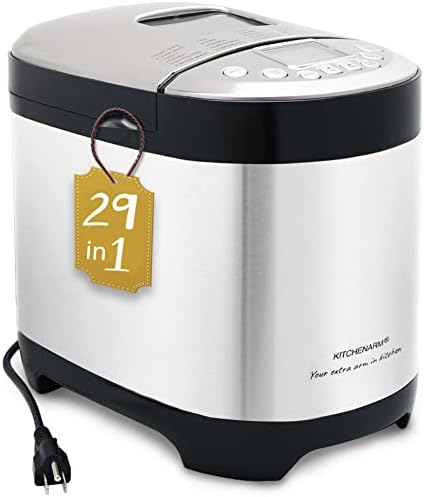
The KITCHENARM offers a wide range of automatic programs plus a customizable menu for bakers who want to do more than make standard loaves. Its 29 menus include bread types such as whole wheat, rye, multigrain, gluten-free, sourdough, and keto, as well as non-bread options like cake, jam, and yogurt. The supplied recipe book lists 77 recipes, and the product description also points to an online recipe collection.
It supports 1-, 1.5-, and 2-pound loaves, three crust colors, and a 15-hour delay timer. Its standout feature is the HOME MADE menu: you can save up to four personalized programs and set the timing for stages such as kneading, rising, and baking. The machine also has a nut-addition and paddle-removal alert, a one-hour keep-warm function, and a short power-interruption recovery feature.
That range of controls is useful if you enjoy testing recipes or want to adjust a cycle to suit a particular dough. It may be more machine than you need if you plan to use just one or two basic programs. Compared with the Cuisinart, it emphasizes customization over a simpler selection of settings; compared with the KBS, it does not list an automatic ingredient dispenser.
Pros:
- Wide selection of bread and non-bread menus
- Customizable cycle timing with space for four personalized menus
- Three loaf sizes and three crust colors
- Recipe book, delay timer, and alerts for add-ins and paddle removal
Cons:
- The many menus and adjustments may feel complex to users who want simple operation
- No automatic ingredient dispenser is listed in the supplied product details
Verdict: The KITCHENARM is a strong fit if you want to tailor programs and explore different bread styles, rather than rely only on preset cycles.
KBS Pro Bread Maker: A Larger Loaf with Automatic Add-In Handling

The KBS Pro is designed for bakers who want a larger loaf option and a broad mix of preset programs. It has 17 automatic settings, including gluten-free, sourdough, French, whole wheat, multigrain, cake, jam, yogurt, and dough. A custom setting lets you adjust baking time and temperature, and the machine comes with a recipe book listing 53 recipes.
Its stated loaf sizes are 1, 1.5, and 2.2 pounds. The product description highlights a ceramic pan and paddle, a stainless-steel dispenser that adds ingredients during the cycle, and a 710-watt motor. It also lists convection heating, three crust shades, a 15-hour delay timer, a one-hour keep-warm function, and a power-interruption backup feature.
The automatic dispenser is a practical distinction if you regularly add ingredients such as nuts or other mix-ins and want them added during the process without a manual step. The ceramic pan may appeal if you prefer that material, though the product information does not provide detailed care instructions. This model has more baking-focused features than the Cuisinart, while the KITCHENARM offers more automatic menus and deeper cycle customization.
Pros:
- Offers a larger 2.2-pound loaf size
- Automatic dispenser handles ingredients added during baking
- Ceramic pan and paddle, plus a custom setting
- Includes specialty programs and a recipe book
Cons:
- The product description provides fewer custom cycle details than the KITCHENARM
- The larger loaf option may be unnecessary if you usually bake for one or two people
Verdict: Consider the KBS if you want a larger loaf option and the convenience of an automatic dispenser for mix-ins.
OSIPOTO Bread Maker: A Beginner-Friendly Set of Everyday Programs

The OSIPOTO is a 17-program bread maker with a stainless-steel exterior and a digital interface described as beginner-friendly. Its menu covers options such as French and whole wheat bread, pizza dough, and jam. The supplied kit includes a measuring cup, spoon, kneading blade, and recipe book.
The machine offers three loaf sizes and three crust shades, though the product details do not specify the exact weight of each loaf option. A 15-hour delay timer and one-hour keep-warm function make it possible to schedule baking ahead. Its removable nonstick pan is designed to help bread release and make cleanup easier.
This model is a straightforward choice if you want several common programs without the extensive cycle programming of the KITCHENARM. The feature list is useful but does not provide the same level of detail about custom settings, recipe support, or ingredient dispensing as some other picks. If exact loaf weight or a specialty setting is important to you, confirm that the machine covers your needs before choosing it.
Pros:
- 17 programs include bread, dough, and jam options
- Three loaf sizes and three crust shades
- Delay timer and keep-warm function
- Includes basic measuring accessories and a recipe book
Cons:
- The exact weights for its three loaf sizes are not specified in the supplied details
- Offers less information about recipe customization than the KITCHENARM and KBS
Verdict: The OSIPOTO is worth considering if you want a set of familiar programs and scheduling features, but check that its unspecified loaf sizes work for your household.
Zojirushi Virtuoso Plus: Specialty Programs and Custom Memory Settings

The Zojirushi Virtuoso Plus stands out for its range of specialty programs and the ability to save custom baking sequences. Its listed menus include white, whole wheat, European, multigrain, gluten-free, salt-free, sugar-free, vegan, rapid bread, dough, sourdough starter, cake, jam, and homemade settings. Three homemade memory settings let you customize kneading, rising, and baking times.
The machine has a 13-hour delay timer and a large LCD display. The product description states that areas contacting food or beverages are free of PFAS, including PTFE and PFOA, as well as BPA. Its menu range gives it a different focus from simpler machines: it may suit you if you want to explore specific dietary styles and adjust cycle timing.
The supplied details do not list selectable loaf sizes, so check that point if loaf capacity is a deciding factor. Unlike the KBS description, the Zojirushi details do not mention an automatic dispenser for add-ins. Its strongest case is its specialty menu selection and saved custom settings, not a clearly stated larger loaf capacity or automatic mix-in handling.
Pros:
- Offers specialty menus such as vegan, salt-free, sugar-free, and gluten-free
- Three memory settings for custom knead, rise, and bake times
- Includes sourdough starter, dough, cake, and jam settings
- Food-contact areas are described as free of PFAS and BPA
Cons:
- Selectable loaf sizes are not specified in the supplied product details
- An automatic dispenser for add-ins is not listed
Verdict: Choose the Zojirushi if its specialty programs and custom memories matter most, and verify the loaf capacity before buying.
How to Choose a Bread Maker
Think About How Often You Will Use It
A bread maker makes the most sense when you expect to use it regularly. It can take over mixing, kneading, rising, and baking for many recipes, but it still needs ingredients, setup, and cleanup. If you bake only occasionally, consider whether those conveniences are worth dedicating storage or counter space to another appliance.
Match the Loaf Size to Your Household
Smaller loaves can help limit leftovers, while a larger capacity may suit families or people who bake less often but want more bread at once. The Cuisinart and KITCHENARM list 1-, 1.5-, and 2-pound options; the KBS goes up to 2.2 pounds. The OSIPOTO lists three sizes without specifying their weights, and the supplied Zojirushi details do not list loaf sizes, so check those details if capacity is important.
Choose Programs for the Bread You Actually Make
Basic white, whole wheat, and dough settings may be enough if you have a few regular recipes. If you want to make gluten-free loaves, specialty breads, jam, or cake, look for those specific programs. A longer menu can offer more options, but it is most useful when you plan to use them.
Decide Whether You Need Custom Controls
Preset programs keep the process simple. Custom settings let you change cycle times or baking preferences, which can help if you like testing recipes or want to repeat a particular method. The KITCHENARM offers detailed cycle programming and saved custom menus, while the Zojirushi provides three homemade memory settings. Consider whether those controls will solve a real need or add complexity you would rather avoid.
Consider Add-Ins and Scheduling
If your recipes use nuts or other ingredients that need to be added during a cycle, an automatic dispenser may reduce hands-on steps; the KBS description lists one. Delay timers can help schedule baking around your day, and keep-warm functions can hold a finished loaf for a limited time. Check the specific timer and warming features rather than assuming every machine handles them the same way.
Look at the Pan and Cleanup Needs
Pan material and coating affect what to expect from care and food-contact materials. The Cuisinart and OSIPOTO list nonstick pans, while the KBS describes a ceramic pan and paddle. Follow the maker’s care instructions for the model you choose, and consider whether the pan and paddle are easy for you to remove and clean.
Balance Convenience Against Homemade-Bread Preferences
A machine can reduce the hands-on work, but it does not automatically make it the right tool for every baker. Some people prefer to shape loaves and control the oven-baking stage themselves. A dough program can be a middle ground: the machine prepares the dough, and you finish it separately. Choose the approach that fits your routine and the kind of loaf you want.
Frequently Asked Questions
Is a bread maker worth getting if I only bake sometimes?
It may be, if you value the convenience or want to make specific breads at home. If you bake only a few times a year, the appliance may see little use, so consider storage space and how often you expect to make bread.
Does a bread maker do all the work?
It automates many steps, including mixing and kneading, and some models bake the loaf as well. You still need to measure ingredients, load the pan, choose a program, and clean the parts. Dough programs prepare dough for a separate baking step.
Can I make gluten-free bread in these machines?
The Cuisinart, KITCHENARM, KBS, and Zojirushi product details list gluten-free programs. The OSIPOTO details provided do not specifically list one. A dedicated setting is a useful feature, but you will still need a recipe suited to that program.
Can I use a bread maker for more than bread?
Several of these machines include programs for items such as dough, cake, or jam. The KITCHENARM also lists yogurt, while the Zojirushi includes a sourdough starter setting. Check the menu for the specific model rather than assuming all machines have the same options.
What is the benefit of a delay timer?
A delay timer lets you load ingredients and schedule a cycle to start later. It can make it easier to plan around your routine, but follow the manufacturer’s instructions for which ingredients and recipes are suitable for delayed starts.
Which bread maker is best for a beginner?
The Cuisinart is a good starting point if you want a clear selection of everyday programs. The OSIPOTO also describes its controls as beginner-friendly. If you expect to experiment with recipes, the KITCHENARM offers more control but also more settings to learn.
Will a bread maker save money?
That depends on how often you use it, the ingredients you choose, and the bread you would otherwise buy. A machine is more likely to make sense when you bake regularly and value the ability to choose your ingredients. Compare your typical ingredient costs and habits rather than assuming every homemade loaf costs less.
Final Recommendation
A bread maker is most worth getting when homemade bread is part of your regular routine and you want the machine to handle much of the work. The Cuisinart is a sensible pick for everyday presets and a compact design, while the KITCHENARM suits recipe experimentation. Choose the KBS for its larger loaf option and automatic dispenser. Before ordering, confirm the loaf capacity and programs you need, especially for the OSIPOTO and Zojirushi, whose supplied details leave some capacity information unspecified.