
The best Japanese knife for the money is the one that fits the work you do most. An all-purpose gyuto can handle everyday prep, while a nakiri is shaped for vegetables and a fillet knife is better suited to fish. The picks below range from single knives to a four-knife set, with differences in steel, edge design, and versatility to help you choose based on your kitchen needs—not just appearance.
Quick Comparison
| Knife | Type | Standout feature | Best for |
|---|---|---|---|
| HOSHANHO 8" Gyuto Chef Knife | 8-inch gyuto | 9-layer construction and 12° edge | A versatile main kitchen knife |
| HOSHANHO 7-Inch Nakiri Knife | 7-inch nakiri | Vegetable-focused blade with a 15° edge | Chopping and slicing produce |
| SHAN ZU 7-Inch Fillet Knife | 7-inch fillet and boning knife | Japanese K133 steel and Honbazuke sharpening | Fish preparation and detailed trimming |
| imarku 8.4" Pro Chef Knife | 8.4-inch chef knife | 13° edge per side and ash wood handle | Everyday prep with a longer blade |
| XCHIEF PRO Japanese Knife Set | Four-knife set | Four blade styles, storage bag, shears, and honing steel | Building a multi-purpose knife collection |
Our Picks: Best Japanese Knives For The Money reviews
HOSHANHO 8-Inch Gyuto: The Most Versatile Single Knife

This 8-inch gyuto is the strongest all-around pick for someone who wants one main knife for routine cooking. Its Japanese 10CR15MOV core sits within a nine-layer composite construction, and the listed blade hardness is up to 62 HRC. The hand-polished edge is specified at 12°, a fine angle suited to controlled slicing and precise prep.
The rosewood handle and hammered, blackened blade give it a traditional look. The maker also describes the handle as ergonomic and the knife as suitable for left- and right-handed users. Its combination of a general-purpose profile and a relatively acute edge makes it a more flexible choice than the dedicated nakiri or fillet knife in this lineup.
There are trade-offs. A harder, finer-edged knife needs more careful handling than a thick, heavy-duty workhorse. Use a suitable cutting board, avoid twisting the blade in hard ingredients, and hand-wash and dry it promptly. The claim that it needs sharpening only every few months depends on how often and how carefully you use it.
Pros:
- Versatile 8-inch gyuto profile for a wide range of prep
- Nine-layer construction with a 10CR15MOV core
- Fine, hand-polished 12° edge
- Rosewood handle and distinctive hammered finish
Cons:
- Its fine edge calls for careful cutting and storage habits
- Not as specialized for vegetables or fish as the dedicated knives below
Verdict: Choose this HOSHANHO if you want one capable, Japanese-style chef knife for most kitchen tasks and are willing to care for a fine edge.
HOSHANHO 7-Inch Nakiri: A Focused Pick for Vegetable Prep
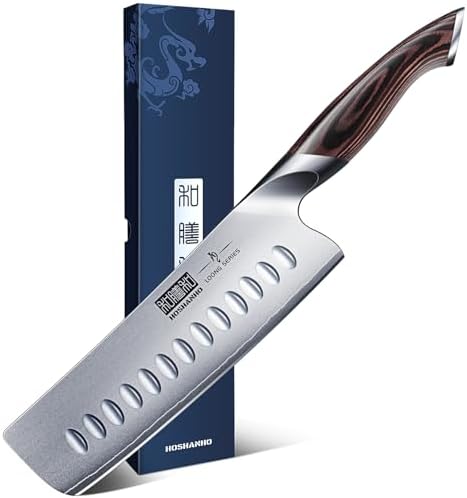
A nakiri has a broad, mostly straight edge that works well for chopping, slicing, and dicing vegetables. This HOSHANHO model has a 7-inch blade made from Japanese 10Cr15CoMoV high-carbon stainless steel. The listed hardness is 60 HRC, and the edge is hand-polished to 15°.
Its pakkawood handle is shaped for a comfortable hold, while the scallop-shaped hollows on the blade are designed to help ingredients release during cutting. The maker describes it as suitable for meat and fruit as well as vegetables, but its straight profile is especially useful for produce-focused prep.
Compared with the 8-inch gyuto, this is a more specialized tool and may be less convenient as your only knife. Its squared-off shape is also not designed for the rocking motion some cooks use with a curved chef knife. The scallops may help with food release, but they do not eliminate sticking in every situation.
Pros:
- Vegetable-friendly 7-inch nakiri shape
- 10Cr15CoMoV high-carbon stainless steel
- 15° hand-polished edge and 60 HRC listed hardness
- Pakkawood handle and scalloped blade design
Cons:
- Less versatile than a gyuto as a single-knife choice
- Straight edge may not suit cooks who prefer a rocking cut
Verdict: Pick this nakiri if vegetables make up much of your prep and you want a dedicated chopping knife rather than an all-purpose chef knife.
SHAN ZU 7-Inch Fillet Knife: A Specialized Tool for Fish

This 7-inch knife is aimed at fish preparation and detailed trimming, not as a replacement for an everyday chef knife. SHAN ZU specifies Japanese K133 steel and says the blade is made using a three-step Honbazuke method. The product description also highlights a multi-step manufacturing process and a hand-sharpened edge.
The narrower, task-focused format can make it easier to work around fish and bones than a broad chef knife. Its design includes a Genbu theme, drawing on the Japanese guardian spirit named in the product description. That gives it a more distinctive look than the understated HOSHANHO options.
The key limitation is specialization: if you rarely prepare fish or trim meat closely, this knife may spend more time stored than in use. The provided details do not specify a blade hardness or the level of flexibility, so shoppers who need a particular feel should check those details before choosing it. As with other high-carbon knives, careful washing and drying are sensible habits.
Pros:
- Purpose-built 7-inch fillet and boning profile
- Japanese K133 steel specified by the maker
- Honbazuke sharpening process is part of its construction
- Distinctive Genbu-inspired design
Cons:
- Less useful for general chopping than a gyuto or nakiri
- Blade hardness and flexibility are not stated in the supplied details
Verdict: Choose this SHAN ZU if fish work and close trimming are regular parts of your cooking; for general meal prep, a gyuto is a better first knife.
imarku 8.4-Inch Pro Chef Knife: A Longer Everyday Option

The imarku is an 8.4-inch chef knife for cooks who want a longer blade for slicing, chopping, and mincing. It has a double-bevel edge sharpened to 13° per side, a tapered blade, and high-carbon stainless steel. The maker lists the hardness as 57±1 HRC and describes the heat treatment as designed to balance edge retention, toughness, and rust resistance.
Its carbonized ash wood handle is secured with three rivets. A finger opening at the bolster is intended to help with control, and the blade has a laser-etched wave pattern. The longer blade may suit larger ingredients or longer slicing strokes, but it can feel less manageable if you prefer a compact knife or have limited counter space.
At the listed hardness, this knife is positioned as a balance between edge performance and toughness rather than an especially hard blade. That may appeal to cooks who prioritize a practical daily tool. The finger opening and handle shape are personal-fit features, though, so consider whether they match your grip before choosing this model over the more conventional HOSHANHO gyuto.
Pros:
- Long 8.4-inch blade for broad slicing and everyday prep
- Double-bevel edge sharpened to 13° per side
- Carbonized ash wood handle with triple rivets
- Finger opening designed to support control
Cons:
- Longer blade may feel unwieldy for smaller hands or tight workspaces
- Finger-ring design may not suit every grip
Verdict: Consider the imarku if you want a longer chef knife with a wood handle and value a balance of cutting performance and toughness.
XCHIEF PRO Four-Knife Set: A Broad Starter Collection
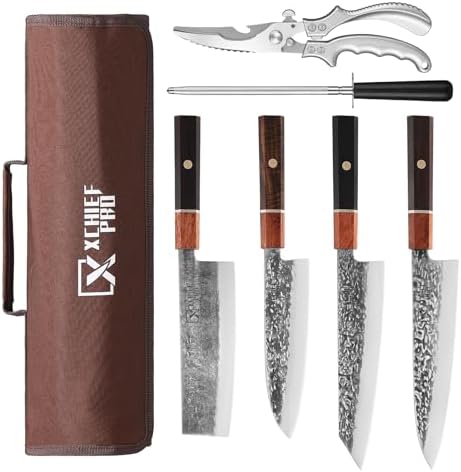
This set includes an 8-inch kiritsuke, an 8-inch gyuto, a 7-inch santoku, and a 7-inch nakiri, along with poultry shears, a honing steel, and a storage bag. The mix gives you several blade shapes for different prep styles, making it a convenient option if you are starting a collection or want knives that can be packed for cooking away from home.
The knives have hand-polished edges listed at 15–17°, wooden handles, and a hammered finish with a black coating on both sides. The product description says the blades are made from high-carbon steel, but it does not name a specific steel grade or hardness. It also recommends hand-washing and drying the knives after use.
A set provides more tools, but it may be more than you need if you already have a good chef knife. The description does not give exact steel or hardness details, so it is harder to compare the blades directly with the individual knives in this guide. The included honing steel is for routine edge maintenance; it does not take the place of proper sharpening when a blade becomes dull.
Pros:
- Four blade styles for different kitchen tasks
- Includes poultry shears, honing steel, and a storage bag
- 15–17° edge specification and hammered finish
- Portable bag can be useful for outdoor cooking or storage
Cons:
- Steel grade and blade hardness are not specified in the supplied details
- Several knives may be unnecessary if you only need one dependable daily blade
Verdict: Choose this set if you want several Japanese-style blade shapes and accessories together; choose a single knife if you prefer a simpler, more focused purchase.
How to Choose a Japanese Knife for Your Kitchen
Start with the jobs you do most
If you want one knife for everyday prep, look at a gyuto or chef knife. A nakiri is a better match if you spend much of your time chopping vegetables. A fillet knife makes sense when you regularly prepare fish or need a narrow blade for close trimming. A multi-knife set can cover more tasks, but only if you expect to use the extra pieces.
Pick a blade length you can control
The knives here range from 7 to 8.4 inches. A longer blade can help with broad slicing strokes, while a shorter one may be easier to handle on a small board or in tight spaces. Think about your cutting board, storage space, and comfort as well as the kind of food you prepare.
Understand the steel and hardness details
Steel type and hardness can affect how a knife performs and how you care for it. The listed single knives provide different specifics: the HOSHANHO gyuto uses a 10CR15MOV core and is rated up to 62 HRC, while its nakiri uses 10Cr15CoMoV at 60 HRC. The imarku lists 57±1 HRC. The XCHIEF PRO set does not identify a steel grade or hardness in the supplied details, so those specifications are harder to compare.
Consider edge angle and your cutting habits
The listed edge angles range from 12° on the HOSHANHO gyuto to 15–17° on the XCHIEF PRO set; the imarku gives an angle of 13° per side. These descriptions are not always stated in the same way, so avoid treating the numbers as a direct performance ranking. Whatever you choose, use a stable cutting board and avoid twisting or prying with the edge.
Choose a handle that feels secure
Handle shape and material affect how a knife feels in your hand. These options include rosewood, pakkawood, and carbonized ash wood, along with an imarku model that has a finger opening at the bolster. A feature that helps one cook feel in control may feel awkward to another, so consider your grip and hand size when comparing designs.
Factor in upkeep and storage
Follow the care directions for the specific knife, and make a habit of washing and drying it after use. Store knives so their edges do not knock against other utensils. A honing steel can help maintain an edge between sharpening sessions, but it is not a substitute for sharpening when the blade needs it. If you prefer low-maintenance kitchen tools, consider whether you are ready to care for a fine-edged knife.
Frequently Asked Questions
What is the best all-purpose knife in this group?
The HOSHANHO 8-inch gyuto is the most versatile single pick here. Its chef-knife shape is suited to a range of prep, including slicing, chopping, and mincing. The imarku is another everyday option if you prefer a longer blade.
Is a nakiri better than a chef knife?
Not for every cook. A nakiri’s straight edge is especially useful for chopping and slicing vegetables, while a gyuto or chef knife is generally a more flexible choice for mixed kitchen tasks.
Can the SHAN ZU fillet knife replace a chef knife?
It is designed for fish work and close trimming, so it is not the best substitute for a general-purpose chef knife. If you cook a wide range of meals, consider a gyuto or chef knife as your main blade.
What does HRC mean on a knife description?
HRC is a scale used to describe steel hardness. The supplied descriptions list hardness for the HOSHANHO gyuto, HOSHANHO nakiri, and imarku chef knife. A hardness number alone does not tell you whether a knife will suit your grip, cutting style, or maintenance preferences.
Does a Japanese-style knife need special care?
Care depends on the knife and its materials, so follow the maker’s directions. As a practical habit, wash and dry the blade promptly, use an appropriate cutting board, and avoid using the knife to pry or twist through hard foods.
Should I buy a knife set or one individual knife?
Choose a set if you want several blade shapes and will use the included accessories. If you mainly need a reliable daily knife, one well-matched gyuto or chef knife may be the more useful choice.
Final Recommendation
For most cooks seeking one Japanese-style knife for the money, the HOSHANHO 8-inch gyuto is the most balanced starting point because it combines a general-purpose shape with clearly stated steel and edge details. Choose the HOSHANHO nakiri for produce-focused prep, the SHAN ZU for fish work, or the XCHIEF PRO set if you want several blade styles in one package. The imarku is worth considering if you prefer a longer chef knife and its handle design suits your grip.