
Hard vegetables like carrots, sweet potatoes, and winter squash can challenge a dull or poorly balanced knife. For most kitchen prep, a sharp nakiri or santoku with a comfortable grip makes it easier to cut controlled slices without forcing the blade. These five options vary in size, steel, and handle style, so the right choice depends on how much cutting room and control you want.
Quick Comparison
| Knife | Type and size | Standout feature | Best for |
|---|---|---|---|
| PAUDIN Nakiri Knife | 7-inch nakiri | 5Cr15MoV steel and pakkawood handle | Everyday vegetable chopping |
| HOSHANHO 7-Inch Nakiri | 7-inch nakiri | 10Cr15CoMoV steel and 15-degree edge | Precise, straight-down cuts |
| imarku 5-Inch Santoku | 5-inch santoku | Compact blade with pakkawood handle | Control and smaller hands |
| DDF iohEF 7-Inch Santoku | 7-inch santoku | Double-edged blade and stainless steel handle | Ambidextrous everyday prep |
| QEGNOBOK 7-Inch Santoku | 7-inch santoku | Hollow-edge blade and full-steel handle | Versatile slicing and chopping |
Our Picks: Best Knife For Cutting Hard Vegetables reviews
PAUDIN Nakiri: A Versatile 7-Inch Vegetable Knife

The PAUDIN is a 7-inch nakiri-style knife made for chopping, slicing, dicing, and mincing. Its broad, straight-edged blade suits repeated up-and-down cuts through firm vegetables. Although the product title calls it a cleaver, it is better understood as a kitchen knife for food prep—not a tool for chopping bones.
The blade is made from 5Cr15MoV stainless steel and is listed at 56+ hardness. Its pakkawood handle is shaped to balance with the blade at the pinch point. A wave pattern on the blade is part of its design; the listing notes that it is not real Damascus steel. The knife is described as easy to resharpen, clean, and maintain.
The 7-inch length gives you more cutting surface than the compact imarku, while the nakiri shape favors straight cuts over tip-led work. That makes it a practical pick for carrots, cabbage, and other vegetables that benefit from steady chopping. For especially dense produce, use a stable cutting board and controlled strokes rather than trying to force the blade through.
Pros:
- Broad 7-inch blade is well suited to vegetable prep.
- Stainless steel construction is described as rust-resistant.
- Pakkawood handle is shaped for a balanced grip.
- Designed to be resharpened and maintained.
Cons:
- The squared nakiri profile is less suited to tasks that need a pointed tip.
- The decorative wave pattern is not Damascus steel.
Verdict: Choose the PAUDIN if you want a full-size nakiri for everyday vegetable chopping and prefer a pakkawood handle.
HOSHANHO Nakiri: A Precise Pick for Firm Produce
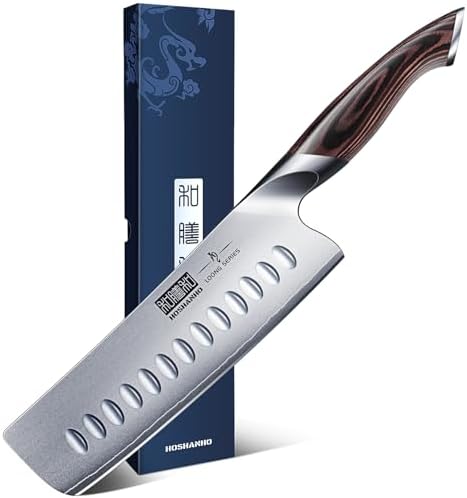
This 7-inch nakiri pairs a straight vegetable-knife profile with Japanese 10Cr15CoMoV high-carbon stainless steel. The maker lists a 15-degree edge and a hardness of up to 60 HRC after heat treatment. Those specifications point to a knife intended for sharp, controlled cuts; they do not mean you should use it to pry apart or twist through dense food.
The blade has scallop-shaped hollows intended to help food release, and the pakkawood handle is shaped to fit a natural grip. Like the PAUDIN, its straight edge works well for chopping vegetables with a steady up-and-down motion. Its 7-inch blade provides a useful amount of cutting surface, though it may feel large if you prefer a compact knife.
Compared with the PAUDIN, the HOSHANHO lists a higher hardness and a more acute edge angle. That may appeal if edge sharpness is a priority, while the PAUDIN may be a more straightforward fit if you value the product’s stated ease of resharpening and maintenance. Either way, keep the edge in good condition for safer, cleaner cuts through firm produce.
Pros:
- 7-inch nakiri shape suits repeated vegetable chopping.
- Listed 15-degree edge is designed for precise cutting.
- Scalloped hollows are intended to reduce food sticking.
- Pakkawood handle has an ergonomic shape.
Cons:
- The maker does not provide a specific care routine in the supplied product details.
- The straight-edged profile is not as versatile for pointed-tip tasks.
Verdict: Pick the HOSHANHO if you want a full-size nakiri with a finely angled edge and a blade design intended to help food release.
imarku 5-Inch Santoku: Compact Control for Smaller Prep

At 5 inches, this imarku santoku is the smallest knife in this group. Its shorter blade is designed to be easy to maneuver and gives you close control for detailed cuts. The product details list a hand-polished edge of 15–18 degrees, a 2.3 mm blade, and a pakkawood handle.
The compact size can be useful for carrots, smaller potatoes, and other produce where careful placement matters. It is also described for slicing, dicing, and mincing a range of foods. However, a shorter blade offers less length for cutting through a large vegetable in one stroke than the 7-inch options, so it may take more passes for bigger pieces.
The anti-stick surface is intended to help food release, while the handle is shaped for a secure grip. This knife is a reasonable choice if a full-size santoku or nakiri feels unwieldy. If your main task is breaking down large or especially dense vegetables, one of the 7-inch blades offers more working length.
Pros:
- Compact blade offers control for detailed prep.
- Listed edge angle is suited to precise slicing.
- Anti-stick surface is designed to help food release.
- Pakkawood handle is shaped for a comfortable grip.
Cons:
- Shorter blade provides less reach for large vegetables.
- May require more cuts than a 7-inch knife for wide produce.
Verdict: Choose the imarku if control and a compact blade matter more to you than the longer cutting reach of a full-size knife.
DDF iohEF 7-Inch Santoku: A Double-Edged Everyday Option

This 7-inch santoku has a double-edged blade, with a listed edge angle of 15 degrees per side. The product information identifies the steel as 5Cr15MoV and gives a hardness of up to 58. The double-bevel design is specified for both left- and right-handed users, which makes it a flexible choice for a shared kitchen.
Its stainless steel handle has an ergonomic shape, and the knife is described as balanced for frequent kitchen use. A santoku is a versatile style for chopping and slicing vegetables, fruit, meat, and cheese. The 7-inch blade provides more reach than the imarku, while its profile offers a middle ground between a dedicated vegetable knife and a general-purpose chef’s knife.
The listing says this knife is dishwasher safe, but check the care instructions that come with the product before cleaning it. A stainless handle may also be less appealing if you specifically want the warmer feel of wood or pakkawood. For controlled cuts through hard vegetables, use a sharp edge and avoid twisting the blade in the food.
Pros:
- Double-edged design is specified for left- and right-handed cooks.
- 7-inch blade handles a range of everyday prep tasks.
- Ergonomic stainless steel handle is designed for comfort.
- Listed as dishwasher safe.
Cons:
- Stainless steel handle may not suit cooks who prefer a wood-style grip.
- It does not have the broad, straight profile of a nakiri.
Verdict: Consider the DDF iohEF if you want a 7-inch, double-edged santoku that can serve left- and right-handed cooks.
QEGNOBOK 7-Inch Santoku: A Versatile Blade with a Hollow Edge

This 7-inch santoku has a 3Cr15MoV steel blade, a listed 15-degree double-bevel edge, and hollows designed to help reduce food sticking. Its sheep’s-foot tip and blade shape support both rocking and push-cutting motions, according to the product details. It is presented as an all-purpose knife for vegetables, fruit, meat, and fish.
The full-stainless-steel handle has contoured finger grooves and a palm swell. That design may suit cooks who like a solid metal handle, while those who prefer pakkawood may find the PAUDIN, HOSHANHO, or imarku more appealing. The product maker recommends hand washing and drying the knife promptly, so it is not the lowest-effort choice for cleanup.
For hard vegetables, the 7-inch blade gives you more cutting length than a compact knife, and the hollow-edge design may help with food release. Its santoku profile is more versatile for mixed prep than a straight-edged nakiri. As with the other knives here, it is a food-prep tool, not a substitute for a heavy cleaver when splitting dense items.
Pros:
- 7-inch blade is sized for general kitchen prep.
- Double-bevel edge is listed at 15 degrees.
- Hollow-edge design is intended to reduce sticking.
- Full-steel handle has shaped grip features.
Cons:
- Hand washing and immediate drying are recommended.
- Full-steel handle may not appeal to cooks who prefer pakkawood.
Verdict: Choose the QEGNOBOK if you want a 7-inch santoku with a hollow-edge blade and do not mind hand washing and drying it.
How to Choose a Knife for Cutting Hard Vegetables
Pick a blade shape that matches your cutting style
A nakiri has a broad, relatively straight edge that suits chopping vegetables with up-and-down strokes. A santoku is a more general-purpose shape for chopping and slicing a mix of ingredients. If you mainly prepare vegetables, a nakiri may feel natural; if you want one knife for vegetables and other everyday tasks, a santoku may be the more flexible choice.
Consider blade length and control
A 7-inch blade gives you more cutting surface for larger vegetables, while a 5-inch blade can be easier to maneuver for small ingredients and detailed work. Think about the produce you cut most often and the size of your cutting board. A longer blade is not automatically better if you find it harder to control.
Look at the edge and steel details
A sharp edge matters more than forcing a knife through a hard vegetable. The products here list different steels, edge angles, and hardness levels. These specifications can help you compare options, but they do not replace regular edge care. Avoid twisting or levering the blade in dense produce, since that can put extra stress on the edge.
Choose a handle you can grip comfortably
Handle material and shape affect how a knife feels during repeated prep. The options here include pakkawood and stainless steel handles, with different ergonomic designs. If you can, consider how the handle fits your hand and whether you prefer a traditional wood-style feel or a metal grip. A secure hold helps you make more controlled cuts.
Check care instructions before buying
Care needs vary by knife. The QEGNOBOK product details recommend hand washing and prompt drying, while the DDF iohEF listing says it is dishwasher safe. Follow the instructions provided with the knife, and keep the edge sharp. Clean, dry storage also helps protect the blade and makes the knife ready for use.
Use safe technique with very dense produce
Set the vegetable on a stable cutting board and create a flat side first if it tends to roll. Keep your fingers clear of the blade path and use controlled cuts. If a vegetable is too large or dense to cut safely with a kitchen knife, choose a safer way to portion it rather than forcing or twisting the blade.
FAQs
Is a nakiri or santoku better for hard vegetables?
A nakiri’s straight edge is designed for vegetable chopping, while a santoku is more versatile across different foods. Either can work for firm vegetables when sharp and used with controlled technique. Choose the shape that best matches your usual cutting motion.
Is a 5-inch knife long enough for cutting hard vegetables?
A 5-inch knife can handle smaller vegetables and detailed cuts, but it offers less reach than a 7-inch blade. If you often prepare large carrots, squash, or other wide produce, a longer blade may be more convenient.
Can these knives cut winter squash?
They are kitchen prep knives, but winter squash can be very dense and difficult to cut safely. Use a stable board and controlled technique, and do not twist or force the blade. If the squash is too large or firm to handle safely, use a safer method to portion it.
Does a higher hardness rating mean a knife is better?
Not on its own. Hardness is one specification among several, along with blade shape, edge geometry, handle comfort, and care needs. The best fit is the knife you can control and maintain properly.
Are hollow-edge dimples the same as a nonstick coating?
No. The HOSHANHO and QEGNOBOK product details describe blade hollows or divots intended to help food release. That design is not the same as a nonstick coating, and it cannot guarantee that food will never cling to the blade.
Should I put a kitchen knife in the dishwasher?
Follow the care instructions for the specific knife. The DDF iohEF listing describes its knife as dishwasher safe, while the QEGNOBOK listing recommends hand washing and drying. When instructions are unclear, hand washing and drying promptly is a cautious approach.
Final Recommendation
For a dedicated vegetable-prep knife, the PAUDIN and HOSHANHO are the strongest shape matches in this group because both use a 7-inch nakiri profile. The PAUDIN is a practical all-around choice with stated ease of maintenance, while the HOSHANHO stands out for its listed edge angle and steel hardness. If you prefer a more versatile knife, consider one of the 7-inch santoku options; choose the compact imarku when maneuverability matters most. Whatever you pick, a sharp edge, stable cutting board, and controlled technique matter when working with hard vegetables.