
A large insulated hot beverage container can make it easier to serve coffee, tea, cocoa, or hot water to a group without keeping an electric warmer running. The right choice depends on how much you need to serve and how people will pour: pump-top airpots suit self-service coffee stations, while large insulated dispensers with spigots are better for catering, camping, and events. Below, we compare five options by capacity, dispensing style, materials, and the temperature-retention details provided by each maker.
Quick Comparison
| Product | Capacity | Dispensing style | Temperature-retention claim | Best suited for |
|---|---|---|---|---|
| Gezoss 102-Ounce Pump Airpot | 102 oz / 3 L | Pump top; rotating base | Up to 24 hours hot; 36 hours cold | Office coffee stations and gatherings |
| Cresimo 102-Ounce Pump Airpot | 102 oz / 3 L | Pump top | Up to 12 hours hot; 36 hours cold | Home hosting and smaller group service |
| VEVOR 5-Gallon Beverage Dispenser | 5 gal / 18.9 L | Two-stage spigot | Over 10 hours, according to the product description | High-volume events and food service |
| PYY 5-Gallon Thermal Server | 5 gal / 19 L | Drip-resistant faucet | Up to 8 hours; specific test conditions are stated | Catering, restaurants, and outdoor gatherings |
| JIVGDN 3.5-Gallon Stainless Interior Dispenser | 3.5 gal / 13 L | Spout | Hours of retention; no exact duration is provided | Buffets, camping, and group service |
Our Picks: Best Large Insulated Hot Beverage Container reviews
1. Gezoss 102-Ounce Pump Airpot: Best for All-Day Coffee Service

The Gezoss is a 3-liter airpot designed for serving coffee and other drinks without lifting and tipping a heavy container. Its pump-action top dispenses drinks into a cup, and the base rotates 360 degrees so people can reach the pump from different directions. The maker lists the capacity as 102 ounces, or about 15 cups.
The inner container is described as food-grade 304 stainless steel. The listed temperature-retention claims are up to 24 hours for hot drinks and 36 hours for cold drinks. Those figures are useful for comparison, but actual results can vary with the starting temperature, how often the lid is opened, and the surrounding conditions.
A wide opening is intended to make filling and cleaning easier, and the product description says a cleaning brush is included. The pump top can also be removed for more thorough cleaning. This design makes sense for an office, family gathering, or buffet where guests want to serve themselves without handling a bulky urn.
Compared with the two 5-gallon dispensers below, this airpot holds much less, but it takes up less serving space and is more practical for a coffee station. Its pump mechanism also has more parts to clean than a simple open-pour carafe, so regular cleaning matters.
Pros:
- Stainless-steel interior is described as food-grade 304 steel.
- Rotating base and pump top support convenient self-service.
- Wide opening and included brush are intended to simplify cleaning.
- Listed hot and cold retention claims are longer than those of the other airpot here.
Cons:
- Its 102-ounce capacity is not suited to very large events.
- The pump top needs more careful cleaning than a basic spout.
Verdict: Choose the Gezoss if you want a medium-size, pump-dispensed coffee container with a rotating base and the strongest stated hot-retention claim among these two airpots.
2. Cresimo 102-Ounce Pump Airpot: A Practical Pick for Home Hosting

This Cresimo airpot holds 102 ounces, matching the capacity of the Gezoss. Its pump top is designed to dispense coffee, tea, or hot cocoa without pouring the full container. That makes it a useful format for a holiday drink station, a meeting, or a gathering where several people may serve themselves.
The maker states that the carafe keeps drinks hot for up to 12 hours and cold for up to 36 hours. That hot-retention claim is shorter than the Gezoss’s stated 24 hours, so the Cresimo may be a better fit when you need to serve drinks over a shorter stretch rather than keep them hot all day.
The product description emphasizes a top that opens for cleaning and a durable exterior designed to resist stains, scratches, and cracks. It does not specify the interior material in the supplied details, so shoppers who prioritize a particular steel grade should verify that information on the product listing before buying.
Its 3-liter capacity is easier to manage than a 5-gallon catering dispenser, but it will need refilling sooner at a large event. The pump is convenient for self-service, though any pump assembly can take more attention to clean than a wide-open container with a simple faucet.
Pros:
- 102-ounce capacity works for small group service.
- Pump dispensing avoids lifting and pouring a full carafe.
- Listed cold-retention claim is up to 36 hours.
- Top opens for wiping and cleaning.
Cons:
- Its stated hot-retention time is shorter than the Gezoss airpot’s.
- The supplied product details do not identify the interior material.
Verdict: The Cresimo is a sensible option for home hosting and smaller coffee stations if its 12-hour hot-retention claim meets your needs.
3. VEVOR 5-Gallon Dispenser: Best for High-Volume Serving

With a 5-gallon capacity, the VEVOR is built for serving a crowd rather than keeping a few cups of coffee ready at home. Its large volume can hold coffee, tea, juice, milk, or other drinks, and the two-stage spigot is designed to control the flow. A press-to-stay-open function can be useful when filling several cups in a row.
The dispenser uses a non-electric insulation design with an LDPE exterior and a polyurethane foam layer. The maker says it keeps drinks at the desired temperature for over 10 hours without electricity. That makes it suitable for events where a power outlet is not convenient, but it is not a replacement for an electric warmer or a heated serving vessel.
At a listed weight of 16 pounds, it is lighter than some commercial-style containers of similar volume, though the filled dispenser will be much heavier. It has integrated handles for carrying and latches to secure the lid. Plan where to place it before filling, because a full 5-gallon container is not something most people will want to move often.
Compared with the PYY 5-gallon option, the VEVOR description gives a broad retention claim rather than a detailed temperature test. It is also a larger choice than the 3-liter airpots and is best considered when serving volume matters more than a compact footprint.
Pros:
- Large 5-gallon capacity suits events and food-service settings.
- Non-electric insulation does not require a power source.
- Two-stage spigot includes a press-to-stay-open function.
- Integrated handles and lid latches support transport and setup.
Cons:
- Its size is excessive for routine household coffee service.
- The filled unit will be considerably heavier than its listed empty weight.
Verdict: Pick the VEVOR for large groups that need a high-capacity, non-electric dispenser with a controlled-flow spigot.
4. PYY 5-Gallon Thermal Server: A Large Option with Detailed Insulation Claims

The PYY is another 5-gallon container intended for coffee shops, restaurants, outdoor gatherings, and other group settings. It has a double-wall construction, a polyurethane insulation layer, a top lock, and a faucet for dispensing. The maker describes the faucet and seals as drip-resistant and leak-resistant, which are important features when a full dispenser will sit on a serving table.
PYY provides specific temperature claims: under stated conditions, 100°C water loses 2°C per hour, while a 1:1 mixture of ice and water at 4°C retains ice that is described as nearly unmelted during the first 8 hours. The product description also says the dispenser maintains temperature for up to 8 hours. These figures are tied to the maker’s stated conditions, so they should not be treated as a guarantee for every room or serving setup.
The container is made with food-grade LLDPE and has a 20 mm PU insulation layer. Its listed size is 16.7 by 10 by 25.6 inches, so check your counter, vehicle, or storage space before ordering. Integrated handles are intended to make it easier to carry, and the design supports stacking different volumes.
Compared with the VEVOR, the PYY offers more detailed temperature-test information and describes a leak-conscious faucet design. Both are large, non-electric dispensers, so your decision may come down to dimensions, dispensing details, and which maker’s stated insulation specifications better match your use.
Pros:
- 5-gallon capacity is suited to large groups.
- Maker provides specific hot- and cold-retention test claims.
- Double-wall construction and a 20 mm insulation layer are specified.
- Integrated handles and stacking-friendly design support event use.
Cons:
- The stated retention results depend on the listed test conditions.
- Its large dimensions require planning for storage and placement.
Verdict: The PYY is worth considering for catering or outdoor service if you want a 5-gallon capacity and more detailed insulation claims to compare.
5. JIVGDN 3.5-Gallon Dispenser: Best for a Stainless-Steel Interior
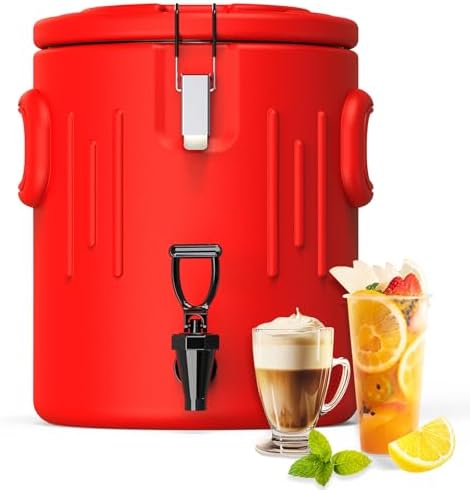
This JIVGDN dispenser sits between the compact airpots and the 5-gallon servers in capacity. It holds 3.5 gallons, or 13 liters, and has a food-grade 18/8 stainless-steel interior. The maker says the interior does not absorb or retain odors or flavors and is designed for easier cleaning.
The dispenser is designed for hot and cold drinks, with a molded plastic exterior and foam insulation. Its wide opening is useful for filling and cleaning, while the spout supports serving from a stationary container. The maker describes the insulation as using foam that is 40% thicker, but the supplied details do not give a specific number of hours for hot or cold retention.
This capacity may suit a buffet, camping trip, sports event, or group meal where a 102-ounce airpot would need frequent refills but a 5-gallon server would be more than necessary. The product description also lists foods such as soup and porridge, though its suitability for any particular food depends on safe handling and cleaning practices.
Compared with the larger VEVOR and PYY dispensers, the JIVGDN holds less but still offers a substantial serving volume. Its stainless-steel interior is a notable distinction, while the lack of a precise temperature-retention figure makes it harder to compare insulation performance directly.
Pros:
- 3.5-gallon capacity offers a middle ground between airpots and 5-gallon servers.
- Food-grade 18/8 stainless-steel interior is specified.
- Wide opening is intended to ease filling and cleaning.
- Designed for both hot and cold drinks.
Cons:
- The supplied product details do not state an exact hot-retention duration.
- It is bulkier than a pump airpot for smaller coffee stations.
Verdict: Choose the JIVGDN if you want a large but not maximum-size dispenser and value a stainless-steel interior over a precise published heat-retention figure.
How to Choose a Large Insulated Hot Beverage Container
Match capacity to the number of servings
Capacity is the first decision because it affects refills, carrying, and storage. The 102-ounce airpots are suited to a coffee station serving a smaller group, while the 3.5-gallon and 5-gallon models are aimed at larger gatherings. Think about how many cups you expect to serve and whether you can refill during the event. A container that is too large can be awkward to move and store, while one that is too small may need frequent refills.
Choose a dispensing style for the way people will serve themselves
A pump top is useful when guests will fill cups from a counter or table and you want to avoid lifting the container to pour. A spigot is more common on high-capacity dispensers and can be easier to use when serving many people in a row. Consider cup height and clearance under the outlet, as well as whether the dispenser needs to sit on a table or stand.
Compare insulation claims carefully
Look for a stated hot-retention duration, but read the claim in context. Some makers provide a general time estimate, while others give test conditions that may not match your room or serving habits. Opening the lid, pouring frequently, and starting with a cooler beverage can affect results. If exact temperature matters for your use, check the manufacturer’s full specifications rather than treating a headline claim as a guarantee.
Check materials and cleaning access
Food-contact materials, interior surfaces, and access to the lid or pump all matter for a container that will hold drinks for hours. Stainless-steel interiors are specified on the Gezoss and JIVGDN models, while the large VEVOR and PYY dispensers describe food-grade plastic components. A wide opening can make filling and washing easier. For pump or spigot models, check whether the dispensing parts can be accessed and cleaned thoroughly.
Consider weight, dimensions, and where it will sit
Capacity adds weight quickly once a container is full. A 5-gallon dispenser can be difficult to move after filling, even if the empty unit has built-in handles. Check the listed dimensions against your serving table, vehicle, and storage area. If you need to transport the beverage, consider filling the container near its final serving spot when possible.
Decide whether you need a compact coffee station or event-scale service
Airpots and bulk dispensers solve different problems. A pump airpot is generally the more practical format for an office, meeting, or home gathering. A large insulated server makes more sense for a buffet, outdoor event, or food-service setting where high volume is the priority. Buying more capacity than you need can make cleaning and handling harder without improving your day-to-day setup.
Frequently Asked Questions
Which container is best for a home coffee station?
A 102-ounce pump airpot is the most compact choice in this group. The Gezoss and Cresimo both use pump dispensing, so compare their stated hot-retention times and the material details that matter to you.
Which option holds the most?
The VEVOR and PYY models each have a stated capacity of 5 gallons. They are designed for larger groups and event service rather than small countertop coffee stations.
Do these containers need electricity to keep drinks warm?
The VEVOR is described as using non-electric insulation. The other supplied product descriptions also focus on insulated containers rather than powered warmers, but check each product listing for complete operating details.
How long will a large insulated container keep coffee hot?
It depends on the model and conditions. The listed claims range from up to 8 hours for the PYY to up to 24 hours for the Gezoss airpot. The Cresimo lists up to 12 hours, while the VEVOR claims over 10 hours. The JIVGDN description does not provide an exact duration. These are maker claims, not guarantees for every setup.
Is a pump top or spigot easier to use?
A pump top works well for dispensing individual cups from a countertop carafe. A spigot is often more practical for a larger container serving many people. Your choice should depend on container size, cup placement, and how frequently you expect people to pour.
Can these containers hold cold drinks too?
Yes. The supplied descriptions identify all five as suitable for hot and cold beverages, although the specific cold-retention claims vary by product. Follow the product’s cleaning and use instructions for the drinks you plan to serve.
What should I check before buying a 5-gallon dispenser?
Check its dimensions, empty weight, handle design, spigot style, and cleaning access. Also plan where it will sit once filled, since moving a full 5-gallon container can be difficult.
Conclusion
For most coffee stations and smaller gatherings, the Gezoss 102-ounce airpot is the most versatile pick in this lineup thanks to its pump top, rotating base, wide opening, and stated 24-hour hot-retention claim. Choose the Cresimo if its 12-hour claim fits your serving window. For large events, the VEVOR or PYY offers much more capacity, while the JIVGDN is a middle-capacity choice with a specified stainless-steel interior. Before you buy, match the container’s size and dispensing style to your actual serving needs, and treat insulation times as product claims that may vary in use.