
A good meat slicer can make hot pot prep easier by turning a firm piece of beef, lamb, or pork into thin slices at home. The options below are manual slicers, so they do not need electricity, but they do require careful handling and meat prepared according to the product instructions. Compare the thickness ranges, blade setup, and included safety features to find the right fit for your kitchen.
Quick Comparison
| Product | Thickness range | Standout feature | Best for |
|---|---|---|---|
| ZOAMEACY Manual Frozen Meat Slicer | 0.2–20 mm | Thick stainless steel board; spare blade included | Home cooks who want a wide range of slice thicknesses |
| PAYISHO Manual Frozen Meat Slicer | 0.2–20 mm | Comes with a spare blade and meat bags | Hot pot and shabu shabu prep |
| Koconic Stainless Steel Food Slicer | Not specified | 1.6 mm stainless steel plate and 200 mm blade | Those who prioritize a longer blade |
| KEYEUST Stainless Steel Food Slicer | 1–8 mm | Safety guard and suction cups | People who want a compact slicer with stated safety features |
| Jerliflyer Manual Frozen Meat Slicer | 0.3–8 mm | Two blades and four suction cups | Home cooks who want included blade and stability accessories |
Our Picks: Best Meat Slicer For Hot Pot reviews
1. ZOAMEACY Manual Slicer: A Broad Thickness Range for Varied Cuts

The ZOAMEACY is a hand-operated slicer designed for frozen beef, mutton, pork, ham, and fish. Its stated thickness range runs from 0.2 mm to 20 mm, giving you options for very thin hot pot slices as well as thicker cuts for other meals. The slicer has a 7.9-inch blade and a stainless steel board described as 1.5 mm thick.
The package includes a spare blade, a meat holder, two suction cups, food bags, an Allen wrench, and an instruction manual. At 18.1 by 6.3 by 4.7 inches and 2.3 kg, it will need a dedicated spot for storage, though it does not require an outlet. The meat needs to be properly frozen for the cleanest cuts, according to the product instructions.
Its wide adjustment range is useful if you plan to use one slicer for hot pot, stir-fry, or other dishes. One practical caveat: the listed range reaches 20 mm, but very thick cuts are not the main reason to buy a hot pot slicer. For frequent thin slicing, careful setup and a stable work surface matter more than the maximum setting.
Pros:
- Wide stated thickness range from 0.2 mm to 20 mm
- Spare blade and meat holder are included
- Stainless steel board is listed as 1.5 mm thick
- Designed for several types of meat and fish
Cons:
- Requires properly frozen meat and manual effort
- Its size and weight may be more than you want for occasional use
Verdict: Choose the ZOAMEACY if you want a broad adjustment range and a package with a spare blade, but compare its listing carefully with similar slicers before deciding.
2. PAYISHO Manual Slicer: A Similar Option for Hot Pot and Shabu Shabu

The PAYISHO is another manual frozen-meat slicer intended for hot pot, shabu shabu, barbecue, and home meal prep. Its listed adjustment range is 0.2 mm to 20 mm, matching the ZOAMEACY’s stated range. The product description also lists a 1.5 mm stainless steel plate, a pre-installed blade, and a spare blade.
Its package includes a meat holder, two suction cups, an Allen wrench, a manual, and ten meat bags. Those accessories give you the basics for setup and handling, although you should check the product instructions for how to position and secure the slicer. The manufacturer advises freezing meat properly before slicing.
The specifications are very close to the ZOAMEACY, so the listed accessories and the details on each product page may be more useful for comparing them than the headline claims. The large thickness range offers flexibility, but a manual slicer still takes repeated hand movement and may not suit someone preparing large quantities at once.
Pros:
- Stated range of 0.2 mm to 20 mm
- Includes a spare blade and meat holder
- Comes with two suction cups and ten meat bags
- Intended for several home-cooking uses, including hot pot
Cons:
- Requires manual work and properly frozen meat
- Its listed specifications closely resemble another option in this guide
Verdict: The PAYISHO is worth considering if its accessory package and listing suit your needs, but it offers few clearly stated specification differences from the ZOAMEACY.
3. Koconic Stainless Steel Slicer: A Longer Blade for Wider Cuts
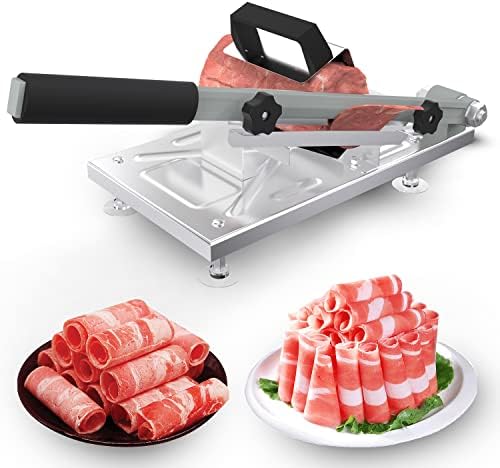
Koconic’s manual slicer is made for frozen ingredients such as beef, mutton, ham, bacon, and cheese. The product description specifies a 1.6 mm stainless steel plate and a 200 mm blade, which is about 7.9 inches long. It also says the blade is 3 mm wide and designed to handle pressure during cutting.
The longer blade may be useful when you want to work with a wider piece of meat, and the product is presented for hot pot, barbecue, pizza, and other meals. However, the supplied details do not give an adjustable slice-thickness range or list accessories such as a spare blade or meat holder. If a precise thin setting is important to you, confirm that information on the product page before buying.
Compared with the first two options, Koconic provides a thicker plate specification and specific blade measurements, but less detail about thickness adjustment. Its product description stresses reading the instructions and taking care with the sharp blade. That is especially important with any manual slicer, where your hands work close to the cutting area.
Pros:
- 1.6 mm stainless steel plate is specified
- 200 mm blade length is stated
- Designed for meat and other ingredients such as cheese
- Suitable for hot pot and several other meal types
Cons:
- No slice-thickness range is provided in the supplied details
- Included accessories are not specified
Verdict: Consider the Koconic if the longer blade and stated plate thickness appeal to you, but verify the adjustment method and included parts before ordering.
4. KEYEUST Stainless Steel Slicer: Safety Features and Simple Adjustment

The KEYEUST is a manual slicer with a stated adjustment range of 1–8 mm. Its product description says the thickness is changed with a knob, with thinner settings intended for hot pot and thicker ones for barbecue. It is described as suitable for beef, lamb, chicken, ham, and fish.
Two details stand out for day-to-day use: the slicer has suction cups to help secure it to a counter and a safety guard intended to help keep hands away from the blade. It also has a detachable design and a non-slip handle. The description says it can be rinsed or wiped clean, but follow the product’s care instructions and handle the sharp blade cautiously.
Its 1–8 mm range is narrower than the 0.2–20 mm ranges listed for the first two slicers, but it is focused on the thinner cuts most useful for hot pot. The listed minimum is 1 mm, so it may not be the best match if you specifically want a setting below that. The product is also described as compact and lightweight, though exact dimensions are not provided.
Pros:
- Knob-adjustable thickness from 1 mm to 8 mm
- Includes suction cups and a safety guard
- Detachable design and non-slip handle are specified
- Designed for several meats and fish
Cons:
- Its stated minimum thickness is 1 mm
- Exact dimensions and included spare parts are not specified
Verdict: Choose the KEYEUST if you want a focused hot pot thickness range with a guard and suction cups, and do not need a setting below 1 mm.
5. Jerliflyer Manual Slicer: Two Blades and Four Suction Cups

The Jerliflyer is a manual frozen-meat slicer with a stated adjustment range of 0.3–8 mm. The product description lists two alloy steel blades, four suction cups, and a non-slip meat cover. It is intended for beef, lamb, pork, ham, and fish, as well as other home cooking uses such as sandwiches and pizza.
For hot pot, its thin end of the range is the key feature. The four suction cups may help keep the slicer in place on a suitable work surface, while the meat cover is intended to help hold the food during cutting. The description also says the blades can be used for frozen meat and vegetables, but follow the manual for setup and safe use.
This model gives you more included stability accessories than the first two products list, while its maximum setting is 8 mm rather than 20 mm. That may be a sensible trade-off if your main goal is hot pot and other relatively thin slices. The product description does not provide the slicer’s dimensions or weight, so check the listing if storage space is a concern.
Pros:
- Adjusts from 0.3 mm to 8 mm
- Includes two alloy steel blades
- Four suction cups and a non-slip meat cover are listed
- Designed for several meats and some vegetables
Cons:
- Maximum stated thickness is less than some alternatives
- Dimensions and weight are not provided in the supplied details
Verdict: The Jerliflyer is a strong fit if you want a thin-cut range plus multiple stability accessories, but confirm its size and setup details before purchase.
How to Choose a Meat Slicer for Hot Pot
Look for a useful thin-slice setting
Hot pot usually calls for thin pieces that cook quickly in broth. Compare the minimum thickness, not only the maximum. The products here list minimum settings from 0.2 mm to 1 mm, while one product does not provide a range. A very low setting gives you more adjustment on paper, but the product must still be set up correctly and used with meat prepared as the instructions require.
Check how the thickness adjusts
A slicer may use a knob or another manual adjustment method. A clearly stated range makes it easier to compare models, while a simple control can be useful when you switch between hot pot and thicker cuts. If the product description does not explain the adjustment, check the product page or manual before buying rather than assuming it has a specific setting.
Consider blade details and replacement parts
Blade length can affect the size of the meat you can work with, and a spare blade may be useful over time. The products in this guide vary: some list a spare blade, one specifies a 200 mm blade, and another includes two blades. A sharp blade is also a safety concern, so read the instructions and use any included holder or guard as directed.
Prioritize a stable setup
Manual slicing involves pushing or pulling meat across a blade, so a secure base matters. Several options list suction cups; one also lists a safety guard, while another includes a non-slip meat cover. Make sure the counter is suitable for the suction cups and that the slicer is stable before you begin. Do not rely on an accessory to replace careful handling.
Match the slicer to your prep volume
A manual model avoids the need for electricity, but you provide the cutting motion. It can make sense for occasional home hot pot or small meal prep. If you plan to prepare a large amount of meat regularly, consider whether repeated manual slicing will feel practical for you. The product descriptions do not provide a shared capacity measure, so compare the size and setup details on each listing.
Plan for safe food handling and cleanup
Follow the maker’s guidance on how frozen the meat should be; several product descriptions call for properly frozen meat. Use the meat holder or guard when supplied, keep your hands clear of the blade, and keep the slicer away from children. Clean and store the blade according to its manual. A detachable design or stated rinse-and-wipe method may help, but always check the specific care directions first.
Frequently Asked Questions
Do I need frozen meat for a manual hot pot slicer?
The products in this guide are described as frozen-meat slicers, and several instructions say to freeze meat properly for clean cuts. Follow the specific product manual rather than assuming every slicer works the same way.
What thickness is best for hot pot?
Thin slices are commonly used for hot pot because they cook quickly. The right setting depends on your preference and the meat. Start with the product’s instructions and adjust carefully rather than assuming the thinnest setting is always the best choice.
Can these slicers cut foods other than meat?
Some descriptions mention fish, cheese, bacon, or vegetables, but the stated uses vary by model. Check the product details and manual before cutting foods beyond the listed uses.
Are manual meat slicers electric?
No. These five products are described as manual slicers and do not require electricity. You move the meat through the slicer by hand, so prep takes physical effort.
Which options include a spare blade?
The ZOAMEACY and PAYISHO descriptions list a spare blade. The Jerliflyer listing specifies two blades. The other product details supplied here do not list a spare blade.
Which slicer has a safety guard?
The KEYEUST description specifically lists a safety guard. The Jerliflyer lists a non-slip meat cover, and other models include accessories such as a meat holder. Use accessories only as directed and keep hands clear of every blade.
Final Recommendation
For a hot pot-focused slicer with a stated thin-cut range, the KEYEUST is a practical choice if its 1 mm minimum suits you and you value its listed safety guard and suction cups. If you want a lower stated minimum and multiple stability accessories, compare the Jerliflyer’s 0.3–8 mm range with its two blades and four suction cups. The ZOAMEACY and PAYISHO offer broader stated thickness ranges, while Koconic provides specific blade measurements but does not list a thickness range in the supplied details. Check each product page for current listing information, dimensions, and instructions before choosing.